Table of Contents
- What "near me" really means for a coding class
- Local classroom vs live online, compared fairly
- Coding classes near me with fees: what drives the cost
- The checklist: how to choose coding classes near you
- The trial-class test that beats any brochure
- Coding classes for kids near me (ages 6 to 12)
- Coding classes for teens near me (ages 13 to 18)
- Coding classes for adults near me
- For beginners and students: offline or online?
- Find coding classes in your city
- How we teach it
- Frequently asked questions
If you are searching for coding classes near me, you have two real choices: a classroom you can travel to (a local coding centre, a school club, a library or community programme) or a live online class with a real teacher, where "near" means a time that fits your week rather than a street. Judge either one on the same four things: who teaches, how many students share that teacher, whether the timing survives a normal week, and whether the student writes code in every class. Distance only decides the travel.
We should say plainly where we stand. Modern Age Coders teaches live online only. We have no centre, classroom or local address in your city, and none of our city pages claim one. What we offer is a live teacher, small batches and a schedule you pick, for students aged 6 to 67 in 25+ countries. This guide compares the two options fairly, gives you a checklist that works for any class, and then lets you find the page written for your city.
The short version
A good local class beats a weak online one, and a good online class beats a weak local one. Pick the teacher and the batch size first, then the format. If a class fails the checklist below, being close to home does not rescue it.
What "near me" really means for a coding class
When people search for a gym or a dentist near them, distance matters because the service happens in a building. Coding is different. The work happens on a computer, the feedback comes from a person, and the progress comes from writing and fixing code every week. A classroom ten minutes away gives you a short drive. It does not, on its own, give you a better teacher.
So the useful question is not "what is closest?" but "what can my child (or I) attend every week, with a teacher who notices mistakes?" For some families that is a centre down the road. For others, especially where the nearest centre is a long drive or runs one fixed batch a week, a live online class is the closer option in every way that counts.
Local classroom vs live online, compared fairly
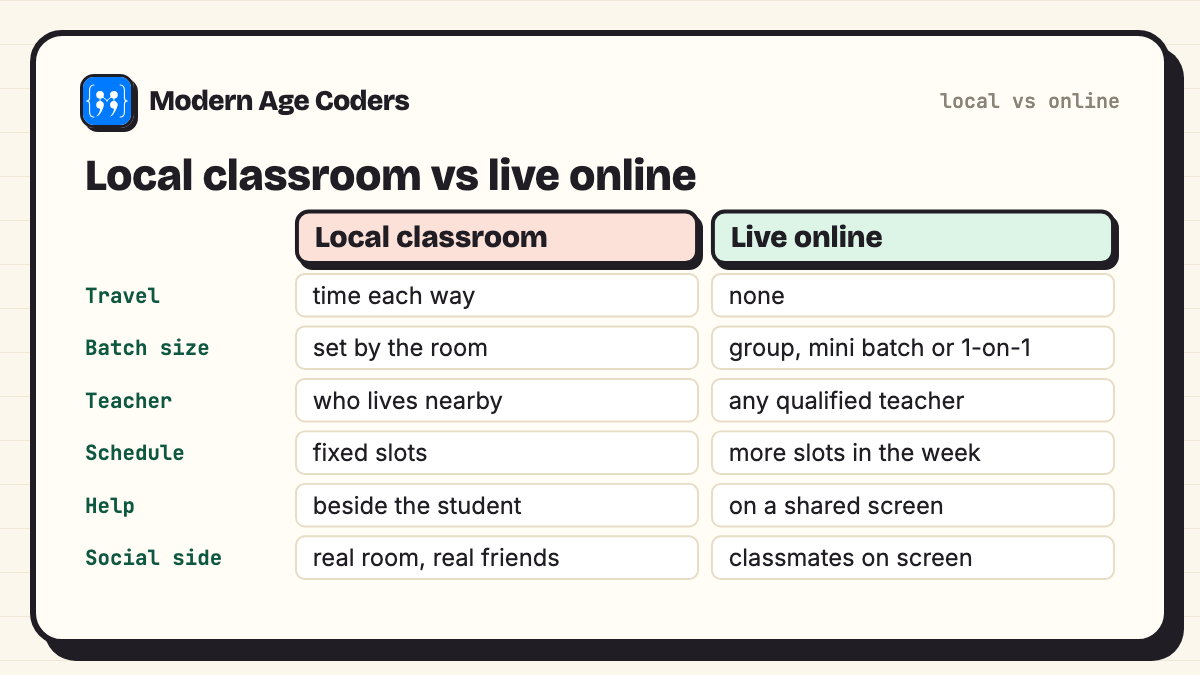
Here is an honest side-by-side. Neither column wins every row.
| What matters | Local classroom | Live online class |
|---|---|---|
| Travel | Real travel time each way, often with a parent driving and waiting | None; the class starts at your desk |
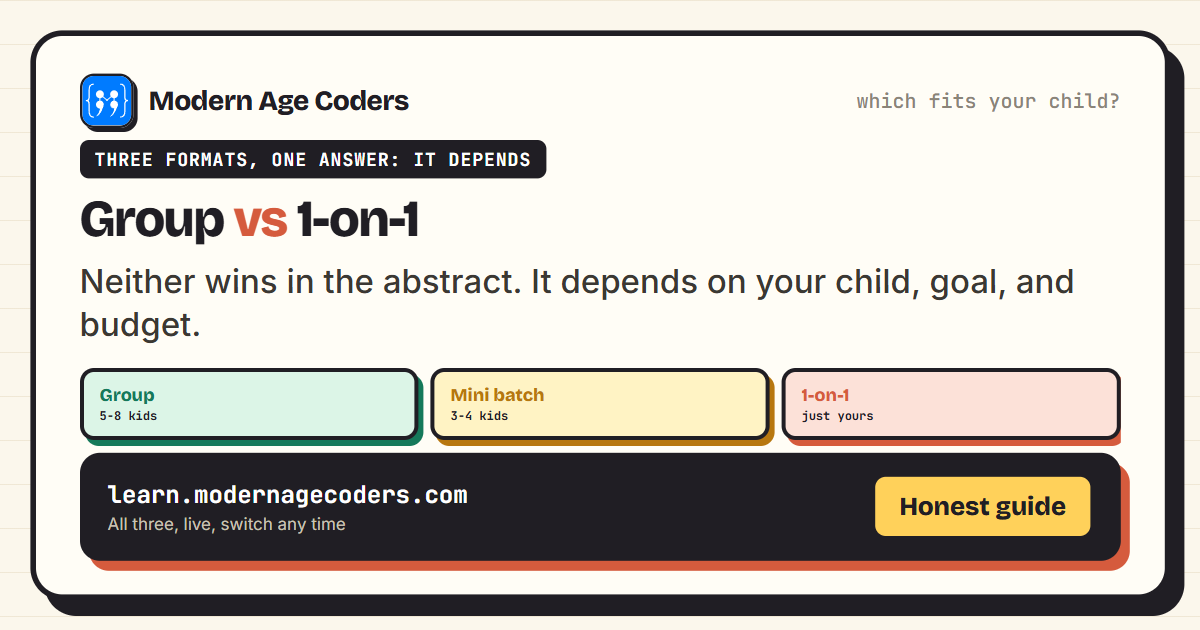
| Batch size | Set by the room; ask the exact number | Set by the provider; ours are group (15 to 20), mini batch (up to 6) or 1-on-1 |
| Teacher | Limited to people who live nearby | Can be any qualified teacher, wherever they live |
| Schedule | Usually fixed slots; a missed class may be lost | Usually more slots across the week; ask about missed classes |
| Hands-on help | The teacher can lean over and point at the screen | The teacher sees the student's shared screen and guides by voice |
| Social side | Real friends in a real room, which some children need | Classmates on screen; quieter children sometimes speak up more |
| Setup at home | Not needed; the centre provides machines | A laptop or desktop, a headset and steady internet |
| What drives the fee | Rent, travel, kits, teacher time, batch size | Teacher time, batch size, hours per month |
When a local classroom is the better choice
- Your child is very young and needs a person in the room. Some 6 and 7 year olds settle better with a teacher beside them.
- The social side is the main goal. If the point is friends and a club feeling, a good local group is hard to beat.
- You have no workable computer at home. A centre with machines removes that barrier.
- The centre is genuinely close and the teacher is genuinely good. Then there is little reason to look further.
When a live online class is the better choice
- The nearest good centre is far away, or runs one slot that clashes with school, sport or work.
- You want a specific subject (Python, Java for ICSE, AP Computer Science, AI) that no local centre teaches well.
- You are an adult fitting lessons around a job, where a commute to a weekday class is the first thing to break.
- You want a smaller batch or 1-on-1 without paying for a room as well as a teacher.
- You move house or travel; an online class comes with you.
Coding classes near me with fees: what drives the cost
Searches for coding classes near me with fees are really asking "what should this cost?". We do not print figures here, because fees change and vary by country, but the things that push a fee up or down are the same everywhere:
- Batch size. The fewer students per teacher, the higher the fee per student and the more attention each one gets.
- Teacher time per month. Compare classes per month and minutes per class, not the headline number.
- Rent and travel. A local centre pays for a room; you pay for the travel. Online classes carry neither.
- Kits and hardware. Robotics courses often add the cost of a kit you keep.
- Subject depth. Exam preparation and advanced subjects usually cost more than a first block-coding course.
- Payment terms. Monthly, termly or longer prepayment can change the effective price; read the refund terms.
Our own fees for every format are on the pricing page, shown in your region's currency. For a broader look at how class formats compare, see our guide to group vs 1-on-1 coding classes.
The checklist: how to choose coding classes near you
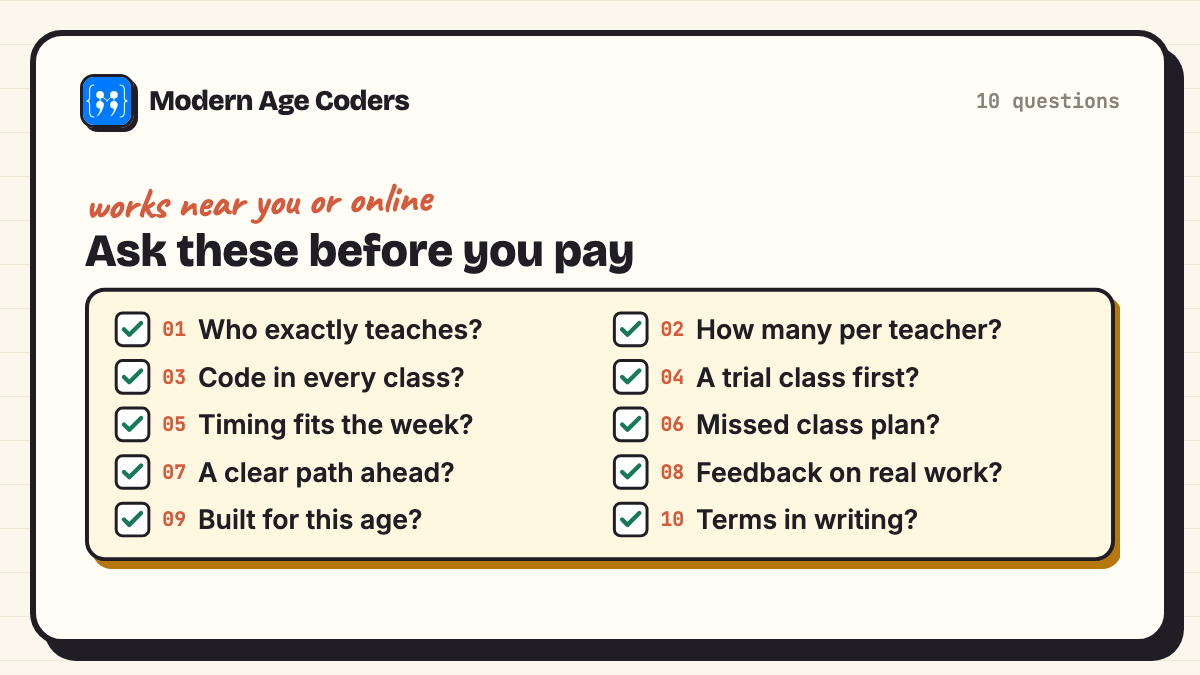
Use this on any class, local or online. A class worth paying for passes most of these.
- Who exactly teaches? Ask for the teacher's name and background, not just the brand.
- How many students per teacher? Get a number, not "small".
- Does the student write code in every class? Watching a teacher type is not learning to code.
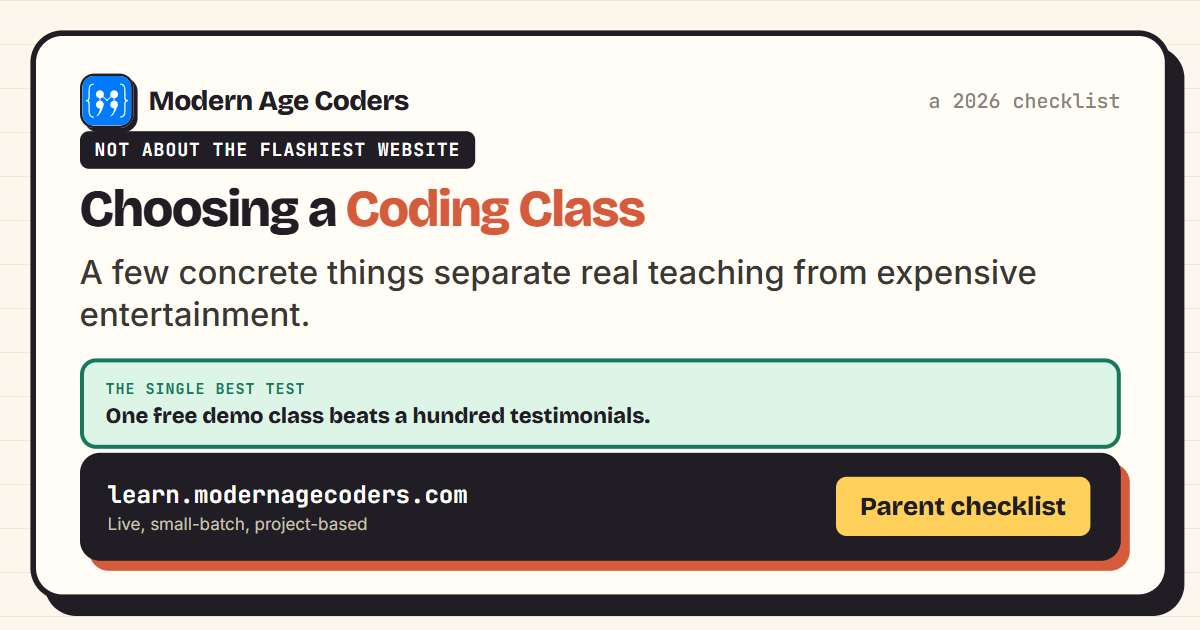
- Is there a trial class? A provider that is confident will let you see a real lesson first.
- Does the timing survive a normal week? Count the travel too. A class you miss every third week is a worse class.
- What happens after a missed class? A recording, a make-up slot, or nothing?
- Is there a clear path? What will the student be able to build after three months, and after a year?
- How is progress reported? Look for feedback on real work, not only a certificate.
- Does the age fit? A class built for 8 year olds will bore a 14 year old, and an adult course will lose a child.
- Are the terms clear? Fees, refunds and how to pause should be in writing before you pay.
If you are choosing for a child, our longer guide on how to choose a coding class for your child adds questions to ask and red flags to avoid.
The trial-class test that beats any brochure
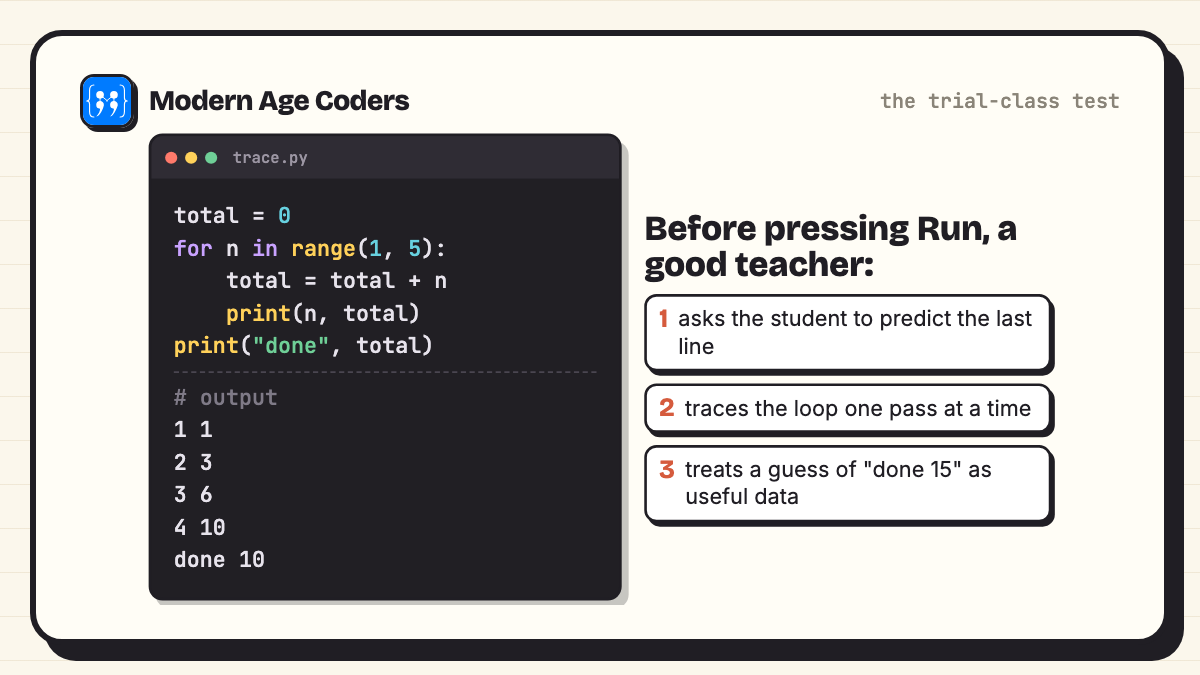
The quickest way to judge a teacher is to watch what they do with a tiny program. Here is one that a beginner of about 10 or older can meet in a first class:
total = 0
for n in range(1, 5):
    total = total + n
    print(n, total)
print("done", total)
When we run it, the output is:
1 1
2 3
3 6
4 10
done 10
A weak class runs it and moves on. A good teacher stops before running it and asks the student to predict the last line, then traces the loop one pass at a time: n is 1, total becomes 1; n is 2, total becomes 3, and so on. If the student guesses "done 15" (because range(1, 5) looks as if it should reach 5), the teacher treats that as useful, not wrong, and asks where the loop really stops. Watch for exactly that in any trial class, near or online.
Coding classes for kids near me (ages 6 to 12)
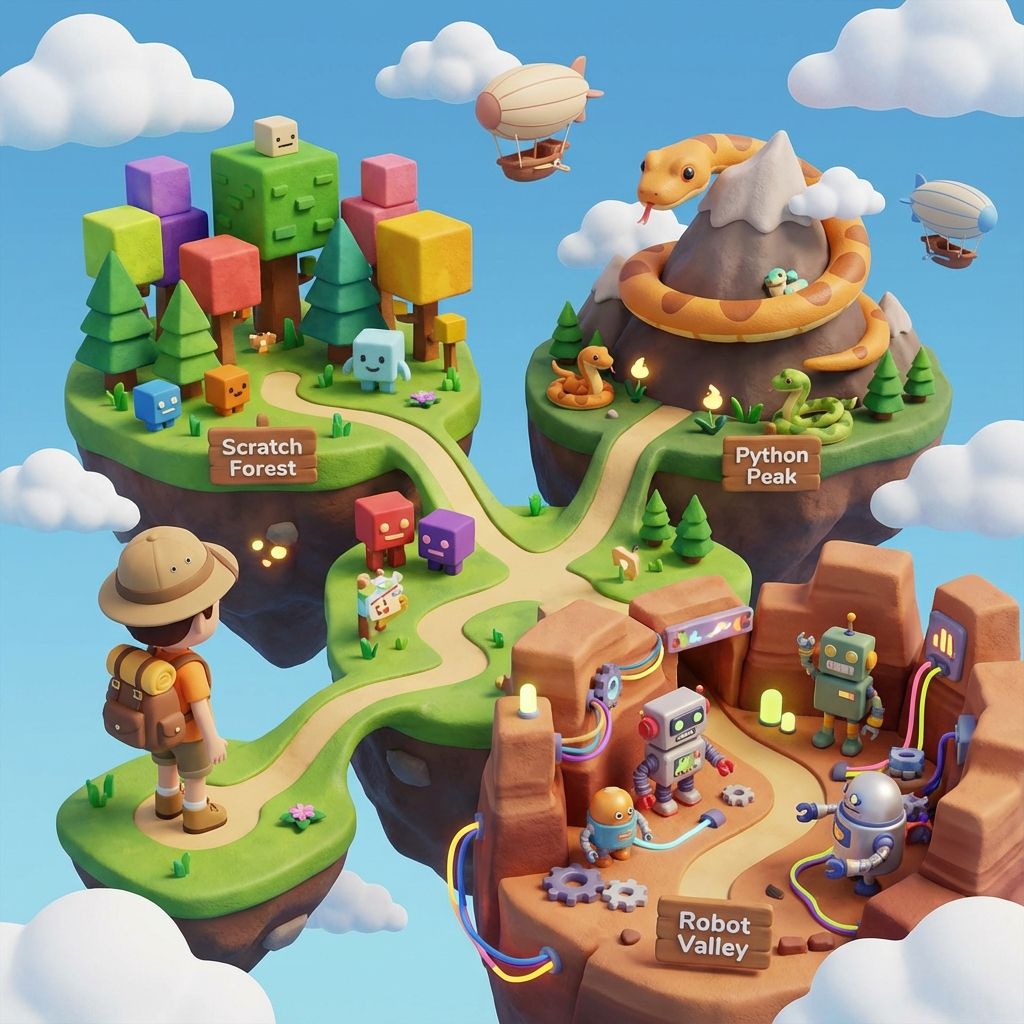
For children, the format matters less than the shape of the lesson. Look for short explanations, a lot of making, and a teacher who checks each child's screen. Ages 6 to 8 usually start with block coding such as Scratch, then move to typed code around 9 to 11. Ask whether a class mixes ages; a 6 year old and an 11 year old need different lessons.
- By age: learn coding by age, coding for 8 year olds, coding for 10 year olds, coding for 12 year olds
- By school stage: coding classes for elementary students, middle school students
- AI for children: AI classes for kids
Coding classes for teens near me (ages 13 to 18)
Teenagers usually want one of three things: a real language (Python, Java, JavaScript), help with a school subject or exam, or projects that look good on an application. A local club may be fun but rarely covers board syllabuses or AP courses in depth; check the syllabus before you enrol. For school students in India, also check the class covers your board's programs.
- Coding classes for high school students
- Coding for 13 year olds, 15 year olds, 17 year olds
- Coding bootcamp for teens and AI classes for teenagers
- By class in India: learn coding by class
Coding classes for adults near me
Adults are where local classes most often struggle: evening slots fill fast, a commute after work is tiring, and most centres are built around children. Ask any provider whether the class is for adults only, or whether you would sit with teenagers. Look for a course with a clear outcome (a portfolio, a job-ready skill, an automation you can use at work) rather than a general "intro".
- Coding classes for adults, ages 18 to 67
- AI classes for adults and AI classes for beginners
- Changing career: our guide to learning to code for a career change
For beginners and students: offline or online?
Complete beginners do well in either format, as long as the first weeks are about writing small programs, not setting up software. Online, the teacher can see your screen and fix setup problems in minutes. Offline, the centre's machines remove setup entirely. College students usually want depth in one language plus data structures; for them the deciding factor is the syllabus, not the building. If you search for "offline coding classes near me" because you worry online means recorded videos, check that the class is live: a live online class has a teacher and classmates at a fixed time, just like a classroom.
Find coding classes in your city
Every page below is about our live online classes for learners in that place: how they fit local schools, exams and the working week. None of them is a centre or a street address. Open your country, then pick your state, region or city.
Not listed? Your city does not need its own page. The classes are the same live online classes wherever you join from; just book a free class and tell us where you are.
How we teach it
In our classes, students explain their thinking out loud. We trace a loop line by line until the student can predict every step, let students derive a rule before they see it written down, and show the same problem three ways until it clicks. Mistakes are data, not failures. You can see the format for any age through adult classes, high school classes or classes by age, and the first class is free.
Frequently asked questions
List the local options (coding centres, school clubs, libraries, community programmes) and two or three live online providers. Then run each one through the same checklist: who teaches, how many students per teacher, whether students code in every class, and whether there is a trial class. Book a trial with your top two before you pay.
They can be, if they are live, small and taught by a real teacher who watches the student's screen. A recorded video course is not the same thing. A local class is better when a young child needs a person in the room or when the social side is the goal.
No. We teach live online only and have no physical centre or local address in any city. Our city pages explain how our live online classes work for learners in that place.
It depends on batch size, hours per month, the subject and, for local centres, rent and travel. Compare cost per hour of teacher time, not the monthly headline. Our own fees are on our pricing page in your region's currency.
Many children start with block coding at 6 to 8 and move to typed languages such as Python around 9 to 11. Start when the child can read short instructions and stay with one task for 20 minutes or so.
Some centres run evening adult classes, but many are built for children. Live online classes are often easier for adults because there is no commute after work. Check the batch is adults only.
Either works if the class is live and the first weeks are spent writing small programs. Choose the one you can attend every week without fail; consistency matters more than format.
Ask how many students the batch will have, who will teach it every week, what happens after a missed class, and what the student will build in the first three months. Then watch whether the teacher asks the student to predict and explain code, not just copy it.