Skip to content
Wakefield, West Yorkshire

Coding classes in Wakefield

What are the best coding classes in Wakefield?

Census 2021 counted 353,368 usual residents in the Wakefield district, and 7.5% of them were aged 50 to 54, against 6.9% in England. The Hepworth Wakefield opened in 2011 to house the city's art collection and to give Barbara Hepworth a legacy in the town where she was born. Wakefield learners aged six to sixty-seven study with our India-based teachers over live video, on their own or in a group of five to ten with a matching level, with lessons fitted around the UK day. There is no charge for the first lesson, and after that a group place is USD 100 a month and private teaching USD 150.

The Environment Agency measures the River Calder at Methley, downstream of Wakefield, every fifteen minutes. Add up those readings with the trapezium rule and the river carried about 640 million cubic metres of water in 2024. Sample it once an hour instead and the answer barely moves; once every six hours, still barely. Look only once a day and the year's total falls by 1.57%, which sounds harmless. But in the five days around the November flood peak of 202.4 cubic metres a second, the once-a-day total is 28.6% short, and the highest flow it ever sees is 121.1. Our teenagers integrate the flow, then learn why the sampling interval must match the fastest thing they care about.

Facts last verified 23 September 2026. Teaching is online; no Wakefield branch is claimed.

Course picks for Wakefield

Four courses for the city on the Calder

Choose by what the learner likes most. Each course opens with a free live lesson, and we never ask for a card to book it.
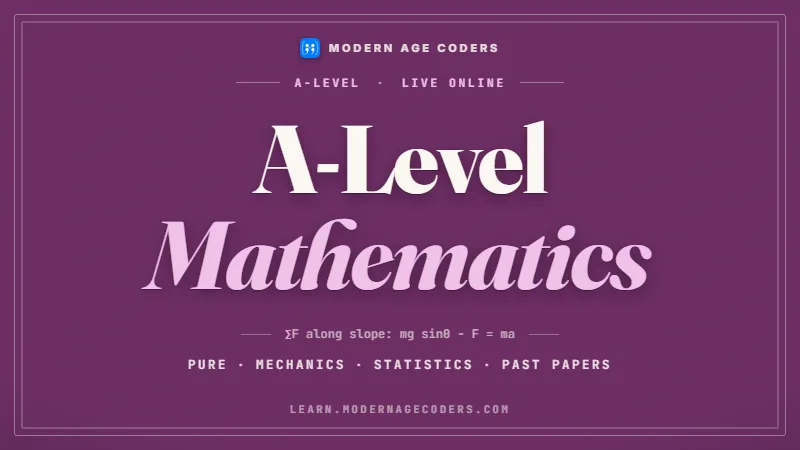
Browse the course atlas for more than one hundred options and use the coding roadmap to check prerequisites.

The four we are known for

Python, AI, vibe coding and agentic coding

These run underneath everything above. Every one is live and online, placed by ability rather than by age, and the first class is free.

Wakefield today

A large district with an older middle

Census 2021 figures for the City of Wakefield district, which takes in Pontefract, Castleford and many former mining villages, as published by the Office for National Statistics on Nomis.

Wakefield district, Census 2021
MeasureWakefieldEngland
Usual residents353,36856,490,048
Living in households349,825Not compared
Aged 20 to 2418,002 (5.1%)6.0%
Aged 50 to 5426,331 (7.5%)6.9%
Aged 55 to 5924,998 (7.1%)6.7%
Students among residents aged 5 and over59,040 (17.7%)20.4%
Usual residents per square kilometre1,043.6433.5

Fifties above average

Residents aged 50 to 59 were a larger share of the district in 2021 than of England, while people in their early twenties were a smaller one.

Fewer full-time students

Of 333,296 residents aged five and over, 59,040 were at school or in full-time study, 17.7% against 20.4% nationally.

Towns and villages

The district spreads at 1,043.6 residents per square kilometre across a city, several towns and many villages, with 349,825 people in households.

That older middle is part of why we teach adults as well as children. A Year 4 pupil in Sandal might be writing a first game, a Year 11 student in Ossett revising for GCSE Computer Science, and someone in their fifties in Castleford learning Python for a new role, each in a small group at the same level.

Sculpture and coal

A gallery for Barbara Hepworth and a colliery kept open for visitors

From The Hepworth Wakefield's own history and the National Coal Mining Museum for England.

1934

The gallery says the original Wakefield Art Gallery was established that year, the start of the collection that the new building was later made to house.

2011

The Hepworth Wakefield opened in a building by David Chipperfield Architects, chosen through a RIBA competition in 2003, and says it reached its first year's target of 150,000 visitors within five weeks.

Prototypes and tools

Two galleries show 44 of Barbara Hepworth's plaster and aluminium prototypes, with her work bench and tools, exploring how she actually made her sculpture.

We have no connection with The Hepworth Wakefield or the National Coal Mining Museum. The museum sits at the former Caphouse Colliery on the western edge of the Yorkshire coalfield, where it says a plan dated 1791 already shows workings. Both places are about measuring and making things carefully, from a sculptor's prototypes to the surveys of a pit. The project below measures a river.

Where the flow figures come from

The Environment Agency's Hydrology service publishes river flow for its gauging stations, both every fifteen minutes and as daily means, with a quality flag on each value. The Methley station on the River Calder lies about nine kilometres north-east of Wakefield city centre.

Signature project

How much water did the Calder carry in 2024?

Flow is a rate, in cubic metres a second. Volume is the area under the flow curve, and the trapezium rule estimates that area by joining the readings with straight lines.

Volume of the River Calder past Methley, 2024, estimated from 15-minute flow readings sampled at different intervals
Readings usedWhole yearChangeFive days around the November peakChange
Every 15 minutes640.0 million m3Reference28.09 million m3Reference
Every hour639.7 million m3-0.04%27.99 million m3-0.4%
Every six hours639.3 million m3-0.11%27.22 million m3-3.1%
Once a day630.0 million m3-1.57%20.05 million m3-28.6%
Published daily means642.8 million m3+0.44%Not comparedNot compared

1. Join the dots

Between each pair of readings, treat the flow as a straight line and work out the area underneath: the average of the two flows times the 900 seconds between them.

2. Add it all up

Over 35,136 readings with no gaps, the areas sum to about 640 million cubic metres, a mean flow of 20.24 cubic metres a second for the year.

3. Thin the readings

Keep one reading an hour, then one every six hours, then one a day, and repeat. A good method should give nearly the same answer until the gaps grow too wide.

Averages hide storms

Over a whole year, once-a-day sampling looks almost good enough, because most days the river changes slowly. A flood is different. The Calder at Methley rose to 202.4 cubic metres a second at 02:30 on 24 November 2024. A once-a-day reading never saw more than 121.1, and it missed 28.6% of the water in those five days. Choose the interval to suit the fastest change you care about, not the average day.

The quality flags need care too. Only 47.5% of the year's volume comes from readings flagged Good; the rest is Unchecked, Estimated or Suspect. And at 15:45 on 20 November one reading, flagged Good, shows a flow of minus 5.158 cubic metres a second between readings of 8.751 and 3.636. A flag records someone's judgement, not a guarantee, and a careful learner looks at the numbers as well as the labels.

Adding up rates

Five checks before integrating any sensor data

Learned on a river, then used on electricity meters, fuel use, fitness trackers, network traffic and the energy bills of computer systems.

Turning a rate into a total, carefully
CheckFor the Calder at MethleyWhat it prevents
Are the steps regular?35,136 readings at exactly 15 minutesAreas computed over the wrong widths
Are there gaps?None in 2024Missing water treated as zero
How fast can it change?Hours during a floodA sampling interval that misses peaks
What do the flags say?Good covers 47.5% of the volumeTreating estimates as measurements
Do values make physical sense?One negative flow flagged GoodTrusting a label over the data

The published daily means differ from the 15-minute trapezium total by 0.44%, not because either is wrong but because they are built differently: each daily mean runs from 09:00 to 09:00 and is published as a series of its own. Comparing two honest methods and explaining the gap is a better habit than picking the one that looks tidier.

Younger learners

Filling a jug from a tap that speeds up and slows down, and checking the level only now and then.

Teenagers

The Hydrology API in Python, the trapezium rule on real flow data, and totals recomputed at wider and wider intervals.

Adults

Integrating meter and sensor data at work, with gaps, flags and sampling intervals checked before totals are reported.

We have no connection with the Environment Agency, The Hepworth Wakefield, the National Coal Mining Museum or Wakefield Council. The flow data and census tables are published openly; the totals, comparisons and sampled series here are our own calculations.

Learning ladder

From filling a jug to the trapezium rule

The age bands are only a rough guide, and the free lesson finds the real starting point.

Ages 6 to 10

Little and often

Adding many small amounts, and discovering that checking only occasionally can miss what happened in between.

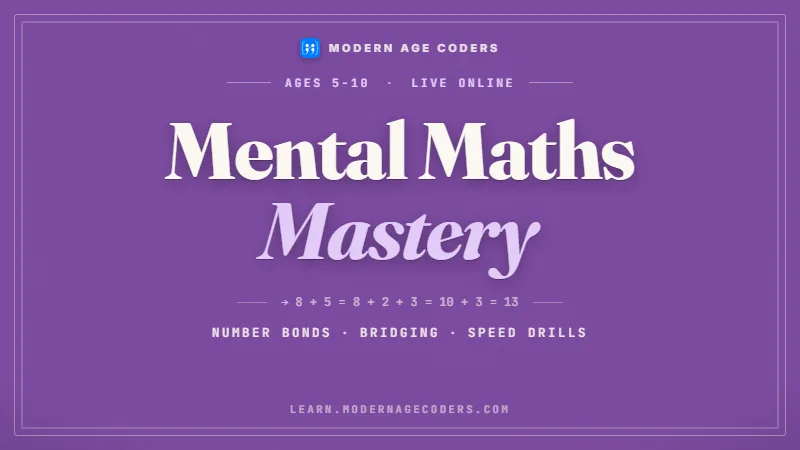
Mental Maths for KidsCoding for Kids
Ages 11 to 13

Rates and totals

Speed and distance, flow and volume, worked out in code from a table of readings.

Maths Through CodingPython and AI for Kids
Ages 14 to 18

Numerical integration

The trapezium rule on real sensor data, sampling intervals, quality flags and the error they introduce.

A-Level MathsData Science for Teens
Ages 18 to 67

Sensor data at work

Totals from meters and logs, built with the gaps and flags handled rather than ignored.

Python MasterclassData Analysis Course
Coding and AI

Numerical libraries integrate data in one call. Why should a Wakefield teenager do it by hand?

Because the call cannot tell you whether you looked at the river often enough.

An AI assistant will happily integrate a column of flows and return a total. If the column holds one reading a day, it will return 630 million cubic metres with complete confidence, and the missing quarter of a flood will never be mentioned. A learner who has thinned the data and watched the storm disappear knows the question to ask first: how fast can this thing change?

The same issue runs through AI systems that learn from sensor data. A model trained on hourly or daily summaries cannot learn from events shorter than its sampling interval, however clever it is. People who understand sampling are the ones who notice when a dataset was never capable of showing the thing a model is asked to predict.

So a Wakefield teenager should still learn to program in 2026, in a city whose gallery shows the prototypes behind finished sculptures: the tools produce the answer, but understanding how it was made is what makes it trustworthy. The longer argument is in why coding is worth learning in 2026.

Delivery

Sandal, Ossett or Pontefract, from home

The Wakefield district stretches from Ossett to South Elmsall, and an evening trip across it is long. A live online lesson needs no trip at all.

City, towns and villages

A learner in Horbury and another in Knottingley can share one lesson without either leaving home.

Stages as schools use them

Reception, Key Stages 1 to 4, GCSE options and A levels, named the way Wakefield schools name them, with teaching in English.

A first lesson with real work

The free session covers a proper task and ends with a recommended level, course and weekly time. We take no card details.

Five to ten learners per group

Everyone in a group works at the same stage, drawn from Wakefield, the rest of the UK and overseas, so each level has a suitable hour.

Twice a week

Two regular lessons weekly, around eight a month, with holidays and exam weeks agreed with the teacher in good time.

Teaching after dark in India

A 5.30 pm lesson in Wakefield begins at 10 pm in India in the British summer and 11 pm in winter, as Indian clocks never change; our teachers keep those hours for UK learners.

Across West Yorkshire

Families in Leeds, Dewsbury, Barnsley or Selby join exactly the same classes, because everything is online and groups are formed by level.

Fees

Wakefield lesson fees

A free lesson first, then one fee a month.

First classUSD 0

A full lesson at no cost, ending with a level, course and weekly time we suggest.

Group tuitionUSD 100

Around eight live lessons a month, in a class of five to ten learners at the same stage.

Private tuitionUSD 150

Around eight live lessons a month, with a teacher for your learner alone.

Normanton and Hemsworth pay what every family outside India pays: one fee in US dollars, and not a single price in pounds on our site. Payment begins only after the free lesson has settled a course and a weekly slot, and our pricing page explains pausing, missed lessons and changes between group and private teaching.

Reviews

Six families on Google, in their own words

Rated 4.9 across 547 Google reviews. These are real reviews, reproduced as written.

★★★★★

"The one step solution for my son. Modern Age Coders make learning coding so simple that kids love it. The teachers explain complex concepts clearly with practical exercises and interactive content."

Ria Mukherjee

Parent

★★★★★

"Modern Age Coders has been a game-changer for me. I struggled to grasp IT concepts and coding before joining, but their classes transformed everything. I can now confidently write complex programs with ease."

Samriddha Mondal

Student

★★★★★

"One of the most wonderful education centres out there. Education is not limited to school syllabus but focuses on skill development."

Vansh Agarwal

Student

★★★★★

"My child Dhairya is really enjoying the Modern Age Coders classes. This is his first online class and he eagerly looks forward to it. I can already see his improvement, and the teachers are very cooperative."

Sonam Oswal

Parent of Dhairya

★★★★★

"Modern Age Coders have wonderful teachers who teach in a clear, easy and practical way. The teacher boosts students' confidence and inspires them to learn without hesitation."

Sonu Goyal

Parent

★★★★★

"I highly recommend this computer coding class! The teachers are incredibly knowledgeable and passionate about coding."

Ritu Kedia

Parent

Free placement class

Book a free lesson for a Wakefield learner

The first task depends on the learner: a fill-the-jug adding game for a young child, a short Python program that turns a speed into a distance for a beginner, or the Calder flow file and the trapezium rule for a teenager ready for real data.

+44

FAQ

Wakefield coding class questions

What Wakefield families most often ask us.

How many people live in the Wakefield district?

Census 2021 counted 353,368 usual residents in the City of Wakefield district, which includes Pontefract, Castleford and many villages; 349,825 of them lived in households.

How does Wakefield compare with England?

Wakefield has more people in their fifties and fewer in their early twenties: 7.5% of residents were aged 50 to 54 in 2021 (England 6.9%), and 17.7% of those aged five and over were students (England 20.4%). Density was 1,043.6 residents per square kilometre (England 433.5).

What is the trapezium rule?

A way of estimating the area under a curve, and so a total from a rate, by joining neighbouring readings with straight lines and adding up the trapezium-shaped areas beneath them.

How much water did the River Calder carry in 2024?

About 640 million cubic metres past Methley, by our trapezium-rule total of 15-minute Environment Agency readings, a mean flow of 20.24 cubic metres a second.

Where does the river data come from?

The Environment Agency's Hydrology service, which publishes 15-minute and daily flows for the Methley gauging station on the River Calder, each with a quality flag.

Why is there a gallery named after Barbara Hepworth?

The Hepworth Wakefield says it opened in 2011 to house Wakefield's art collection and to provide a legacy for Barbara Hepworth in the town where she was born. We are not connected with the gallery.

When are Wakefield lessons?

On weekday afternoons or evenings, or at the weekend, at a UK time fixed in the free lesson. India is four and a half hours ahead of Wakefield in summer and five and a half in winter.

Is there a Modern Age Coders centre in Wakefield?

No. We have no Wakefield centre and no premises anywhere in the UK, because all lessons are live online. Learners need a computer with sound and a steady connection, and our phone number is Indian.

How much do Wakefield lessons cost?

The first lesson is free. After it, a group place is USD 100 a month for two live lessons a week, about eight a month, with five to ten learners, and one-to-one lessons on the same pattern are USD 150 a month. Course, format and time are agreed before any charge.

How are Wakefield groups formed?

By level, pace and goals rather than age or postcode, with five to ten learners at one stage. If no group fits the learner's week, we offer one-to-one lessons.

Explore England and the UK

Yorkshire and beyond

Up the road, the Leeds page samples a year of footfall fairly, and to the south Sheffield shows how a least-squares trend moves with its starting year. York measures the surprise in its street names. Our England guide explains the school stages, and the UK coding page opens onto every city.

Free Wakefield classCall +91 91233 66161

Keep exploring Modern Age Coders

Coding classes in nearby cities

Free resources

From the blog

Start here