Skip to content
Bangor, County Down

Coding classes in Bangor, Northern Ireland

What are the best coding classes in Bangor, Northern Ireland?

The Bangor settlement had 64,596 usual residents at the 2021 census, according to the Northern Ireland Statistics and Research Agency, within the council area of Ards and North Down. The Historic Environment Division lists the Tower House on Quay Street with a construction date of 1600 to 1649. Bangor learners aged six to sixty-seven are taught live over video by teachers based in India, singly or in classes of five to ten at one level, with lesson times arranged around the Northern Ireland school day and working hours. The first lesson is free, and after that a class place is USD 100 a month and one-to-one teaching USD 150 a month.

On an ordinary Wednesday, Translink's timetable has 51 trains leaving Bangor for Belfast, an average of one every 19.82 minutes. So an average wait of about ten minutes? No. Some trains leave three minutes apart in the rush hour, while in the evening the gaps stretch to half an hour or more, and a passenger who turns up at a random moment is far more likely to land in a long gap than a short one. Our Bangor project rebuilds the timetable from Translink's open data and measures the real average wait: 13.64 minutes, not 9.91. Teenagers prove it with a formula, then again by simulating 200,000 passengers.

Facts last verified 23 September 2026. Teaching is online; no Bangor branch is claimed.

Course picks for Bangor

Four courses for the city at the end of the line

Choose the course that fits what the learner already likes. All four start with a free live lesson, and booking asks for no card.
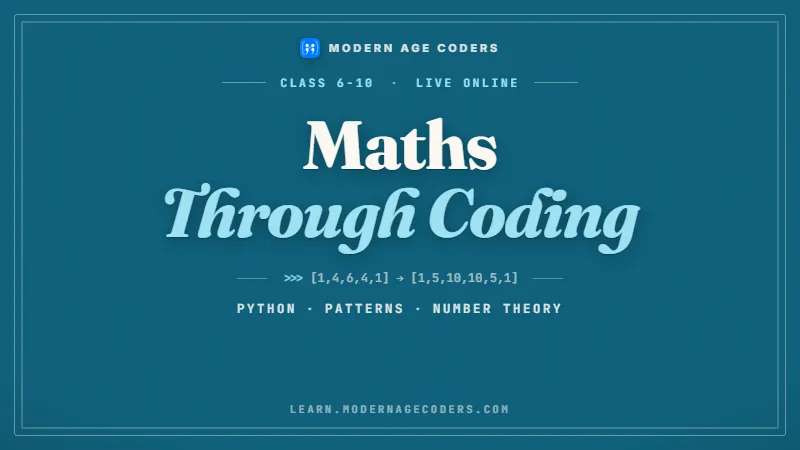
Browse the course atlas for more than one hundred options and use the coding roadmap to check prerequisites.

The four we are known for

Python, AI, vibe coding and agentic coding

These run underneath everything above. Every one is live and online, placed by ability rather than by age, and the first class is free.

Bangor today

A city in North Down

Census 2021 figures from the Northern Ireland Statistics and Research Agency (NISRA), for the Bangor settlement, the three district electoral areas named after the city, the council area and Northern Ireland.

Bangor in the 2021 census, usual residents (NISRA)
AreaType of areaUsual residents
BangorSettlement64,596
Bangor CentralDistrict electoral area26,637
Bangor East and DonaghadeeDistrict electoral area22,850
Bangor WestDistrict electoral area19,517
Ards and North DownCouncil area163,659
Northern IrelandCountry1,903,175

Seventies

In the Bangor settlement, 5.8% of residents were aged 70 to 74 in 2021, against 4.4% across Northern Ireland, by NISRA's published age table.

Children

Children under five made up 5.1% of Bangor's residents, against 6.0% in Northern Ireland; those aged 10 to 14 were 6.4%, against 6.7%.

Nineties

People aged 90 or over were 1.0% of Bangor residents in 2021, compared with 0.7% across Northern Ireland as a whole.

Each figure is quoted exactly as NISRA publishes it, table by table, without adding areas or age groups together. Our Bangor classes draw on the city and the places along the coast and the line. A Ballyholme seven-year-old making a first game, a Year 12 student from Carnalea preparing for CCEA GCSE Digital Technology and a Groomsport adult learning Python for work could each join a different class, grouped by level.

Listed Bangor

A tower house, a town hall and a railway line

From the Listed Buildings Northern Ireland dataset of the Department for Communities' Historic Environment Division, published on OpenDataNI.

1600 to 1649

The Tower House at 34 Quay Street is listed at Grade B1, with a construction date in these years. The record gives its former use as a house and its current use as an office.

1840 to 1859

The Town Hall at Bangor Castle is listed at Grade A, built in these years as a house. Bangor Abbey Parish Church of Ireland, from 1820 to 1839, is listed at Grade B+.

1860 to 1879

Along the line to Belfast, the station at Helen's Bay and the railway viaduct in Crawfordsburn Country Park are both listed at Grade A, each with a construction date in these years.

The same dataset lists the Royal Ulster Yacht Club on Clifton Road at Grade B+, built between 1880 and 1899, and many buildings on the Clandeboye estate. The line those Grade A railway structures serve is the one whose timetable this project studies. We have no connection with the Department for Communities, Translink or Ards and North Down Borough Council, and the records here are theirs.

Where the timetable comes from

Translink publishes the complete NI Railways timetable on OpenDataNI in the TransXChange format, under the Open Government Licence. The version used here was updated on 4 September 2026. We rebuilt every journey from its pattern of stops and running times, then kept the trains leaving Bangor for Belfast.

Signature project

Why is the wait longer than half the gap?

If trains ran exactly every 20 minutes, a passenger arriving at a random moment would wait 10 minutes on average. When gaps vary, the long gaps take up more of the day, so more random arrivals fall into them. The average wait becomes the sum of the squared gaps divided by twice their total.

Trains from Bangor towards Belfast in the NI Railways timetable, for dates in autumn 2026
DayTrainsAverage gapHalf the average gapReal average wait
Wednesday 30 September5119.82 minutes9.91 minutes13.64 minutes
Saturday 3 October3132.00 minutes16.00 minutes16.88 minutes
Sunday 4 October1460.00 minutes30.00 minutes30.00 minutes

1. Rebuild the timetable

Each journey in the file has a start time and a pattern of timed links between stations. Adding the links up gives the time every train leaves Bangor, 51 of them on the Wednesday.

2. Measure the gaps

On the Wednesday the gaps run from 3 minutes to 60: six gaps of 3 minutes and six of 6 in the busy hours, eighteen of 30 minutes, and one of an hour late in the evening.

3. Test by simulation

Drop 200,000 imaginary passengers at random times between the first and last trains and measure each wait. The simulation gives 13.64 minutes, exactly what the formula predicts.

Where the extra wait comes from

Half of the Wednesday's gaps are 20 minutes or longer, but those long gaps cover 76.0% of the day. A random passenger is therefore about three times as likely to arrive in a long gap as a short one. That is the inspection paradox: sample by time, and the long gaps are over-represented. On Sunday, when every gap is exactly an hour, the paradox disappears and the real wait is exactly half the gap.

Of course, most commuters check the timetable and do not arrive at random, so the 13.64 minutes describes someone who turns up without looking. It also shows what the timetable could offer: 51 trains spread evenly over the same hours would give an average wait of 9.91 minutes. Pairing trains in the rush hour suits passengers who plan their journey; someone who turns up at a random moment gains less from it.

Averages that mislead

Five checks before quoting an average wait

Learned on the Bangor line, then used for bus stops, lift queues, website response times, class sizes and any average where people meet the long cases more often than the short ones.

Decisions behind the Bangor timetable study
QuestionFor the Bangor trainsWhat goes wrong if you skip it
Average of what?Waits felt by passengers, not gaps between trainsA service that seems twice as frequent as it feels
Which day is it?A Wednesday, a Saturday and a SundayA weekday figure quoted for the weekend
Does the formula hold?Checked with 200,000 simulated arrivalsA formula applied without being tested
Who arrives at random?Only passengers who do not check the timetableA result stretched to cover everyone
Which version of the timetable?The file updated on 4 September 2026Old times compared with new ones

The first row is the lesson that transfers. The same trick explains why a school's average class size can look small while most pupils sit in big classes, and why the average gap between buses is shorter than the gap most passengers experience. Whenever something is counted by how often people meet it, the long cases weigh more.

Younger learners

Marking a day's trains on a paper clock, throwing counters at random and counting where they land.

Teenagers

Parsing a real timetable file, the inspection paradox and a simulation in Python, checked against a formula.

Adults

Spotting averages at work that describe the system rather than the people using it, and fixing them.

We have no connection with Translink, the Northern Ireland Statistics and Research Agency or the Department for Communities. The timetable, census tables and listed buildings data are published openly; the journey rebuilding, waiting-time calculations and simulation on this page are our own work.

Learning ladder

From a paper clock to the inspection paradox

The ages are a rough guide; the free lesson finds the right starting level.

Ages 6 to 10

Times and gaps

Reading times, counting gaps and making a simple timetable game in block code.

Scratch Coding for KidsProblem Solving and Computational Thinking for Kids
Ages 11 to 13

Averages in Python

Lists of times, differences and averages in Python, with a program that finds the longest gap.

Python and AI for KidsMaths Through Coding
Ages 14 to 18

Paradoxes and simulation

Reading a real data file, the inspection paradox and Monte Carlo checks against exact formulas.

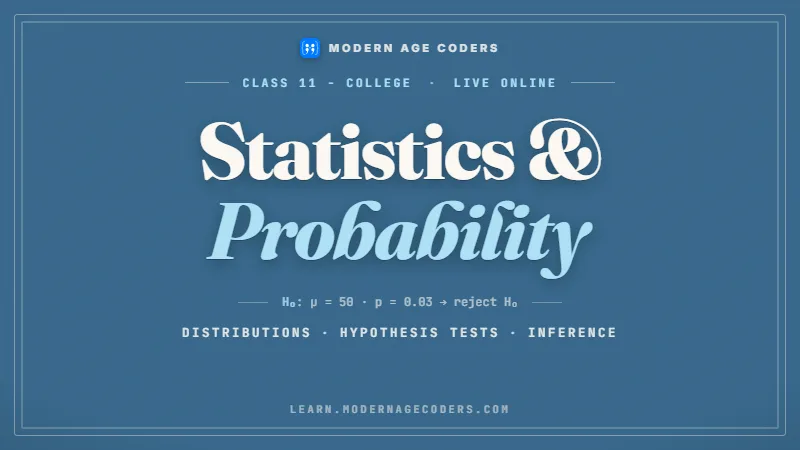
Statistics & ProbabilityPython for Teens
Ages 18 to 67

Service data at work

Measuring waits, delays and queues as customers experience them, with honest averages.

Python Automation CourseData Analysis Course
Coding and AI

AI can average any table. Why should a Bangor teenager ask what the average means?

Because the average gap between trains and the average wait for a train are different numbers, and a quick summary easily confuses them.

Ask an AI tool how often trains leave Bangor and it may correctly say every 20 minutes on average, and then suggest a 10 minute wait. The mistake is subtle and plausible. A learner who has simulated 200,000 passengers knows the right question: averaged over what, and from whose point of view?

The project also practises working with a real, messy data format. Rebuilding journeys from TransXChange patterns and timing links is exactly the kind of careful data engineering that AI systems depend on and rarely explain.

So a Bangor teenager should keep learning to code in 2026, at the end of a line whose Grade A station at Helen's Bay dates from the 1860s or 1870s: AI can compute an average instantly, but people still decide which average matters. The longer argument is in why coding is worth learning in 2026.

Delivery

Ballyholme, Groomsport or Helen's Bay, in one class

Bangor learners live along the coast and the railway, from Groomsport to Helen's Bay. Online, no one needs to catch a train for the lesson.

Coast and line

A learner in Seahill and another in Crawfordsburn can share a class without waiting on any platform.

Northern Ireland school years

Our stages follow Northern Ireland schooling from P1 to Year 14, through the transfer test years to CCEA GCSE and A level, with every lesson taught in English.

A working first lesson

The free session is real coding, not a presentation, and ends with the teacher recommending a level, a course and a weekly slot. No card is needed.

Classes by level

Five to ten learners at the same stage, drawn from Bangor, the rest of the UK and abroad, so every level has workable times.

Two lessons weekly

Two fixed lessons each week, about eight a month, with holidays and exam study arranged with the teacher in advance.

India time

India does not change its clocks, so a Bangor lesson at 5 pm starts at 21:30 for our teachers in summer and 22:30 in winter.

Across County Down

Learners in Newtownards, Holywood, Donaghadee or Comber join exactly the same classes, since every lesson is online and classes are set by level.

Fees

Bangor lesson fees

The first lesson is free, then there is one monthly fee.

First classUSD 0

A full lesson with no charge, ending with a suggested level, course and weekly slot.

Group tuitionUSD 100

Around eight live lessons a month, in a class of five to ten learners at one stage.

Private tuitionUSD 150

Around eight live lessons a month, with a teacher for your learner alone.

Families in Clandeboye or Bangor West pay in US dollars, like all families outside India, and our site shows no pound prices. Nothing is charged until after the free lesson and the agreement of a course and weekly slot; the pricing page explains pauses, missed lessons and switching between group and one-to-one teaching.

Reviews

Six Google reviews from families, as written

Rated 4.9 across 547 Google reviews. These are real reviews, reproduced as written.

★★★★★

"The one step solution for my son. Modern Age Coders make learning coding so simple that kids love it. The teachers explain complex concepts clearly with practical exercises and interactive content."

Ria Mukherjee

Parent

★★★★★

"Modern Age Coders has been a game-changer for me. I struggled to grasp IT concepts and coding before joining, but their classes transformed everything. I can now confidently write complex programs with ease."

Samriddha Mondal

Student

★★★★★

"One of the most wonderful education centres out there. Education is not limited to school syllabus but focuses on skill development."

Vansh Agarwal

Student

★★★★★

"My child Dhairya is really enjoying the Modern Age Coders classes. This is his first online class and he eagerly looks forward to it. I can already see his improvement, and the teachers are very cooperative."

Sonam Oswal

Parent of Dhairya

★★★★★

"Modern Age Coders have wonderful teachers who teach in a clear, easy and practical way. The teacher boosts students' confidence and inspires them to learn without hesitation."

Sonu Goyal

Parent

★★★★★

"I highly recommend this computer coding class! The teachers are incredibly knowledgeable and passionate about coding."

Ritu Kedia

Parent

Free placement class

Book a free lesson for a Bangor learner

The first lesson fits the learner: a timetable game for a young child, a short Python program that finds the gaps in a list of times for a beginner, or the real NI Railways timetable and the inspection paradox for a teenager ready for probability.

+44

FAQ

Bangor coding class questions

What Bangor families ask us most.

How many people live in Bangor?

NISRA's Census 2021 counted 64,596 usual residents in the Bangor settlement. The council area of Ards and North Down had 163,659.

How does Bangor compare with Northern Ireland?

It has more residents in their early seventies on NISRA's figures: 5.8% of residents were aged 70 to 74 in 2021, against 4.4% across Northern Ireland, and 5.1% were under five, against 6.0%.

What is the inspection paradox?

When you sample by time or by people, long intervals are over-represented. For trains, a passenger arriving at a random moment is more likely to land in a long gap, so the average wait is longer than half the average gap unless the gaps are all equal.

How long do you wait for a Bangor train?

On a Wednesday in the NI Railways timetable, trains to Belfast leave on average every 19.82 minutes, but a passenger arriving at a random moment waits 13.64 minutes on average, not 9.91. On Sunday, with trains every hour, the wait is exactly 30 minutes.

Where does the timetable data come from?

From Translink's NI Railways timetable, published on OpenDataNI under the Open Government Licence and updated on 4 September 2026. We are not connected with Translink.

Which Bangor buildings are listed?

The Historic Environment Division lists the Town Hall at Bangor Castle at Grade A and the Tower House on Quay Street at Grade B1, and, on the line to Belfast, the station at Helen's Bay and the viaduct in Crawfordsburn Country Park at Grade A.

When are Bangor lessons?

Bangor families usually choose a time after school, on a weekday evening or at the weekend, agreed in the free lesson. With our teachers in India, that is a late-evening lesson for them: four and a half hours ahead of Northern Ireland in summer, five and a half in winter.

Is there a centre in Bangor?

No. We have no Bangor centre and no premises anywhere in the UK, because every lesson is live online. Learners need a computer with sound and a steady connection, and our phone number is Indian.

What do Bangor lessons cost?

The first lesson is free. After that, a group place costs USD 100 a month for two live lessons a week, about eight a month, with five to ten learners, and one-to-one teaching on the same timetable costs USD 150 a month. Nothing is charged until the course, format and time are agreed.

How are learners grouped?

By level, pace and goals rather than age or where they live, with five to ten learners at the same stage. If no group suits the learner's week, we offer one-to-one lessons.

Explore Northern Ireland and the UK

Northern Ireland and beyond

Down the line, the Belfast page runs PageRank over the city's Metro and Glider stops, and Armagh counts how far a star catalogue is out of order. Students working towards CCEA qualifications will find help for GCSE Digital Technology programming and A level Software Systems Development. How our levels line up with Northern Ireland schooling is set out in the Northern Ireland guide, and the UK coding page links every other city.

Free Bangor classCall +91 91233 66161

Keep exploring Modern Age Coders

Coding classes in nearby cities

Learn more

Free resources

From the blog

Start here