Skip to content
Home/Canada/Nova Scotia
Nova Scotia, Canada

Coding classes in Nova Scotia

Where can a Nova Scotia student get real coding lessons with a live teacher?

Modern Age Coders gives Nova Scotia students live online lessons in coding, Python, Java and AI, for anyone aged 6 or older, taught one to one or in a shared group of fifteen to twenty. Python and AI for Kids is the common first course for younger children; high school students often choose Java for Teens, which matches Computer Programming 12. Lessons run on Atlantic time, and the first is free.

In Nova Scotia, coding is woven into the early grades as information technology, sits beside math and science in the Grade 7 and 8 numeracy block, and becomes a course of its own in Computer Programming 12, which the province's virtual school teaches in Java. The graduation rules give technology a place too, through one compulsory credit that can come from science or technology courses. What the system cannot give every student is a programming teacher every week from Grade 4 to Grade 12. This page sets out the credit rules and the 2026 to 2027 assessment calendar from the department's own pages, turns the province's public library statistics into a Python exercise, and explains how live classes on Atlantic time fit around a Nova Scotia school year.

Facts last verified 22 October 2026. Teaching is online; no Nova Scotia branch is claimed.

Course picks for Nova Scotia

Four courses Nova Scotia families start with

Chosen by age and by what Nova Scotia schools teach at each stage, then confirmed in a free first lesson.

Browse the course atlas for more than one hundred options and use the coding roadmap to check prerequisites.

The four we are known for

Python, AI, vibe coding and agentic coding

These run underneath everything above. Every one is live and online, placed by ability rather than by age, and the first class is free.

Coding in Nova Scotia schools

Where programming fits in a Nova Scotia education, Primary to Grade 12

The Department of Education and Early Childhood Development publishes the Public School Program and the graduation rules on its EDnet site. Everything here was read on 22 October 2026. Words in quotation marks belong to the department; the plain-English summaries were written by us.

Technology and programming through a Nova Scotia school career (Nova Scotia Education and Early Childhood Development pages; summaries ours)
StageWhat the department saysWhere coding can fit
Primary to Grade 3Literacy and numeracy come first, with “information technology” among the subjects integrated with language arts and mathematicsShort block-coding tasks inside math and reading projects
Grades 7 and 8Timetables have “the numeracy block which includes mathematics, technology and science”Typed code fits naturally into the numeracy block
Grade 9“The secondary school program begins at grade 9.”The year to build Python or Java fluency before course choices narrow
Grade 12Computer Programming 12 is offered through the Nova Scotia Virtual School in its Technology Education category, with course materials in JavaA full programming course, built around a realistic project

The virtual school describes Computer Programming 12 by what students do: they “will be expected to understand and apply the basic skills and processes of problem solving using computer programming”, plan solutions and work together on a realistic problem. It runs in the second semester and uses CodeHS in Java, with other development tools allowed for project work. Students who meet Java for the first time that semester spend much of it on syntax; students who arrive fluent can spend it on the project.

Nova Scotia High School Graduation Diploma: the credit rules that matter for a future programmer (Credits for Graduation Diploma, Education and Early Childhood Development)
RuleDepartment wording
Total“Students require a minimum of 18 credits to graduate.” At most seven may be Grade 10 courses and at least five must be Grade 12 courses
Mathematics“3 mathematics (one credit at each grade level)”, in Grades 10, 11 and 12
Science or technologyOne more credit from science or technology, chosen from the Public School Programs categories Sciences; Skilled Trades; Technology Education; and Technology Integration and ICT Courses
Extended Mathematics 11A full-year, two-credit course that counts as one mathematics credit and one technology credit
Beyond the minimumSchools are encouraged to schedule so students can complete 20, 21, or even 24 credits

Next to the school course, not instead of it

Our classes support students in Computer Programming 12, in math courses and in grades with no programming course at all, and we do not grant Nova Scotia credits. Whether a course counts toward the diploma is settled by the school and the department. We are not connected with Education and Early Childhood Development, a regional centre for education or the Nova Scotia Virtual School.

Provincial assessments

Nova Scotia's assessment calendar for 2026 to 2027, and the Mathematics 10 exam

The department's Student Assessment division runs provincial assessments in Grades 3, 6 and 8 and examinations at the end of three Grade 10 courses. Windows are the department's, read on 22 October 2026.

Nova Scotia provincial assessments and examinations, next administrations (Education and Early Childhood Development, Student Assessment)
Who writes itWhatNext administration
Grade 3Reading, writing and mathematics assessment10 to 26 May 2027
Grade 6Reading, writing and mathematics assessment, held in October and early NovemberTo be announced
Grade 8Reading, writing and mathematics assessment, held in May and June17 May to 8 June 2027
Grade 10Mathematics 10 or Mathématiques 10 examination23 June 2027

The Mathematics 10 exam

Students write it at the end of Mathematics 10, Pre-IB Mathematics 10 or their French equivalents, on paper, in one two-hour session. Teachers score it with a provincial marking guide, and the department says the exam counts for 20% of the final course mark.

Grades 6 and 8 go online

The department says students will complete the Grade 6 and 8 assessments online using school devices instead of on paper. The Grade 6 math portion comes in four parts of about 30 minutes, so typing and reading a screen matter as much as arithmetic.

Not a report card mark

For Grade 8, the department states that results are not used to determine report card grades or grade level placement decisions. They guide teaching. The Grade 10 exam is different: it is part of the course mark.

We do not coach students on assessment items, and we never reproduce them; the department publishes its own sample questions for Mathematics 10. What we do is teach the mathematics properly, in the order a Nova Scotia course covers it, with problems we write ourselves. For a student heading to Grade 10 math, a few weeks of algebra worked through short Python programs, where every equation has to be typed exactly and every answer checked, tends to show where the gaps are faster than a worksheet.

Nova Scotia data project

Which library system lends its collection the most? Rates, not totals, on Nova Scotia's open data

The province publishes annual statistics for its nine regional public library systems. Our students download the file and learn the most useful idea in data work: divide by the right thing before you compare. Every figure below is our own calculation.

Our calculation on Nova Scotia Public Libraries Statistics, 2024-2025 fiscal year (downloaded 22 October 2026): loans per item owned, in-person visits per hour open, and the change in visits since 2022-2023
Library regionLoans per item ownedVisits per hour openVisits since 2022-2023
Halifax Public Libraries6.9976.3+24.7%
Annapolis Valley Regional Library5.3411.3-12.6%
South Shore Public Libraries4.1818.3+1.8%
Colchester-East Hants Public Library3.7728.3+15.4%
Cape Breton Regional Library2.8213.6+18.7%
Pictou-Antigonish Regional Library2.5923.1+24.6%
Eastern Counties Regional Library2.492.1+24.6%
Cumberland Public Libraries2.476.8+19.0%
Western Counties Regional Library1.8713.4+1.2%

The script below produces every number in the table from the downloaded CSV, using only the Python standard library:import csv with open("tnu4-55e9.csv", encoding="utf-8") as f: rows = list(csv.DictReader(f)) def number(text): return float(text.replace(",", "")) latest = [r for r in rows if r["Year"] == "2024-2025"] earlier = {r["Library region"]: r for r in rows if r["Year"] == "2022-2023"} for r in sorted(latest, key=lambda r: number(r["Borrowing"]) / number(r["Items owned"]), reverse=True): turnover = number(r["Borrowing"]) / number(r["Items owned"]) per_hour = number(r["Annual in-person visits"]) / number(r["Hours open"]) before = number(earlier[r["Library region"]]["Annual in-person visits"]) change = 100 * (number(r["Annual in-person visits"]) - before) / before print(r["Library region"], round(turnover, 2), round(per_hour, 1), round(change, 1))

1. Pick a denominator

Halifax borrows far more items than any other system, which says little on its own because it also owns far more. Dividing borrowing by items owned gives loans per item, a measure of how hard a collection works. On that measure Halifax still leads, at 6.99, but Annapolis Valley is close behind at 5.34.

2. Compare like with like

Percent change needs the same region at two dates. The script builds a dictionary of 2022-2023 rows keyed by region, then looks each 2024-2025 row up in it. Most systems gained visitors over those two years; Annapolis Valley fell by 12.6%.

3. Question the odd one

Eastern Counties shows 2.1 in-person visits per hour open, far below every other system. The file's definition of hours open includes branches, bookmobiles and satellite locations, so students ask whether the hours and the visits measure the same places before drawing any conclusion.

What not to do with this file

We never add the nine regions together to make a provincial figure; the department publishes regions, and a sum of them is not a number it stands behind. The usage note also warns that closures in the early years and the Same Page shared catalogue, introduced in April 2023, changed borrowing and data collection, which is why our comparison starts in 2022-2023.

A Grade 12 extension: plot public access computers against program attendance for the nine systems and decide whether a straight line is honest with only nine points. Contains information licensed under the Open Government Licence - Nova Scotia. Data: Nova Scotia Public Libraries Statistics, published by the Department of Communities, Culture, Tourism and Heritage on the Nova Scotia open data portal. The rates, changes and script are ours, and the Province of Nova Scotia does not endorse this page.

Contests from Nova Scotia

CEMC computing and math contests for Nova Scotia schools

Nova Scotia schools can order the University of Waterloo's CEMC contests like schools anywhere in Canada. The dates below are CEMC's for North and South America.

Selected CEMC contests for 2026 to 2027 (dates and eligibility as CEMC lists them)
ContestWhoDate
Beaver Computing ChallengeGrade 10 or below; no programming required9 to 20 November 2026
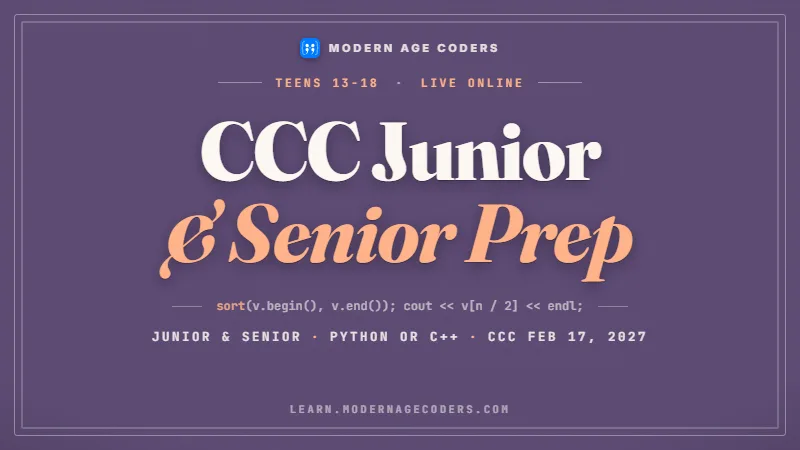
Canadian Computing CompetitionJunior or Senior by skill, in Java, Python, C or C++Wednesday 17 February 2027
Pascal, Cayley and FermatGrades 9, 10 and 1123 and 24 February 2027

For a student taking Computer Programming 12 in Java, the CCC is the obvious next challenge: CEMC accepts Java alongside Python, C and C++, and lets each student choose Junior or Senior whatever their grade. Students write it at school, online, and a school has to place the order, since CEMC does not take individual registrations. We teach contest skills with problems we write, and leave CEMC's own past papers, which are free online, for timed practice. See our Beaver Computing Challenge guide and CCC preparation page. We have no tie to CEMC.

Atlantic time

Nova Scotia time, India time and the two clock changes this school year

Nova Scotia, including Cape Breton, keeps Atlantic time and still changes clocks in spring and autumn. The table lines that up with India, where our teachers work; the example times and conversions are ours.

Atlantic time and India time, 2026 to 2027 (offsets from IANA tzdb 2026e, America/Halifax and America/Glace_Bay; example times ours, not fixed class times)
PeriodNova Scotia offsetIndia is ahead bySaturday 10 am in Halifax is, in IndiaWeekday 4 pm in Halifax is, in India
To 1 November 2026UTC-38 hours 30 minutes6:30 pm Saturday12:30 am the next day
1 November 2026 to 14 March 2027UTC-49 hours 30 minutes7:30 pm Saturday1:30 am the next day
From 14 March 2027UTC-38 hours 30 minutes6:30 pm Saturday12:30 am the next day

Halifax and Cape Breton

The time zone database lists Cape Breton under its own zone name, America/Glace_Bay, but with the same offsets as Halifax, so Sydney and Halifax always share a clock. We confirm every class in Atlantic time.

Phone numbers

Nova Scotia numbers use the 902 and 782 area codes, which Prince Edward Island shares. Both are accepted by our booking form, which already carries the +1, so only the ten-digit number is needed.

Close to India evenings

Of all Canadian provinces apart from Newfoundland and Labrador, Atlantic Canada sits closest to India time, so weekend morning classes in Nova Scotia land in the Indian early evening.

Learning ladder

From Primary block coding to Computer Programming 12

These bands are a guide only; the free class shows where each student should start.

Primary to Grade 3

Blocks and stories

Block coding tied to reading and counting, the way Nova Scotia integrates information technology in the early grades.

Coding for KidsScratch Coding for Kids
Grades 4 to 8

First typed code

Python with loops and functions, ready for the numeracy block of Grades 7 and 8.

Python and AI for KidsMaths Through Coding
Grades 9 to 11

Python, then Java

Python taken properly, then Java, so Computer Programming 12 can be about the project.

Python for TeensJava for Teens
Grade 12 and beyond

AI and contests

Machine learning on real data and CCC preparation for students who want a contest.

AI and Machine Learning for TeensCCC Junior and Senior Preparation (Canadian Computing Competition)
Coding and AI

An AI tool can total a column. Knowing not to is the skill

The library project turns on one judgment, which numbers to divide and which never to add, and that judgment is exactly what students need when AI does the arithmetic.

Ask an AI assistant which Nova Scotia library system is busiest and it may hand back raw borrowing totals, which only say that Halifax is biggest. A student who has worked the file knows to ask a better question, loans per item or visits per open hour, and to check an odd figure such as 2.1 visits an hour before believing it.

So our students build their own analysis first and compare it with a tool's answer second. Teenagers use AI tools only within each tool's age rules, with a parent's permission where the tool requires it. Children under 13 learn how AI works by writing their own small programs rather than using tools built for adults.

Computer Programming 12 asks students to identify problems and select effective strategies; choosing the right denominator is one of the first strategies a programmer working with data has to learn. The longer argument is in is coding still worth learning in 2026.

Delivery

Live online from Yarmouth to Cape Breton

A real teacher leads each lesson over video, which puts a student in Antigonish and a student in Halifax in one class.

When classes run

Weekdays or weekends, flexible: choose your batch, or for a very personalised plan choose 1-on-1 at your convenience, weekend mornings or weekdays.

Across the province

Halifax, Dartmouth, Sydney, Truro, New Glasgow, Kentville, Bridgewater or Yarmouth: wherever a student lives, the lesson and the teacher are the same.

Two ways to learn

Join fifteen to twenty classmates working at the same level, or book individual lessons to move faster or to get help on a Computer Programming 12 project.

Nova Scotia grades

Teachers plan in Nova Scotia grades, from Primary, and know when the Mathematics 10 exam and the second-semester programming course fall.

Java or Python

Students preparing for Computer Programming 12 can learn in Java from the start; younger students usually begin in Python and move on.

Start free

Lesson one costs nothing. It is taught like any other class, and at the end the teacher suggests a level, a course and a regular time.

No Nova Scotia office

Modern Age Coders has no centre in Nova Scotia and claims none. Teaching is live online from India, and a student needs a computer with a microphone, speakers and a steady internet connection.

Fees

Fees for Nova Scotia families

Every fee is shown with its currency beside it.

First classFree

An introductory live lesson with no charge, after which the teacher proposes a starting level, course and weekly slot.

Group tuition$140 CAD

The monthly fee for a place in a batch of fifteen to twenty learners at one level.

Private tuition$210 CAD

The monthly fee for individual lessons with one teacher, at agreed times.

There is one Canadian fee, so a Nova Scotia family pays what a family in Ontario or Alberta pays. No charge is made before the free lesson, or before the course and schedule are settled; holidays and missed classes are explained on the pricing page.

Reviews

Google reviews from families and students

Rated 4.9 across 547 Google reviews. These are real reviews, reproduced as written.

★★★★★

"The one step solution for my son. Modern Age Coders make learning coding so simple that kids love it. The teachers explain complex concepts clearly with practical exercises and interactive content."

Ria Mukherjee

Parent

★★★★★

"Modern Age Coders has been a game-changer for me. I struggled to grasp IT concepts and coding before joining, but their classes transformed everything. I can now confidently write complex programs with ease."

Samriddha Mondal

Student

★★★★★

"One of the most wonderful education centres out there. Education is not limited to school syllabus but focuses on skill development."

Vansh Agarwal

Student

★★★★★

"My child Dhairya is really enjoying the Modern Age Coders classes. This is his first online class and he eagerly looks forward to it. I can already see his improvement, and the teachers are very cooperative."

Sonam Oswal

Parent of Dhairya

★★★★★

"Modern Age Coders have wonderful teachers who teach in a clear, easy and practical way. The teacher boosts students' confidence and inspires them to learn without hesitation."

Sonu Goyal

Parent

★★★★★

"I highly recommend this computer coding class! The teachers are incredibly knowledgeable and passionate about coding."

Ritu Kedia

Parent

Free placement class

Tell us about your Nova Scotia student

The first task is set by level: a block-coding story for a Grade 1 child, a Python number game for Grade 6, or the library statistics for a Grade 11 student who wants real data.

+1

FAQ

Nova Scotia coding questions

What Nova Scotia families most often ask before the first class.

Do you have coding classes in Nova Scotia?

Yes, live and online. There is no Nova Scotia centre; students join from home with a teacher, in a group batch of fifteen to twenty or one to one.

Is there a computer programming course in Nova Scotia high schools?

Yes. Computer Programming 12 is offered through the Nova Scotia Virtual School, in its Technology Education category, with course materials in Java. Ask your school how students enrol.

How many credits does a Nova Scotia student need to graduate?

At least 18, according to the department. No more than seven can be Grade 10 courses, at least five must be Grade 12 courses, and three must be mathematics, one at each grade level.

Do your classes count toward the Nova Scotia graduation diploma?

No. We do not grant Nova Scotia credits. Diploma credits come from school courses; our classes build the skills alongside them.

When is the Mathematics 10 exam?

The department lists 23 June 2027 for Mathematics 10 and Mathématiques 10. The exam is written on paper in one two-hour session and counts for 20% of the final course mark.

Should my teen learn Java or Python first?

For a student planning on Computer Programming 12, Java is a sensible early choice because the virtual school course uses it. Younger students usually start with Python, then add Java.

What time are classes for Nova Scotia families?

Weekdays or weekends, flexible: choose your batch, or for a very personalised plan choose 1-on-1 at your convenience, weekend mornings or weekdays. All times are confirmed in Atlantic time.

Can a Nova Scotia student write the Canadian Computing Competition?

Yes, if their school places an order with CEMC, which has set the 2027 contest for Wednesday 17 February 2027. Java, Python, C and C++ are all allowed.

Do 902 and 782 numbers work in your form?

Yes. Enter the ten digits of any Nova Scotia number; the country code is already in place.

How young can a child start?

From about age 6, in Primary or Grade 1, with block coding. Typed Python usually begins around Grade 4, and adults are welcome at any stage.

Where are the fees listed?

Further up this page, under Fees. You will see three lines, for the free introductory lesson, the group rate per month and the one-to-one rate per month, each shown in your currency. Payment only starts after the introductory lesson.

Nova Scotia cities

Our city page in Nova Scotia

One page so far for a Nova Scotia city, written for families there.

More for Canada

Other pages for Nova Scotia students

For all of Canada, go to coding classes in Canada; the curriculum by province compares Nova Scotia with its neighbours. Contest dates for the whole country sit in the Canadian contest calendar, and students who need math support can read about online math tutoring in Canada.

Free classPriority demoCall us

Keep exploring Modern Age Coders

Coding classes in nearby places

Learn more

Free resources

From the blog

Start here