CST / THINK / 01
Puzzles and logic
Breaking problems into steps, seven to twelve.
Open the syllabusStuttgart · Coding for children · Ages 6 to 12
Baden-Württemberg has just made computing a compulsory school subject, but it starts in grade 5 and its first proper curriculum is not due before August 2027. Before that, a Stuttgart child spends four years of Grundschule with no computing lesson on the timetable. This page sets out what the new subject is, what our English-language video lessons look like for a six to twelve year old, a free maths contest in April 2027, and a project built on the two bike counters whose figures Stuttgart gives away as open data.
Live online classes since 2020 · 10,000+ students worldwide · the same mentor each week, in English
The short answer
Modern Age Coders runs coding classes for kids in Stuttgart as live video lessons, in English, for six to twelve year olds. The youngest build games from blocks; from about nine, children type real Python and try small AI projects, such as charting Stuttgart's own bike counters. A regular mentor sets the speed and speaks clearly for children still learning English. Families pick a shared class of fifteen to twenty pupils or private lessons, after school or on a weekend morning.
Where Stuttgart children begin
A gentle start for the youngest, a long course from blocks to apps, and a typed Python route for children ready to leave blocks behind.
CST / 01
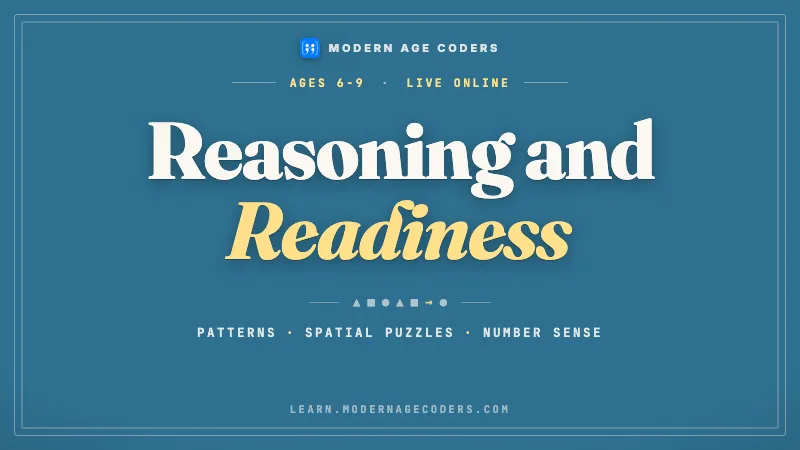
For six to nine year olds. Patterns, sorting and step-by-step puzzles that build the habits coding needs, before any screen work gets serious.
Open the syllabus →
CST / 02
For six to twelve year olds, sorted into age groups. A school year of block games that grow into small apps, ending with how an AI makes a choice.
Open the syllabus →
CST / 03
For nine to twelve year olds. Real code typed from week one, turtle drawings, small games and data work like the bike counter chart below.
Open the syllabus →Schools in Stuttgart
In grade 5, in a subject that is only now being built. Everything below comes from the Gesellschaft für Informatik, which tracks the rules of all sixteen Länder.
Since the 2025/26 school year, Baden-Württemberg has a compulsory subject called Informatik und Medienbildung, computing and media education. The Informatik-Monitor 2026/27 says it is being introduced across secondary school types, beginning in grades 5 and 6 and growing year by year after that.
At Werkrealschule, Hauptschule, Realschule and Gemeinschaftsschule the plan is four lessons a week in total over the years of Sekundarstufe I. That puts the Land among the four that meet the short-term target of four compulsory hours, alongside Hamburg, Sachsen and Schleswig-Holstein.
The same monitor is frank about one gap: "Hierfür liegt noch kein Bildungsplan vor", there is no curriculum for the subject yet. A consultation is planned in the 2026/27 school year and the new Bildungsplan is to take effect in August 2027. Until then, teachers in grades 5 to 7 lean on older plans and a reading guide.
Primary school, Grundschule, covers grades 1 to 4 in Baden-Württemberg, and the new subject does not reach into it.
| Grades | School stage | What the timetable offers |
|---|---|---|
| 1 to 4 | Grundschule | No computing subject |
| 5 and 6 | All secondary school types | Informatik und Medienbildung, compulsory, new since 2025/26 |
| 7 to 10 | Secondary school | The new subject grows up the year groups; older elective courses run out |
| 10 | Gymnasium | Usually the Einführungsphase of the Oberstufe (eight-year route) |
| 11 and 12 | Gymnasium Oberstufe | Informatik as an elective, a basic subject or an advanced subject, if the school offers it |
Source: the Informatik-Monitor 2026/27 published by the GI (Gesellschaft für Informatik), its Baden-Württemberg page and its national comparison, read on 2 November 2026. The national page also notes that in Baden-Württemberg only about one Oberstufe pupil in twelve takes Informatik, one of the three lowest shares in Germany.
School rules are set by the Land, so they are the same in Stuttgart, home to 612,663 people on 31 December 2024 according to Destatis, as in Esslingen, Ludwigsburg, Böblingen, Fellbach or Waiblingen. Our classes are online, so a family anywhere in the Stuttgart region joins the same groups.
For a Stuttgart family with a child of 7 or 8, the practical meaning is simple. Your child will meet computing at school around the age of 10, in a young subject whose teachers are still settling on what to teach. A child who has spent two or three years building games and solving puzzles at home starts that subject relaxed, and often ends up helping the classmate at the next desk.
Taught in English
Yes. We teach live and only in English, and small children cope well because the mentor bends to them rather than the reverse.
There is no German-language option. We put that near the top so no family books a trial expecting one. Children at the international and bilingual schools around Stuttgart already learn in English; children at a German Grundschule get an hour of English practice that happens to be about games.
Mentors slow down, say a step again in easier words and point at the screen as they talk. If a six year old replies with one word, or with a German word, that is fine: the mentor simply offers the English one.
Blocks snap together, characters move, a score goes up. Children learn a great deal by watching and copying a move, then changing it. The English a child needs in the first months is small: start, stop, repeat, if, turn, again.
The mentors work from India over a video call. India runs several hours ahead of Stuttgart, so school-day afternoons here land in the mentor's evening, and that is what makes the times below easy. One mentor stays with your child for months and quickly notices whether your child wants a hard task at once, likes a quiet minute before answering, or learns most by repairing a broken program.
A real Stuttgart project
Stuttgart publishes yearly totals from its two permanent bicycle counters, free for anyone to reuse. Our older children use them to learn a trick that grown-up analysts use every day: when two things are very different in size, compare how fast they grow, not how much.
The city's open data file lists two fixed counters. The first has counted since 1 July 2012 on the König-Karls-Brücke in Bad Cannstatt, on main cycle route 1. The second, in Stuttgart-Süd on the Böblinger Straße, has counted since 10 December 2013.
The file gives one total per counter per year from 2013 to 2022. For the Böblinger Straße in 2013 it says NA, not available, which makes sense: that counter only ran for the last three weeks of the year.
Which counter grew faster between 2014 and 2022? A child looks at the numbers and says the bridge, because its totals are much bigger. The first program agrees. The second program shows why that answer is unfair.
Children work from a short file, stuttgart_bikes.csv, holding three columns: year, counter and count. Rows marked NA are skipped on purpose, so that one empty year cannot crash the program.
import csv

counts = {}
with open("stuttgart_bikes.csv", encoding="utf-8") as f:
    for row in csv.DictReader(f):
        if row["count"] == "NA":
            continue
        counts[(row["counter"], int(row["year"]))] = int(row["count"])

for counter in ["König-Karls-Brücke", "Böblinger Straße"]:
    first = counts[(counter, 2014)]
    last = counts[(counter, 2022)]
    print(counter, "grew by", last - first)
It prints: König-Karls-Brücke grew by 384076 and Böblinger Straße grew by 203508.
The bridge added 384,076 bikes a year, the Böblinger Straße 203,508. So the bridge grew faster? Not so quick. The bridge started in 2014 with more than three times as many bikes, so adding a lot was easy for it. To compare fairly we turn each counter's 2014 total into 100 and scale every other year the same way. This is called an index, and it is how prices, sales and many other numbers in the news are compared.
for counter in ["König-Karls-Brücke", "Böblinger Straße"]:
    base = counts[(counter, 2014)]
    index = []
    for year in range(2014, 2023):
        index.append(round(100 * counts[(counter, year)] / base))
    print(counter, index)
It prints: König-Karls-Brücke [100, 113, 110, 112, 134, 137, 189, 154, 152] and Böblinger Straße [100, 104, 108, 117, 147, 154, 195, 178, 195].
Now the picture flips. By 2022 the bridge stands at 152, about half as many bikes again as in 2014, while the Böblinger Straße stands at 195, almost twice its 2014 level. The smaller counter grew faster. Both lines jump in 2020, the highest year for the bridge, and the Böblinger Straße beats its own 2020 total in 2022 by only 450 bikes. The file does not say why the numbers moved, so we teach children not to invent a reason the data does not give.
| Counter | 2014 total | 2022 total | Extra bikes | Index in 2022 |
|---|---|---|---|---|
| König-Karls-Brücke | 738,880 | 1,122,956 | 384,076 | 152 |
| Böblinger Straße | 214,360 | 417,868 | 203,508 | 195 |
Data: Landeshauptstadt Stuttgart, Radfahrende an den Zählstellen in Stuttgart seit 2013, published through Open Data BW, licence CC BY 4.0, downloaded 2 November 2026. Differences and index values are our own calculation from the yearly totals in that file; the file ends with 2022.
A free first contest
One good choice for ages 8 to 12 is the Känguru der Mathematik, a multiple-choice maths contest written at school, which moves to a later date in 2027.
The Känguru der Mathematik is an individual contest of 75 minutes. Pupils in grades 3 and 4, and in grades 5 and 6, each face 24 problems; older pupils get 30. In March 2026 more than 920,000 pupils from more than 13,000 schools took part, according to the organisers.
It is a maths contest, not a coding one, but the thinking overlaps a great deal: spotting a pattern, ruling options out, working backwards from an answer.
Normally the contest falls on the third Thursday of March. For 2027 the organisers moved it to 8 April 2027, since the March date would land right before Easter holidays in nearly all Länder.
Online registration opens on 1 December 2026 and closes on 31 January 2027. Ask your child's school early whether it takes part.
None of the contest's own problems appear in our lessons. Mentors invent fresh puzzles of a similar kind and train the habits behind them, such as checking each answer option in turn rather than guessing. Children who enjoy those puzzles usually enjoy the Känguru, and a child who later wants a computing contest can try the Informatik-Biber, which runs in schools from 9 to 20 November 2026. We are not connected with either organiser.
Class times
Groups meet on weekday afternoons and at weekends; one-to-one lessons go wherever your diary has room. The rows below show how a Stuttgart start time reads on the mentor's clock.
| In Stuttgart | Same moment in India, to 27 March 2027 | Same moment in India, from 28 March 2027 |
|---|---|---|
| 15:45 | 20:15 | 19:15 |
| 16:45 | 21:15 | 20:15 |
| 17:15 | 21:45 | 20:45 |
| Saturday 11:00 | 15:30 | 14:30 |
Example start times only; no batch hour is fixed. German clocks show CET, UTC+1, through the winter and CEST, UTC+2, in summer, as the Einheitenzeitgesetz sets out. They went back on 25 October 2026 and go forward on 28 March 2027. India does not change its clocks (UTC+5:30), so it sits four and a half hours ahead of Stuttgart until late March and three and a half hours ahead after that.
Classes do not stop for the Baden-Württemberg school holidays, which the KMK table for 2026/27 lists as 23 December 2026 to 9 January 2027 at Christmas, 25 March and 30 March to 3 April 2027 at Easter, 18 to 29 May 2027 at Whitsun and 29 July to 11 September 2027 in summer. Many families keep going through the holidays; others pause for a trip and pick up afterwards.
Progress
Stages we wrote ourselves. Mentors use them to place a new child and to show parents what has changed since last term.
| Stage | Usual age | Your child can |
|---|---|---|
| 1. Order | 6 to 7 | Put picture steps in order and make a character walk and talk |
| 2. Repeat | 7 to 8 | Use a loop instead of copying the same block ten times |
| 3. Decide | 8 to 9 | Make a game react with if and else, and keep a score |
| 4. Type | 9 to 11 | Type small Python programs that use lists and loops |
| 5. Compare | 10 to 12 | Read a data file and compare two things fairly |
Stage 5 is the bike counter project. A child who asks "compared with what?" will ask it about every big number they hear.
Reports to parents describe what your child built and can explain, never screen time.
A bigger number is not always the bigger change. Ask where each one started.
When the data says NA, it is telling you something. Skip it on purpose, and say you did.
More for children
Every course is live, in English, with one mentor who knows your child, in a group or one to one.
CST / THINK / 01
Breaking problems into steps, seven to twelve.
Open the syllabusCST / THINK / 02
Beads first, then sums in the head.
Open the syllabusCST / THINK / 03
Quick, confident arithmetic for five to ten year olds.
Open the syllabusCST / PLAY / 01
A short course that ends with games your child designed.
Open the syllabusCST / PLAY / 02
A real game engine, gently introduced.
Open the syllabusCST / PLAY / 03
Building with AI help while learning what the code does.
Open the syllabusCST / MAKE / 01
What a model learns from examples, with no adult accounts.
Open the syllabusCST / MAKE / 02
Working apps on a real phone, eight to twelve.
Open the syllabusCST / MAKE / 03
Twelve weeks of building towards a project, ages 8 to 12.
Open the syllabusHow classes work
Weekdays or weekends, flexible: choose your batch, or for a very personalised plan choose 1-on-1 at your convenience, weekend mornings or weekdays.
After school
Stuttgart afternoons, once homework is done.
Weekend mornings
A calm slot that suits six and seven year olds.
1-on-1
A time you agree with the mentor, at your child's pace.
The same person every week, who remembers what your child made.
Short sentences, shown on screen, repeated when needed.
Your child moves the mouse and types from the first class.
Groups are formed by age, so nobody is lost or bored.
A note for parents on what was built and what is next.
A group of fifteen to twenty, or one to one.
Student work
A seven year old dragging blocks today can be shipping real software as a teenager. Here are a few things our older learners made; the student labs page has the rest.

AI and ML
An AI nutrition coach that reads what you eat and works you toward a target.

AI and ML
A chatbot that answers mathematics and programming questions, built and deployed by a student.

AI and ML
An assistant that helps a young person recognise unsafe situations online.

Web app
A weather forecasting site with live conditions for any location.
Fees
You pay month by month for eight live classes. The euro amounts on this page use the reference rate published by the European Central Bank; the charge itself goes through in US dollars, so your bank converts it and the figure on your statement can move slightly.
Free first class
Free
no card required
Group batch
€90
a month, eight live classes, charged in US dollars
One to one
€134
a month, eight live classes, charged in US dollars
What families say
What parents and students wrote on Google, word for word.
★★★★★
"The one step solution for my son. Modern Age Coders make learning coding so simple that kids love it. The teachers explain complex concepts clearly with practical exercises and interactive content."
Ria Mukherjee
Parent
★★★★★
"Modern Age Coders has been a game-changer for me. I struggled to grasp IT concepts and coding before joining, but their classes transformed everything. I can now confidently write complex programs with ease."
Samriddha Mondal
Student
★★★★★
"One of the most wonderful education centres out there. Education is not limited to school syllabus but focuses on skill development."
Vansh Agarwal
Student
★★★★★
"My child Dhairya is really enjoying the Modern Age Coders classes. This is his first online class and he eagerly looks forward to it. I can already see his improvement, and the teachers are very cooperative."
Sonam Oswal
Parent of Dhairya
★★★★★
"Modern Age Coders have wonderful teachers who teach in a clear, easy and practical way. The teacher boosts students' confidence and inspires them to learn without hesitation."
Sonu Goyal
Parent
★★★★★
"I highly recommend this computer coding class! The teachers are incredibly knowledgeable and passionate about coding."
Ritu Kedia
Parent
Stuttgart parents ask
No. We teach only in English, always live. The mentor keeps sentences short, checks that your child has followed and gets used to the way your child speaks, so a beginner in English is not left behind. Blocks and Python keywords are identical whatever language the lesson uses.
Not as a subject. Grundschule in Baden-Württemberg runs from grade 1 to grade 4, and the new compulsory subject, Informatik und Medienbildung, only begins in grade 5. It started in 2025/26 with grades 5 and 6 and adds a year group each year.
The Land's new compulsory secondary subject, combining computing with media education. According to the Informatik-Monitor 2026/27 it has no written curriculum yet: the draft goes out for consultation in 2026/27 and should apply from August 2027.
From 6. At that age lessons use picture blocks, so your child needs neither typing nor long texts. The Thinking before coding course is built for six to nine year olds, and many children switch to typed Python at around nine.
Weekdays or weekends, flexible: choose your batch, or for a very personalised plan choose 1-on-1 at your convenience, weekend mornings or weekdays. In practice most Stuttgart pupils log in in the late afternoon or on a Saturday or Sunday morning.
For eight to twelve year olds the Känguru der Mathematik is a friendly start. Its 2027 date is 8 April, a few weeks later than normal because of Easter. Registration is online from 1 December 2026 until 31 January 2027, so it is worth asking the school soon.
They are in India and teach by live video. That suits Stuttgart: a 15:45 lesson here begins at 20:15 for the mentor during the winter months. The mentor stays the same from one week to the next.
Between fifteen and twenty, all close in age. A family that wants private teaching books the one-to-one plan instead, with two lessons each week at agreed times.
Once a month. Amounts on this page are in euro at the European Central Bank reference rate; your card is charged in US dollars and your bank converts the sum, so a small difference on the statement is normal. The trial lesson costs nothing and no card is asked for.
Six to eight year olds make games and moving stories from blocks. Older children write Python, draw shapes with code and, at ten to twelve, start asking questions of real files, like the Stuttgart bike counter totals on this page.
Elsewhere on this site
Further reading for families around Stuttgart.
The starting point for all our Germany pages.
School computing in all sixteen Länder, side by side.
How the maths contest works and how to get ready.
The block language many six year olds start with.
Minimum ages for the common AI tools.
A live lesson explained from start to end.
Part of the guide: Coding classes in Baden-Württemberg
More guides: Coding classes in North Rhine-Westphalia · Coding classes in Lower Saxony · Coding classes in Land Bremen · Coding classes in Hesse · Coding classes in Bavaria · Coding classes in Saxony-Anhalt · Coding classes in Schleswig-Holstein · Coding classes in Saarland · Coding classes in Rhineland-Palatinate · Coding and maths in Berlin · Coding and maths in Hamburg · Coding classes in Saxony · Coding classes in Thuringia · Coding classes in Brandenburg · Coding classes in Mecklenburg-Vorpommern
Start here
In the trial lesson your child solves a puzzle and builds something tiny. Afterwards the mentor tells you which course and group would suit, based on how your child reasons and how easily they follow English.
Prefer to read first? How we teach walks through a lesson, and all courses has each syllabus.
WhatsApp us · +91 91233 66161 · connect@modernagecoders.com
Every lesson is live, online and in English only, with a mentor in India. For quick questions WhatsApp is fastest; please write to us in English.
A priority demo is a full class of about 45 to 60 minutes. After the class the mentor sends a written skill report and a personal learning roadmap on WhatsApp. If you enrol, the demo fee is adjusted against your first month's fee. Share your demo Order ID with us on WhatsApp and we take it off.
Book a priority demo