Skip to content
Bradford, West Yorkshire, England

Coding classes in Bradford

What are the best coding classes in Bradford?

Bradford district had 546,412 usual residents at the 2021 Census, with children aged 10 to 14 making up 7.6% of them against 6.0% across England. It is the world's first UNESCO City of Film, and Saltaire, within the district, has been a World Heritage Site since 2001. Modern Age Coders teaches Bradford learners aged six to sixty-seven live online, in groups of five to ten sorted by level or one to one, with teachers in India and lesson times set in UK hours. The first lesson is free of charge; after that it is USD 100 a month for a group place or USD 150 a month for private lessons.

Here is a walk anyone can take through Bradford's weather. The Met Office has kept monthly rainfall for its Bradford station, 134 metres up, since 1908, with the rainfall column complete from 1911. For every month from January 1911 to December 2025, take one step up if it was wetter than usual for that time of year and one step down if it was drier. The walker climbs to 28 steps up by June 1969, then drifts down to 12 below by November 2011. It looks like a story: wet decades, then a drying trend. But shuffle the same 1,380 steps into a random order and walk again, ten thousand times, and the typical shuffled walk strays about 30 steps from zero. A third of them spend at least 82% of their months on one side, just as the real walk did. That is a random walk, and learning not to read stories into one is the lesson Bradford's rain gives our teenage learners.

Facts last verified 21 September 2026. Teaching is online; no Bradford branch is claimed.

Course picks for Bradford

Four courses for the City of Film

Choose by what the learner likes most. Each course opens with a free live lesson, and booking needs no card.
Browse the course atlas for more than one hundred options and use the coding roadmap to check prerequisites.

The four we are known for

Python, AI, vibe coding and agentic coding

These run underneath everything above. Every one is live and online, placed by ability rather than by age, and the first class is free.

Bradford today

A district full of children and teenagers

Census 2021 for the Bradford metropolitan district, from the Office for National Statistics tables on Nomis.

Bradford district, Census 2021
Census 2021BradfordEngland
Usual residents546,412Not compared
In households540,549, 98.9%Not compared
In communal establishments5,863, 1.1%Not compared
Aged under 536,096, 6.6%5.4%
Aged 5 to 939,556, 7.2%5.9%
Aged 10 to 1441,350, 7.6%6.0%
Aged 15 to 1937,779, 6.9%5.7%
Schoolchildren and full-time students, of 510,315 aged five and over124,422, 24.4%20.4%

Every young band above England

Each five-year age band from birth to 19 made up a larger share of Bradford's residents than of England's; ages 10 to 14 reached 7.6% against 6.0%.

Homes, not halls

Some 98.9% of residents lived in households and just 1.1% in communal establishments, so almost everyone lives in an ordinary household.

Students across the district

In 2021, 24.4% of residents aged five and over were schoolchildren or full-time students, compared with 20.4% in England.

The practical point for families is choice at every level. A nine-year-old in Keighley starting with blocks, a GCSE student in Heaton who wants more than the syllabus and an adult in Ilkley returning to learning can each join five to ten others at exactly their stage, which a single local class could rarely offer all three.

Film, mills and a university

The world's first City of Film

From Bradford UNESCO City of Film, UNESCO's World Heritage List, the University of Bradford and Bradford Culture Company.

City of Film

Bradford UNESCO City of Film describes Bradford as the world's first UNESCO City of Film, with a history in film and filmmaking going back to the birth of cinema.

2001

UNESCO inscribed Saltaire that year as a complete, well-preserved industrial village of the later 19th century, whose mills, public buildings and workers' housing share one style and whose street plan survives intact.

1966

The University of Bradford says it became the UK's fortieth university that year, with the Prime Minister, Harold Wilson, installed as its first Chancellor.

The University reports 10,887 students for 2024/25, of whom 8,037 are undergraduates. Bradford was also UK City of Culture for 2025, a year-long programme of more than 5,000 events delivered by the charity Bradford Culture Company. We have no connection with any of these organisations. We name them because film, textiles and a technical university all depend on patterns, and this page is about telling a real pattern from an accidental one.

The weather file itself

The Met Office publishes the Bradford record as a plain text file: estimates carry an asterisk, missing months show three dashes and recent months are marked provisional. Rainfall is missing for all of 1908 to 1910, so the walk starts in January 1911 and stops at December 2025, before the provisional 2026 months.

Signature project

A walk through 115 years of Bradford rain

A random walk adds up a string of steps up and down. We built one from the Met Office Bradford rainfall record and set it beside ten thousand shuffled copies of itself.

Where the Bradford rain walk stood, January 1911 start, one step per month
DatePosition
January 19202 below the start
January 19307 above
January 19508 above
June 196928 above, the highest point
January 199015 above
January 2010Level with the start
November 201112 below, the lowest point
January 20208 below

1. Decide what usual means

For each calendar month, find the median rainfall from 1911 to 2025. A month above its median is a step up and one below is a step down; the 12 months exactly on it stay put.

2. Take the walk

Add the steps in date order. The walk ends exactly where it began, because by definition half the Januaries sit above the January median and half below, and the same for every month.

3. Shuffle and compare

Put the same 1,380 steps in a random order and walk again, ten thousand times. Every shuffled walk also ends at zero, which makes it a fair comparison with the real one.

The story that chance tells

The real walk spent 82.0% of its months above zero and reached 28 steps up. Among the shuffled walks, 62.1% strayed at least 28 steps from zero at some point and 33.4% spent at least 82% of their months on one side. The wet middle of the century and the drift down since are exactly the kind of shape pure chance produces. That does not prove Bradford's rain has no pattern; it shows that this picture is not evidence of one.

This is the surprising heart of random walks. People expect a fair walk to hover near zero, crossing back and forth; in fact long stays on one side are normal, and the typical distance a walk strays grows with the square root of its length. For 1,380 steps that square root is about 37. Learners who understand this stop seeing trends in every wandering line, whether it is rainfall, a game score or a league position.

Reading a wandering line

Five checks before calling something a trend

Learned on rainfall, used afterwards on sales figures, game statistics, marks across a school year and any chart that seems to tell a story.

Testing a trend against chance
CheckWhat it looks likeWhat it prevents
Say what a step isDefine up and down against a stated baseline, here each month's own medianA walk that drifts only because the baseline was wrong
Notice built-in endingsRecognise that a median baseline forces the walk back to zeroReading a forced return as a real recovery
Compare with a fair baselineShuffle the same steps many times and walk each copyMistaking an ordinary wander for a signal
Report how surprising it isGive the share of shuffled walks at least as extreme as the real oneStriking charts with no measure of surprise
Handle the gapsStart after missing years and stop before provisional monthsMissing months quietly treated as dry ones

The last check matters because the file marks missing months with three dashes. A careless parser that turns them into zero millimetres adds three years of false dry steps at the very start of the record, and the whole walk shifts.

Younger learners

A coin-toss walk along a number line in the playground, then the same walk drawn step by step by a short program.

Teenagers

The Met Office file parsed flag by flag, the rain walk built in Python, ten thousand shuffles run and the verdict written up.

Adults

Trend claims at work tested against shuffled versions of the same data before anyone puts them in a report.

We are not connected with the Met Office, Bradford UNESCO City of Film, UNESCO, the University of Bradford or Bradford Culture Company. The station record is published for public use; the walk, the shuffles and the percentages are our own work.

Learning ladder

From a coin-toss walk to a trend you can test

The age bands are a starting guess; the free lesson sets the level properly.

Ages 6 to 10

Coin-toss walks

Steps up and down a number line decided by a coin, and the surprise of how far a fair walk can wander.

Mental Maths for KidsCoding for Kids
Ages 11 to 13

Positive and negative steps

Running totals, negative numbers and a first loop that draws a walk on screen.

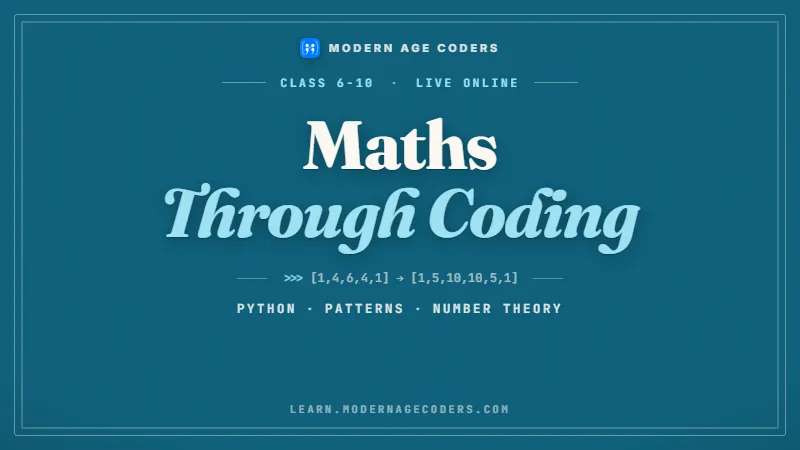
Maths Through CodingMiddle School Mathematics Mastery
Ages 14 to 18

Random walks in Python

Real records turned into walks, shuffles run by the thousand and the square-root spread checked.

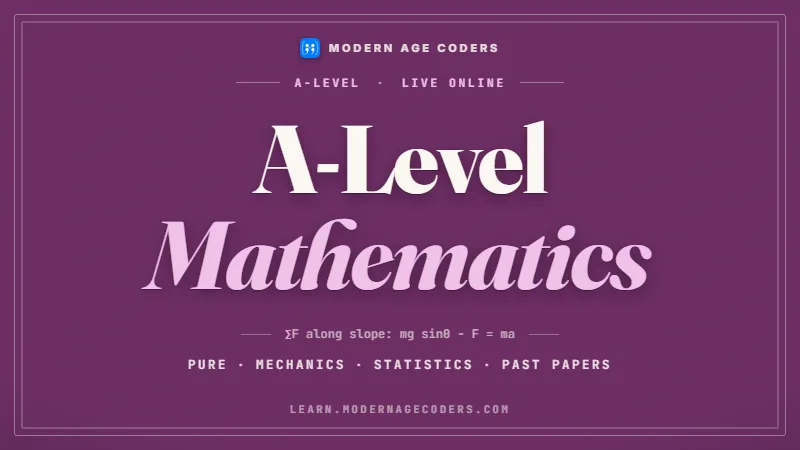
Python for TeensA-Level Maths
Ages 18 to 67

Signal or noise at work

Hypothesis tests, simulation and honest reporting for anyone who has to say whether a trend is real.

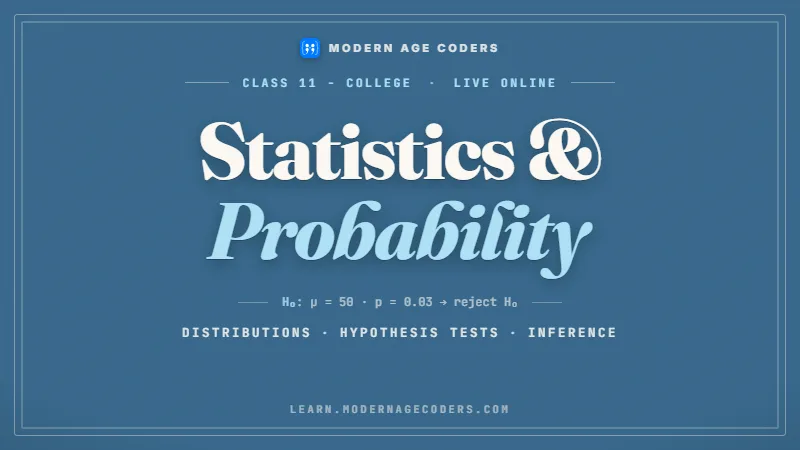
Statistics & ProbabilityMaths for Data Science
Coding and AI

An assistant will happily find a trend in any chart. Why should a Bradford teenager build a random walk?

Because a random walk is the surest defence against trends that are not there.

Show an AI tool the Bradford rain walk and ask what it shows, and it may well describe wet decades followed by a drying trend, in fluent and persuasive language. Nothing in the chart supports that more strongly than chance would. A learner who has shuffled the steps ten thousand times knows to ask how often luck alone draws the same picture.

Random walks also run through a great deal of computing. They drive the simulations behind games and physics, one famous way of ranking web pages imagines a surfer clicking links at random, and they appear in methods for learning from networks of data. Building one by hand is a small first step into all of that.

That is why a Bradford teenager should still learn to program in 2026, in the world's first City of Film: machines can spin a story out of any chart, and knowing when the story is only chance is a skill worth keeping for life. The longer argument is in the case for learning to code in 2026.

Delivery

Keighley, Shipley or Ilkley, joined from home

Bradford district runs from the city centre out to Keighley, Haworth and Ilkley; a live online lesson makes the distance irrelevant.

Town or moorland, one lesson

A learner in Haworth and another in Manningham can share a lesson without either of them travelling across the district.

Stages Bradford schools use

From Reception through Key Stages 1 to 4, Year 9 options, GCSEs and A levels, we use the same stages as local schools, and teach in English.

A proper first lesson

We teach a real task in the free lesson, then recommend a level, a course and a weekly slot. Booking it asks for no card.

Levels decide the group

Five to ten learners at one stage, drawn from Bradford, the rest of the UK and overseas, so every level can meet at a time that works.

Two lessons a week

The same two weekly times, about eight lessons a month, with holiday and exam breaks agreed with the teacher beforehand.

India-based teachers

Our teachers work on India Standard Time, which never shifts: four and a half hours ahead of Bradford in summer and five and a half in winter, so after-school and evening lessons sit inside their working hours.

Starting young

Bradford has a large share of children, and our youngest learners start at six with block coding in groups at their level, moving to Python when they are ready rather than on a fixed date.

Fees

What Bradford lessons cost

Two monthly prices after one free lesson.

First classUSD 0

A complete lesson at no charge, closing with a recommended level, course and weekly time.

Group tuitionUSD 100

Around eight live lessons a month in a group of five to ten learners at one level.

Private tuitionUSD 150

Around eight live lessons a month with a teacher who teaches only your learner.

Families outside India all pay one US dollar fee, so a household in Bingley pays the same as one in Queensbury, and we do not quote prices in pounds. Charges begin only after the free lesson has agreed a course and a time; our pricing page explains pauses, missed lessons and changes between group and private teaching.

Reviews

Google reviews from six families, as posted

Rated 4.9 across 547 Google reviews. These are real reviews, reproduced as written.

★★★★★

"The one step solution for my son. Modern Age Coders make learning coding so simple that kids love it. The teachers explain complex concepts clearly with practical exercises and interactive content."

Ria Mukherjee

Parent

★★★★★

"Modern Age Coders has been a game-changer for me. I struggled to grasp IT concepts and coding before joining, but their classes transformed everything. I can now confidently write complex programs with ease."

Samriddha Mondal

Student

★★★★★

"One of the most wonderful education centres out there. Education is not limited to school syllabus but focuses on skill development."

Vansh Agarwal

Student

★★★★★

"My child Dhairya is really enjoying the Modern Age Coders classes. This is his first online class and he eagerly looks forward to it. I can already see his improvement, and the teachers are very cooperative."

Sonam Oswal

Parent of Dhairya

★★★★★

"Modern Age Coders have wonderful teachers who teach in a clear, easy and practical way. The teacher boosts students' confidence and inspires them to learn without hesitation."

Sonu Goyal

Parent

★★★★★

"I highly recommend this computer coding class! The teachers are incredibly knowledgeable and passionate about coding."

Ritu Kedia

Parent

Free placement class

Set up a free lesson for a Bradford learner

We match the first task to the learner: a coin-toss walk for a young child, a first Python program that draws one, or the Met Office Bradford record and ten thousand shuffles for a teenager ready for real data.

+44

FAQ

Bradford coding class questions

What Bradford families most often want to know.

How many people live in Bradford district?

The 2021 Census counted 546,412 usual residents: 540,549 in households and 5,863, or 1.1%, in communal establishments.

Is Bradford a young district?

Its age profile is younger than England's. In 2021 every five-year band from birth to 19 made up a larger share of residents than nationally; those aged 10 to 14, for example, were 7.6% against 6.0%.

What does City of Film mean?

Bradford UNESCO City of Film describes Bradford as the world's first UNESCO City of Film, part of UNESCO's Creative Cities Network. We are not connected with the organisation.

What is a random walk?

A path built by adding up random steps, such as one step up or down for each coin toss. The Bradford project builds one from monthly rainfall and compares it with shuffled copies of itself.

Has Bradford been getting drier?

The rain walk falls from 28 steps up in June 1969 to 12 below by November 2011, but a third of walks made from the same steps in random order are at least as lopsided, so this picture alone is not evidence of a trend.

What is Saltaire?

A 19th-century industrial village in Bradford district, inscribed by UNESCO as a World Heritage Site in 2001 as a complete and well-preserved example of its kind.

When are lessons for Bradford learners?

After school, in the evening or at weekends, at a UK time fixed during the free lesson. Our teachers are four and a half hours ahead of Bradford in summer and five and a half in winter.

Is there a Modern Age Coders centre in Bradford?

No. We have no centre in Bradford and no premises in the UK; every lesson runs live online. Learners need a computer with sound and a steady connection, and our phone line is in India.

What do Bradford lessons cost?

The first lesson is free. Then a group place costs USD 100 a month for two live lessons a week, about eight a month, with five to ten learners, and one-to-one lessons on the same pattern cost USD 150 a month. Course, format and time are agreed before anything is charged.

How are Bradford groups arranged?

By level, pace and goals, not by age or postcode, with five to ten learners at one stage. If no group suits the learner's times, we offer one-to-one lessons.

Explore the UK

Yorkshire neighbours and other cities

Next door, the Leeds page samples a footfall record fairly. Over the Pennines, Manchester times a rise travelling down the River Medlock, and the Oxford page builds a Markov chain from two centuries of rain. The England guide sets out the school stages, and the UK coding page lists every UK page.

Free Bradford classCall +91 91233 66161

Keep exploring Modern Age Coders

Coding classes in nearby cities

Learn more

Free resources

From the blog

Start here