What makes the best coding class for a Houston child?
A live teacher who checks your child's own code, a level set by a real first lesson, and finished projects rather than videos. Modern Age Coders teaches Houston kids from age 6 online, in level-matched groups of fifteen to twenty children or with a private teacher, from Scratch to Python, with projects such as a histogram of the city's 380 park records.
Search for coding classes in Houston and you get a long list of camps, centers and apps, and very little help choosing between them. This page is our answer to that problem. It sets out what to look for in any class, shows the kind of project a child should finish, and builds one in full on a dataset the City of Houston publishes about its own parks. You will also find the short version of what Texas now expects schools to teach in technology applications, the Central Time arithmetic for class times, and what our classes cost.
Facts last verified 18 October 2026. Teaching is online; no Houston branch is claimed.
Ages below are a starting guess; the trial lesson settles where your child actually begins.

Drag-and-drop blocks that turn into animations and simple games, with a teacher asking the child to explain each step.
See the syllabus
Full Scratch projects with scoring, levels and variables, the bridge between play and real programming.
See the syllabus

First typed code in Python, then small data and AI projects such as the Houston parks histogram below.
See the syllabus
Games designed, coded and tested by the child, with the debugging habits that make later courses easier.
See the syllabusBrowse the course atlas for more than one hundred options and use the coding roadmap to check prerequisites.
The four we are known for
These run underneath everything above. Every one is live and online, placed by ability rather than by age, and the first class is free.
Scratch games and small apps, with AI as a helper the child learns to question.
See the syllabus
First typed code: games, turtle art and small programs that make decisions.
See the syllabus
Blocks first, then games and apps, at the pace of the child.
See the syllabus
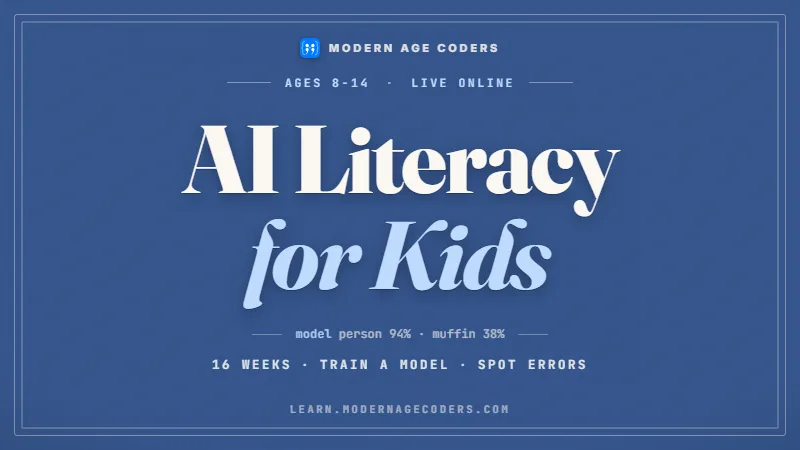
How AI works, where it goes wrong, and how to use it safely.
See the syllabusUse these with any provider in Houston, including us. A good class answers every one of them without hesitation.
| Ask this | A strong answer | A warning sign |
|---|---|---|
| Who reads my child's code? | A named teacher looks at the actual program in every class | Videos with a quiz at the end, and no person checking |
| How is the level set? | A trial lesson with a real task, then a recommendation | Placement by age alone |
| What does my child finish? | A game, an app or a data project they can show and explain | Badges, streaks and certificates without a working program |
| How big is the group? | A stated number, with children at the same stage | No number given, or mixed levels in one room |
| What happens when they get stuck? | The teacher asks questions until the child finds the bug | The answer is typed in for them |
| Is there a path after this? | A next course that builds on the last one | One short camp and nothing after it |
We wrote this table from what we watch go right and wrong in first lessons. Price matters, but it is the last question, not the first: a cheap class that never reads a child’s code is expensive in lost months. In our classes the batch is fifteen to twenty children at the same level, or one child with one teacher, and every project is the student’s own.
Short sessions, blocks rather than typing, and lots of talking. The goal is a child who can say what their program will do before they press go.
Bigger Scratch builds, the first variables and loops that count, and an early look at typed Python for children who are ready.
Typed code as the default: Python, JavaScript, or Luau for Roblox, with data and game projects that take several weeks.
The City of Houston’s GIS office (COHGIS) publishes a map layer of city parks. We downloaded its attribute table on 18 October 2026 and sorted the park sizes into bins, the way a child would in a first data project.
| Size band | Park records |
|---|---|
| Under 1 acre | 91 |
| 1 to under 5 acres | 106 |
| 5 to under 10 acres | 72 |
| 10 to under 25 acres | 59 |
| 25 to under 50 acres | 27 |
| 50 to under 100 acres | 6 |
| 100 to under 500 acres | 13 |
| 500 acres and over | 6 |
The layer held 380 park records on download day: 378 in Harris County and 2 in Fort Bend. A child checks that number before drawing anything, because a chart of the wrong rows is worse than no chart.
With bins of 1,000 acres, almost every Houston park lands in the first bar and the chart says nothing. The largest single record, listed at 10,488.7 acres, stretches the axis so far that the small parks vanish.
Bins that widen as they go (1, 5, 10, 25, 50, 100, 500) show the real shape: most parks are small, a few are enormous. Our median is about 4.75 acres, far below the average a big park drags upward.
These bins and the median are our own calculation from one download. Most acreage values carry the source label GIS Value (367 records), with a handful from a survey, a parcel or a deed, and the city states that COHGIS data is for general reference and comes with no warranty. A child who learns to write that sentence under a chart has learned something most adults skip.
A second question uses the Park_Type column: 167 records are labelled Neighborhood Park, 22 Pocket Park, and 30 have no type at all. Counting the blanks before charting the rest is the habit we want. The first version of this project takes one or two classes in Python for a ten- or eleven-year-old; younger children do the same counting with sticky notes and a Scratch bar chart.
Official City of Houston figures, read on 18 October 2026, set beside what the data layer shows.
| Topic | What the city says |
|---|---|
| Developed parks | HPARD stewards and manages over 380 developed parks |
| Greenspaces | 172 greenspaces, in addition to the developed parks |
| Total parkland | more than 25,000 acres of parkland and greenspace |
| Recent work | In 2023, HPARD and partners revitalized 30 neighborhood parks, with 25 more in a second campaign |
| Accreditation | Nationally accredited through the NRPA Commission for Accreditation of Park and Recreation Agencies |
| City Council | Sixteen Council Members, with the Mayor and City Controller, elected every four years |
| Council seats | Five elected At-Large and eleven by district, from District A to District K |
Notice that the data layer’s 380 records sit right beside the department’s “over 380 developed parks”, while the 172 greenspaces may be counted elsewhere. Matching a dataset to the official description of it is a real research skill, and it is the kind of check we ask children to make out loud.
One paragraph on the state picture; our Texas page covers it in depth.
The Texas Education Agency (TEA) says the State Board of Education gave final approval in 2022 to revised technology applications standards for kindergarten through grade 8, implemented from the 2024 to 2025 school year and set out grade by grade in 19 TAC Chapter 126. In August 2026 TEA ran its TEKS Guide 101 webinars for teachers, split into grades K to 2, 3 to 5 and 6 to 8. For the full picture, including how computer science counts toward graduation, read our coding classes in Texas page.
| Measure | Texas | Source as published |
|---|---|---|
| High schools offering CS, 2023 to 2024 | 1,036 of 2,160 (48.0%) | State Education Agency and School Catalogs |
So in 2023 to 2024 fewer than half of Texas high schools offered a computer science course, by Code.org’s count. A Houston child who starts coding in elementary school arrives in high school with years of practice, whatever their campus timetable holds. Suggested citation: Code.org (2025). 2025 State of AI + CS Education.
Houston keeps Central Time, listed in the IANA time zone database as America/Chicago. Our teachers work from India.
Weekdays or weekends, flexible: choose your batch, or for a very personalised plan choose 1-on-1 at your convenience, weekend mornings or weekdays.
India time runs 10 hours 30 minutes ahead of Central Daylight Time and 11 hours 30 minutes ahead of Central Standard Time, since India keeps one clock all year.
Houston clocks go back an hour on November 1, 2026 and ahead an hour on March 14, 2027. We confirm every class time in Central Time so nobody has to do the sum.
A puzzle for older kids
Ask a twelve-year-old to work out what time an 8 a.m. India class lands in Houston on October 31 and again on November 2, 2026. Getting two different answers, and explaining why, is a first lesson in why programmers store time zones by name.
A typical route for a Houston child; the starting rung comes from the free lesson.
Sequences, events and simple loops, told as stories the child animates.
Coding for KidsAI Literacy for Kids (Ages 8 to 14)Games with scores and levels, and early logic puzzles.
Scratch Coding for KidsProblem Solving and Computational Thinking for KidsPython basics, data counting like the park project, and Roblox scripting for game fans.
Python and AI for KidsRoblox Game Coding for KidsMulti-week games and web pages, ready for a middle school elective.
Game Development for KidsJavaScript for TeensYes, and the park histogram shows why in one picture.
Ask an AI tool for a chart of Houston park sizes and it will happily draw the first, useless version with equal bins, one tall bar and a long empty tail. It will not notice that 30 parks have no type, or that the biggest record is a lease. A child who has built the chart by hand spots both in seconds.
That is the skill coding teaches young children: checking. They learn that a computer does exactly what it is told, so every result needs a reason. With that habit in place, AI tools become something a child can question later rather than something they simply believe.
We teach the checking first, with blocks and then Python, and bring in AI tools only when a child is old enough to use them under the provider’s own age rules. The longer argument is in is coding still worth learning in 2026.
Houston traffic makes a cross-town class a commitment. An online one starts at the kitchen table.
A child logs in from home, so a weekday class does not cost an hour on the freeway after school.
Teachers think in US grade levels and the Texas school calendar, and keep school assignments the child’s own work.
Your child completes a real task with a teacher; you get a suggested level, course and time, and no card is asked for.
A group of fifteen to twenty young coders working at one level, some in Houston and some elsewhere in the US.
A single teacher for a single child, useful for shy beginners and fast movers alike.
Weekdays or weekends, as you choose, always confirmed in Central Time.
Online only
We have no building in Houston and do not claim one. Classes are live on a laptop or desktop with sound; a tablet works for the youngest block coders.
The whole price list, in three lines.
One complete trial lesson at no cost, with a level and course suggested at the end.
A monthly fee for a batch of fifteen to twenty children at the same stage.
A monthly fee for one child with one teacher, at times you pick.
Houston families pay one national rate in US dollars. Nothing is charged until after the free lesson and your agreement on course and time, and holiday weeks and missed classes are explained on the pricing page.
Rated 4.9 across 547 Google reviews. These are real reviews, reproduced as written.
★★★★★
"The one step solution for my son. Modern Age Coders make learning coding so simple that kids love it. The teachers explain complex concepts clearly with practical exercises and interactive content."
Ria Mukherjee
Parent
★★★★★
"Modern Age Coders has been a game-changer for me. I struggled to grasp IT concepts and coding before joining, but their classes transformed everything. I can now confidently write complex programs with ease."
Samriddha Mondal
Student
★★★★★
"One of the most wonderful education centres out there. Education is not limited to school syllabus but focuses on skill development."
Vansh Agarwal
Student
★★★★★
"My child Dhairya is really enjoying the Modern Age Coders classes. This is his first online class and he eagerly looks forward to it. I can already see his improvement, and the teachers are very cooperative."
Sonam Oswal
Parent of Dhairya
★★★★★
"Modern Age Coders have wonderful teachers who teach in a clear, easy and practical way. The teacher boosts students' confidence and inspires them to learn without hesitation."
Sonu Goyal
Parent
★★★★★
"I highly recommend this computer coding class! The teachers are incredibly knowledgeable and passionate about coding."
Ritu Kedia
Parent
Tell us your child’s age and what they enjoy, a first Scratch animation for a six-year-old or the parks histogram for an eleven-year-old, and we set the task to match.
Short answers, with the sources named where it matters.
From age 6. The youngest start with drag-and-drop blocks and lots of talking; typed Python usually begins around age 10, depending on reading and typing.
Ask who reads your child's code, how the level is set, what your child will finish, how large the group is, and what happens when they get stuck. A strong class has a clear answer to each.
Fifteen to twenty children at the same level, or one to one if you prefer a teacher for your child alone.
Children download the COHGIS Houston Parks layer, count its 380 records and turn the park sizes into a histogram, then explain why equal-width bins hide most of the parks.
No. The bins and the median are our own calculation from a download on 18 October 2026. The official figures, such as over 380 developed parks, come from the Houston Parks and Recreation Department.
TEA says revised technology applications standards for kindergarten to grade 8 were approved in 2022 and implemented from the 2024 to 2025 school year. Our Texas page covers the high school rules.
Weekdays or weekends, flexible: choose your batch, or for a very personalised plan choose 1-on-1 at your convenience, weekend mornings or weekdays. Times are confirmed in Central Time.
The Houston time stays as agreed. The US switch dates are November 1, 2026 and March 14, 2027, and we confirm the Central Time slot around each change.
No. Every class is live and online, taught from India, so you only need a computer, sound and a steady connection at home.
Near the bottom of this page: one trial lesson that costs nothing, then a monthly group fee or a monthly private fee. You are not charged before the trial.
Game fans can read how to make a Roblox game or Python games for kids. Parents comparing stages can see coding for elementary students and coding milestones by age.