In 2020 a bridge cut two hours to thirty minutes without moving anything on the map
The short answer
Temburong is separated from the rest of Brunei by Malaysian territory, and until the Sultan Haji Omar Ali Saifuddien Bridge opened, reaching the capital by road meant two or more hours through Sarawak and four international passport checks. The bridge solved the road. It did not put a computing class at the end of it, and a district of 9,444 people with one secondary school cannot assemble one locally. Modern Age Coders teaches live online, ages six to sixty-seven, from USD 100 a month, and the first class is free.
An online class is simply one more connection into this district. Unlike the bridge, it required no construction, and it is available on the evening you ask for it.
Lessons are taught over live video from India. Neither country adjusts its clocks, so the gap between a Bangar evening and the teacher is a permanent two and a half hours. We hold nothing in Temburong and claim nothing here.
No card. No obligation. We call, we do not spam.
Facts last verified 17 August 2026. Teaching is online; no premises in Brunei are claimed.
Four sensible starting points, not one course for everybody
Four starting points covering a primary-age beginner, the lower secondary years, a learner already at Sultan Hassan working toward the O Level, and an adult. In a district with one secondary school the year group is a poor guide to what somebody is ready for, so a task in the free class decides it instead.
Kids Coding Blocks Masterclass
Sequencing, conditions and debugging before syntax becomes the distraction.
See the syllabus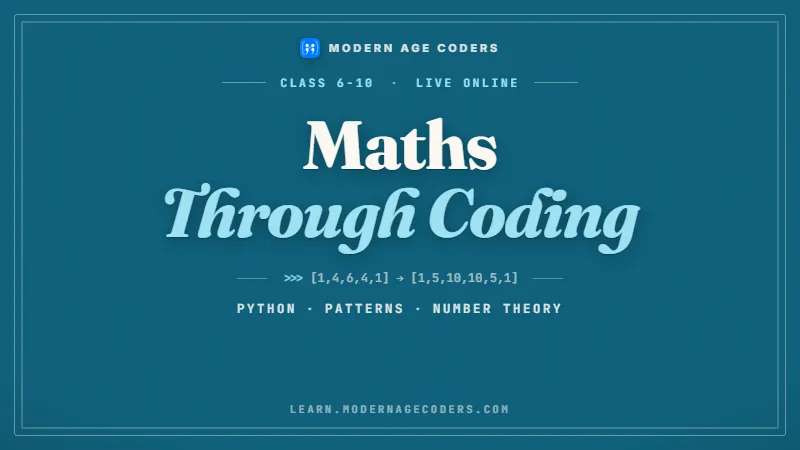
Maths Through Coding
Variables, coordinates and patterns become things a learner can run and test.
See the syllabus
Python Complete Masterclass for Teens
A structured move from logic to functions, data and independent programs.
See the syllabus
HTML and CSS for Beginners
The fastest route to a finished thing a learner can send to somebody, which matters when nobody within an hour of you is building the same thing.
See the syllabusThat is four of more than a hundred. The rest, sorted by age and subject, sit on the course atlas, and the order we teach them in is on the coding roadmap.
The four we are known for
Python, AI, vibe coding and agentic coding
These run underneath everything above. Every one is live and online, placed by ability rather than by age, and the first class is free.

Vibe Coding for Teens
Python, web and AI projects where the learner still owns the thinking.
See the syllabus
AI and Machine Learning for Teens
Train a model, read what it learned, and be able to say why it is wrong.
See the syllabus
Codex and Claude Code
Run AI coding agents on real work without losing control of the codebase.
See the syllabusAn exclave of 9,444 people, and one secondary school
Two facts about this district explain everything else, and neither of them is about distance.
Temburong is an exclave. It is divided from the rest of Brunei by the Malaysian district of Limbang, which sits between it and the mainland. It covers 1,306 square kilometres, the second largest district in the country, and recorded 9,444 residents at the 2021 census, up from 8,852 in 2011 and estimated at about 9,600 by 2024. Bangar is the district town.
Most of that territory is forest. Ulu Temburong National Park covers more than 500 square kilometres and carries a canopy walkway 250 metres above the ground, and the Peradayan, Selirong and Labu forest reserves hold mangrove and old growth. It is the least developed and least populated district in Brunei, and by most accounts the most beautiful.
| Getting to the capital by road | Before 2020 | Now |
|---|---|---|
| Journey time | Two or more hours | About thirty minutes |
| Route | Through Sarawak, Malaysia | Direct across Brunei Bay |
| Border formalities | Four international passport checks | None |
That change came from the Sultan Haji Omar Ali Saifuddien Bridge, which opened in 2020 and runs across Brunei Bay. It is the single most consequential thing to happen to this district in a generation, and it is worth being precise about what it changed and what it did not.
The bridge fixed the road. There is still one secondary school
Temburong has thirteen primary schools, public and private, and Sultan Hassan Secondary School, which serves the whole district. For an ordinary subject that is fine. For a specialised one it means a learner is not choosing between options, they are choosing between the one thing that exists and nothing at all. A thirty minute drive to the capital is a genuine improvement over two hours, but nobody sensibly commits to an hour of driving twice a week for a class that may not exist at the other end either. What a district of 9,444 people cannot supply is not transport. It is a room of five to eight people working at the same level on the same thing.
Sources: exclave status and the position of Limbang, the district area of 1,306 square kilometres, populations of 8,852 in 2011, 9,444 at the 2021 census and about 9,600 in 2024, Bangar as district town, the Sultan Haji Omar Ali Saifuddien Bridge opening in 2020 and reducing a journey of two or more hours via Sarawak requiring four international passport checks to approximately thirty minutes, Ulu Temburong National Park at more than 500 square kilometres with a canopy walkway at 250 metres, the Peradayan, Selirong and Labu forest reserves, and the count of thirteen primary schools and one secondary school, all from the Temburong District summary citing Brunei government material. Mukim-level figures reported for this district sum to ten more than the published district total, so no mukim breakdown is used here. Verified 17 August 2026.
What this district actually needs, and what we do about it
The constraint on the left. Our response on the right.
Sultan Hassan serves the district, so for a specialised subject there is no second option.
Groups of five to eight assembled by demonstrated ability from twenty-five countries. The peer group is the product, and it is the one thing 9,444 people cannot generate.
Thirty minutes to the capital instead of two hours, which solves travel and nothing else.
We add a different kind of connection. No driving, no fuel, and no dependence on something existing at the far end of the journey.
Out here the connection decides whether this works, and nothing else about the arrangement does.
Tested during the free class, which is partly what that session is for. If it will not hold we say wait, rather than take the booking.
Which days a Bruneian household has free depends on where the adults in it work.
Nothing is advertised as a default slot. We ask, then build round the answer. The country page sets out why that matters here.
Neither Brunei nor India adjusts its clocks at any point in the year.
An evening slot chosen once is still correct twelve months later. There is no seasonal rescheduling on this market at all.
Send the learner's age and the evenings you have free. That is enough for us to say what they should be doing and when.
Ask on WhatsApp Book the free classA course ladder that leaves room for school
Building first, explaining second, typing third. Nothing has to be memorised before it has been understood. Once O Level work begins the ladder narrows on purpose, because the scarce resource by then is hours rather than options. Adults enter at the point their goal and prior knowledge support.
Builders
Ages 6 to 10
Problem solvers
Ages 11 to 13
Independent programmers
Ages 14 to 18
Applied study
College and adult, 18 to 67
The complete catalogue is on the course atlas, and the method is set out on how we teach.
The network changed, not the map
Every page in this cluster works through one analytical mistake. Temburong's is the one that broke more delivery systems, routing engines and logistics models than any other, and this district demonstrates it better than anywhere on earth.
The learner writes a small program. Given two places and their coordinates, how long does it take to get from one to the other? The usual first version computes the straight-line distance and divides by a plausible speed. It works. Tested on a dozen pairs of towns it gives sensible answers, and it is the version almost everybody writes first.
Then it is run on Bangar and Bandar Seri Begawan, and asked for the answer in 2019 and again in 2021.
Nothing on the map moved between those two dates. No river shifted, no town relocated, no coordinate changed by a single degree. So a program built on coordinates cannot see any difference, and it confidently reports that the journey is what it always was.
In reality the 2019 answer should have been two or more hours, because the only road route ran through another country and crossed four international checkpoints. The 2021 answer should have been about thirty minutes, because a bridge now spans Brunei Bay. The program was too optimistic in 2019 and too pessimistic in 2021, using exactly the same arithmetic and the same inputs, and at no point did it indicate any difficulty.
So the learner rewrites it as a graph. Places become nodes, connections become edges, and each edge carries a cost that includes the border checks. Bangar and the capital were always close together; before 2020 they were simply not adjacent, because no edge joined them. Distance is a property of geometry. Cost is a property of the network. Straight-line distance is only ever a proxy for travel time, and it is a proxy that holds while the network happens to agree with the map.
The transferable point is the uncomfortable one. A model built on the wrong quantity does not announce itself. It produces stable, plausible, well-formatted answers for years, and it fails silently on the day the network changes, which is precisely the day somebody is relying on it. Nothing in the data ever said this is not what you think it is. A person had to know that a bridge had opened, and then go back and ask which of their assumptions that bridge had quietly invalidated.
Every fact used in the exercise is public and linked above. Learners supply their own pairs of places, and the point of the task is to find a case where the two models disagree rather than to be shown one.
Does coding still matter when AI can write it?
Ask any assistant how long it takes to drive from Bangar to Bandar Seri Begawan. The answer you get depends entirely on how much of its training material predates 2020, and it will be delivered in the same confident tone either way.
This is not a criticism of the tools. It is a description of what they are. They summarise what has been written, and what has been written about Temburong includes a great deal of material describing a two hour journey through Sarawak, because that was true for a very long time and false only recently. The model has no way to know which of the two worlds it is describing, because nothing in the text is marked with an expiry date.
What that leaves for a person is the part that never automates: knowing that a thing changed, and then working out what else that change quietly invalidated. It is not a technical skill and it is not taught by a syllabus. It is built by being wrong, repeatedly, on data you can check, which is what the project above is for.
If model building rather than programming foundations is the goal, that lives on AI and machine learning classes in Brunei. The long version of this argument is is coding still worth learning in 2026?, the order of topics is on the coding roadmap, and how we teach describes an hour from inside it.
How a term works from Bangar
Taught live, questioned live, reviewed live. Nothing is pre-recorded and nothing is installed.
The first hour
Free, and it settles what the learner should study and at what level. They attempt one problem while the teacher watches the approach rather than the outcome.
A group of five to eight
Built from ability across our whole intake. Being the only person in your district working on something stops being true the moment the class starts.
Or one to one
Suited to a narrow adult objective, to an examination year with no room in it, or to a week that will not hold a standing appointment.
Two evenings weekly
About eight lessons in a month, on evenings you nominate rather than evenings we advertise.
Permanently two and a half hours
Clocks move at neither end, so a time settled in one season remains correct in the next.
What is required
A keyboard, a connection that survives a video call, and audio the teacher can hear. Nothing is bought from us.
What do coding classes in Temburong cost?
No enrolment charge, nothing to buy, no minimum term.
The usual answer, and the one that supplies what this district cannot: five to eight people at the same level, arguing about the same problem in the same hour.
Right when the objective is narrow and specific, when an examination year has no spare hours, or when the household week refuses to hold a fixed appointment.
Two live lessons a week under either plan, and deciding between them costs nothing. One figure is published for every country we operate in, so Temburong carries no local rate and no remoteness surcharge.
Pauses, plan changes and missed classes are covered on the pricing page.
What families say
Rated 4.9 across 547 Google reviews. These are real reviews, reproduced as written.
★★★★★
"The one step solution for my son. Modern Age Coders make learning coding so simple that kids love it. The teachers explain complex concepts clearly with practical exercises and interactive content."
Ria Mukherjee
Parent
★★★★★
"Modern Age Coders has been a game-changer for me. I struggled to grasp IT concepts and coding before joining, but their classes transformed everything. I can now confidently write complex programs with ease."
Samriddha Mondal
Student
★★★★★
"One of the most wonderful education centres out there. Education is not limited to school syllabus but focuses on skill development."
Vansh Agarwal
Student
★★★★★
"My child Dhairya is really enjoying the Modern Age Coders classes. This is his first online class and he eagerly looks forward to it. I can already see his improvement, and the teachers are very cooperative."
Sonam Oswal
Parent of Dhairya
★★★★★
"Modern Age Coders have wonderful teachers who teach in a clear, easy and practical way. The teacher boosts students' confidence and inspires them to learn without hesitation."
Sonu Goyal
Parent
★★★★★
"I highly recommend this computer coding class! The teachers are incredibly knowledgeable and passionate about coding."
Ritu Kedia
Parent
More, with photographs and student work, on the wall of love.
Questions from Temburong households
Starting with the two this district asks that no other district does.
There is one secondary school in the whole district. What can an online class realistically add?
A peer group, which is the thing a district of 9,444 people cannot supply on its own. Sultan Hassan Secondary School serves the entire district, so for any specialised subject a learner is not choosing between options, they are choosing between the one that exists and nothing. Our groups hold five to eight learners assembled by demonstrated ability from an intake across twenty-five countries, so a fourteen year old in Bangar sits with people working at the same level rather than with whoever happens to live nearby.
The bridge already fixed our connection to the capital. Why does this matter?
Because the bridge fixed the road and nothing else. Getting to Bandar Seri Begawan takes about thirty minutes now instead of two hours through Sarawak, which is a genuine transformation, and it does not put a computing class at the other end of it. Driving an hour each way twice a week to attend something that may not exist anyway is not a plan. An online class is simply another connection added to the district, and this one needed no construction.
Do you have anywhere in Temburong, or in Brunei?
Nowhere in either. There is no premises, no branch and no representative in Bangar or anywhere else in the country, and the telephone number printed here rings in India, where the teaching is done from. What is needed at your end is a computer with a keyboard, a connection that holds a video call, audio the teacher can hear and a browser that is reasonably current.
Our connection out here is the thing I worry about. Be honest with me.
It is the right thing to worry about, and it is the only real risk in this for a Temburong household. Everything else about the arrangement is indifferent to where you live; bandwidth is not. Test it during the free class, which is exactly what that session is for. If the call struggles, we will tell you plainly to wait rather than take a booking that will make everybody miserable by the third week.
How much do coding classes in Temburong cost?
The first class is free. Group tuition is USD 100 per month for two live lessons each week, normally eight lessons monthly, in a group of five to eight compatible learners. Private tuition is USD 150 per month for one learner with one teacher on the same usual frequency. There is no enrolment fee, nothing to buy and no minimum term.
Which evenings would the lessons be on?
Yours to choose. Brunei does not run a single working week, and which pattern a household keeps depends on where the adults in it work, so we ask rather than assume and we never publish a default slot. The country page explains why that question is a real one here rather than a formality.
What time, and does it move with the seasons?
It never moves. Brunei stays on UTC plus 8 the whole year and India stays on UTC plus 5:30 the whole year, which fixes the difference at two and a half hours permanently. Half past seven in the evening in Bangar is five in the afternoon for the teacher, in every month there is. A slot agreed in one term is still the right slot in the next.
Is this instead of school?
Alongside it, and it certifies nothing. What it supplies is consecutive weeks on a single build with somebody who can read code that does not work and say something better than start again. School timetables cannot easily give that to one subject anywhere, and in a district with one secondary school there is no second option to fall back on. Where the right answer is fewer lessons, in an examination term for instance, we will say so.
Are adults taught, out here?
Yes, ages six to sixty-seven, and remoteness is a common reason people write to us. An adult in Temburong who wants to automate a monthly return has no evening course to enrol in and no realistic commute to one. Two one to one hours a week for a few months usually finishes a goal that specific, and it can be paused for a season without penalty.
What happens once we send the form?
It reaches a person, who telephones to arrange the free session. No card is requested and nothing is charged. Being clear about what you are agreeing to: sending it opens a conversation rather than an enrolment, and it does not hold a place in any class. The course, the format and the evening all get decided in that conversation, before money is raised.
Ask before booking
Send us a message on WhatsApp with the learner's age and your free evenings, or use the form. Nothing is agreed on price until the course and the time are settled.
One problem, and an answer you can hold us to
Nothing is charged for the first hour and nothing is sold in it. The learner is handed a problem chosen for their age and the teacher watches how they approach it, which tells us far more than any placement form would. It is also when we find out whether your connection will carry this. Afterwards you get something specific: this course, this format, this evening, and the reasoning behind each. If the reasoning points at waiting a year, we will tell you that instead.
Other ways in: the contact page lists them all, about us says who runs this, and the Brunei guide covers the country.
WhatsApp reaches us fastest from Brunei and costs nothing to use. The number is Indian, not a local one.