Table of Contents
There are more coding classes for kids than ever, and the marketing for all of them sounds the same: fun, futuristic, and guaranteed to raise a genius. Picking well is not about the flashiest website. It is about a few concrete things that separate real teaching from expensive entertainment. Here is exactly what to look for, what to ask, and what to avoid.
The short answer
Choose a class that is live, small-batch, and project-based, with a free trial before you pay and honest monthly pricing you can stop. Everything else is detail. If a class is genuinely live with a real teacher, keeps batches small, and has your child build real things, your child will learn. If it is recorded video dressed up as live, or a huge batch, or a big prepaid lock-in, be careful.
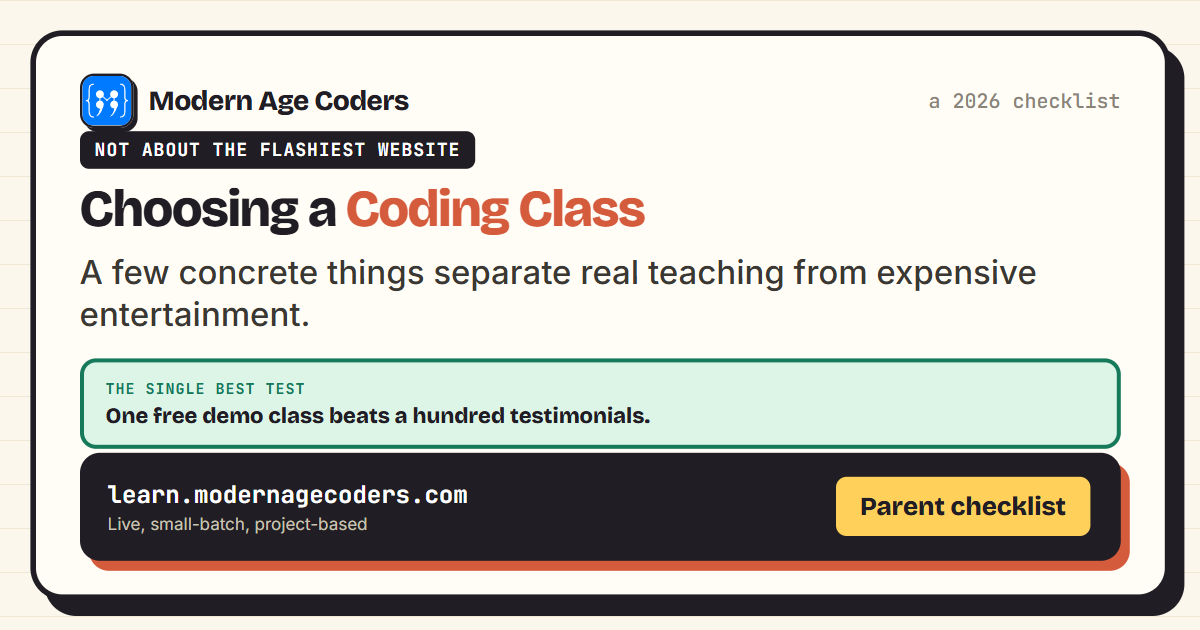
The single best test is a free demo class. One live lesson tells you more about the teaching than a hundred testimonials. If a provider will not let you try before you pay, that is an answer in itself.
The checklist: what to look for
| Look for | Why it matters |
|---|---|
| Live teaching, not recorded video | A real teacher explains and corrects in the moment, which pre-recorded lessons cannot do |
| Batches, 15 to 20 children | Your child is seen and helped instead of lost in a crowd of thirty |
| Real projects | Building, not just watching, is where actual understanding forms |
| A free trial class | Lets you judge the real teaching before any money changes hands |
| Honest, monthly pricing | Clear fees you can stop any time, not a prepaid package sold as a discount |
| Coding and maths together, ideally | Connects the two so code becomes real problem solving, not just syntax |
Seven questions to ask before you enrol
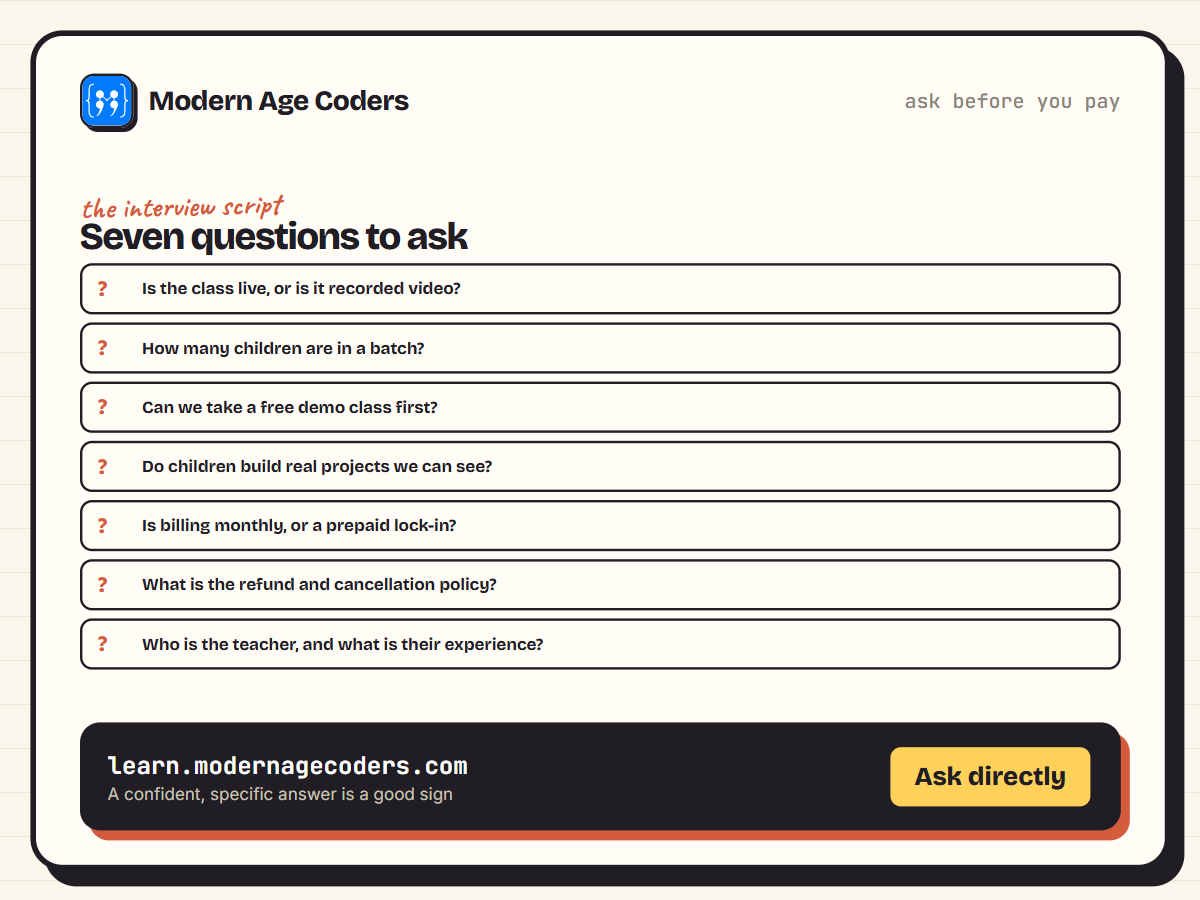
- Is the class live, or is it recorded video? Ask directly.
- How many children are in a batch?
- Can we take a free demo class first?
- Do children build real projects, and can we see examples?
- Is billing monthly, or do we have to prepay for months or a year?
- What is the refund and cancellation policy?
- Who is the teacher, and what is their experience?
The red flags to avoid
- Big prepaid lock-ins. Paying for one or two years up front looks like a discount and really just keeps your money if it does not work out.
- Fake urgency. A price that is only good if you sign up today is pressure, not a deal.
- Recorded content sold as live. Some platforms charge live prices for pre-recorded video. Confirm before paying.
- Huge batches. A cheap group class with dozens of children gives your child almost no attention.
- No free trial. If you cannot try the teaching before paying, ask why.
- Constant upsells. A low headline price that turns into endless paid add-ons costs more in the end.
How to make the final decision
Shortlist two or three classes that pass the checklist, then take a free demo of each. Watch how the teacher engages your child, whether your child is building or just watching, and how they feel afterwards. The right class is usually obvious within one live lesson. Trust that over any amount of marketing.
Children do not need another app that teaches them to copy code. They need a mentor who teaches them to think.
, Shivam Khemka, Founder of Modern Age Coders
The bottom line
A good coding class for your child is live, small-batch, project-based, and honest about pricing, and it lets you try before you pay. Modern Age Coders is built exactly that way: live small batches, real shipped projects, coding and maths together for ages 6 to 67, clear monthly pricing, and a free demo class first. We are rated 4.9 across 547 Google reviews. Judge us the same way you would judge anyone else: take the free demo and see.
Frequently Asked Questions
Look for live teaching in small batches, real projects rather than passive video, and a free trial before you pay. Ask about batch size, whether classes are genuinely live, and the refund and billing terms. Avoid big prepaid lock-ins and fake discounts. A single free demo class tells you more than any brochure.
Ask whether the class is live or recorded, how many children are in a batch, whether you can take a free demo first, whether children build real projects, whether billing is monthly or prepaid, what the refund policy is, and who the teacher is. Clear, confident answers are a good sign.
Watch for large prepaid lock-ins, fake urgency and discounts, recorded video sold at live-class prices, very large batches, no free trial, and constant paid upsells. Any of these suggests the sales matter more than the teaching.
For most children, yes. A live teacher notices when a child is stuck or ready for more and helps in real time, which recorded video cannot. Recorded lessons can supplement learning, but they are not a substitute for a real teacher in a small live batch.
Yes. A free demo class lets you judge the actual teaching before paying, and it is the single most useful test. If a provider will not let you try before you commit, treat that as a warning sign.
Two or three that already pass the basic checklist is usually enough. Comparing far more than that mostly adds decision fatigue rather than better information, since a single live demo class tends to make the right choice obvious well before you run out of options.
Not necessarily, but a very low price paired with a large batch or no free trial is a real warning sign, since genuine live, small-batch teaching has a cost that a class has to cover somehow. Judge on the checklist first, price second, rather than assuming cheaper always means worse or pricier always means better.