What is the best coding class in Dundalk?
Dundalk holds 42,735 usual residents in the census town tables, spread across 15,923 households. Lessons are taught into the house: a teacher live on video, twice in most weeks, with either an ability group of five to ten learners or one learner on their own, anywhere between the ages of six and sixty-seven. The opening lesson is not charged for. A shared place then runs at USD 100 a month, and private teaching at USD 150.
Our own lessons need a connection that carries live video, so the census figure looks like exactly the right one to quote: 12,686 of Dundalk's 15,923 households report broadband. It answers a different question than it appears to. The census asked each household which kind of internet access it has and offered four answers, and the count that comes back is a count of reported categories. It contains no speed, no reliability, no measure of what happens at seven in the evening when several people are online at once, and no information about the rooms a signal reaches. A household with a slow line and a household with a fast one are the same row. We use the figure for what it is, and we test the actual connection in the free lesson, because a category is not a measurement.
Facts last verified 18 September 2026. Teaching is online; no Dundalk branch is claimed.
Pick by age and interest. The course teacher takes the free lesson and sets the level from what the learner does in it.
Block coding where a program has to be tested rather than assumed to work.
See the syllabus
Python from the beginning, with measurements taken instead of guessed at.
See the syllabus
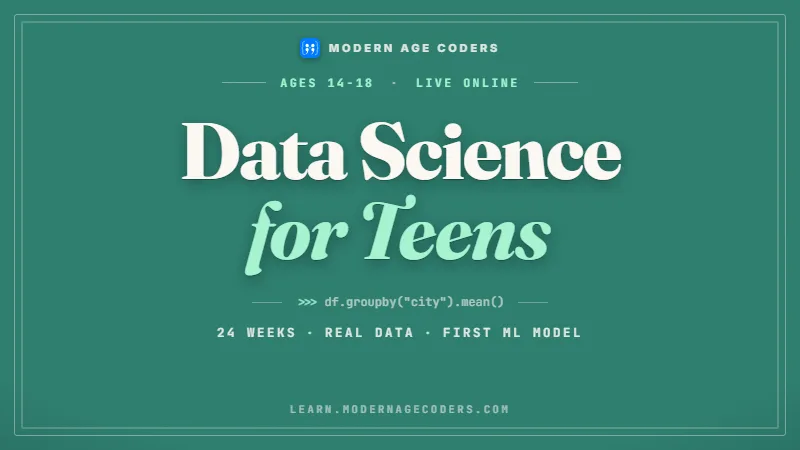
Real data in Python, and the question of whether a column measures what its name suggests.
See the syllabus
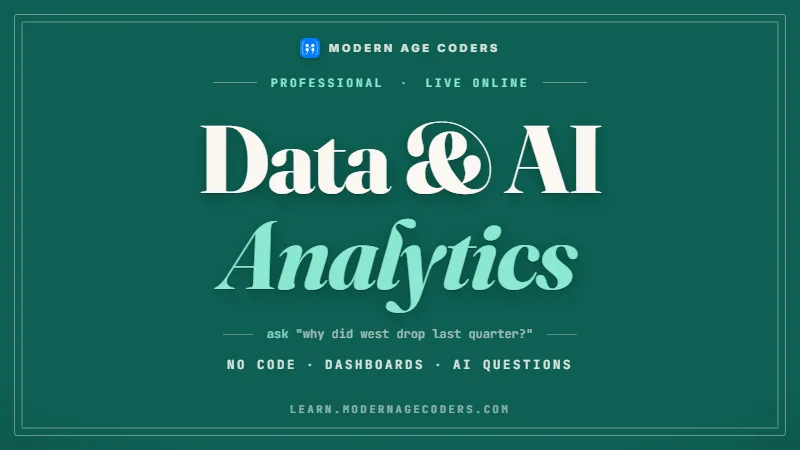
For adults choosing metrics at work, where the easy number is rarely the right one.
See the syllabusBrowse the course atlas for more than one hundred options and use the coding roadmap to check prerequisites.
The four we are known for
These run underneath everything above. Every one is live and online, placed by ability rather than by age, and the first class is free.

Python, web and AI projects where the learner still owns the thinking.
See the syllabus

Automate the work you already do, then let AI carry part of it.
See the syllabus

Train a model, read what it learned, and be able to say why it is wrong.
See the syllabus

Run AI coding agents on real work without losing control of the codebase.
See the syllabusInternet access in Dundalk, Census 2022, with every answer the table offers. Counts are published and shares are ours.
| Answer as published | Dundalk households | Share | All towns combined |
|---|---|---|---|
| Broadband | 12,686 | 79.7% | 82.2% |
| Other | 310 | 1.9% | 1.8% |
| No | 1,454 | 9.1% | 7.3% |
| Not stated | 1,473 | 9.3% | 8.7% |
| Total households | 15,923 | 100% | 1,317,616 |
One answer for each household, chosen from four, recorded on one day in April 2022, about the household rather than the people in it. That is the whole of it, and the four rows sum exactly to the 15,923 households in the town.
Speed. Reliability. Behaviour at busy times. Whether the signal reaches the room a learner works in. Cost. Whether the household would call the connection good. None of those questions was asked, so none has an answer here, for Dundalk or anywhere else.
Measurements rather than categories: recorded speeds over time, for identified locations. We have not gathered any such data for this town, and so this page makes no claim at all about how fast anything in Dundalk is.
Page views standing in for interest. Time in the building standing in for work done. Tickets closed standing in for customers helped. Exam marks standing in for understanding. Lines of code standing in for progress. Each proxy is easier to collect than the thing it represents, which is why it gets collected, and each one drifts away from that thing the moment somebody starts managing the proxy instead. Naming what a column measures, and naming what it was chosen to stand in for, is the difference between a number that informs a decision and one that quietly replaces it.
The project is a data dictionary rather than a chart. For this one variable the learner writes down the question asked, the four permitted answers, the unit counted, the date, and then three questions the variable cannot answer, each with the kind of data that could. They finish by taking a measurement of their own, the connection test we run in the free lesson, and writing one paragraph on what the measurement tells them that the census category does not. It is the shortest project in this cluster and the one that travels furthest, because every dataset a learner meets later will have a column whose name promises more than the column contains.
Published for the built-up area Dundalk, Co Louth, in the Census 2022 small area tables.
| Measured | Count |
|---|---|
| Usual residents | 42,735 |
| Households | 15,923 |
| Households reporting broadband | 12,686 |
| Residents born in Ireland | 31,283 |
| Residents born in the United Kingdom | 3,946 |
| Children under fifteen in childcare | 2,426 |
The travel table counts 17,180 working residents in the town, and a separate table records 4,792 of them doing at least some work from home, 10,164 who never do and 2,224 who did not state.
That home-working table has the same shape as the internet one: a status reported by a person, not a measurement of hours or days. It tells you how many said yes, not how much work moved home.
Of the 2,426 children under fifteen in childcare, 1,053 are four or under and 1,373 are between five and fourteen.
The station
Irish Rail gives Dundalk (Clarke) as Carrickmacross Road, Dundalk, Co. Louth, Eircode A91 TD61. It lists the station as staffed around the clock, open from 05.00 to 01:30, with toilets, an enclosed waiting room, a booking office on weekdays and Saturdays, a filtered water refill unit, a car park of 200 spaces, and among its routes the Dublin to Dundalk commuter service and the DART and Dublin commuter timetable. The same page lists no Wi-Fi at the station, which is a useful reminder that a place being well connected in one sense says nothing about another.
Written out in full, with the parts that make each one true.
| Sentence | Supported |
|---|---|
| 12,686 Dundalk households reported broadband in April 2022 | Yes, this is the published count |
| 79.7% of the town's households reported broadband | Yes, our division of 12,686 by 15,923 |
| 1,454 households reported no internet access at all | Yes, this is the published count |
| Most homes in Dundalk have fast internet | No, speed was never asked |
| A learner in Dundalk can stream a lesson | No, that is a measurement we take ourselves |
| Internet access in Dundalk improved | No, this is one census with no comparison made here |
Everything in the supported column is either a number printed by the CSO or one division of two such numbers, with the denominator named. That is the whole budget of claims a single table gives you.
They are kept as their own row rather than folded into any other. The share of households reporting broadband is calculated over all 15,923, and the page says so wherever the figure appears.
Nothing here explains why Dundalk sits below the all-towns broadband share or above it on no internet access, and nothing compares the town with an earlier census.
The arts centre
An Tain Arts Centre describes itself on its own site as an independent arts space in Dundalk, Co. Louth, with two theatres, a gallery, artist studios and a production house, at Crowe St, Townparks, Dundalk, A91 W20C, company registration 537097. We have no connection with it and reproduce none of its prices.
One weekly hour, a live teacher, and a connection tested rather than assumed.
In the free lesson we run the actual video call the course will use, on the actual machine, at the actual hour. That is a measurement, and it settles what no census table can.
Block coding for younger children, then Python, web projects and AI work through the junior and senior cycle years.
Data, Python and AI for adults at any level, including the 4,792 working residents already doing some of their work at home.
Irish Rail and An Tain Arts Centre are quoted from their own published pages and neither is connected with us, nor is Louth County Council. Every count on this page is a Central Statistics Office Census 2022 figure for this built-up area, printed as published, and the three percentages are our own division with the denominator named beside each. Where a reader might expect a claim about internet speed in the town, there is none, because we have not measured it and the census did not ask.
Ages are a guide; the free lesson decides the level.
Small programs in block code that have to be run and checked rather than assumed correct.
Coding for KidsScratch Coding for KidsWriting code that measures something real, then asking how good the measurement is.
Python and AI for KidsMaths Through CodingDocumenting real datasets, including what each variable stands in for and what it misses.
Data Science for TeensPython for TeensPicking measures at work that survive being used, rather than proxies that drift.
Data and AI Analytics for Non-Programmers (Excel, Sheets, Power BI)Python Automation CourseAn answer will arrive, built from a table that never asked.
A model handed this table and asked about internet quality will usually convert 79.7% into a verdict, sometimes with words like strong or solid attached. The number is right and the verdict is unsupported, because the underlying question was about a category and the answer is about performance. Nothing in the reply marks the swap.
A learner who has written the data dictionary answers in two parts instead: here is what the census counted, and here is the measurement you would need for the question you asked. They can also say which one we run before a course starts, and why it is the one that matters for a live lesson.
The interesting skill in 2026 is not getting a number out of a tool. It is knowing what the number was ever able to mean. The longer argument is in why learning to code holds its value.
Six practical points.
Present for the whole lesson, working from what appears on the learner's screen.
Five to ten learners at one level, joining from Dundalk, the rest of Ireland and other countries.
About eight in a month, at an hour agreed once and then kept.
Mid-terms, holidays and exam weeks are planned into the schedule before it starts.
Machine, sound and connection are all tried in the free lesson rather than taken on trust.
Where no group at the right level meets at a workable hour, the course runs privately.
If the connection is the problem
Sometimes the free lesson shows that a household connection will not hold a class. We say so plainly, suggest what would need to change, and do not take a payment in the meantime.
Three lines, complete.
A full opening lesson, taught and assessed, with no charge and no obligation.
One month in an ability group of five to ten, about eight live lessons.
One month of private teaching on the same weekly pattern.
Charges are monthly and in US dollars, at the single rate for families outside India, so Dundalk sees the same figure as Drogheda and no euro list appears beside it. Nothing is billed until the opening lesson has settled a course, an hour and a working connection, and the pricing page covers breaks, missed weeks and moves between group and private teaching.
Rated 4.9 across 547 Google reviews. These are real reviews, reproduced as written.
★★★★★
"The one step solution for my son. Modern Age Coders make learning coding so simple that kids love it. The teachers explain complex concepts clearly with practical exercises and interactive content."
Ria Mukherjee
Parent
★★★★★
"Modern Age Coders has been a game-changer for me. I struggled to grasp IT concepts and coding before joining, but their classes transformed everything. I can now confidently write complex programs with ease."
Samriddha Mondal
Student
★★★★★
"One of the most wonderful education centres out there. Education is not limited to school syllabus but focuses on skill development."
Vansh Agarwal
Student
★★★★★
"My child Dhairya is really enjoying the Modern Age Coders classes. This is his first online class and he eagerly looks forward to it. I can already see his improvement, and the teachers are very cooperative."
Sonam Oswal
Parent of Dhairya
★★★★★
"Modern Age Coders have wonderful teachers who teach in a clear, easy and practical way. The teacher boosts students' confidence and inspires them to learn without hesitation."
Sonu Goyal
Parent
★★★★★
"I highly recommend this computer coding class! The teachers are incredibly knowledgeable and passionate about coding."
Ritu Kedia
Parent
Send an age and an interest. The first hour is planned around it, and it doubles as the test of whether the machine and the line at home are up to the course.
What Dundalk families ask before booking.
The Census 2022 small area tables count 42,735 usual residents in the built-up area of Dundalk, living in 15,923 households. Our Louth page covers the county figures and how the towns sit inside them.
Learners write a data dictionary for one census variable, household internet access, listing the question asked, its four permitted answers, the unit and the date, then three questions it cannot answer. They finish by taking a real measurement, the connection test from the free lesson, and comparing the two.
No. It records which kind of access each household reported, and 12,686 of 15,923 reported broadband. Speed, reliability and behaviour at busy times were not asked, so no figure here describes them.
We test it. The free lesson runs on the same video system, the same machine and the same hour as the course, and if it will not hold we say so before anything is paid.
After school, in the evenings and on weekend mornings. Our teachers work in India, ahead of Irish clocks by four and a half hours in summer and by five and a half once the clocks change, and the weekly hour is agreed in the free lesson.
Yes, up to sixty-seven and from no experience whatever. The free lesson decides whether an adult joins a group at the same level or is taught one to one.
Then we talk about what is possible rather than pretending. Some households manage on a mobile connection and some cannot, and the free lesson is where that gets established rather than guessed.
No, and we never imply one. Teaching is live over video only, with no premises in Ireland. A learner needs a laptop or desktop, working sound and a steady connection, and the number shown here belongs to India.
The first lesson is free. After that a shared place costs USD 100 a month and brings two live lessons a week, about eight monthly, with five to ten learners; one to one on the same schedule is USD 150 a month. Everything is agreed before payment.
Five to ten, grouped by ability, pace and goal rather than age or address. Where nothing suitable meets at a workable hour, we teach one to one instead.
Down the coast is Drogheda, with County Louth around both and the province of Leinster beyond. Our comparison page puts us beside other online schools, and the Ireland hub lists every page.