COB / KID / 01
Coding for kids
A long block-coding course from games to first apps.
Open the syllabusBavaria · Coding and Informatik · Mittelschule to Abitur
In Bavaria the school a child attends decides how much computing they meet: a Mittelschule pupil has Informatik every year from grade 5, a Realschule pupil has a whole subject called Informationstechnologie, and at a Gymnasium it turns on the branch until grade 11. This page lays that out, gives the 2027 Abitur dates from the ministry's own notice, lists the holidays (Bavaria's autumn break is this very week), explains our live classes in English, and ends with a Munich data project that starts by finding the wrong answer.
Teaching live online since 2020 · 10,000+ learners worldwide · English-only lessons with one steady mentor
In short
For families in Bavaria, Modern Age Coders runs live online coding classes in English for school pupils aged roughly 8 to 19 and for adults, as a batch of fifteen to twenty or one to one. Younger pupils build programs in Scratch and Python beside school Informatik or Informationstechnologie; Gymnasium pupils prepare in Java or Python for the Oberstufe and an Abitur exam written on paper. The Informatik Companion course follows Klasse 5 to 10.
Starting points in Bavaria
A companion to lower-secondary computing in any of the three school types, an Oberstufe course built around the paper exam, and contest training for pupils who want more.
COB / 01
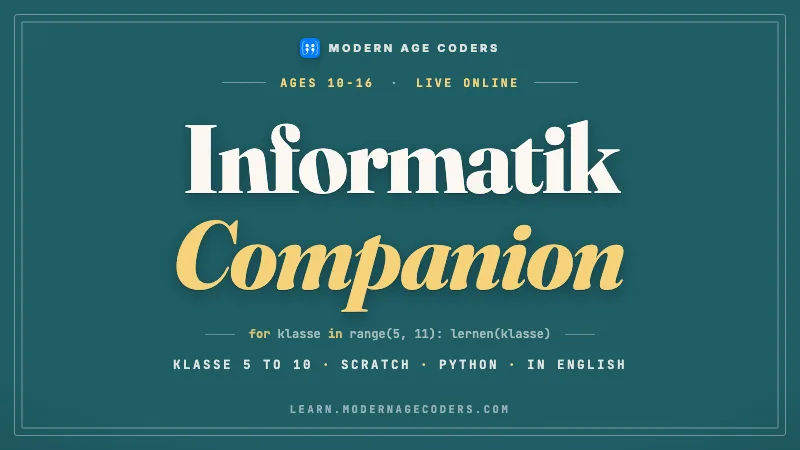
For roughly 10 to 16 year olds. Step-by-step thinking, data and code from blocks to Python, useful whether the school calls the subject Informatik, Informationstechnologie or Natur und Technik.
Open the syllabus →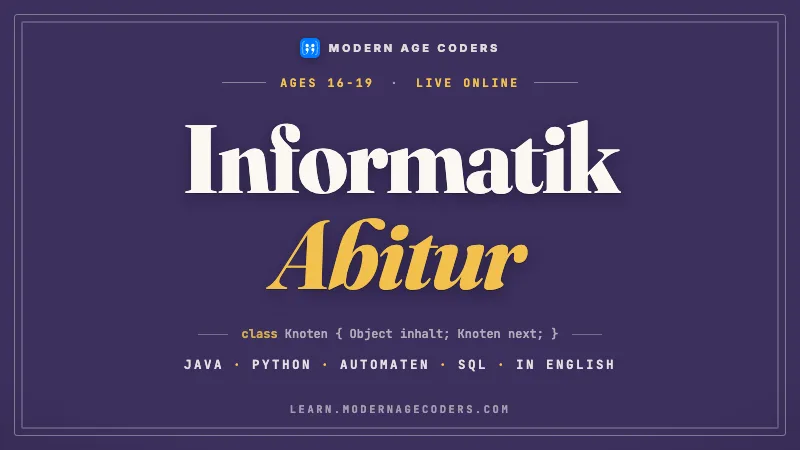
COB / 02
Ages about 16 to 19. Object orientation, data structures, recursion and databases, with regular handwritten programming under time pressure.
Open the syllabus →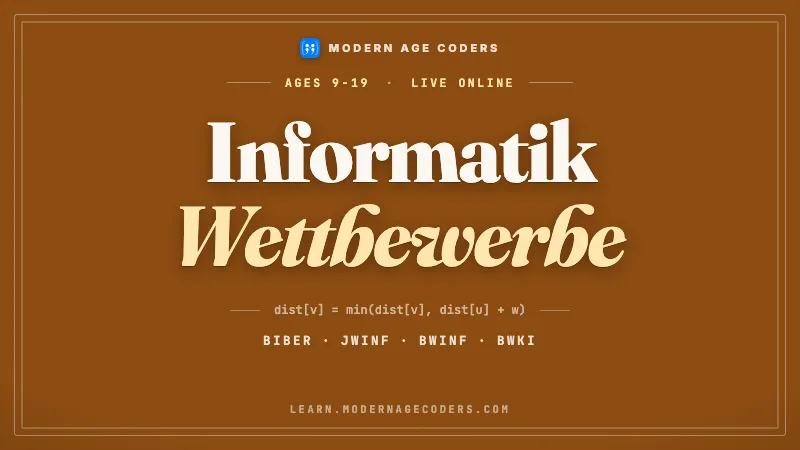
COB / 03
For roughly 9 to 19 year olds. From Biber-style puzzles to Bundeswettbewerb algorithm tasks and AI projects, every problem written by us.
Open the syllabus →Informatik at Bavarian schools
Three school types, three different answers. The Gesellschaft für Informatik summarises the Bavarian school ordinances in its Informatik-Monitor 2026/27; this table follows it.
| School type | Grades | Computing on the timetable |
|---|---|---|
| Mittelschule | 5 to 10 | Informatik, compulsory, one lesson a week in every grade |
| Mittelschule | 7 to 10 | Optional: Informatik und digitales Gestalten, two lessons a week |
| Realschule | 5 to 10 | Informationstechnologie, compulsory; 7 to 11 weekly hours in total, by subject group |
| Gymnasium, all branches | 6 and 7 | One lesson a week of Informatik inside Natur und Technik |
| Gymnasium, NTG branch | 9 and 10 | Informatik, compulsory, two lessons a week |
| Gymnasium, all branches | 11 | Two compulsory lessons a week of an informatics subject |
Source: Gesellschaft für Informatik, Informatik-Monitor 2026/27, Bayern page, read 2 November 2026, compiled from the Mittelschulordnung, Realschulordnung and Gymnasialschulordnung. At the Realschule the total depends on the Wahlpflichtfächergruppe: eleven hours in group I, eight in group II, seven in IIIa and nine in IIIb, plus four optional profile hours. At the economics branch (WWG) the subject in grades 9 and 10 is Wirtschaftsinformatik.
A Bavarian Gymnasium is organised in branches, called Ausbildungsrichtungen: humanistic, languages, science and technology (NTG), music, economics and social sciences. Only the NTG branch has compulsory Informatik in grades 9 and 10, so two pupils at the same school can leave grade 10 with very different amounts of programming behind them.
Grade 11 evens things out a little. The monitor records that in grade 11 every branch has two compulsory hours of an informatics subject: Informatik at the NTG, Wirtschaftsinformatik at the economics branch and spät beginnende Informatik, late-start Informatik, everywhere else.
Bavaria has returned to the nine-year Gymnasium. The ministry's Gymnasium page says the reintroduced G9 covers grades 5 to 13 in 2025/26, and the monitor describes grade 11 as the Einführungsphase and grades 12 and 13 as the Qualifikationsphase.
In the Qualifikationsphase an NTG pupil can continue Informatik with three hours a week at basic level or five hours at raised level; the late-start course continues at three hours at basic level. The monitor gives 11 % as the share of Bavarian upper secondary pupils taking Informatik in 2024/25, from KMK figures.
Two more numbers set the scene. Bavaria is home to 13,248,928 people, 1,505,005 of them in Munich, the Land capital (Destatis, 31 December 2024). For 2025/26 the monitor reports 1,248 qualified Informatik teachers at Bavarian Realschulen and Gymnasien, 3 % of all their teachers, with 75 newly hired in the year. KMK's school overview also explains a name that confuses newcomers: Mittelschule is simply Bavaria's word for the Hauptschule.
Taught in English
In English, always, and live. Our mentors work from India and adapt to the learner, not the reverse.
We say this plainly because families ask: every lesson is in English. A pupil at a German school practises English while learning to code; a pupil at an international school in or around Munich simply keeps working in the language of their classroom.
Mentors adjust how fast they speak, repeat a step in different words and get used to a learner's accent within a few lessons. Nobody is expected to sound like a textbook.
Bavarian lessons use words such as Algorithmus, Variable, Objekt and Klasse. We say the German term and the English one side by side, so homework and our lessons reinforce each other.
The Abitur in 2027
The Staatsministerium announced the 2027 dates in the Bayerisches Ministerialblatt in September 2025. The exam format comes from the Informatik-Monitor.
| Date | What is written |
|---|---|
| 21 April 2027 | All raised-level subjects except German, maths, English, French, biology, chemistry and physics |
| 27 April 2027 | German |
| 30 April 2027 | English |
| 3 May 2027 | French |
| 5 May 2027 | Mathematics |
| 7 May 2027 | All basic-level subjects except English, French, biology, chemistry and physics |
| 11 to 13 May 2027 | Biology, physics and chemistry |
| 31 May to 4 June and 7 to 11 June 2027 | Colloquium exams (two exam weeks) |
Source: Bayerisches Staatsministerium für Unterricht und Kultus, Abiturprüfung 2027, notice of 18 August 2025, BayMBl. 2025 Nr. 354, read 3 November 2026. Informatik is in neither exception list, so by the notice's own rule a written Informatik exam falls on 21 April 2027 at raised level and on 7 May 2027 at basic level; that reading is ours, and your school confirms the timetable. Additional oral exams must be finished by 18 June 2027.
The ministry's Gymnasium page sums up the format in one line: the Abitur consists of three written and two oral exams. In the colloquium a pupil is examined in conversation, which is where explaining an algorithm aloud, in clear German, matters.
The monitor adds that Informatik at raised level is examined in writing or orally, that it cannot replace the required foreign language or science among the exam subjects, and that Wirtschaftsinformatik and late-start Informatik can be taken as oral exams.
The written Informatik exam is set centrally and, in the monitor's words, large parts of it are programming tasks on paper with no practical work at a computer. Permitted aids are an approved formula collection, the ministry's document of mathematical formulas, an approved scientific calculator and a current spelling dictionary.
For a teenager used to an editor that underlines mistakes, that is a different skill. We practise it directly: a task, a timer, a sheet of paper, then a line-by-line review. The school course and teachers remain what counts for the Abitur; we do not set or mark school work.
Holidays
Bavaria starts its summer last of all the Länder in 2027, and its autumn holiday falls in the first week of November. Lessons with us carry on through the holidays unless a family pauses them.
| Holiday | Dates |
|---|---|
| Autumn | 2 to 6 November 2026 |
| Christmas | 24 December 2026 to 8 January 2027 |
| Winter | 8 to 12 February 2027 |
| Easter | 22 March to 2 April 2027 |
| Whitsun | 18 to 28 May 2027 |
| Summer | 2 August to 13 September 2027 |
Taken from the KMK's holiday overview for 2026/2027 (dated 9 October 2025) and from its long-range table of summer holidays for 2025 to 2030. The KMK agrees summer dates years in advance; the Land fixes the rest.
Two dates are worth circling. The Easter holiday ends on 2 April 2027, less than three weeks before the first written Abitur day on 21 April 2027, so Oberstufe pupils often want extra paper practice in March. And the summer break that runs until 13 September 2027 is long enough for a beginner to finish a whole short course, such as Scratch, before grade 5 starts.
A Munich data project
The Landeshauptstadt München publishes the full stop list of the regional transport association MVV as open data. With it our learners practise the check that saves every mapping project: make sure you know which column is which before you calculate anything.
The file MVV_Haltestellen_Report_s26.csv lists 11,061 stops with a number, a name, a place (Ort), a global ID and two coordinate columns labelled WGS84 X and WGS84 Y. It is published under CC BY 4.0, which permits reuse with credit to the Münchner Verkehrs- und Tarifverbund GmbH (MVV). We downloaded it on 3 November 2026.
In maths class, x runs left to right and y runs bottom to top. On a map that would make X the east-west position (longitude) and Y the north-south position (latitude). That is the assumption most beginners make, and it is the one Version 1 makes.
Which stop in the file is furthest north? It sounds like one line of code: take the largest y. A pupil who writes that line will get an answer, print it proudly, and be wrong.
The point of the project is not the stop. It is the habit of checking a result against something you already know before you believe it.
import csv

stops, missing = [], 0
with open("MVV_Haltestellen_Report_s26.csv", encoding="utf-8") as f:
    for row in csv.DictReader(f, delimiter=";"):
        if row["WGS84 X"] == "" or row["WGS84 Y"] == "":
            missing += 1
            continue
        x = float(row["WGS84 X"].replace(",", "."))   # assumed: east
        y = float(row["WGS84 Y"].replace(",", "."))   # assumed: north
        stops.append((row["Name ohne Ort"], row["Ort"], x, y))

north = max(stops, key=lambda s: s[3])
print("Stops with coordinates:", len(stops), "without:", missing)
print("Northernmost stop?", north[0], north[1], north[3])
It prints: Stops with coordinates: 10173 without: 888 and Northernmost stop? Hauptbahnhof Passau 13.4507801.
Passau sits in the far east of Bavaria, on the Austrian border, so "northernmost" is already suspicious. The number gives it away: 13.45 is a perfectly good longitude for Passau and an impossible latitude for anywhere in Bavaria, which lies between roughly 47 and 50.5 degrees north. Version 2 checks one stop everyone knows, Marienplatz in the centre of Munich, at about 48.14 degrees north and 11.58 degrees east.
marienplatz = [s for s in stops if s[0] == "Marienplatz" and s[1] == "München"][0]
print("Marienplatz X, Y:", marienplatz[2], marienplatz[3])
north = max(stops, key=lambda s: s[2])   # X is the latitude
south = min(stops, key=lambda s: s[2])
print("Northernmost:", north[0], north[1], north[2])
print("Southernmost:", south[0], south[1], south[2])
It prints: Marienplatz X, Y: 48.1364359 11.577658, Northernmost: Nürnberg Hbf Nürnberg 49.445615 and Southernmost: Bahnhof Seefeld in Tirol 47.3284912.
In this file, X holds the latitude and Y the longitude: the labels are the other way round from school maths. With that fixed, the northernmost stop is Nürnberg Hbf and the southernmost is Seefeld in Tirol, across the border in Austria, both reached by regional trains in the association's list. Version 1 also counted 888 stops with no coordinates at all, which a careful report mentions instead of hiding.
Version 3 asks a second question with a second trap: which five stops are closest to Marienplatz? Measuring straight in degrees treats a step east as long as a step north. At Munich's latitude it is not: a degree of longitude covers only about two thirds of the distance of a degree of latitude, because the lines of longitude meet at the poles. Multiplying by the cosine of the latitude fixes it.
import math
lat0, lon0 = marienplatz[2], marienplatz[3]

def degrees_apart(s):
    return math.hypot(s[2] - lat0, s[3] - lon0)

def km_apart(s):
    north_km = (s[2] - lat0) * 111.2
    east_km = (s[3] - lon0) * 111.2 * math.cos(math.radians(lat0))
    return math.hypot(north_km, east_km)

others = [s for s in stops if s is not marienplatz]
print("By degrees:", [s[0] for s in sorted(others, key=degrees_apart)[:5]])
print("By km:", [s[0] for s in sorted(others, key=km_apart)[:5]])
print("Within 1 km:", sum(1 for s in others if km_apart(s) <= 1))
It prints: By degrees: ['Marienplatz (Hl.-Geist-Kirche)', 'Tal', 'Marienplatz (St.-Peter)', 'Viktualienmarkt', 'Nationaltheater'], By km: ['Marienplatz (Hl.-Geist-Kirche)', 'Tal', 'Marienplatz (St.-Peter)', 'Viktualienmarkt', 'Rindermarkt'] and Within 1 km: 34.
Data: Haltestellenliste MVV, published by the Landeshauptstadt München, licence CC BY 4.0, credit Münchner Verkehrs- und Tarifverbund GmbH (MVV), downloaded 3 November 2026. All counts and rankings are our own calculations. The 111.2 km per degree is the usual round figure for one degree of latitude; good enough for ranking stops in a city, not for surveying.
Contests
The national ones, mostly through school.
The Informatik-Biber, run by Bundesweite Informatikwettbewerbe for grades 3 to 13, takes place from 9 to 20 November 2026; Bavarian pupils return from their autumn break just in time, and the school registers them. The 45th Bundeswettbewerb Informatik has its first round open from 1 September to 23 November 2026 and is open to young people up to 21. We describe what these contests test and train with original problems we write ourselves; we never reproduce an organiser's tasks or solutions and are not connected to BWINF.
Class times
Mostly after school on weekdays, or on a weekend morning. When you book, you pick a slot in your own time zone.
| Bavarian time | India, before 28 March 2027 | India, from 28 March 2027 |
|---|---|---|
| 14:45 | 19:15 | 18:15 |
| 18:00 | 22:30 | 21:30 |
| Sunday 10:00 | 14:30 | 13:30 |
Under the Einheitenzeitgesetz Germany runs on UTC+1 in winter and UTC+2 in summer; the change back happened on 25 October 2026 and the next change forward is on 28 March 2027. India keeps UTC+5:30 throughout, which puts it four and a half hours ahead this winter and three and a half from the end of March. These are sample times, not fixed batches.
Milestones
A scale we use ourselves to place learners and to describe progress to parents; it sits beside school marks, not instead of them.
| Stage | Typical grade | The learner can |
|---|---|---|
| 1. Instructions | 5 | Give a sprite exact step-by-step instructions and fix the order when it goes wrong |
| 2. Coordinates and loops | 6 to 7 | Move objects on a grid with loops and explain which axis is which |
| 3. Real files | 8 to 9 | Read a CSV file in Python, convert German decimal commas and check a known row |
| 4. Objects | 10 to 11 | Model a problem with classes and methods, as Oberstufe Informatik expects |
| 5. Exam conditions | 12 to 13 | Write and trace code on paper within a time limit, without an editor |
The Munich project belongs to stage 3. Its real lesson is checking: a pupil who tests a known point before trusting a result will do the same with every number they meet.
You hear from us about what your child built and can explain, not about minutes online.
Before you calculate, check one row you already understand. If it looks wrong, the labels might be.
A degree is not a distance. Convert to kilometres first.
More courses
Every course below is taught live in English by a mentor who stays with the learner, in a batch or one to one.
COB / KID / 01
A long block-coding course from games to first apps.
Open the syllabusCOB / KID / 02
Programming inside a world children already know.
Open the syllabusCOB / KID / 03
Coordinates, patterns and number puzzles in Python.
Open the syllabusCOB / TEEN / 01
Python, tables and charts with real data sets.
Open the syllabusCOB / TEEN / 02
The algorithm thinking contests and exams reward.
Open the syllabusCOB / TEEN / 03
Queries and table design, an Oberstufe topic.
Open the syllabusCOB / ADULT / 01
Scripts that save hours at work.
Open the syllabusCOB / ADULT / 02
A full Java path from first class to projects.
Open the syllabusCOB / ADULT / 03
Front end, back end and deployment.
Open the syllabusHow classes run
Weekdays or weekends, flexible: choose your batch, or for a very personalised plan choose 1-on-1 at your convenience, weekend mornings or weekdays.
Weekdays
After lessons end, from mid-afternoon into the evening.
Weekends
Saturday or Sunday mornings, a calm start.
Private
One to one at a time you arrange, shifted around exams.
The same mentor every week, who remembers last week's mistake.
The learner types; the mentor watches, asks and explains.
Timed handwritten tasks for the Bavarian written exam.
German Informatik terms paired with English ones.
A few lines for parents on progress and next steps.
A group of fifteen to twenty, or one to one.
Student work
Some of the projects our learners have made are below; there are many more on the student labs page.

AI and ML
An AI nutrition coach that reads what you eat and works you toward a target.

AI and ML
A chatbot that answers mathematics and programming questions, built and deployed by a student.

AI and ML
An assistant that helps a young person recognise unsafe situations online.

Web app
A weather forecasting site with live conditions for any location.
Fees
Eight live lessons a month, paid monthly. The euro amounts you see are converted at the European Central Bank reference rate, but the charge itself is made in US dollars, so your bank converts it and the amount on the statement may differ by a little.
Free first class
Free
no card required
Group batch
€90
a month, eight live classes, charged in US dollars
One to one
€134
a month, eight live classes, charged in US dollars
What families say
What families and learners wrote on Google, word for word.
★★★★★
"The one step solution for my son. Modern Age Coders make learning coding so simple that kids love it. The teachers explain complex concepts clearly with practical exercises and interactive content."
Ria Mukherjee
Parent
★★★★★
"Modern Age Coders has been a game-changer for me. I struggled to grasp IT concepts and coding before joining, but their classes transformed everything. I can now confidently write complex programs with ease."
Samriddha Mondal
Student
★★★★★
"One of the most wonderful education centres out there. Education is not limited to school syllabus but focuses on skill development."
Vansh Agarwal
Student
★★★★★
"My child Dhairya is really enjoying the Modern Age Coders classes. This is his first online class and he eagerly looks forward to it. I can already see his improvement, and the teachers are very cooperative."
Sonam Oswal
Parent of Dhairya
★★★★★
"Modern Age Coders have wonderful teachers who teach in a clear, easy and practical way. The teacher boosts students' confidence and inspires them to learn without hesitation."
Sonu Goyal
Parent
★★★★★
"I highly recommend this computer coding class! The teachers are incredibly knowledgeable and passionate about coding."
Ritu Kedia
Parent
Bavarian families ask
No. We only teach in English, live, with mentors based in India who adapt to each learner's pace and accent. When a school term in German comes up, the mentor gives the English word next to it.
It depends on the school type. The Informatik-Monitor 2026/27 records compulsory Informatik one lesson a week in grades 5 to 10 at the Mittelschule, the compulsory subject Informationstechnologie at the Realschule, and at the Gymnasium an Informatik focus in grades 6 and 7 plus two compulsory hours in grade 11.
Some. They get one weekly lesson with an Informatik focus in grades 6 and 7 and a two-hour late-start Informatik course in grade 11, according to the Informatik-Monitor. Compulsory Informatik in grades 9 and 10 is only at the NTG branch.
The ministry's notice in the Bayerisches Ministerialblatt sets 21 April 2027 for raised-level subjects not listed separately and 7 May 2027 for basic-level ones. Informatik is not listed separately, so by that rule its written exam falls on those days. Your school confirms the timetable.
No. The Informatik-Monitor says the written tasks are set centrally and large parts are programming on paper, with no practical work at a computer.
No, and they are not meant to. Our mentors add programming practice and handwritten tasks in the exam style next to the school course. Only the school's own course and exams count towards the Abitur, and we never give school grades.
Weekdays or weekends, flexible: choose your batch, or for a very personalised plan choose 1-on-1 at your convenience, weekend mornings or weekdays. A lot of Bavarian pupils pick a slot between mid-afternoon and early evening.
Not unless you want them to. Many families keep going through the autumn break of 2 to 6 November 2026 and pause for part of the summer, which runs from 2 August to 13 September 2027.
The page shows a monthly fee in euro, based on the European Central Bank reference rate. Your card is charged in US dollars and your bank converts it, so small differences on the statement are normal. The first lesson is free.
No. We are an independent online school and have no connection with the Bavarian Staatsministerium, the KMK, BWINF, the MVV or any school.
Elsewhere on this site
More reading for families in Bavaria.
The full list of our Germany pages.
Bavaria next to the other Länder.
The Oberstufe subject in plain English.
How the national contest works.
The olympiad Germany hosts next year.
A live lesson from start to finish.
More guides: Coding classes in North Rhine-Westphalia · Coding classes in Lower Saxony · Coding classes in Land Bremen · Coding classes in Hesse · Coding classes in Saxony-Anhalt · Coding classes in Schleswig-Holstein · Coding classes in Baden-Württemberg · Coding classes in Saarland · Coding classes in Rhineland-Palatinate · Coding and maths in Berlin · Coding and maths in Hamburg · Coding classes in Saxony · Coding classes in Thuringia · Coding classes in Brandenburg · Coding classes in Mecklenburg-Vorpommern
Start here
The free lesson is one short task at the right level for the learner's grade. From it the mentor can tell how the learner approaches a problem and how comfortably they follow English, and then suggests where to start.
If you want to know more first, see our teaching approach or browse the full course catalogue.
WhatsApp us · +91 91233 66161 · connect@modernagecoders.com
All lessons are live online, taught in English by mentors in India. WhatsApp is the quickest way to reach us.
A priority demo is a full class of about 45 to 60 minutes. After the class the mentor sends a written skill report and a personal learning roadmap on WhatsApp. If you enrol, the demo fee is adjusted against your first month's fee. Share your demo Order ID with us on WhatsApp and we take it off.
Book a priority demo