Home / United States / Georgia
In Georgia, the right coding course is worth tuition money.
The short answer
A HOPE Scholar has to earn four full rigor credits before graduating, and computer science courses sit on the approved rigor list alongside Advanced Placement subjects. Modern Age Coders teaches the coding and the mathematics that make those courses survivable, live, to learners aged 6 to 67. Groups cap at eight, private tuition is available, and fees are USD 100 or USD 150 monthly.
Most states treat computer science as a good idea. Georgia attached it to a cheque. The HOPE Scholarship pays tuition at Georgia institutions, and to qualify a student must earn a minimum of four full rigor credits from the state's Academic Rigor Course List. Computer Science Principles is on that list. So is Games, Apps and Society. So are the Advanced Placement courses in core subjects.
That turns a subject a lot of families treat as enrichment into part of a funding calculation. This page is about that, about what the state mandate actually obliges schools to do, and about the gap between the two. Georgia is one of the states covered from our United States hub.
No card. No obligation. We call, we do not spam.
Built around the four rigor credits
The two Advanced Placement courses at the front are the ones that do double duty in this state: real learning, and a line on the rigor ledger. The other two are what makes them passable rather than punishing.
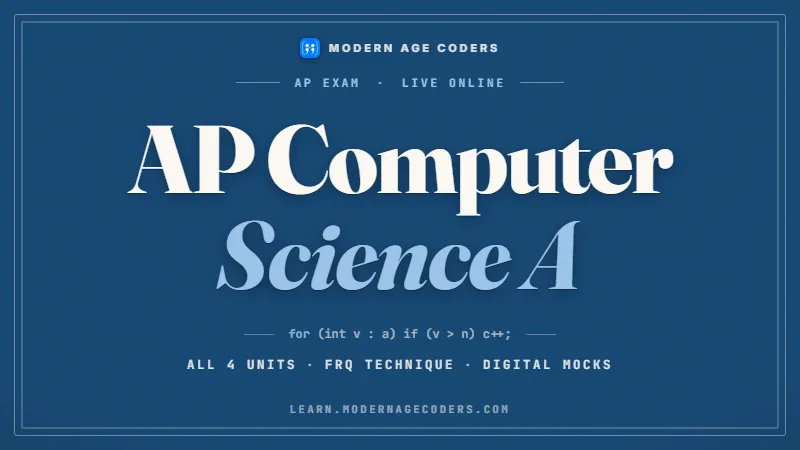
AP Computer Science A
Java, the unit structure, and the free response questions that decide the grade.
See the syllabus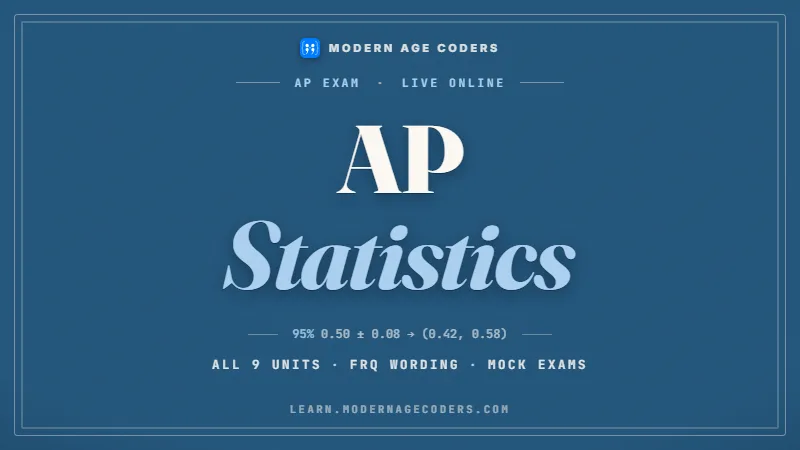
AP Statistics
The other AP that pairs naturally with computer science, and the maths behind the project below.
See the syllabus
High school mathematics
HOPE is decided on a grade point average, so the ordinary subjects matter as much as the rigorous ones.
See the syllabus
Python and AI
Started early enough, the AP years become a choice rather than a scramble.
See the syllabusThat is four of more than a hundred. The rest, sorted by age and subject, sit on the course atlas, and the order we teach them in is on the coding roadmap.
The four we are known for
Python, AI, vibe coding and agentic coding
These run underneath everything above. Every one is live and online, placed by ability rather than by age, and the first class is free.

Vibe Coding for Teens
Python, web and AI projects where the learner still owns the thinking.
See the syllabus
Python AI Automation
Automate the work you already do, then let AI carry part of it.
See the syllabus
AI and Machine Learning for Teens
Train a model, read what it learned, and be able to say why it is wrong.
See the syllabus
Codex and Claude Code
Run AI coding agents on real work without losing control of the codebase.
See the syllabusFour credits, and why the choice of them matters
A student meeting the requirements to be a HOPE Scholar at the point of high school graduation must earn a minimum of four full rigor credits from the Academic Rigor Course List. It is not a suggestion or a tiebreak. It is a gate, and it sits alongside the grade point average requirement rather than replacing it.
Computer science is on the list. Computer Science Principles and Games, Apps and Society both count, and Advanced Placement courses in core subjects are approved rigor courses. For a family with a child who already likes computers, that is unusually good news: the thing the child wants to do is also the thing the funding formula rewards.
Check the list yourself, every year
The Academic Rigor Course List is maintained by the Georgia Student Finance Commission and it is revised. Do not take a course on the strength of a web page, including this one. Ask your counselor to show you the current list, and confirm the specific course code your school will actually enter on the transcript.
There is a second, quieter point about which rigor credits to take. Four credits is a small number, and a student who fills all four with the least demanding qualifying options has satisfied the letter of the requirement while learning less than a student who used the same four slots well. HOPE checks the count. Universities read the transcript.
And the grade point average has not gone anywhere. A rigor course taken and scraped through does less for a HOPE application than the same course taken with the underlying mathematics in place. That is the unglamorous reason we teach both subjects on one track and price them as one thing.
What schools must offer, and how wide the door is
Georgia legislated a computer science requirement and phased it in deliberately.
| Who | Obligation | From |
|---|---|---|
| All middle schools in a local system | Offer instruction in exploratory computer science | Per the statute, including state charter schools serving middle grades |
| At least 50 percent of a system's high schools | Offer a course in computer science | 2023 to 2024 school year |
| All high schools in a local system | Offer a course in computer science | 2024 to 2025 school year |
The phase-in is worth noticing rather than skipping. For one school year the law was satisfied when half of a district's high schools offered the subject, which means a Georgia parent whose child was at the wrong half of the district was not being failed by anybody. They were on the wrong side of a deliberate transition.
Then there is the definition, which the statute supplies directly. Computer science means the study of computers, algorithmic processes, coding, and logical thinking, including computer principles, their hardware and software designs, their implementation, and their impact on society.
Read that definition again as a parent
It is a wide door, and deliberately so, because a narrow one would have been unenforceable in districts without specialist staff. But it means two schools can both truthfully report that they offer computer science while running courses that share almost nothing. The sentence "our school offers computer science" carries less information in Georgia than families assume.
The practical move is the same one we recommend everywhere, adjusted for what Georgia actually promises. Do not ask whether the school offers computer science; the answer is now yes almost everywhere by law. Ask which course, whether it appears on the current rigor list, what a student produces in it, and what they can take the year afterwards.
Four slots, and what we would put in them
On the left, what the requirement is asking for. On the right, the course we would use, and the honest reason. Confirm every one against the current list before committing.
An entry point that proves the student can carry a rigorous course at all.
Computer science before the Advanced Placement year, taught to real depth so the AP course is a step rather than a cliff. See Python Complete Masterclass for Teens.
A computer science credit with genuine content behind it.
AP Computer Science A. Java, and an external examiner who does not care how nice the classroom was. See AP Computer Science A.
Something quantitative that is not more programming.
AP Statistics, which is the single most useful course a future software or data person can take, and the one that makes the project below make sense. See AP Statistics.
Whatever the student is actually strongest at, since the grade still counts.
We do not have an opinion on which subject. We do have one on the mathematics underneath it, because a weak foundation shows up in every rigorous course at once. See High School Mathematics.
The years that decide whether any of the above is realistic.
Middle school is where the rigor pathway is really won or lost, and almost nobody is thinking about HOPE yet. See Middle School Mathematics.
Where a Georgia learner joins
Weighted toward statistics and probability higher up, because that is the mathematics the state's biggest employers actually run on and the one most likely to be skipped.
Elementary
Ages 6 to 10
College and adult
18 to 67
The complete catalogue is on the course atlas, and the method is set out on how we teach.
The test is 99 percent accurate. You tested positive. Should you worry?
Atlanta is the home of the Centers for Disease Control and Prevention, so Georgia students get the question its analysts answer every day, and the one almost every adult gets wrong.
A student picks a condition and finds its prevalence from published CDC figures, so the number is real rather than invented for the exercise. Then they take a screening test with plausible published characteristics: it correctly identifies almost everybody who has the condition, and it wrongly flags only a small percentage of people who do not.
The question is the one a real person asks in a waiting room. My test came back positive. What is the probability I have this?
Nearly everybody, including a lot of adults with degrees, answers with the accuracy of the test. The correct answer often has almost nothing to do with it.
The trap
Work it on a hundred thousand imaginary people rather than in symbols. If the condition is rare, the number of true positives is small, while the false positives are drawn from the enormous group who do not have it. A one percent error rate applied to ninety-nine thousand healthy people produces far more positive results than a near-perfect test applied to the thousand who are ill. Most positives are wrong, and the test is still excellent.
The number that decides the answer is the one nobody was given: how common the condition is to begin with. This is why the same test means something different in a screening programme for the whole population than in a clinic where everybody already has symptoms. The test did not change. The base rate did.
We teach it with a table of counts instead of a formula, deliberately. A student who has filled in four cells of a two by two table and read the answer off it understands what Bayes' theorem is doing before they ever see it written down, and they stop being impressed by an accuracy figure quoted on its own.
It generalises immediately and unpleasantly. It is why a fraud alert on a rare event is mostly false alarms, why a face recognition system with impressive accuracy misidentifies people constantly at airport scale, and why an AI classifier that flags one in a thousand documents needs a human reading its output rather than acting on it.
| Step | What the student does | What it teaches |
|---|---|---|
| Guess | Write down an answer before calculating anything | Intuition here is reliably and instructively wrong |
| Populate | Fill a two by two table for a hundred thousand people | Counting beats symbol manipulation for understanding |
| Read | Take the answer straight off the table | The result is a ratio of two cells, nothing more |
| Vary | Redo it with a common condition instead of a rare one | The base rate is doing the work, not the accuracy |
| Transfer | Apply the same table to a spam filter or a fraud alert | One structure, many industries |
Students look up the current prevalence figures themselves rather than using anything printed here, and older ones go on to why screening programmes are designed around this rather than in spite of it.
It runs straight into AP Statistics and statistics and probability, and for students building classifiers rather than interpreting them, AI and machine learning in the USA. Finished work sits in the student labs.
What a Georgia family is buying
A teacher who codes
Live for the whole hour, watching the student work rather than presenting at them. Mistakes get caught in the minute they appear.
Coding and maths as one thing
HOPE is decided on rigor credits and a grade point average together. Splitting the two subjects across two providers makes that harder to manage, not easier.
Five to eight, one teacher
Small groups that keep the same teacher every week, or one to one where a student needs the hour to themselves.
An exam somebody else marks
Advanced Placement results are the least arguable evidence a student can carry, which is why our high school track points at them.
Placement before payment
The opening class is free, real, and used to work out the honest starting level rather than to sell a package.
Nothing to install
Everything runs in a browser tab. A laptop or desktop, a microphone and a workable connection is the entire list.
What it costs a Georgia family
No enrolment charge, nothing to buy, no minimum term.
Five to eight learners with one consistent teacher. Where most Georgia families begin.
One learner setting the pace. Most often chosen in an Advanced Placement year, when the calendar stops negotiating.
Pauses, plan changes and missed classes are covered on the pricing page.
What families say
Rated 4.9 across 547 Google reviews. These are real reviews, reproduced as written.
★★★★★
"The one step solution for my son. Modern Age Coders make learning coding so simple that kids love it. The teachers explain complex concepts clearly with practical exercises and interactive content."
Ria Mukherjee
Parent
★★★★★
"Modern Age Coders has been a game-changer for me. I struggled to grasp IT concepts and coding before joining, but their classes transformed everything. I can now confidently write complex programs with ease."
Samriddha Mondal
Student
★★★★★
"One of the most wonderful education centres out there. Education is not limited to school syllabus but focuses on skill development."
Vansh Agarwal
Student
★★★★★
"My child Dhairya is really enjoying the Modern Age Coders classes. This is his first online class and he eagerly looks forward to it. I can already see his improvement, and the teachers are very cooperative."
Sonam Oswal
Parent of Dhairya
★★★★★
"Modern Age Coders have wonderful teachers who teach in a clear, easy and practical way. The teacher boosts students' confidence and inspires them to learn without hesitation."
Sonu Goyal
Parent
★★★★★
"I highly recommend this computer coding class! The teachers are incredibly knowledgeable and passionate about coding."
Ritu Kedia
Parent
More, with photographs and student work, on the wall of love.
Georgia questions, answered plainly
Is this page about the US state or the country Georgia?
The US state, covering Atlanta, Alpharetta, Johns Creek, Marietta, Savannah, Augusta, Columbus and Macon. We teach students in the country of Georgia too, and anywhere else, but everything about scholarships, statutes and school requirements on this page refers to the American state.
Does Georgia require schools to teach computer science?
It requires schools to offer it, which is a different thing. Under Georgia Code 20-2-149.3, every local school system must ensure that all middle schools offer instruction in exploratory computer science. For high schools the duty was phased: at least 50 percent of a system's high schools from the 2023 to 2024 school year, and all of them from 2024 to 2025.
How does computer science affect the HOPE Scholarship?
This is the part worth real money. A student must earn a minimum of four full rigor credits from the Academic Rigor Course List before graduating to qualify as a HOPE Scholar. Computer Science Principles and Games, Apps and Society both appear on that list, and Advanced Placement courses in core subjects are approved rigor courses. Confirm the current list with your counselor at gafutures.org, because course lists are revised.
What counts as a computer science course under the Georgia statute?
The law defines it broadly: the study of computers, algorithmic processes, coding, and logical thinking, including computer principles, their hardware and software designs, their implementation, and their impact on society. That is a wide door. Two schools can both satisfy the requirement while offering courses of very different depth, so the fact that a school offers computer science tells you less than it sounds.
Do you teach anywhere in Georgia?
Across the state. Because teaching happens over live video, metro Atlanta and rural Georgia are the same to us and neither involves a commute. What a learner needs is a laptop or desktop, something to speak into, and enough connection to hold a video call. We ship no hardware and install nothing.
What time do classes run on Eastern Time?
The timetable is arranged around your household. Weekend slots are the easiest to fill on Eastern Time and weekday slots are agreed individually. Times are fixed on the demo call before any payment, because a slot that works on paper and not in practice wastes everybody's term.
What are the fees?
A group place is USD 100 a month and private tuition is USD 150 a month, each two classes a week and eight a month. Nothing is charged to enrol, no materials are sold, and there is no minimum term. The opening class is free and is used to work out where a student actually belongs.
Which ages do you take?
Six through sixty-seven. Entry is decided by demonstrated ability in the opening class rather than by school year. Younger children start in blocks, middle schoolers move to Python, high schoolers work toward AP courses that also carry rigor credit, and adults are taught at adult pace.
How large is a class and who teaches it?
Between five and eight learners in a group, or one to one. The same teacher takes the class every week in both formats. Staff are not rotated between sessions, because the part of teaching that depends on knowing a particular student restarts from zero every time a teacher changes.
How does a family begin?
Take the free opening class, which is taught rather than sold. A teacher gives the student genuine work, watches how it goes, and recommends a level on that basis. If waiting a year is the honest recommendation, or if another provider suits better, that is what you will be told.
Taught, not sold
Tell us the grade and whether HOPE rigor is already on your mind. A teacher runs a real opening class, finds the honest starting point, and recommends a level. If we are not right for your child, you will hear it on the call.
You can also use the contact page, or read about us first.