Skip to content
Oxford, Oxfordshire, England

Coding classes in Oxford

What are the best coding classes in Oxford?

Oxford counted 162,040 usual residents in the 2021 Census, and 35.1% of those aged five and over were at school or in full-time study, against 20.4% across England. The city's Radcliffe Meteorological Station holds the longest single-site weather records in the United Kingdom, and the University set up its Computing Laboratory in 1957. Modern Age Coders runs live online lessons for Oxford learners aged six to sixty-seven, in a class of five to ten matched by level or with a teacher for one, at times fixed in UK hours by teachers working from India. Your first lesson costs nothing. After that, USD 100 a month pays for a group place and USD 150 a month for private teaching.

Does rain remember yesterday? Few places can answer that as well as Oxford, because the Radcliffe Meteorological Station, in the garden of Green Templeton College off Woodstock Road, has recorded daily rainfall since January 1827. From 1853, before which the University's geographers warn that some daily values may be totals for several days, to the end of 2025 there are 63,187 days, and on 19,763 of them at least a millimetre of rain fell. That is 31.3% of days. Yet after a wet day the next was wet 49.4% of the time, and after a dry day only 23.0%. Rain roughly doubles the chance of more rain tomorrow. A model built from those two numbers alone, called a Markov chain, reproduces the long-run share of wet days. Then it gets two things wrong, and finding them is the most valuable part of the lesson for our Oxford teenagers.

Facts last verified 21 September 2026. Teaching is online; no Oxford branch is claimed.

Course picks for Oxford

Four courses for a city of records

Pick by what the learner enjoys. Each course opens with a free live lesson, booked without a card.

Browse the course atlas for more than one hundred options and use the coding roadmap to check prerequisites.

The four we are known for

Python, AI, vibe coding and agentic coding

These run underneath everything above. Every one is live and online, placed by ability rather than by age, and the first class is free.

Oxford today

A young city in its late teens and twenties

From the 2021 Census tables for the Oxford local authority district, published by the Office for National Statistics on Nomis.

Oxford district, Census 2021
MeasureOxfordEngland share
Usual residents162,040Not compared
Living in households140,818Not compared
Living in communal establishments21,222, 13.1%Not compared
Aged 5 to 97,852, 4.8%5.9%
Aged 15 to 1915,874, 9.8%5.7%
Aged 20 to 2421,992, 13.6%6.0%
Schoolchildren and full-time students, of 154,903 aged five and over54,356, 35.1%20.4%

More than a third studying

In 2021, 35.1% of Oxford residents aged five and over were schoolchildren or full-time students, well above England's 20.4%.

Halls and colleges

Some 21,222 residents, 13.1% of the total, lived in communal establishments, a Census category that includes student halls and college rooms.

Fewer young children

Children aged 5 to 9 made up 4.8% of residents against 5.9% nationally, while 15 to 19 year olds were 9.8% against 5.7%.

For a family with a young child, that last contrast has a practical side: a local class for one narrow age and level can be hard to fill. Our groups are formed online from learners across the UK and beyond, so a seven-year-old in Marston can join five to ten others at exactly the same stage, and a teenager in Headington can move on to real data work as soon as they are ready.

Records and computing

Two centuries of weather, seven decades of computing

From the University of Oxford, its School of Geography and the Environment, and its Department of Computer Science.

14 November 1813

The School of Geography and the Environment says observations at the Radcliffe Observatory recommenced on this date and have continued, with only very minor interruptions, ever since. Daily rainfall follows from January 1827 and sunshine from February 1880.

The longest in the UK

The School calls these the longest single-site weather records in the United Kingdom. They are kept in the garden of Green Templeton College, beside the Radcliffe Observatory and its 33-metre octagonal tower.

1957

The Department of Computer Science records that the Oxford University Computing Laboratory was set up that year under Leslie Fox, running a mainframe for the wider University and working at first almost entirely on numerical analysis.

In 1960 Joan Walsh became the laboratory's first woman to be awarded a DPhil, and in 1965 the Programming Research Group was founded under Christopher Strachey, broadening the laboratory's scope well beyond numerical analysis. It took the name Department of Computer Science in 2011. The University says teaching existed in Oxford in some form in 1096, and its facts and figures page, which gives no date for the count, reports more than 26,000 students, including 12,460 undergraduates and 13,755 postgraduates. The same page says there are usually around 3,300 undergraduate places, and that over 23,000 people applied to start in 2024. We have no connection with the University. Its story matters here because it shows careful measurement and computing growing up side by side in one city.

Documented from the start

The School stresses that the station's instruments and their exposure have been fully documented throughout. That is what lets a learner use 173 years in one model with open eyes: readings before 1972, for example, were taken in inches and have been converted to millimetres, and the notes say so rather than leaving it to be discovered.

Signature project

Two probabilities, 173 years of Oxford rain

A Markov chain predicts tomorrow from today and nothing earlier. We built one from the Radcliffe station's daily rainfall, counting a day as wet when at least 1.0 millimetre fell.

What followed each day at the Radcliffe station, 1 January 1853 to 31 December 2025
TodayNext day wetNext day dryChance the next day is wet
Wet9,7669,99749.4%
Dry9,99733,42623.0%

1. Count the pairs

Walk through the 63,187 days once, tallying each pair of neighbours: wet then wet, wet then dry, dry then wet, dry then dry. Those four counts fill the table.

2. Turn counts into odds

Divide along each row. After a wet day, 49.4% of next days were wet; after a dry one, 23.0%. Those two numbers are the whole model.

3. Let it run

Start anywhere and roll a weighted die for each new day. Within a few steps the chain settles at wet 31.3% of the time, the same share as the real record.

Where the chain forgets too quickly

The model says memory fades fast. Three days after a wet day it gives rain a 32.5% chance, almost back to the everyday 31.3%, but the real record shows 39.5%. A week on, the chain has forgotten entirely while Oxford still shows 34.6%. Wet weather here arrives in spells that outlast a one-day memory, and a learner who checked only the next-day odds would never find out.

Whole years expose a second gap. Across the 173 years, a year held 114.2 wet days on average, from 79 in 1921 to 150 in 1872, with a standard deviation of 14.7 days. We simulated 34,600 years with the chain and matched that average, but with a spread of only 11.6 days; a memoryless coin gave 8.8. The chain is a clear improvement on the coin and still makes Oxford's years look more alike than they really are. Good modelling means reporting both halves of that sentence.

Testing a model of chance

Five checks before trusting a probability model

Learned on rain, used afterwards on predictive text, queues at a help desk, games of chance and any sequence where the next step depends on the last.

How to test a Markov chain against its data
CheckWhat it looks likeWhat it prevents
Count pairs, not just daysTally what follows each wet day and each dry day, not only how many days were wetA model that treats every day as a separate coin toss
Know which checks are freeNotice that wet-to-dry and dry-to-wet counts can differ by at most one, so matching the long-run share proves littleMistaking arithmetic for evidence
Test beyond the fitCompare the model with the record two, three and seven days ahead, which it was not built fromTrusting a model only on the numbers it was tuned to
Compare spread, not only averagesSimulate thousands of years and compare how much wet-day counts varyA model right on average and wrong about unusual years
Read the data notesStart in 1853, because earlier daily values may cover several daysA three-day total counted as one wet day

The second check explains a result that looks too good in the project: both middle counts are exactly 9,997, because every wet spell that begins must end, and the record happens to start and finish on dry days. Seasons are the natural next experiment. In winter a wet day was followed by another 52.0% of the time; in summer, 46.2%. A single year-round chain blurs that difference, and building one chain per season is the obvious improvement to try.

Younger learners

Spinner and coin games in blocks, a tally chart of what came up, and the surprise that a fair coin has no memory.

Teenagers

The Radcliffe file read in Python, the four pair counts found, a chain simulated for thousands of years and tested at longer lags.

Adults

Sequence models for demand, risk or customer behaviour, checked on data they were not fitted to.

We are not connected with the University of Oxford, its School of Geography and the Environment or its Department of Computer Science. The Radcliffe daily dataset is published by the School; the pair counts, the chain and the simulations are ours.

Learning ladder

From a coin toss to a chain you can test

Ages are only a starting point; the free lesson decides the level.

Ages 6 to 10

Chance games

Spinners, dice and coin tosses, counting what turns up and noticing that a fair coin has no memory.

Mental Maths for KidsCoding for Kids
Ages 11 to 13

What follows what

Tallying pairs in a table, turning counts into fractions and percentages, and writing the first loop that does the tallying.

Maths Through CodingMiddle School Mathematics Mastery
Ages 14 to 18

Markov chains in Python

A transition table built from real data, years simulated from it and the model tested at longer lags.

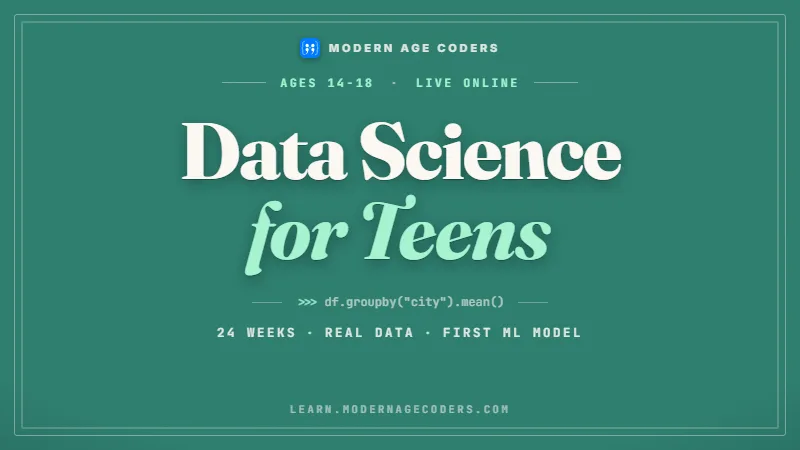
Data Science for TeensAI and Machine Learning for Teens
Ages 18 to 67

Sequence models at work

Conditional probability, simulation and model checking for anyone who forecasts demand, risk or behaviour.

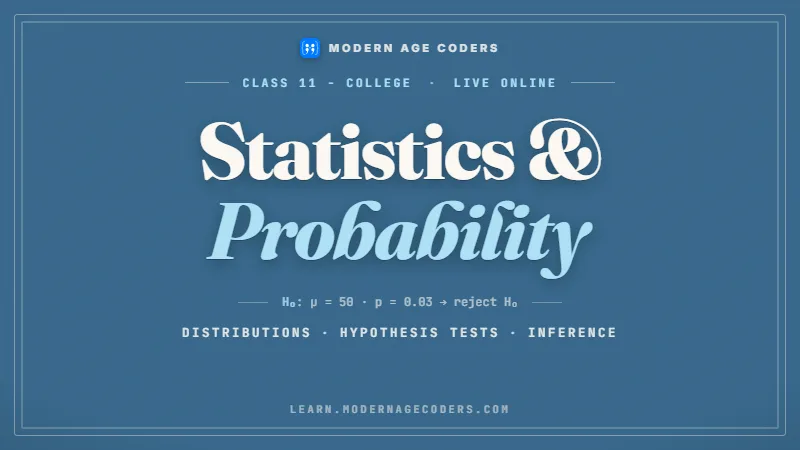
Statistics & ProbabilityMaths for Data Science
Coding and AI

Any chatbot will guess tomorrow's weather. Why should an Oxford teenager build a Markov chain?

Because the chain shows exactly where a simple prediction stops being right.

A Markov chain is the plainest form of an idea that runs through modern AI: predict what comes next from what came just before. Predictive text on a phone works in that spirit, and so, at vastly greater scale and with far longer memory, do the language models behind today's assistants. Building a two-state chain from Oxford rain teaches the heart of that idea with numbers a learner can check by hand.

It also teaches the limit. Our chain matched the long-run share of wet days and the next-day odds, because it was built from them, yet it forgot wet spells too quickly and made years look more alike than they are. An assistant asked about Oxford rain will produce confident numbers. A learner who has tested a model at longer lags and against year-to-year spread knows which of those numbers deserve trust.

So an Oxford teenager should still learn to program in 2026, in the city that keeps the longest single-site weather record in the country: predictions are everywhere now, and the ability to test one is what makes a programmer worth listening to. The longer argument is in whether learning to code is still worth it in 2026.

Delivery

Headington, Cowley or Summertown, with no journey at all

Even a short journey across Oxford costs time; a live online lesson takes it out of the week altogether.

No trip across the city

A learner in Wolvercote and another in Littlemore can sit the same lesson from their own rooms, with no bus through the centre at rush hour.

School stages as England names them

We use Reception, Key Stages 1 to 4, Year 9 options, GCSEs and A levels, as Oxford schools do, and every lesson is taught in English.

A first lesson that counts

The free session is real teaching on a real task. It ends with an honest view of level, a suggested course and a proposed weekly time, and no card details are asked for.

Matched on ability

Groups of five to ten learners at one level, gathered from Oxford, the rest of the UK and other countries, which is how every level finds a time that works.

Twice a week, same slot

Lessons run twice weekly at a fixed time, around eight a month, with breaks for holidays and exams arranged with the teacher.

Teachers in India

India Standard Time never moves, so Oxford sits four and a half hours behind our teachers in British Summer Time and five and a half behind in winter, which puts after-school and evening lessons inside their working day.

Pauses agreed in advance

A learner who is also at university can pause over vacations or exams and pick up again at the same level, as long as the dates are agreed with the teacher first. Schoolchildren do the same around GCSEs, A levels and family holidays.

Fees

Oxford class fees

Three prices, and nothing to add to them.

First classUSD 0

One complete lesson, free, after which you receive a level, a course suggestion and a weekly time.

Group tuitionUSD 100

A month of live teaching, normally eight lessons, with five to ten learners working at one level.

Private tuitionUSD 150

The same eight or so lessons a month, taught to one learner alone.

Everyone outside India pays one US dollar rate, so a family in Marston and a family in Wolvercote pay exactly the same, and we publish no prices in pounds. Billing begins only after the free lesson has fixed a course and a slot; the pricing page sets out how pauses, missed lessons and switches between group and private teaching work.

Reviews

Straight from Google: six family reviews, no edits

Rated 4.9 across 547 Google reviews. These are real reviews, reproduced as written.

★★★★★

"The one step solution for my son. Modern Age Coders make learning coding so simple that kids love it. The teachers explain complex concepts clearly with practical exercises and interactive content."

Ria Mukherjee

Parent

★★★★★

"Modern Age Coders has been a game-changer for me. I struggled to grasp IT concepts and coding before joining, but their classes transformed everything. I can now confidently write complex programs with ease."

Samriddha Mondal

Student

★★★★★

"One of the most wonderful education centres out there. Education is not limited to school syllabus but focuses on skill development."

Vansh Agarwal

Student

★★★★★

"My child Dhairya is really enjoying the Modern Age Coders classes. This is his first online class and he eagerly looks forward to it. I can already see his improvement, and the teachers are very cooperative."

Sonam Oswal

Parent of Dhairya

★★★★★

"Modern Age Coders have wonderful teachers who teach in a clear, easy and practical way. The teacher boosts students' confidence and inspires them to learn without hesitation."

Sonu Goyal

Parent

★★★★★

"I highly recommend this computer coding class! The teachers are incredibly knowledgeable and passionate about coding."

Ritu Kedia

Parent

Free placement class

Arrange a free lesson for an Oxford learner

The first task fits the learner: a spinner game for a young child, a first Python program that tallies coin tosses, or the Radcliffe rain record and a two-state chain for a teenager ready to model real data.

+44

FAQ

Oxford coding class questions

The questions Oxford families ask us most.

How many people live in Oxford?

The 2021 Census counted 162,040 usual residents in the Oxford district. Of these, 140,818 lived in households and 21,222, or 13.1%, in communal establishments such as student halls.

How many Oxford residents are students?

In 2021, 54,356 of the 154,903 residents aged five and over were schoolchildren or full-time students, 35.1% against 20.4% in England. The University of Oxford's facts and figures page reports more than 26,000 students, including 12,460 undergraduates and 13,755 postgraduates, without giving a date for the count.

What is the Radcliffe Meteorological Station?

A weather station run by the University's School of Geography and the Environment in the garden of Green Templeton College. The School describes its records, with daily temperature from 1813 and daily rainfall from 1827, as the longest single-site weather records in the UK. We are not connected with the University.

What does the Markov chain project involve?

Learners read 63,187 days of Radcliffe rainfall from 1853 to 2025, count what follows each wet and dry day, build a two-state chain from the results and then test it at longer lags and against the spread of real years.

Does rain in Oxford make rain more likely the next day?

In the Radcliffe record, yes: a wet day was followed by another 49.4% of the time, against 23.0% after a dry day. Three days later the effect is weaker but still clear, at 39.5% against an everyday 31.3%.

When did computing start at the University of Oxford?

The Department of Computer Science dates itself to the Oxford University Computing Laboratory, set up in 1957 under Leslie Fox. The Programming Research Group followed in 1965 under Christopher Strachey, and the laboratory became the Department of Computer Science in 2011.

What time are lessons for Oxford learners?

Slots run after school, in the evening and at weekends, fixed in UK time at the free lesson. Our teachers work four and a half hours ahead of Oxford in summer and five and a half in winter, which suits those hours well.

Does Modern Age Coders have a centre in Oxford?

No. There is no Oxford centre and no UK premises; every lesson is taught live online. A learner needs a computer with audio and a steady internet connection. Our phone number is Indian.

What do Oxford lessons cost?

Nothing for the first lesson. After that, a group place costs USD 100 a month for two live lessons a week, about eight a month, with five to ten learners, and one-to-one teaching on the same pattern costs USD 150 a month. We agree the course, format and time before any payment.

How do you put Oxford learners into groups?

By ability, pace and goals rather than age or postcode, with five to ten learners at one level in each group. If no group meets at a suitable time, we suggest one-to-one lessons instead.

Explore the UK

More UK cities and the national guide

Cambridge answers Oxford with EDSAC and a heap that ranks its warmest months on the Cambridge page. Milton Keynes has Colossus and a map estimated from random points, and London has a guide of its own. School stages across England are explained in the England guide, and the UK coding page links to every UK page.

Free Oxford classCall +91 91233 66161

Keep exploring Modern Age Coders

Coding classes in nearby cities

Learn more

Free resources

From the blog

Start here