What are the best coding classes in Derry~Londonderry?
The settlement NISRA calls Derry City had 85,279 usual residents at the 2021 census, in the council area of Derry City and Strabane. The Historic Environment Division lists the Guildhall on Shipquay Place at Grade A, and the town walls are a scheduled monument. Anyone here from six to sixty-seven can join our lessons, which a teacher in India leads live on a video call, one to one or with a group of five to ten working at one level, fitted around school and work in Northern Ireland. You pay nothing for the first session; staying on costs USD 100 a month in a group or USD 150 a month for private teaching.
Trains leave Derry~Londonderry for Coleraine about once an hour, and trains from Coleraine come the other way. Somewhere, each pair must pass. Our project finds where, using a time-distance chart: time along one axis, distance along the other, every train a sloping line. Where an eastbound line crosses a westbound one, two trains meet. A first, simple model, with one time per station, says the meetings happen out on the line between Bellarena and Castlerock. Add the minutes each train waits at a station, from the same timetable, and all 15 of Wednesday's meetings move to one place: the platform at Bellarena.
Facts last verified 23 September 2026. Teaching is online; no Derry~Londonderry branch is claimed.
Any of these four is a good starting point, depending on what the learner likes; whichever you choose, the first live lesson is free and you give no payment details to book it.
Block programming for younger children, from games to two trains that set off towards each other and must meet.
See the syllabus
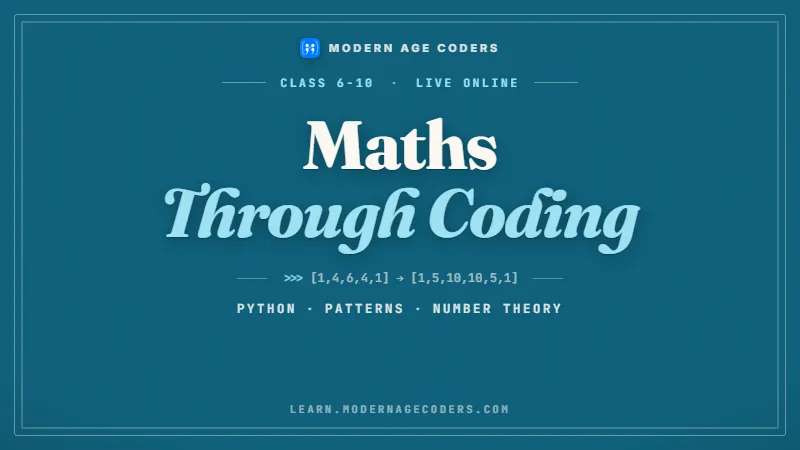
Graphs, gradients and where two lines cross, worked out in short programs, the maths inside every timetable chart.
See the syllabus
Python from first lines to full projects, enough to read a real timetable file and draw every train as a line.
See the syllabus

Python for adults who plan shifts, rotas or deliveries and need to see where schedules collide.
See the syllabusBrowse the course atlas for more than one hundred options and use the coding roadmap to check prerequisites.
The four we are known for
These run underneath everything above. Every one is live and online, placed by ability rather than by age, and the first class is free.

Python, web and AI projects where the learner still owns the thinking.
See the syllabus
Automate the work you already do, then let AI carry part of it.
See the syllabus
Train a model, read what it learned, and be able to say why it is wrong.
See the syllabus
Run AI coding agents on real work without losing control of the codebase.
See the syllabusThe table uses NISRA's 2021 census results: the settlement it names Derry City, four district electoral areas within the city, the wider council area and the whole of Northern Ireland.
| Area | Kind of area | Usual residents |
|---|---|---|
| Derry City | Settlement | 85,279 |
| Waterside | District electoral area | 29,045 |
| Ballyarnett | District electoral area | 25,252 |
| Foyleside | District electoral area | 17,568 |
| The Moor | District electoral area | 17,128 |
| Derry City and Strabane | Council area | 150,756 |
| Northern Ireland | Country | 1,903,175 |
Children under five were 6.2% of the Derry City settlement's residents in 2021 and those aged 10 to 14 were 6.8%, a little above Northern Ireland's 6.0% and 6.7%.
People aged 20 to 24 made up 6.0% of the settlement, against 5.9% across Northern Ireland, on NISRA's published age table.
Residents aged 70 to 74 were 4.2% of Derry City, against 4.4% in Northern Ireland, and those aged 90 or over 0.4%, against 0.7%.
We quote each NISRA figure as published and never add areas or age groups together. Our classes draw on the city and the places around it. In one week our teachers might see a Waterside eight-year-old on a first game, a Year 12 pupil from The Moor working on CCEA GCSE Digital Technology and a Foyleside adult automating a small business with Python, each in the class that matches their level.
From the Department for Communities' Historic Environment Division: its Listed Buildings Northern Ireland dataset and its map of scheduled zones, both published openly.
The Historic Environment Division's scheduled zones include monument 014:033, recorded as Londonderry Town Walls, in the townland of Derry.
The Irish Society Office in St Columb's Court, dated 1760 to 1779, and St Columba's Church on Long Tower Street, dated 1780 to 1799, are both listed at Grade A.
The Guildhall on Shipquay Place is listed at Grade A with a construction band of 1880 to 1899, as is St Columb's Hall on Newmarket Street.
In the townland of Clooney, the scheduled zones also include a 19th-century star fortification, which the record names Ebbringtons Barracks. The records give dates in construction bands rather than exact years, and we quote them that way. These records belong to the Department for Communities; neither it, Translink nor Derry City and Strabane District Council has any link with us.
Where the timetable comes from
Translink publishes the full NI Railways timetable on OpenDataNI in TransXChange format under the Open Government Licence; this project uses the version updated on 4 September 2026. Each journey lists its stops with running times between them and waiting times at them.
On a time-distance chart, each train is a line that climbs as it travels and stays flat while it waits. Two trains going opposite ways meet where their lines cross. Finding those crossings is a problem of intersecting line segments, one pair at a time.
| Day | Trains each way | Meetings, first model (no waiting times) | Meetings, with waiting times |
|---|---|---|---|
| Wednesday 30 September 2026 | 16 | 15, all between Bellarena and Castlerock | 15, all at Bellarena |
| Saturday 3 October 2026 | 16 | 15, all between Bellarena and Castlerock | 15, all at Bellarena |
| Sunday 4 October 2026 | 6 | None | None |
From the timetable's patterns, work out when each train arrives at and leaves Derry~Londonderry, Bellarena, Castlerock and Coleraine. A typical eastbound train leaves at 11:38 and waits at Bellarena from 11:58 to 12:00.
For each eastbound and westbound pair, check first whether both are at the same station at overlapping times; if not, check whether their trips over the same stretch overlap in time.
The first version gave every train one time per station and put the meetings on the line. Using separate arrival and departure times moves all of them to Bellarena.
The two models disagree by only a minute or two, yet they tell a different story: one says trains pass in open country, the other that they meet, every hour, at one station. The waiting time at Bellarena, two minutes in the timetable, is what makes the meeting happen there. On Sunday, when trains leave Derry~Londonderry every two hours, the pattern is different again and no two trains meet on this stretch at all.
We use Translink's own coordinates to show that the stations are not evenly spaced: in a straight line, Derry~Londonderry to Bellarena is 27.56 km and Bellarena to Castlerock 11.40 km, so Bellarena sits much nearer Castlerock than Derry~Londonderry. The timetable says nothing about the track itself, so the page makes no claim about why the trains meet where they do; it reports only what the times show.
Learned on the Derry~Londonderry line, then used for bus rotas, delivery rounds, meeting-room bookings, air traffic and any plan where things share limited space and time.
| Question | For the Coleraine line | What goes wrong if you skip it |
|---|---|---|
| What does each record contain? | Running times and waiting times | Dwell times dropped without anyone noticing |
| Is the model detailed enough? | Rerun with arrival and departure separately | Meetings placed in the wrong place |
| Which days are tested? | A Wednesday, a Saturday and a Sunday | A weekday pattern assumed for the weekend |
| What can the data not say? | Nothing about track layout | A guess about infrastructure presented as fact |
| Are all pairs checked? | Every eastbound against every westbound | A meeting missed between two rarely paired trains |
The second row is the heart of the project. A model can be simple and still wrong in a way that matters, and the only defence is to add the next level of detail and see whether the answer changes. Here it did, completely.
Two toy trains set off from opposite ends of a track on a timer, and the class predicts where they will meet.
Parsing a real timetable, time-distance charts, segment intersection and model refinement in Python.
Finding clashes in rotas and schedules, and checking a model by adding detail until the answer settles.
We have no connection with Translink, NISRA, the Department for Communities or Derry City and Strabane District Council. The timetable, census tables and heritage records are published openly; the journey rebuilding and meeting analysis on this page are our own work.
The age bands are a guide; the free lesson shows where to begin.
Moving sprites towards each other on a timer in block code, and predicting where they meet.
Scratch Coding for KidsCoding for KidsPlotting times and distances in Python, and finding where two straight lines cross.
Python and AI for KidsMaths Through CodingParsing a TransXChange timetable, segment intersection and model refinement on real NI Railways data.
Python for TeensProblem Solving for TeensDetecting clashes in schedules at work, and checking models against the detail they leave out.
Python Automation CourseData Structures & Algorithms CourseBecause a model that leaves out a two-minute wait can put a meeting in the wrong place, and it will still look perfectly reasonable.
Scheduling tools, including AI ones, work from models of time and space. If a model drops a detail such as waiting time, its output can be confidently wrong. A learner who has watched every meeting jump from open line to a station platform knows to ask what a model left out.
The project also practises saying what data cannot tell you. The timetable shows where trains meet; it does not show the track. Separating what the evidence supports from what it does not is exactly the judgement AI leaves to people.
So a teenager in Derry~Londonderry should keep learning to code in 2026, in a city whose town walls are a scheduled monument: AI can draft the plan, but people still have to check where things really meet. The longer argument is in why coding is worth learning in 2026.
Learners in Derry~Londonderry live across the city and the wider council area of Derry City and Strabane. Online, every one of them is equally close to the lesson.
A learner in Waterside and another near Long Tower can share one class without either travelling across town.
Whether a child is in primary school, facing the transfer test or taking CCEA GCSEs and A levels up to Year 14, we place them at the right stage; all teaching is in English.
The free session is spent writing real code, and closes with the teacher's suggested level, course and weekly time. We never ask for a card.
A class brings together five to ten learners of the same level from here, from elsewhere in the UK and from other countries, which keeps a spread of sensible times open.
Lessons run on two set days every week, making roughly eight a month; the teacher works around school holidays and exam revision with each family.
India has one time zone all year, so a class at 5 pm here begins at 21:30 for our teachers during British Summer Time and 22:30 in winter.
Across the north-west and beyond
Learners in Limavady, Coleraine, Strabane or Castlerock join exactly the same classes, as every lesson is online and classes are set by level.
A free first lesson, then a single monthly fee.
A full lesson with no charge, ending with a suggested level, course and weekly time.
About eight live lessons a month, in a class of five to ten learners at one level.
About eight live lessons a month, with a teacher for your learner only.
Every family outside India, including those in Ballyarnett and The Moor, is billed in US dollars; we do not list prices in pounds. The first charge comes only after the free lesson and once you have chosen a course and a weekly time, and the pricing page explains how breaks, missed sessions and a switch between group and one-to-one classes work.
Rated 4.9 across 547 Google reviews. These are real reviews, reproduced as written.
★★★★★
"The one step solution for my son. Modern Age Coders make learning coding so simple that kids love it. The teachers explain complex concepts clearly with practical exercises and interactive content."
Ria Mukherjee
Parent
★★★★★
"Modern Age Coders has been a game-changer for me. I struggled to grasp IT concepts and coding before joining, but their classes transformed everything. I can now confidently write complex programs with ease."
Samriddha Mondal
Student
★★★★★
"One of the most wonderful education centres out there. Education is not limited to school syllabus but focuses on skill development."
Vansh Agarwal
Student
★★★★★
"My child Dhairya is really enjoying the Modern Age Coders classes. This is his first online class and he eagerly looks forward to it. I can already see his improvement, and the teachers are very cooperative."
Sonam Oswal
Parent of Dhairya
★★★★★
"Modern Age Coders have wonderful teachers who teach in a clear, easy and practical way. The teacher boosts students' confidence and inspires them to learn without hesitation."
Sonu Goyal
Parent
★★★★★
"I highly recommend this computer coding class! The teachers are incredibly knowledgeable and passionate about coding."
Ritu Kedia
Parent
We choose the opening task by age and experience: a two-trains timing game for a young child, a short Python program that finds where two lines cross for a beginner, or the real NI Railways timetable and a time-distance chart for a teenager ready for real data.
What families in Derry~Londonderry ask us most.
NISRA's Census 2021 counted 85,279 usual residents in the settlement it calls Derry City. The council area of Derry City and Strabane had 150,756.
Children are a slightly bigger share and the oldest residents a smaller one: NISRA puts under-fives at 6.2% of the settlement in 2021 (Northern Ireland 6.0%) and people of 90 and over at 0.4% (Northern Ireland 0.7%).
A chart with time along one axis and distance along the other, on which each train is a line. Where lines for trains going opposite ways cross, the trains meet. Finding those crossings is a problem of intersecting line segments.
In the NI Railways timetable for Wednesday 30 September 2026, all 15 meetings between eastbound and westbound trains happen at Bellarena, where both trains are at the station together. On Sunday, with trains every two hours, none meet on this stretch.
From Translink's NI Railways timetable, published on OpenDataNI in TransXChange format under the Open Government Licence. We are not connected with Translink.
Yes. The Historic Environment Division's scheduled zones include monument 014:033, recorded as Londonderry Town Walls. The Guildhall on Shipquay Place is a Grade A listed building.
Most pick a regular slot straight after school, later on a weekday or at a weekend, and settle it during the free lesson. Our teachers are in India, so a teatime lesson here reaches them at about half past nine at night in summer and half past ten in winter.
No. We have no centre here and no premises anywhere in the UK, because every lesson is live online. Learners need a computer with sound and a steady connection, and our phone number is Indian.
The first lesson is free. After that, a group place costs USD 100 a month for two live lessons a week, about eight a month, with five to ten learners, and one-to-one teaching on the same timetable costs USD 150 a month. Nothing is charged until the course, format and time are agreed.
By level, pace and goals rather than by age or where they live, with five to ten learners at the same stage. When no group fits the learner's week, we offer one-to-one lessons.
The same timetable powers the Bangor page, which shows why passengers wait longer than half the gap between trains, while Belfast runs PageRank over its bus and Glider stops. Exam candidates can turn to our pages on CCEA GCSE Digital Technology programming and CCEA A level Software Systems Development. The Northern Ireland guide sets out how our stages match local schooling, and the UK coding page leads to every other city.