Home / United States / Washington
Washington will let you trade maths for code, and legally has to warn you first.
The short answer
Under RCW 28A.230.300 a Washington student may swap a third year mathematics or science course for computer science, once, with everybody's agreement, and only after the counselor puts the consequences in writing. Modern Age Coders teaches both subjects on one track, so the swap never has to be made at all. Ages 6 to 67, taught live. A group holds no more than eight; private tuition is also available. USD 100 or USD 150 monthly.
Education law rarely comes with a warning label. Washington's computer science substitution does. The legislature allowed the trade, then wrote into the same statute that a counselor must hand the family written notification of what the substitution does to their postsecondary opportunities. That is an unusually candid piece of drafting, and it tells you exactly how the state feels about the deal it is offering.
The obvious conclusion is the right one. Take the computer science, keep the mathematics, and never spend the one substitution you are allowed. Washington is one of the states we cover from the United States hub.
No card. No obligation. We call, we do not spam.
The pairing that makes the substitution unnecessary
The first two are the whole argument of this page: run them in the same term and nothing has to be traded away. The other two are where students go before and after.
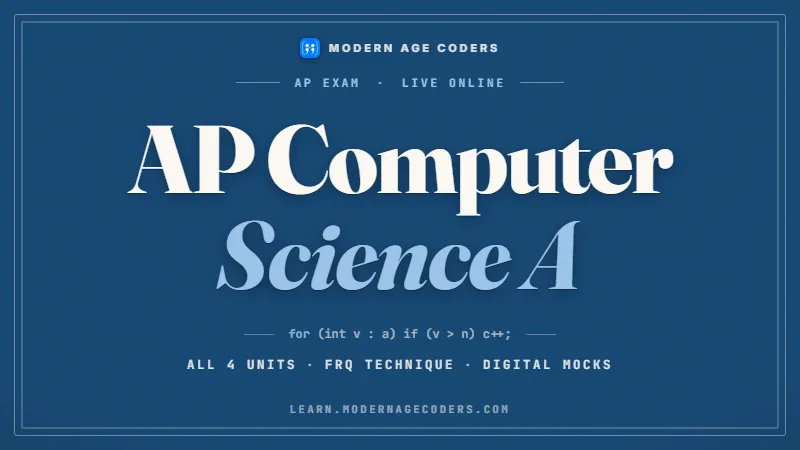
AP Computer Science A
The course RCW 28A.230.097 makes a board approve as maths or science equivalent.
See the syllabus
High school mathematics
The third year the statute would let you drop, and the one the warning is about.
See the syllabus
Problem solving and DSA
What the companies down the road actually interview on, taught early.
See the syllabus
Python and AI
Where a middle schooler builds the runway that makes Grade 11 a choice, not a scramble.
See the syllabusThat is four of more than a hundred. The rest, sorted by age and subject, sit on the course atlas, and the order we teach them in is on the coding roadmap.
The four we are known for
Python, AI, vibe coding and agentic coding
These run underneath everything above. Every one is live and online, placed by ability rather than by age, and the first class is free.

Vibe Coding for Teens
Python, web and AI projects where the learner still owns the thinking.
See the syllabus
Python AI Automation
Automate the work you already do, then let AI carry part of it.
See the syllabus
AI and Machine Learning for Teens
Train a model, read what it learned, and be able to say why it is wrong.
See the syllabus
Codex and Claude Code
Run AI coding agents on real work without losing control of the codebase.
See the syllabusThe trade the state offers, and the warning it attaches
Quoted rather than paraphrased, because the conditions are the interesting part and they are usually left out when this rule gets summarised.
The substitution
A student may substitute "a computer science course aligned to state computer science learning standards as an alternative to a third year mathematics or third year science course."
The warning, in the same statute
Before approving it, "the school counselor provides the student and the student's parent or guardian with written notification of the consequences of the substitution on postsecondary opportunities."
Four conditions travel with the trade, and every one of them is a signal about how the state views it.
| Condition | What it tells you |
|---|---|
| Student, parent or guardian, and counselor or principal must all agree | Three signatures for one course swap is not how routine decisions are handled |
| Written notification of consequences on postsecondary opportunities | The legislature expected some families to regret this and wanted a paper trail |
| Must align with the student's High School and Beyond Plan | It has to fit a stated destination, not just a timetable clash |
| Limited to one such substitution per student | A rationed thing is a thing somebody thought could be overused |
Texas handles the same idea in the opposite spirit, letting a student choose computer science instead of a foreign language with no cap and no cautionary paperwork. The difference is not that one legislature is more careful than the other. It is that a language requirement and a third year of algebra are not equally load-bearing, and Washington priced that in.
Third year mathematics is not an arbitrary hurdle. It is where a student meets the algebraic fluency that every quantitative degree assumes, including the computer science degree they may be substituting toward. Dropping it to take computer science can leave a student holding the destination without the road.
We are not telling you what to choose
That is a conversation for your family and your counselor, and there are students for whom the substitution is exactly right. Our position is narrower: the substitution exists to solve a timetable problem, not a learning problem. If both subjects can be kept, keep them. A release valve you never had to pull is the best kind.
There is a second provision worth knowing by name. Under RCW 28A.230.097, boards of directors must approve AP computer science courses as equivalent to high school mathematics or science, and must denote on the transcript that AP computer science qualifies as a math-based quantitative course for a student who takes it in their senior year. That transcript notation is the piece families most often have never heard of, and it is worth asking for explicitly rather than assuming it appears.
What each subject gives the other
The case for keeping both is not sentimental. On the left is a piece of third year mathematics. On the right is the thing in computer science that stops making sense without it.
Functions, domain and range, and what it means for an input to be invalid.
Every function a programmer writes has a domain, and most bugs a beginner ships are inputs outside it. See Python Complete Masterclass for Teens.
Growth rates: linear against quadratic against exponential.
This is algorithmic complexity with the notation removed. A student who has never compared growth rates cannot feel why one solution dies at scale. See Problem Solving and DSA.
Proportional reasoning, ratios and rates.
The whole of honest data work sits on it, including the project further down this page. See Statistics and Probability.
Logic, quantifiers, and the difference between "some" and "all".
Conditionals and loop invariants are this idea wearing different clothes, which is why students who skip it write conditions that are nearly right. See AP Computer Science A.
Coordinate geometry and transformation.
Anything drawn on a screen is this, whether the student realises it or not. It is also the friendliest way in for a younger learner. See Coding in Blocks.
Where a Washington learner joins
Weighted toward algorithms and interview-grade problem solving at the top, for the unsurprising reason that a lot of these students are aiming at employers within driving distance.
Middle school
Ages 11 to 13
High school
Ages 14 to 18
The complete catalogue is on the course atlas, and the method is set out on how we teach.
The column that does not mean what it is called
Washington students work on a dataset that has taught more people pandas than almost any other, and which quietly answers a different question from the one everybody asks it.
The Fremont Bridge counter has been running since October 2012. Inductive loops set into the east and west pathways register bicycles crossing, and the city publishes an hourly count for each pathway. It is clean, long, free, and beloved of every introductory data science course, which is exactly why it is useful for teaching scepticism.
Set a student two ordinary questions. Is cycling in Seattle growing? And do more people ride into the city in the morning than out of it?
They can produce a confident answer to both within twenty minutes. Both answers are unsound, for two different reasons, and neither reason is visible in the numbers.
The first trap: one bridge is not a city
Every figure in the file describes a single crossing. If cycling shifted to another route, or a nearby trail closed, or the bridge itself was under works, the counter records that as a change in cycling. A claim about Seattle drawn from one sensor is a claim about one sensor. The data is not wrong; the population it describes is much smaller than the question assumed.
The second trap: the column names are lying to you, gently
The two count columns are the east pathway and the west pathway. They are not eastbound and westbound. The loops register a bicycle passing regardless of which way it is travelling. A student who reads the headers as directions will produce a beautiful morning and evening commute chart that measures which side of the bridge people ride on, not which way they are going.
The second one is the lesson we care most about, because it is not a statistical error at all. Nothing was miscalculated. The student read a variable name, assumed a meaning, and never opened the documentation that says otherwise. That mistake scales: it is the same mistake as assuming a column called revenue is net, or that a field called date is the date of the event rather than the date of entry.
The rule we want them to leave with is unglamorous and worth more than most of what we teach: before you use a column, find out what it actually measures, from whoever created it, and write that definition down in your own words.
| Step | What the student does | What it teaches |
|---|---|---|
| Answer | Produce both confident answers from the raw file first | You have to hold the wrong answer to feel the correction |
| Read | Find and read the dataset description before defending either | Documentation is part of the data |
| Restate | Write down what each column actually measures, in their own words | A definition you can restate is one you understand |
| Narrow | Rewrite the claim so it is about the bridge rather than the city | Match the claim to the population |
| Extend | Say what extra data would let the original question be answered | Knowing what is missing is a finding |
Older students go on to weather as a confounder and to what a fair year-on-year comparison would even look like. Students pull the current file from the city portal themselves rather than using anything reproduced here.
The same discipline runs through data science for teens, and for students who want to build models rather than interrogate them, AI and machine learning in the USA. Completed work sits in the student labs.
What a Washington family is buying
| Item | Group | Private |
|---|---|---|
| Learners | Five to eight | One |
| Teacher | Same person weekly | Same person weekly |
| Sessions | Two a week, eight a month | Two a week, eight a month |
| Format | Live video, never a recording | Live video, never a recording |
| Subjects | Coding and mathematics on one track | Coding and mathematics on one track |
| Ends in | A built project and a certificate | A built project and a certificate |
| Commitment | Month to month | Month to month |
| Fee | USD 100 a month | USD 150 a month |
Everything happens in a browser tab, so nothing has to be installed on a district-managed laptop. A microphone and a connection that carries video is the rest of the list.
Two numbers, billed monthly
No enrolment charge, nothing to buy, no minimum term.
Five to eight learners with one consistent teacher. Where most Washington families begin.
One learner setting the pace. Usually chosen for AP preparation, or to carry both subjects in a term that is already full.
Pauses, plan changes and missed classes are covered on the pricing page.
What families say
Rated 4.9 across 547 Google reviews. These are real reviews, reproduced as written.
★★★★★
"The one step solution for my son. Modern Age Coders make learning coding so simple that kids love it. The teachers explain complex concepts clearly with practical exercises and interactive content."
Ria Mukherjee
Parent
★★★★★
"Modern Age Coders has been a game-changer for me. I struggled to grasp IT concepts and coding before joining, but their classes transformed everything. I can now confidently write complex programs with ease."
Samriddha Mondal
Student
★★★★★
"One of the most wonderful education centres out there. Education is not limited to school syllabus but focuses on skill development."
Vansh Agarwal
Student
★★★★★
"My child Dhairya is really enjoying the Modern Age Coders classes. This is his first online class and he eagerly looks forward to it. I can already see his improvement, and the teachers are very cooperative."
Sonam Oswal
Parent of Dhairya
★★★★★
"Modern Age Coders have wonderful teachers who teach in a clear, easy and practical way. The teacher boosts students' confidence and inspires them to learn without hesitation."
Sonu Goyal
Parent
★★★★★
"I highly recommend this computer coding class! The teachers are incredibly knowledgeable and passionate about coding."
Ritu Kedia
Parent
More, with photographs and student work, on the wall of love.
Washington questions, answered plainly
Can computer science replace a maths course in Washington?
Under RCW 28A.230.300 a student may substitute a computer science course aligned to state computer science learning standards as an alternative to a third year mathematics or third year science course. It is not automatic. The student, the parent or guardian, and the school counselor or principal must all agree, it has to align with the student's High School and Beyond Plan, and each student is limited to one such substitution in total.
Why does the law require a written warning?
Because the legislature knew the substitution can cost a student later. Before approving it, the school counselor must provide the student and the parent or guardian with written notification of the consequences of the substitution on postsecondary opportunities. Very few education rules come with a statutory warning label attached. When one does, it is worth reading twice.
So should my child use the substitution?
That is your decision and your counselor's, not ours, and it genuinely depends on the student. What we would say is that the substitution exists to solve a timetable problem, not a learning problem. If a student wants computer science and can also keep third year mathematics, keeping both is strictly better for every postsecondary route we know of. The substitution is a release valve, and a release valve you never had to pull is the best kind.
What about AP Computer Science specifically?
RCW 28A.230.097 requires boards of directors to approve AP computer science courses as equivalent to high school mathematics or science, and to denote on the transcript that AP computer science qualifies as a math-based quantitative course for a student who takes it in their senior year. That transcript notation is the part families most often do not know exists, and it is worth asking about by name.
Do you teach across Washington or only the Seattle side?
The whole state. Live video puts Redmond, Bellevue, Sammamish, Seattle, Tacoma, Spokane and Vancouver on exactly the same footing, and none of them involves the 520 bridge. A student needs a laptop or desktop, a microphone, and a connection that can hold a video call. Nothing gets installed and nothing gets posted.
What time do classes run on Pacific Time?
We build around your household rather than asking you to fit ours. Weekend slots are the easiest to arrange on Pacific Time, and weekday slots are agreed one family at a time. Times are settled on the demo call before any money moves, so nobody discovers afterwards that the only available slot collides with something immovable.
What does it cost a Washington family?
Group classes are USD 100 a month and private tuition is USD 150 a month, each running two classes a week, eight a month. There is no enrolment charge, nothing to buy and no minimum term, so any month can be the last one. The first class is free and is used to place the student properly.
Which ages do you take?
Six to sixty-seven. Placement follows what a learner can demonstrate in the opening class rather than their year group, which cuts both ways: a quick nine year old is moved up, and a sixteen year old with gaps is placed where the gaps actually are. Adults are taught as adults, at adult pace.
How many students share a class?
Five to eight in a group, or one to one. Either way the teacher is the same person from week to week. Rotating staff is the cheapest saving a provider can make and the most expensive one for a student, because every rotation restarts the part of teaching that is about knowing somebody.
How do we start?
Book the free opening class. It is taught, not sold. A teacher sets real work, watches how the student handles it, and recommends a level based on what they saw. If the honest recommendation is to wait a year or to try somebody else, that is what you will be told on the call.
Taught, not sold
Tell us the grade and whether the substitution has already come up with the counselor. A teacher runs a real opening class, finds the genuine starting point, and recommends a level. If we are not right for your child, that is what you will hear on the call.
You can also use the contact page, or read about us first.