CRP / P / 01
Coding for Kids
Games and stories in Scratch, then first apps.
Open the syllabusRheinland-Pfalz · Coding and Informatik · Ages 10 to 19
Rheinland-Pfalz is changing its mind about Informatik. Today it is one of six Länder where the subject is not compulsory for everyone; from the 2028/29 school year it will be compulsory at every school, and some pilot schools have started already. Its Abitur has a surprise too: pupils on the nine-year route write their exams in January. This page covers both, the holidays, and a project on the Land's own events data.
Teaching online since 2020 · 10,000+ students around the world · one mentor, in English
In short
Modern Age Coders teaches coding to pupils in Rhineland-Palatinate aged about 10 to 19 through live online lessons held in English. A family can pick a group of fifteen to twenty or private lessons; either way one mentor stays with the pupil and adapts to how fast they work and how they speak. Rheinland-Pfalz only makes Informatik compulsory in 2028/29, so our Informatik Companion course brings the subject forward to today.
Where pupils in Rheinland-Pfalz start
Matched to a Land in transition: one for grades 5 to 10, one for the Oberstufe, one for contest-minded pupils.
CRP / 01
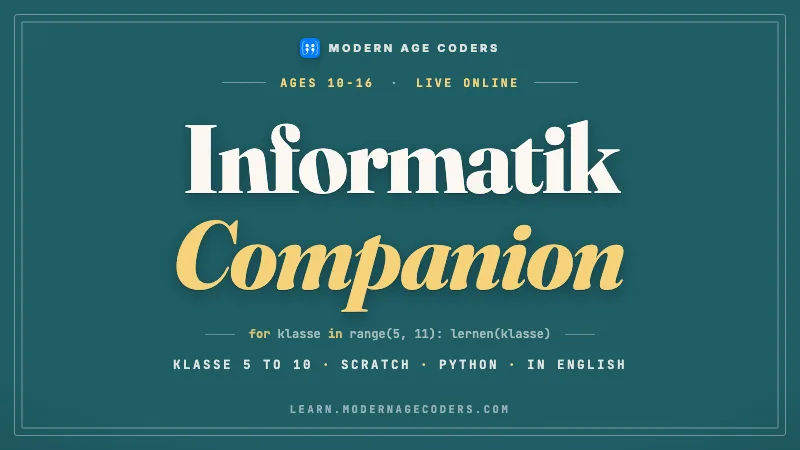
Grades 5 to 10. The subject Rheinland-Pfalz is about to make compulsory, taught now: algorithms, Python, data, networks.
Open the syllabus →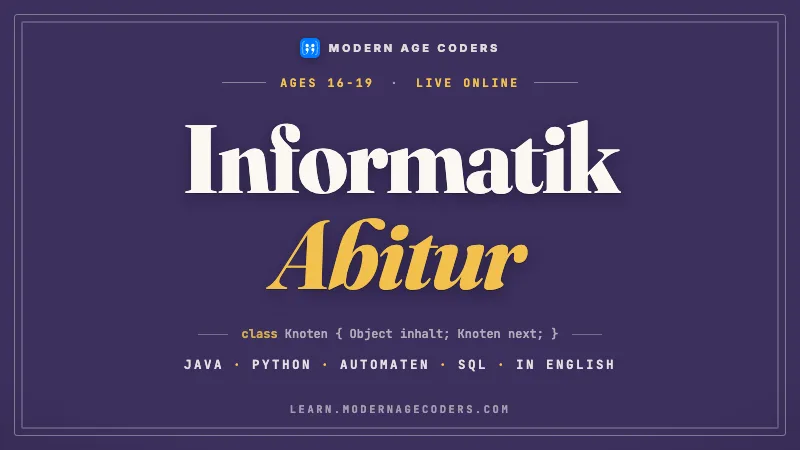
CRP / 02
Oberstufe. Object orientation, data structures and databases for a school-written Abitur paper.
Open the syllabus →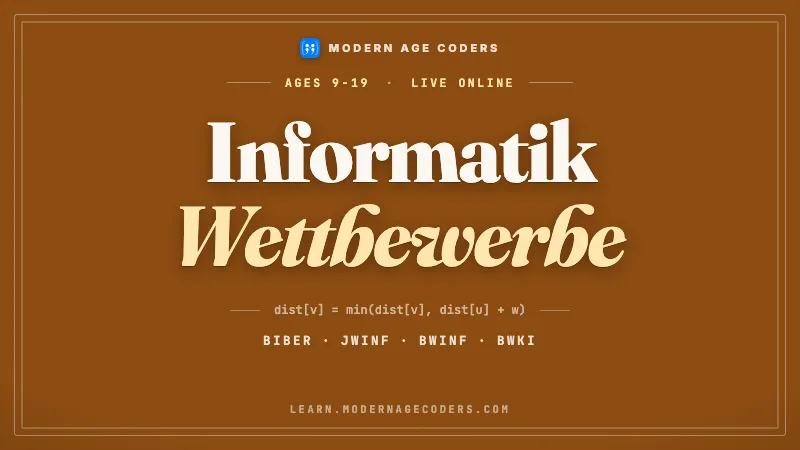
CRP / 03
For 9 to 19 year olds: puzzles we write ourselves, then algorithm tasks where the pupil must also argue why the answer is right.
Open the syllabus →Informatik in Rheinland-Pfalz
From the 2028/29 school year, at all general schools. Until then it depends on the school. Everything here is drawn from the GI's Informatik-Monitor, edition 2026/27, which tracks each Land's regulations; Modern Age Coders has no link with its authors or with the Ministerium für Bildung in Mainz.
After Grundschule, Rheinland-Pfalz has three secondary school types: Realschule plus, Integrierte Gesamtschule and Gymnasium. None has Informatik for all pupils yet, which is why the GI lists the Land among six without compulsory Informatik.
There are exceptions. Since 2021/22, 21 Informatik-Profil-Schulen have taught compulsory Informatik in grade 5, and their pupils can choose to keep it every year from grade 6 to 10.
The monitor reports that Informatik will become compulsory at all general schools and all Förderschulen from 2028/29, with four weekly hours in total according to its national summary.
Schools can apply to start early: 28 pilot schools began the compulsory subject in 2025/26 and 30 more in 2026/27.
| School | Grades | What can be offered |
|---|---|---|
| Realschule plus | 7 to 10 | A 14-hour Wahlpflicht area with required Informatik content; a school's own Informatik elective of four to six hours in total |
| IGS and nine-year Gymnasium | 9 and 10 | A two- to three-hour Wahlfach (not on the classical-languages route) |
| Eight-year Gymnasium | 8 and 9 | A three-hour Wahlpflichtfach |
| Informatik-Profil-Schule | 5, then 6 to 10 | Compulsory in grade 5, continuous by choice |
Read on 2 November 2026 in the Informatik-Monitor 2026/27 (Gesellschaft für Informatik), on its Rheinland-Pfalz page and in its comparison of all Länder. Most Gymnasien and the IGS run the nine-year route; some Gymnasien offer eight years.
One detail matters for families planning ahead. The monitor states that Informatik can currently be taken as a Leistungsfach only if the pupil took it as an elective in the two school years just before the Oberstufe. A pupil who skips the grade 9 and 10 elective may lose the option of an Informatik Leistungsfach later. Our Companion course does not replace that elective, but it keeps a pupil ready to take it.
Interest is high where Informatik is offered: the monitor's Rheinland-Pfalz page gives 26 percent of Sekundarstufe II pupils taking it in 2024/25. In 2025/26 the Land counted 687 qualified Informatik teachers, about 3 percent of its teachers.
Oberstufe and Abitur
Because on the nine-year route the Abitur exams come in the middle of grade 13. The ministry has set the 2027 dates.
| Date | What happens |
|---|---|
| 23 October 2026 | Schools submit their decentral task proposals to the ministry |
| 12 January to 2 February 2027 | Written exams |
| 13 January 2027 | German (central elements) |
| 15 January 2027 | English (central elements) |
| 20 January 2027 | Mathematics (central elements) |
| 3 March 2027 | Grade 13 reports and written results |
| 11 to 17 March 2027 | Oral exams |
| By 19 March 2027 | Abitur certificates |
Source: Ministerium für Bildung Rheinland-Pfalz, letter of 14 May 2025 setting the Abitur 2027 dates for nine-year Gymnasien and Integrierte Gesamtschulen, with its annex, via mss.rlp.de, read 3 November 2026. Central papers start at 9:00. At eight-year all-day Gymnasien and other school forms the written exams are in spring, with maths on 5 May 2027.
Informatik is not among the subjects with central elements. A Leistungsfach in Informatik ends in a written exam whose tasks are written by the teachers at the school and sent to the ministry. An Abitur selection commission picks two of the three proposals, and those two are what the candidate works on.
At basic level (Grundfach) a written Informatik exam is currently not possible at state schools; it can be an oral exam or a special learning achievement.
Unusually, practical parts on a computer are possible, though not required, and there is no fixed list of aids. The monitor notes that the calculators used in maths are often allowed and that computer use with programming software may be limited to parts of a task.
So a pupil should be ready both to code at a machine and to reason on paper.
A January exam changes the calendar of revision: the Christmas holidays, 23 December 2026 to 8 January 2027, end four days before the first paper. We plan the autumn as the main revision period and use the holidays for timed practice. The school writes and marks the Informatik paper and the Abitur is the school's to award; Modern Age Coders gives no German grades or qualifications.
English-medium
Every class is taught live and in English. We do not teach in German, and we would rather that is clear before any booking.
Families come to Mainz, Ludwigshafen, Kaiserslautern or Trier for work and study. Children who already reason in English can study Informatik in that language, whatever school they attend.
An Informatik lesson in English is also English practice. Mentors speak plainly, write new words down and know German school terms such as Leistungsfach or Realschule plus.
Keywords in Python, Java and SQL are English everywhere, so learning them in English removes one translation.
Mentors teach from India over live video. Wherever a pupil lives, the teaching is the same: the mentor gets to know them, the pupil does the coding, and every answer is reasoned through rather than copied from an answer key or an AI tool.
A Land-wide project
Rheinland-Pfalz publishes the events collected on its rlpDirekt platform as open data. Our pupils use it to answer a family question, "what is on during the holidays?", and discover that it hides two different questions.
The dataset is Liste der über rlpDirekt erfassten Veranstaltungen, published by the Land under the Datenlizenz Deutschland Zero 2.0. Its notes say the events come from municipalities, districts, tourism associations and other sources. We saved the file on 3 November 2026 as veranstaltungen-2026-11-03.json.
Each event has a name, a place, a startDate and an endDate. Some dates carry a time and a UTC offset, some only a day, so the day() function keeps just the first ten characters.
How many events are on during the Christmas holidays, 23 December 2026 to 8 January 2027? Version 1 counts events that start inside those dates.
That sounds right, until you think of an exhibition that opened in November and runs into January. It is "on" in the holidays, but it did not start in them.
import json
from datetime import date

with open("veranstaltungen-2026-11-03.json", encoding="utf-8") as src:
    events = json.load(src)

holiday_start, holiday_end = date(2026, 12, 23), date(2027, 1, 8)

def day(text):
    return date.fromisoformat(text[:10])

starting = [e for e in events if holiday_start <= day(e["startDate"]) <= holiday_end]
print("Events in the file:", len(events))
print("Starting in the Christmas holidays:", len(starting))
It prints Events in the file: 2969 and Starting in the Christmas holidays: 33.
The correct test for "is on at some point during the holidays" is an overlap: the event must start no later than the last holiday day, and end no earlier than the first. Two comparisons, each between one range's start and the other range's end. Version 2 uses it.
running = [e for e in events
           if day(e["startDate"]) <= holiday_end and day(e["endDate"]) >= holiday_start]
started_before = [e for e in running if day(e["startDate"]) < holiday_start]
print("On at some point in the holidays:", len(running))
print("...of which started before 23 December:", len(started_before))
It prints On at some point in the holidays: 34 and ...of which started before 23 December: 1.
One event more. It is a guided Roman tour of Bitburg for groups, listed from 5 January 2026 to 26 December 2028. A single row, but the principle is the whole lesson: the first program asked "starts inside?", the family meant "overlaps?". In the autumn holidays of 2026 the same two tests give 92 and 94.
backwards = [e for e in events if day(e["endDate"]) < day(e["startDate"])]
longest = max(running, key=lambda e: (day(e["endDate"]) - day(e["startDate"])).days)
print("Events that end before they start:", len(backwards))
print("Longest running event:", (day(longest["endDate"]) - day(longest["startDate"])).days + 1, "days")
It prints Events that end before they start: 4 and Longest running event: 1087 days.
| Check | Events |
|---|---|
| In the file | 2,969 |
| Starting between 23 December 2026 and 8 January 2027 | 33 |
| Overlapping those holidays | 34 |
| With an end date before the start date | 4 |
Data: Land Rheinland-Pfalz, Liste der über rlpDirekt erfassten Veranstaltungen, Datenlizenz Deutschland Zero 2.0, via GovData, downloaded 3 November 2026. Counts are ours and describe the file, which lists only events entered on rlpDirekt.
School year 2026/27
The Land's dates, from first to last holiday day. Families decide whether lessons continue through them.
| Holiday | Begins | Ends |
|---|---|---|
| Herbstferien | 5 October 2026 | 16 October 2026 |
| Weihnachtsferien | 23 December 2026 | 8 January 2027 |
| Osterferien | 22 March 2027 | 2 April 2027 |
| Sommerferien | 28 June 2027 | 6 August 2027 |
From the Kultusministerkonferenz overview of holidays for 2026/2027 (version dated 9 October 2025); the Rheinland-Pfalz line adds six movable holiday days. There is no winter break and no Whitsun break in the table. The KMK sets summer dates years ahead.
Destatis counts 4,129,569 people in Rheinland-Pfalz on 31 December 2024 and 224,684 in Mainz, the capital. Ludwigshafen am Rhein, Koblenz, Trier and Kaiserslautern also pass 100,000 residents.
From the Eifel to the Pfalz, every pupil can join the same live class.
For the G9 Abitur class, the Christmas holidays end on 8 January 2027 and the written exams begin on 12 January. Revision has to happen in the autumn.
The summer holidays of 2027 start on 28 June, early in the German rotation, so the new school year also begins early.
Class times
German lunchtime and evening slots fall in the Indian afternoon and late evening. These rows illustrate the gap; you choose your actual time when booking.
| Mainz or Trier | Mentor in India, winter | Mentor in India, from 28 March 2027 |
|---|---|---|
| 13:00 | 17:30 | 16:30 |
| 18:15 | 22:45 | 21:45 |
| Saturday 12:30 | 17:00 | 16:00 |
Germany's legal time under the Einheitenzeitgesetz is MEZ, UTC+1, in winter and MESZ, UTC+2, in summer; the change back was on 25 October 2026 and the change forward is on 28 March 2027. With India fixed at UTC+5:30, the mentor's clock reads 4 h 30 later than yours in winter and 3 h 30 later once summer time starts.
Milestones
Our own five stages, used to place pupils from Rheinland-Pfalz and to report their progress.
| Level | Grade, roughly | Pupils at this level |
|---|---|---|
| 1. Algorithms | 5 to 6 | Describe and test a step-by-step method |
| 2. Python basics | 6 to 7 | Loops, conditions, functions |
| 3. Dates and ranges | 7 to 9 | Compare dates, test whether two periods overlap, check a range is valid |
| 4. Data and SQL | 9 to 10 | Read open data, query a database, report honestly |
| 5. Oberstufe | 10 to 13 | Design classes and data structures, both at a keyboard and by hand |
Stage 3 is the events project. The overlap rule turns up in timetables, bookings and calendars everywhere.
Parents get a short note in plain words after each stage.
Two periods overlap when each one starts before the other ends.
If an end comes before a start, report it; do not hide it.
More courses
Each course is taught live, in English, by a single mentor from start to finish, for a class or a single pupil.
CRP / P / 01
Games and stories in Scratch, then first apps.
Open the syllabusCRP / P / 02
Patterns, puzzles and careful steps.
Open the syllabusCRP / P / 03
Working phone apps built from blocks.
Open the syllabusCRP / S / 01
From beginner to confident, project by project.
Open the syllabusCRP / S / 02
Unity and C#, from a first scene to a finished game.
Open the syllabusCRP / S / 03
React and Node.js, a whole site end to end.
Open the syllabusCRP / O / 01
Clean object-oriented code.
Open the syllabusCRP / O / 02
Tables, keys and queries that hold up.
Open the syllabusCRP / O / 03
For a maths paper on 20 January 2027 on the nine-year route.
Open the syllabusHow classes run
Weekdays or weekends, flexible: choose your batch, or for a very personalised plan choose 1-on-1 at your convenience, weekend mornings or weekdays.
Lunchtime
For pupils whose school day ends around one.
Evenings
For older pupils after homework.
1-on-1
Set with the mentor, moved around the January exams.
A mentor who knows how the pupil thinks.
Paced English, German school terms understood.
Pupils write the code themselves.
Planned around Rheinland-Pfalz holidays and Abitur dates.
Brief updates on progress.
A group of 15 to 20, or private lessons.
Student work
Some finished work is shown below; the student labs page gathers more.

AI and ML
An AI nutrition coach that reads what you eat and works you toward a target.

AI and ML
A chatbot that answers mathematics and programming questions, built and deployed by a student.

AI and ML
An assistant that helps a young person recognise unsafe situations online.

Web app
A weather forecasting site with live conditions for any location.
Fees
You pay month by month for eight live classes and can end the plan after any month. Euro amounts on the page come from the European Central Bank reference rate; the actual charge is in US dollars, which your bank converts, so the booked amount may differ by a little.
Free first class
Free
no card required
Group batch
€90
a month, eight live classes, charged in US dollars
One to one
€134
a month, eight live classes, charged in US dollars
What families say
Parents' and students' Google reviews, verbatim.
★★★★★
"The one step solution for my son. Modern Age Coders make learning coding so simple that kids love it. The teachers explain complex concepts clearly with practical exercises and interactive content."
Ria Mukherjee
Parent
★★★★★
"Modern Age Coders has been a game-changer for me. I struggled to grasp IT concepts and coding before joining, but their classes transformed everything. I can now confidently write complex programs with ease."
Samriddha Mondal
Student
★★★★★
"One of the most wonderful education centres out there. Education is not limited to school syllabus but focuses on skill development."
Vansh Agarwal
Student
★★★★★
"My child Dhairya is really enjoying the Modern Age Coders classes. This is his first online class and he eagerly looks forward to it. I can already see his improvement, and the teachers are very cooperative."
Sonam Oswal
Parent of Dhairya
★★★★★
"Modern Age Coders have wonderful teachers who teach in a clear, easy and practical way. The teacher boosts students' confidence and inspires them to learn without hesitation."
Sonu Goyal
Parent
★★★★★
"I highly recommend this computer coding class! The teachers are incredibly knowledgeable and passionate about coding."
Ritu Kedia
Parent
Families in Rheinland-Pfalz ask
No. English is our only teaching language, in every lesson. Mentors choose simple words, slow down for younger pupils, and quickly get used to a German accent; a pupil may drop in a German term like Leistungsfach without any trouble.
From the 2028/29 school year, at all general schools and Förderschulen, according to the Gesellschaft für Informatik's Informatik-Monitor 2026/27. Pilot schools started earlier: 28 in 2025/26 and 30 in 2026/27.
One of 21 schools that, since 2021/22, have taught compulsory Informatik in grade 5, according to the Informatik-Monitor. Their pupils can choose to continue Informatik every year from grade 6 to 10.
Currently not, according to the Informatik-Monitor: Informatik can be a Leistungsfach only if it was taken as an elective in the two school years immediately before the Oberstufe. Ask the school early.
On the nine-year route, the Ministerium für Bildung sets the written exams from 12 January to 2 February 2027, with maths on 20 January, orals from 11 to 17 March and certificates by 19 March 2027.
The Informatik-Monitor explains that teachers at the school write the raised-level tasks and submit three proposals to the ministry; an Abitur selection commission chooses two, which the candidate works on.
Weekdays or weekends, flexible: choose your batch, or for a very personalised plan choose 1-on-1 at your convenience, weekend mornings or weekdays. An 18:15 lesson in Mainz is 22:45 in India during the winter.
No. The Abitur and every school mark are given by the school under Land rules. We help pupils understand and practise; we issue nothing that counts in the German system.
In India. They teach live over video, and each pupil keeps one mentor.
Each month, by card. Prices appear in euro using the European Central Bank's reference rate, yet the money is taken in US dollars and changed by your bank. The trial class costs nothing and asks for no card details.
Elsewhere on this site
More for families in Rheinland-Pfalz.
Every Germany page we have built.
Rheinland-Pfalz compared nationally.
The Oberstufe subject explained.
The maths exam in detail.
The national contest between Biber and BwInf.
What a live lesson looks like.
More guides: Coding classes in North Rhine-Westphalia · Coding classes in Lower Saxony · Coding classes in Land Bremen · Coding classes in Hesse · Coding classes in Bavaria · Coding classes in Saxony-Anhalt · Coding classes in Schleswig-Holstein · Coding classes in Baden-Württemberg · Coding classes in Saarland · Coding and maths in Berlin · Coding and maths in Hamburg · Coding classes in Saxony · Coding classes in Thuringia · Coding classes in Brandenburg · Coding classes in Mecklenburg-Vorpommern
Start here
The free first class is a small problem to think through and a few lines of code. Along the way the mentor sees your child's level and English, and then proposes a course and a class.
You can also read how we teach or browse all courses first.
WhatsApp us · +91 91233 66161 · connect@modernagecoders.com
Live online, English only, with mentors in India. WhatsApp is the quickest route to us, in English.
A priority demo is a full class of about 45 to 60 minutes. After the class the mentor sends a written skill report and a personal learning roadmap on WhatsApp. If you enrol, the demo fee is adjusted against your first month's fee. Share your demo Order ID with us on WhatsApp and we take it off.
Book a priority demo