For the capital, live over video, taught in English
Riyadh is not short of ambition right now, and the children growing up in it can tell. What most of them lack is somewhere to practise. Modern Age Coders teaches coding the patient way: a live teacher on a video call, a group that never grows past eight, one concentrated hour at a time. Students from age six to working adults learn Python, AI and the habit of finishing what they start.
Lessons are timed for Riyadh evenings, once the school day is over and before the house winds down. The opening lesson is free, and we ask for nothing until you have watched it happen.
4.9 rating across 547+ Google reviews
Courses
Each card below is a class that meets weekly at a set hour, with the same teacher and the same classmates from the first week to the last. Open any card for the complete syllabus, the schedule and the fee.
Children write short, genuine programs and watch them do things: draw, count, react. AI enters late and gently, as something a child learns to understand rather than merely consume.
View syllabus
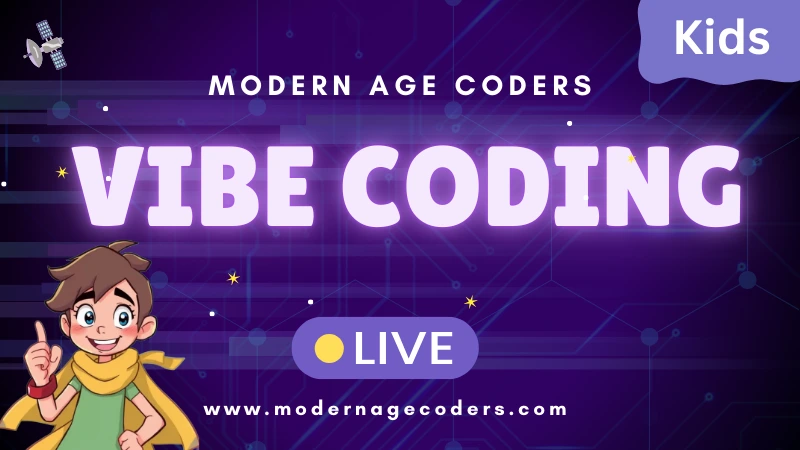
Telling an AI tool what to build, then checking its work. Kids practise giving precise instructions and learn to notice when the machine has quietly guessed.
View syllabus
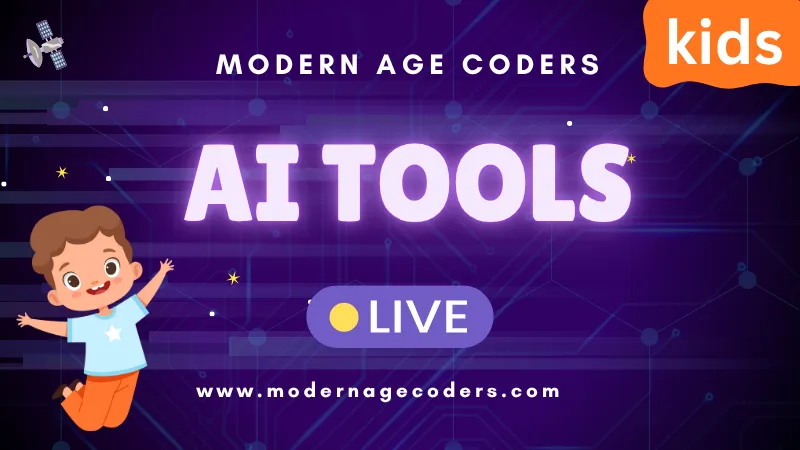
A supervised tour of the tools your child already hears about at school: what they do well, where they fail, and the honest manners of using them.
View syllabus
The full language taken seriously: functions, data structures, files, APIs, and finally programs the teenager designed alone. Strong preparation for any school course examined in Python.
View syllabus

Datasets, training, evaluation and error, learned by doing rather than by lecture. A student finishes able to train a model and, more usefully, explain what it cannot do.
View syllabus
A serious fraction of professional software is now written with AI agents in the loop. Teens learn to direct these tools, read what comes back, and repair it when it is wrong.
View syllabus
For adults who need Python whole, not in fragments: the core language through object-oriented design, closing with a set of finished programs you can show.
View syllabus
A working adult's route into machine learning: real datasets, models you train yourself, and enough theory to judge when a result deserves trust.
View syllabus
Large language models from the builder's side of the counter: calling them from code, grounding them with retrieval, and finishing with compact applications that actually run.
View syllabus
Local context
Riyadh is where most of the Kingdom's technology money currently lands. Ministries are digitising, banks are hiring engineers, consultancies keep opening floors, and Vision 2030 has put software somewhere near the centre of the national conversation. You have heard all this. Your children, growing up in the capital, absorb it without being told.
None of it obliges your child to become a programmer, and we will not pretend a weekly class settles anyone's career. What the class does is smaller and more durable. A child who codes learns to cut a problem into steps, to be wrong twenty times before being right, and to finish things. Those habits transfer: to maths homework, to science fair projects, and eventually to whatever the adult version of that child decides to do in whatever Riyadh has become by then.
For the adults themselves the argument is blunter. Python, data work and AI literacy keep surfacing in the requirement lists of the capital's banks, government digital services, logistics firms and consultancies. An evening course will not hand you a job, and we refuse to promise otherwise. It will leave you with running code, trained models and a portfolio you can open in front of an interviewer, which is the part of the process a course can honestly control.
Our Riyadh students come from national curriculum schools and from the city's international schools, which between them teach British, American, Indian CBSE and IB programmes. We sit beside all of these rather than inside any of them, because we teach the craft itself. A few practical overlaps are worth naming.
Whichever system your child is in, our coursework never collides with school. It runs in the evening, it carries no exams of its own, and its only homework is the project the student already wants to keep working on.
The format
The design has stayed the same for years because nothing about it needs improving in a hurry.
Every session is a teacher and a handful of students on a call at the same moment, working the same problem. Students unmute, put their code on screen and get corrected mid-mistake, which is when correction is worth the most.
Enrolment in a group closes at eight. Under that ceiling a teacher can read faces, spot hesitation and invite the quiet student in the corner to show their screen. Past it, teaching becomes broadcasting.
Weekday lessons sit between late afternoon and nine at night, Arabia Standard Time, so homework has room on either side. Friday and Saturday carry extra slots for families whose weekdays are already full.
Lessons run in English, which is what most of Riyadh's international schools teach in anyway. Instructors handle many students who switch to Arabic at the front door, so they rephrase freely and never let a nod stand in for understanding.
Students end with software that exists: games, tools, small trained models. When a grandparent asks what the class was for, the child can simply run something.
The opening session is free and complete. Enrolment, payment and commitment all wait until after you have seen a real lesson from the inside.
The full ladder
Parents in Riyadh often ask where all of this leads, so here is the whole ladder laid flat. No student climbs it in a year and nobody is expected to. The teacher meets the student in the first session and points at the right rung.
Sequencing, loops and conditions, met first through blocks and stories the child invents. Success at this age has one measurement: whether the child brings up the class before the parent has to.
Typed Python begins, with nothing but a blank editor: variables and conditions first, then functions, then the list and dictionary structures real programs are organised around. Drawing with turtle graphics carries the first weeks, quiz games and small apps carry the rest. Somewhere in this stage the student starts repairing their own errors without calling anyone over, which is the whole point.
Programs begin touching the world: reading files, calling live APIs, wrangling real data. Then machine learning without the mystique. Students gather and clean data, watch training reshape a model's behaviour, and learn why a confident answer is not the same thing as a correct one. A teenager leaves this stage owning a trained model they can defend in plain sentences.
Automation, data analysis, generative AI APIs and the agent tools Codex and Claude Code, all scheduled so the coursework can coexist with a degree or a full-time Riyadh job.
One caution we give every professional: a course can make you capable, but it cannot make anyone hire you. Nobody here will guarantee you a placement, and you should walk away from anyone who does. What we control is the teaching, the code review and the portfolio, so those are what we promise.
Where the fee goes
Instruction is a person's full-time job here, not a side gig. Students frequently keep the same teacher across several courses, which means nothing gets re-explained to a stranger.
The ceiling is the point. Everything parents notice later, the confidence, the questions, the pace, follows from a teacher having so few screens to watch.
Every course closes with artifacts: a game that runs, a script that saves time, a model that predicts. Worksheets do not survive childhood. Projects do.
Completing a course earns a certificate, the kind that slots neatly into a school portfolio or a university application file.
You receive regular notes on what was covered and where your child stands, so progress is something you read about, not something you guess at.
We would rather show you a lesson than write you an argument. Watch one hour of teaching, then decide with evidence.
Verified reviews
Because everything happens online, a Riyadh student sits in a virtual classroom alongside families from many countries. The reviews below come from that wider community, each one real and verified, with plenty more on our Wall of Love.
"My child Dhairya is really enjoying the Modern Age Coders classes. This is his first online class and he eagerly looks forward to it. I can already see his improvement, and the teachers are very cooperative and listen to our suggestions. Overall, I am very happy with the class."
Sonam Oswal
Parent of Dhairya
"The one step solution for my son. Modern Age Coders make learning coding so simple that kids love it. The teachers explain complex concepts clearly with practical exercises and interactive content. The projects were challenging and rewarding."
Ria Mukherjee
Parent
"Modern Age Coders has been a game-changer for me. I struggled to grasp IT concepts and coding before joining, but their classes transformed everything. I can now confidently write complex programs with ease."
Samridho Mondal
Student
"My son has been attending this class for a few months and I have been genuinely impressed with his progress and enthusiasm. The instructors are patient and knowledgeable. He looks forward to every class and his confidence has grown."
Poonam Rathore
Parent
More Saudi guides
This page belongs to our Saudi Arabia guide, which covers the whole country in one place. If your family is elsewhere in the Kingdom, or you want the version written for younger children, start below.
The country-wide guide: every course, every age band, and how the format works across the Kingdom.
The same city, narrowed to ages six to twelve: what starting looks like when the student is a child.
The Red Sea edition, for families on the west coast and their own school calendars.
Dammam, Khobar and Dhahran share a single guide written for the east coast.
Fees
Billing is monthly and in US dollars. The riyal equivalents drift a little as the dollar does, never by much.
Group classes
$40 per month
about SAR 150 per month
One-on-one classes
$100 per month
about SAR 375 per month
There is no joining charge, nothing owed for the demo, and no penalty for stopping. The fee you see is the fee you pay.
Questions
Free demo class
Book the free lesson, sit beside your child, and watch the teaching with your own eyes. Everything we have claimed here is checkable inside that hour, which is exactly why we lead with it.
If WhatsApp is easier, send a message and a mentor calls back the same day.
4.9 rating across 547+ Google reviews