BRE / YOUNG / 01
Coding for Kids
From Scratch games to first apps, grouped by age.
Open the syllabusBremen and Bremerhaven · Coding and Informatik · Ages 10 to 19
The Land Bremen is two cities on the Weser, and for now neither has an Informatik lesson that every pupil must take. The Gesellschaft für Informatik counts Bremen among six Länder without compulsory Informatik, and reports that the Land will introduce the subject step by step from 2027/28. Until then a curious pupil can go from grade 5 to grade 10 without a single timetabled programming lesson. This page covers that gap, the Abitur in 2027, the holidays, and a project on the Land's own budget.
Teaching live online since 2020 · 10,000+ students worldwide · English only, one mentor per pupil
In short
Coding classes for pupils in Bremen and Bremerhaven, from Modern Age Coders, are live online lessons in English for ages of about 10 to 19, in a group of 15 to 20 or one to one, always with the same mentor, who works at the learner's pace and gets used to their accent. Because the Land Bremen has no compulsory Informatik before 2027/28, our Informatik Companion course gives pupils the grounding school does not yet offer.
Where pupils in Bremen start
One course that fills the Sekundarstufe I gap, one for the Leistungskurs and its written exam, and one for contests.
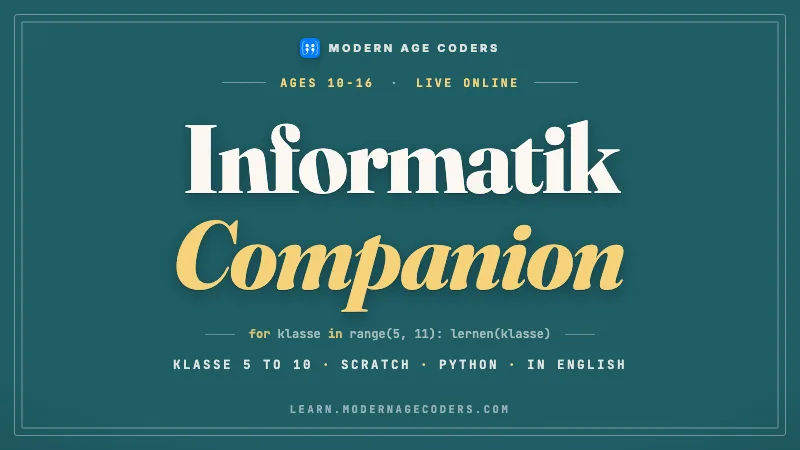
BRE / 01
Aimed at ages 10 to 16: the material a compulsory Informatik subject would cover, which Bremen is only now bringing in, taught two lessons a week.
Open the syllabus →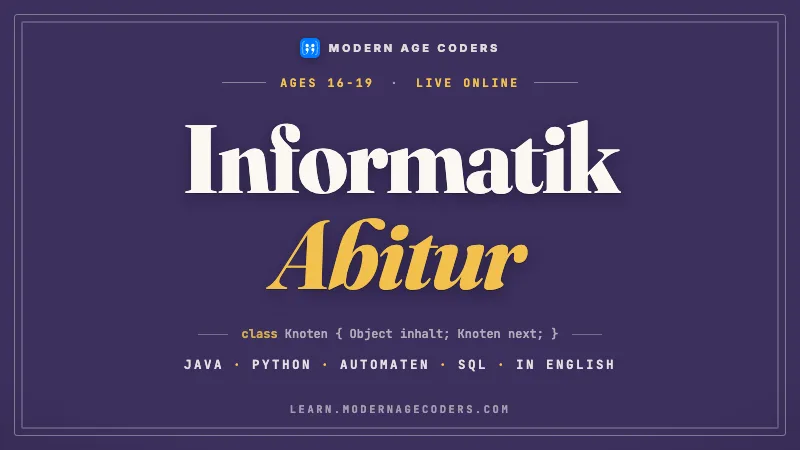
BRE / 02
For the Oberstufe. Data structures, object orientation and databases, with written practice for an exam taken without a computer.
Open the syllabus →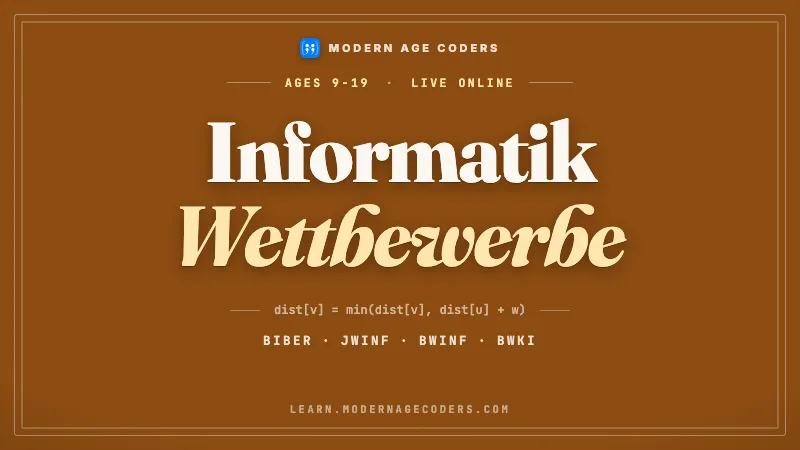
BRE / 03
Ages 9 to 19. Original practice puzzles, then real algorithm problems, written by our mentors.
Open the syllabus →Informatik in the Land Bremen
Not yet. The figures and quotations below come from the 2026/27 Informatik-Monitor of the Gesellschaft für Informatik, which surveys each Land's regulations. We are not connected to the GI or to the Senatorin für Kinder und Bildung.
After four years of Grundschule, pupils in the Land Bremen go to an Oberschule or a Gymnasium. For both, the monitor states plainly that there are no curricular offers with an Informatik focus in the Sekundarstufe I.
The compulsory subject Wirtschaft, Arbeit, Technik in grades 5 and 6 has digital content, but the monitor notes that it aims at media skills, not Informatik. Some schools describe Informatik elements in their own ITG curricula for the Wahlpflicht area.
Bremen is piloting a curriculum in 2025/26 and 2026/27. From the 2027/28 school year it will introduce Informatik as a compulsory subject at all schools, two to four weekly hours in total, step by step.
A pupil in grade 5 today will therefore meet the new subject later in Sekundarstufe I, while pupils now in grades 8 to 10 are likely to finish without it.
| Stage | Grades | Informatik |
|---|---|---|
| Grundschule | 1 to 4 | No subject |
| Oberschule or Gymnasium | 5 to 10 | No curricular Informatik; a compulsory subject is introduced step by step from 2027/28 |
| Einführungsphase | 10 (Gymnasium) or 11 | Two- or three-hour Wahlpflicht elective |
| Qualifikationsphase | 11 to 12 or 12 to 13 | Grundkurs, two to three hours, or Leistungskurs, five hours |
Source: Gesellschaft für Informatik, Informatik-Monitor 2026/27, Bremen page and national comparison, read 2 November 2026. At the Gymnasium the Abitur follows grade 12; Oberschulen with an Oberstufe can run eight-year and nine-year routes.
This is the situation our Informatik Companion course was written for. Two live lessons a week cover what a compulsory subject would: precise algorithms, programming in Python, working with data, how networks move information. When Bremen's own subject arrives, a pupil who has done this is ahead rather than starting cold.
Interest in the Oberstufe is not small: the monitor's Bremen page gives 17 percent of Sekundarstufe II pupils taking Informatik in 2024/25. Given the gap lower down, for most of them that course is likely to be the first timetabled Informatik of their school career.
Oberstufe and Abitur
Bremen's written Informatik Abitur is not one paper for the whole Land. Each school writes its own, and the authority approves it.
A Leistungskurs in Informatik is examined in writing. The monitor explains the process: each school submits its exam tasks in two variants to the authority, which checks and approves them and decides which is used on the main date and which on the second date, sometimes after several rounds of revision.
Tasks are not worked on a computer. Schools apply for the aids they need, such as tables, formula collections, a dictionary or a calculator.
A Grundkurs in Informatik can be an oral exam subject but not a written one. Informatik can be an exam subject at all only if it was taken without a break from the second half of the Einführungsphase through the Qualifikationsphase.
The monitor adds that Informatik cannot be chosen as the third exam subject, and it does not replace a natural science in the course requirements.
| Date | What happens |
|---|---|
| By Monday 18 January 2027 | Schools submit their task proposals to the Fachaufsicht |
| Friday 19 March 2027 | Last day of teaching that counts for the certificate |
| From Tuesday 13 April 2027 | Decentral Leistungskurs papers, on 13 April or a school date up to 5 May |
| Tuesday 27 April 2027 | German, LK and GK |
| Friday 30 April 2027 | English, LK and GK |
| Wednesday 5 May 2027 | Mathematics, LK and GK |
| 10 to 21 May 2027 | Oral exams in the fourth exam subject |
| 24 to 31 May 2027 | Central resit dates |
| By Wednesday 7 July 2027 | Certificates handed out |
Source: Die Senatorin für Kinder und Bildung, Mitteilung Nr. 110/2025 of 22 May 2025, Abiturtermine 2027 im Lande Bremen, read 3 November 2026. The authority notes that schools would be told of any changes in January 2027. Central dates take priority over school dates.
Because a Bremen Leistungskurs paper is written by the pupil's own school, the school's course and its teachers are the surest guide to what will be asked. Our part is the foundations behind any paper: clean code on paper, data structures, databases and the reasoning to explain them. The school and the authority set and mark the Abitur; Modern Age Coders awards no grades or German qualifications.
In English
It means every live lesson, from the first minute, is taught in English. No class is held in German.
Work and study bring families to Bremen and Bremerhaven from abroad. Their children can learn Informatik in the language they think in, while German school life goes on alongside.
For them, a coding lesson in English is two subjects at once. Mentors keep sentences short, repeat key ideas, and accept German school words such as Leistungskurs or Oberschule in a question.
Keywords in Python and Java are English words already. Pupils who learn them in English have one less translation to make when they meet them again in a Bremen classroom.
The mentors are based in India and teach live. Whatever a pupil's city, the teaching stays the same: a mentor who knows them by the second week, lessons where the pupil writes the code, and solutions argued for rather than copied from an answer sheet or an AI tool.
A Land-wide project
The Senatorin für Finanzen publishes the Land's budget line by line, with the plan and the actual result, as open data. Our older pupils use it to learn the most common way a percentage goes wrong: dividing by a base that is zero, or so small that the answer means nothing.
The dataset is Haushalt des Landes und der Stadtgemeinde Bremen 2025 (Ist-Daten), published under CC BY on the Transparenzportal Bremen. We use the file for the Land, downloaded on 3 November 2026. Bremerhaven keeps a budget of its own, so it is not in this file.
Each row is one budget line: its number, its purpose (Zweckbestimmung), the amount planned (Anschlag) and the amount actually booked in 2025, in the last column, headed with the German word for actual. The file is written the German way, with points for thousands and commas for decimals, which the euro() function converts.
For each line, by what percentage did the result differ from the plan? The formula looks harmless: (actual minus plan) divided by plan, times 100.
Version 1 applies it to every line. It reads 8,620 lines and then stops, because some lines were planned at exactly zero.
import csv

def euro(text):
    return float(text.replace(".", "").replace(",", ".")) if text.strip() else 0.0

lines = []
with open("ist_2025_land_utf8.csv", encoding="utf-8") as src:
    table = csv.reader(src, delimiter=";")
    next(table)   # skip the header row
    for row in table:
        # column 2: purpose, column 6: plan, column 8: actual result
        lines.append((row[2].strip(), euro(row[6]), euro(row[8])))

print("Budget lines:", len(lines))
for name, plan, actual in lines:
    change = (actual - plan) / plan * 100
It prints Budget lines: 8620 and then stops with ZeroDivisionError: division by zero.
A crash is a good result here, because it tells the truth: for a line with no plan, "percent of the plan" has no answer. Version 2 replaces the loop at the end of Version 1. It counts the zero-plan lines separately and computes the percentage only where a plan exists.
no_plan = [l for l in lines if l[1] == 0]
print("Lines with a plan of 0:", len(no_plan))
print("...of which money moved anyway:", sum(1 for l in no_plan if l[2] != 0))

planned = [l for l in lines if l[1] != 0]
wildest = max(planned, key=lambda l: abs((l[2] - l[1]) / l[1]))
print("Largest change:", wildest[0][:40], round((wildest[2] - wildest[1]) / wildest[1] * 100), "%")
It prints Lines with a plan of 0: 5355, ...of which money moved anyway: 1068 and Largest change: Erstattungen / Rückzahlungen von Zuwendu 94034 %.
The program no longer crashes, but its headline is useless. A change of 94,034 percent sounds dramatic; it only means the plan for that refund line was tiny. A small base makes every percentage enormous. Version 3 asks the question again, only for lines planned at ten million or more.
big = [l for l in planned if l[1] >= 10_000_000]
big.sort(key=lambda l: (l[2] - l[1]) / l[1])
print("Lines planned at 10 million or more:", len(big))
for name, plan, actual in big[:1] + big[-1:]:
    print(name[:40], "|", round(plan / 1e6, 1), "->", round(actual / 1e6, 1), "million |", round((actual - plan) / plan * 100), "%")
It prints Lines planned at 10 million or more: 127, Risikoabdeckung im Leistungsbereich Land | 55.0 -> 0.0 million | -100 % and Disagio | 20.0 -> 56.7 million | 184 %.
| Check | Result |
|---|---|
| Budget lines in the file | 8,620 |
| Lines planned at zero | 5,355 |
| Zero-plan lines where money was booked anyway | 1,068 |
| Lines planned at 10 million or more | 127 |
Data: Die Senatorin für Finanzen, Freie Hansestadt Bremen, Haushalt des Landes und der Stadtgemeinde Bremen 2025 (Ist-Daten), file for the Land, licence CC BY, via Transparenzportal Bremen, downloaded 3 November 2026. All counts and percentages are our own and describe lines of the file, not the Land's official budget totals.
School year 2026/27
Bremen and Bremerhaven share one holiday calendar. These are the first and last holiday days.
| Break | Starts | Ends |
|---|---|---|
| Herbstferien | Mon 12 Oct 2026 | Sat 24 Oct 2026 |
| Weihnachtsferien | Wed 23 Dec 2026 | Sat 9 Jan 2027 |
| Winter break | Mon 1 Feb 2027 | Tue 2 Feb 2027 |
| Osterferien | Mon 22 Mar 2027 | Sat 3 Apr 2027 |
| Free days | Fri 7 May 2027 | Tue 18 May 2027 (two separate days) |
| Sommerferien | Thu 8 Jul 2027 | Wed 18 Aug 2027 |
Source: KMK, Ferien im Schuljahr 2026/2027 (dated 9 October 2025), Bremen row. The KMK sets the summer holidays long in advance and publishes the Länder's own dates for the rest.
Destatis gives the Land Bremen 704,881 inhabitants on 31 December 2024: 586,271 in the city of Bremen and 118,610 in Bremerhaven. It is the smallest Land by population.
Online lessons take the river out of the equation. A pupil in Bremerhaven and one in Bremen-Nord share the same live class.
For a candidate in 2027, certificate-relevant teaching ends on 19 March, the Easter holidays fill 22 March to 3 April, and the decentral Leistungskurs papers can start on 13 April.
Easter is the natural place for a full practice paper written on paper and timed, followed by a week of work on whatever it uncovered.
Class times
After school in Bremen is evening in India, and a Sunday morning in Bremen is the mentor's early afternoon. These rows show the offset; your booking sets the actual slot.
| Bremen | India before 28 March 2027 | India from 28 March 2027 |
|---|---|---|
| 15:45 | 20:15 | 19:15 |
| 18:30 | 23:00 | 22:00 |
| Sunday 10:30 | 15:00 | 14:00 |
Time rules: the Einheitenzeitgesetz fixes Central European Time (UTC+1) and Central European Summer Time (UTC+2) for Germany. Clocks went back on 25 October 2026 and go forward on 28 March 2027. India, at UTC+5:30 all year, leads by four and a half hours in winter and three and a half in summer.
Milestones
Stages we wrote ourselves, to place a pupil in Bremen or Bremerhaven and to describe progress.
| Stage | Typical grade | The pupil can |
|---|---|---|
| 1. Exact instructions | 5 to 6 | Write steps a stranger could follow without asking |
| 2. Programs | 6 to 7 | Use loops, conditions and variables in Python |
| 3. Numbers that mean something | 7 to 9 | Compute averages and percentages in code, and guard against bad input |
| 4. Data files | 9 to 10 | Read a real public file, convert German number formats, summarise it |
| 5. Oberstufe | 10 to 13 | Design classes and data structures and write them cleanly on paper |
Stage 3 is the budget project: knowing when a percentage is meaningless is a skill for life, not only for Informatik.
Reports tell you what your child can now do, in plain words.
Before you divide, ask what you are dividing by.
A huge percentage is a question, not an answer.
More courses
Live and in English, with one regular mentor for each pupil, in a group or one to one.
BRE / YOUNG / 01
From Scratch games to first apps, grouped by age.
Open the syllabusBRE / YOUNG / 02
Scratch, Roblox and Minecraft in one long course.
Open the syllabusBRE / YOUNG / 03
Percentages, graphs and patterns, explored in Python.
Open the syllabusBRE / MID / 01
A full Python course, beginner to confident.
Open the syllabusBRE / MID / 02
Public data, charts and honest conclusions.
Open the syllabusBRE / MID / 03
HTML, CSS and JavaScript to working web pages.
Open the syllabusBRE / UPPER / 01
Object-oriented programming, a common Leistungskurs language.
Open the syllabusBRE / UPPER / 02
Relational databases from first query to joins.
Open the syllabusBRE / UPPER / 03
For the maths paper on Wednesday 5 May 2027.
Open the syllabusHow classes run
Weekdays or weekends, flexible: choose your batch, or for a very personalised plan choose 1-on-1 at your convenience, weekend mornings or weekdays.
Late afternoon
After school and homework, on weekdays.
Evenings
For older pupils who prefer to work later.
1-on-1
A time agreed with the mentor, around exams.
One mentor, every week, who knows where the pupil stands.
Short sentences, key words on screen, German terms understood.
The mentor guides; the pupil does the typing and the thinking.
Planned around Bremen's holidays and Abitur dates.
A brief update after each block of lessons.
Fifteen to twenty pupils, or one to one.
Student work
A few projects by older students are shown below. The student labs page has the rest.

AI and ML
An AI nutrition coach that reads what you eat and works you toward a target.

AI and ML
A chatbot that answers mathematics and programming questions, built and deployed by a student.

AI and ML
An assistant that helps a young person recognise unsafe situations online.

Web app
A weather forecasting site with live conditions for any location.
Fees
A month of lessons means eight live classes, paid monthly, and you can cancel for the next month at any time. We show fees in euro, calculated from the European Central Bank reference rate; the card payment itself is in US dollars, and your bank converts it, which can leave the statement a little different.
Free first class
Free
no card required
Group batch
€90
a month, eight live classes, charged in US dollars
One to one
€134
a month, eight live classes, charged in US dollars
What families say
Google reviews by parents and students, reproduced as written.
★★★★★
"The one step solution for my son. Modern Age Coders make learning coding so simple that kids love it. The teachers explain complex concepts clearly with practical exercises and interactive content."
Ria Mukherjee
Parent
★★★★★
"Modern Age Coders has been a game-changer for me. I struggled to grasp IT concepts and coding before joining, but their classes transformed everything. I can now confidently write complex programs with ease."
Samriddha Mondal
Student
★★★★★
"One of the most wonderful education centres out there. Education is not limited to school syllabus but focuses on skill development."
Vansh Agarwal
Student
★★★★★
"My child Dhairya is really enjoying the Modern Age Coders classes. This is his first online class and he eagerly looks forward to it. I can already see his improvement, and the teachers are very cooperative."
Sonam Oswal
Parent of Dhairya
★★★★★
"Modern Age Coders have wonderful teachers who teach in a clear, easy and practical way. The teacher boosts students' confidence and inspires them to learn without hesitation."
Sonu Goyal
Parent
★★★★★
"I highly recommend this computer coding class! The teachers are incredibly knowledgeable and passionate about coding."
Ritu Kedia
Parent
Families in Bremen ask
No. All classes are live and taught in English only. Mentors adapt their pace and get used to each pupil's accent, and German school words such as Leistungskurs or Oberschule are fine in a question.
Not yet. The Gesellschaft für Informatik's Informatik-Monitor 2026/27 names Bremen among six Länder without compulsory Informatik for all pupils. It reports that Bremen will introduce a compulsory subject of two to four weekly hours in total, step by step from 2027/28.
According to the Informatik-Monitor, neither the Oberschule nor the Gymnasium has curricular Informatik in Sekundarstufe I at present. Some schools include Informatik elements in their own ITG electives.
No. The Informatik-Monitor explains that each school submits its Leistungskurs tasks in two variants to the authority, which approves them and decides which is used on the main and second dates. Tasks are not worked on a computer.
No. The Informatik-Monitor states that a Grundkurs in Informatik can be examined orally but not in writing. A written Informatik exam is only possible in the Leistungskurs.
The Senatorin für Kinder und Bildung lists the written maths exam, LK and GK, on Wednesday 5 May 2027. German is on 27 April and English on 30 April 2027; the central resit dates run from 24 to 31 May 2027.
Weekdays or weekends, flexible: choose your batch, or for a very personalised plan choose 1-on-1 at your convenience, weekend mornings or weekdays. India is 4 hours 30 minutes ahead of Bremen in winter and 3 hours 30 minutes in summer.
No. We teach alongside school and award no German grades or qualifications. The school and the authority set and mark the Abitur.
From India, live over video and in English. A pupil keeps the same mentor from week to week.
Monthly. Fees are shown in euro at the European Central Bank reference rate and charged in US dollars, so your bank converts the amount. The first class is free and needs no card.
Elsewhere on this site
More for families in the Land Bremen.
The full set of our Germany pages.
How Bremen compares with the other fifteen.
The Oberstufe subject in detail.
Maths and computing, stage by stage.
Why we do not let AI do the reasoning.
What happens in a live lesson.
More guides: Coding classes in North Rhine-Westphalia · Coding classes in Lower Saxony · Coding classes in Hesse · Coding classes in Bavaria · Coding classes in Saxony-Anhalt · Coding classes in Schleswig-Holstein · Coding classes in Baden-Württemberg · Coding classes in Saarland · Coding classes in Rhineland-Palatinate · Coding and maths in Berlin · Coding and maths in Hamburg · Coding classes in Saxony · Coding classes in Thuringia · Coding classes in Brandenburg · Coding classes in Mecklenburg-Vorpommern
Start here
The first class is short and practical: a puzzle to think through and a first few lines of code. The mentor gets to know your child's level and English, and recommends a course and a group.
To read more beforehand, how we teach describes a lesson, and all courses lists every syllabus.
WhatsApp us · +91 91233 66161 · connect@modernagecoders.com
Live online with mentors in India, English only. Message us on WhatsApp, in English, for the quickest reply.
A priority demo is a full class of about 45 to 60 minutes. After the class the mentor sends a written skill report and a personal learning roadmap on WhatsApp. If you enrol, the demo fee is adjusted against your first month's fee. Share your demo Order ID with us on WhatsApp and we take it off.
Book a priority demo