COBO / YOUNG / 01
Scratch coding
From a first sprite to complete games in about three months.
Open the syllabusSan Borja, Lima · Live online, in English · Primaria first
Most San Borja parents who ask us about coding have a child in primaria and two questions: is my child old enough, and will they cope with a class in English? This page answers both, grade by grade from 1° to 6° de primaria, using MINEDU's own ages for each grade. It also shows what an hour of live coding looks like for a six-year-old, what the national curriculum does and does not cover, and a Python lesson for the oldest children in primaria.
Teaching children live online since 2020 · 10,000+ learners worldwide · classes only in English
The short answer
Modern Age Coders runs live online coding classes in English for children in San Borja, Lima, from age 6. In the early primaria grades children solve reasoning puzzles and build Scratch games; from about 9, in 4° de primaria, most move to typed Python; teenagers and adults have their own courses. Every class is live on video with a mentor based in India who speaks slow, simple English, in a group of fifteen to twenty children of the same age or one to one, at any hour that suits the family in Peru time.
Where San Borja children start
One for the youngest thinkers, one long course built on Scratch, and one for children who are ready to type.
COBO / 01
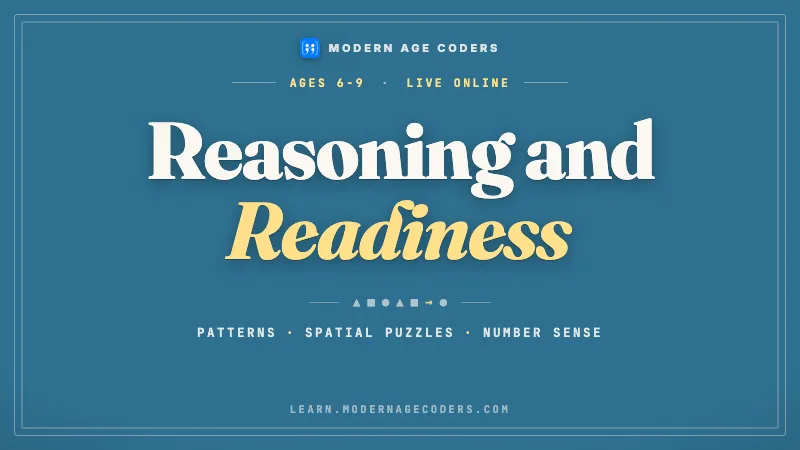
For ages 6 to 9. Patterns, sequences and logic puzzles that train the thinking behind code before any code is typed, in short sessions of very simple spoken English.
Open the syllabus →
COBO / 02
For ages 6 to 12, grouped by age. Scratch stories and games first, then simple apps and a gentle introduction to AI; the usual path through the middle of primaria.
Open the syllabus →
COBO / 03
For children of about 9 to 12 who can read and type. Real Python, turtle drawings and small AI projects, like the word-wrap lesson further down this page.
Open the syllabus →Grade by grade
Quite a lot, if the tools fit the age. MINEDU links each grade to a "normative age", measured on 31 March of the school year, and primaria lasts six years under the Ley General de Educación, Ley 28044. The right-hand columns are our own.
| Grade (MINEDU) | Normative age on 31 March | Where we start (ours) | A typical first project (ours) |
|---|---|---|---|
| Inicial 5 años | 5 | Not yet; we begin at 6 | Ordering picture cards at home |
| 1° de primaria | 6 | Reasoning puzzles, then Scratch | A cat that walks and says hello |
| 2° de primaria | 7 | Scratch | A story with three scenes |
| 3° de primaria | 8 | Scratch, or Roblox from 8 | A catch game with a score |
| 4° de primaria | 9 | Scratch or first Python | A quiz that counts right answers |
| 5° de primaria | 10 | Python | Turtle drawings with loops |
| 6° de primaria | 11 | Python, with small AI projects | A story card that wraps its own text |
| 1° de secundaria | 12 | Python for teens, Java later | Programs that read and summarise files |
Sources: MINEDU, Edades normativas (page and PDF table: the normative age is the age on 31 March of each year, 3 to 16 from Inicial to 5° de secundaria); Ley N.° 28044, Ley General de Educación (primaria lasts six years, secundaria five). Read 8 to 10 November 2026. The two right-hand columns describe our own courses and are not part of any MINEDU document.
Age matters more than grade for us. A child born in April may be the youngest in their grade and a child born in March the oldest, so two classmates can be almost a year apart. We place children by age and by what they can already do, after a free first class.
The jump from blocks to typing usually comes in 4° or 5° de primaria. It depends on reading and typing more than on cleverness: a child who reads fluently and finds the keys without hunting is ready.
The CNEB plan of studies for primaria has 30 teaching periods a week of 45 minutes. Matemática gets 5 in grades 1 and 2 and 4 from grade 3; Inglés gets 2 in the first two grades and 3 from 3° onwards, which is 90 and then 135 minutes a week by our arithmetic.
None of those periods is for computing. The CNEB treats digital skills as a competency shared by every area, number 28, rather than a subject, so a child in a typical primaria never writes a program in class. Bilingual schools in and around San Borja set their own timetables; what each teaches is for the school to say.
Starting at 6
Usually, yes, if the class is built for six-year-olds. That means short tasks, a lot of pointing at the screen, very few words, and a mentor who waits.
Many San Borja children hear English at school, some barely at all. For a six-year-old with very little English we usually suggest starting one to one: the mentor can slow down as much as needed, use gesture and repetition freely, and nobody else is waiting.
A parent sitting nearby for the first few classes helps too, not to translate, but to make the screen feel safe. After a month, most children prefer to be left alone with their mentor.
Children at bilingual schools usually treat the class like any other lesson in English. For them the challenge is the thinking, not the language, and the mentor moves faster through the projects.
Either way, the classes are taught only in English. The mentor understands a Spanish answer and offers the English for it, but does not switch languages. That consistency is what makes the English stick.
For more on the very first year, our pages on coding for six-year-olds in Peru and coding for eight-year-olds go into the detail of each age.
San Borja in figures
INEI counted 6,446 children aged 6 to 11 in San Borja in its 2025 census, out of a total district population of 126,125.
Among the 121,870 people INEI counted in San Borja (it estimates another 4,255 were missed), 4,321 were under 6, 6,446 were 6 to 11 and 7,651 were 12 to 17. People of 60 and over form the largest group, 33,490, or about 27.5% by our division.
Primary-age children are about 5.3% of the people counted. INEI's total splits into 67,994 women and 58,131 men.
Six and a half thousand children spread across six school grades and many schools is not many per age. A specialist coding class in English for seven-year-olds would struggle to fill locally; online, a San Borja seven-year-old joins a full group of seven-year-olds.
Grandparents count too. With so many older residents, we often find a grandparent beside the child at the computer, and sometimes signing up for an adult course of their own.
Source: INEI, Censos Nacionales 2025, Lima Metropolitana indicators, Cuadro N.° 1 and Cuadro N.° 3, saved 8 November 2026. Percentages are our own; we do not add age groups into new totals.
San Borja is bordered by San Isidro, La Victoria, San Luis, Ate, Santiago de Surco and Surquillo. Children in any of those districts join the same groups. Parents who prefer Spanish can read our summer plan for vacaciones útiles de programación en San Borja, which pairs morning sport with coding at home. A Spanish guide for every age, all year, is clases de programación en San Borja.
Why online
Because for a child of six to nine, the journey is often the hardest part of an after-school activity, and a live class at home removes it completely.
We do not quote traffic times; San Borja parents know the afternoon roads better than any table could. What matters is that a forty-five minute class at home costs forty-five minutes, not an afternoon.
Younger children are also tired after school. A class that starts five minutes after a snack, at a familiar table, gets a fresher child than one that starts after a car ride.
Online does not mean a video. The mentor sees each child's screen, speaks to each child by name, and notices when someone is lost. Children in the group see and hear each other too.
What you need: a laptop or desktop with a mouse, a camera and a microphone, and a steady connection. A tablet or phone is not enough for building programs. INEI found that 68.2% of Peruvian children of 6 to 11 used the internet in the second quarter of 2026, the lowest share of any school-age group, so for many children this will be their first serious use of a computer.
A real lesson
This lesson is for children of about 10 to 12 who already type Python. They write a short story and want it to fit on a narrow card, ten letters wide. Splitting text into lines sounds easy, and teaches a surprising amount about counting carefully.
The story is one sentence about a llama and some cactuses. The child writes a function, wrap(text, width), that takes words one at a time and adds each to the current line if it fits, or starts a new line if it does not. This "fill the line, then move on" method is called greedy wrapping.
Before running it, the child predicts the lines on paper. That prediction is the most important part of the lesson.
Version 1 prints bars around each line so we can see its edges. The first line starts with a space. The second line, "jumped over", is 11 letters long on a card only 10 wide. And "extraordinarily" sticks out at 15.
The space at the start comes from adding " " before every word, even the first. The line of 11 comes from forgetting to count the space between words. The long word is a different problem: no rule can fit 15 letters on a line of 10.
story = "The llama jumped over seventeen extraordinarily tall cactuses"

def wrap(text, width):
    lines = []
    line = ""
    for word in text.split():
        if len(line) + len(word) <= width:
            line = line + " " + word
        else:
            lines.append(line)
            line = word
    lines.append(line)
    return lines

for line in wrap(story, 10):
    print("|" + line + "|", len(line))
It prints | The llama| 10, |jumped over| 11, |seventeen| 9, |extraordinarily| 15, |tall| 4 and |cactuses| 8.
import textwrap

story = "The llama jumped over seventeen extraordinarily tall cactuses"

def wrap(text, width):
    lines = []
    line = ""
    for word in text.split():
        if line == "":
            line = word
        elif len(line) + 1 + len(word) <= width:
            line = line + " " + word
        else:
            lines.append(line)
            line = word
    if line:
        lines.append(line)
    return lines

for line in wrap(story, 10):
    print("|" + line.ljust(10) + "|", len(line))
print(textwrap.wrap(story, 10))
It prints |The llama | 9, |jumped | 6, |over | 4, |seventeen | 9, |extraordinarily| 15, |tall | 4, |cactuses | 8, and then ['The llama', 'jumped', 'over', 'seventeen', 'extraordin', 'arily tall', 'cactuses'].
Version 2 starts each line with the first word on its own and adds 1 for the space before every later word. Now no ordinary line goes past 10, and "jumped" and "over" sit on separate lines because together they need 11. The long word still sticks out, and Version 2 keeps it whole on purpose.
The last line uses Python's own textwrap module for comparison. It makes a different choice: it cuts the long word into "extraordin" and "arily", and then fits "arily tall" on one line. Neither answer is wrong. The child has to decide what a story card should do, and that decision, explained in a sentence, is what we are really teaching.
San Borja times
Any time that suits your child. Peru has no daylight saving, so Peru time sits five hours behind UTC all year, and India sits five and a half ahead; ten and a half hours separate San Borja from the mentor's desk on every date. The rows below are conversions, not set slots.
| Peru time, San Borja | India time | Suits |
|---|---|---|
| 08:30 | 19:00 | A child on a summer morning |
| 10:30 | 21:00 | A Saturday class |
| 15:00 | 01:30, next day | A child home after school |
| 17:00 | 03:30, next day | After a snack and some play |
Source: IANA tz database, America/Lima and Asia/Kolkata; neither zone observes summer time. The conversions are our own.
You book in your own time and the mentor sees the India equivalent. Peru's school year started on 16 March 2026, when MINEDU reported 53,631 schools reopening for 6,225,000 pupils; many families start our classes in the January to March summer and keep the same hour once school returns.
Milestones
Our own milestones for children of 6 to 12. They tell us which group a child belongs in, and tell parents what has changed.
| Milestone | Typical age | Your child can | You might hear at home |
|---|---|---|---|
| 1. Steps | 6 | Put three blocks in the right order | "First it walks, then it talks!" |
| 2. Again | 7 | Use a repeat block instead of copying | "I don't need ten blocks, just one." |
| 3. When | 8 | Make something happen on a key or a click | "When I press space, it jumps." |
| 4. Keep | 9 | Store a score that goes up and resets | "The score was wrong, so I fixed it." |
| 5. Type | 10 | Write short Python with loops and if | "Look, I typed it myself." |
| 6. Check | 11 to 12 | Predict output and test an awkward case | "I knew that word would be too long." |
Milestone 6 is the word-wrap lesson above. Listen for the word "because" when your child talks about a program: that is reasoning, not copying.
Our notes home describe what was made and understood, in plain words.
Guess first, then run it. Being wrong is how you find out something new.
Spaces are letters too. Count them.
More courses
Every course here runs live in English; children keep one mentor and can learn in a group or alone.
COBO / YOUNG / 01
From a first sprite to complete games in about three months.
Open the syllabusCOBO / YOUNG / 02
Number sense for ages 5 to 10, built on understanding, not tricks.
Open the syllabusCOBO / YOUNG / 03
Puzzles that build the habits behind every program.
Open the syllabusCOBO / OLDER / 01
Children design and script their own games in Luau.
Open the syllabusCOBO / OLDER / 02
Worlds built with code, from blocks to typing.
Open the syllabusCOBO / OLDER / 03
How AI works and where it fails, for ages 8 to 14.
Open the syllabusCOBO / TEEN / 01
The usual next step after primaria Python.
Open the syllabusCOBO / TEEN / 02
School maths explored in Python, ages 10 to 15.
Open the syllabusCOBO / TEEN / 03
For parents and grandparents who want to code as well.
Open the syllabusHow classes run
Any day, any time, flexible: choose a batch, or for a very personalised plan choose 1-on-1 at the hour that suits your family.
Mornings
Peruvian mornings match the Indian evening, when many mentors teach.
Afternoons
After-school hours in San Borja can be arranged too; just ask.
1-on-1
One child, one mentor, at the hour and pace you choose.
The same friendly face every week.
Simple English, shown as well as said.
Each class ends with something built.
Six-year-olds learn with six-year-olds.
What your child made and what comes next.
Fifteen to twenty children, or one to one.
Student work
Children who carry on into secundaria build impressive things. A few projects by our older students are below, and the student labs page has more.

AI and ML
An AI nutrition coach that reads what you eat and works you toward a target.

AI and ML
A chatbot that answers mathematics and programming questions, built and deployed by a student.

AI and ML
An assistant that helps a young person recognise unsafe situations online.

Web app
A weather forecasting site with live conditions for any location.
Fees
Our plans are monthly and priced in US dollars, paid by card. If you pay with a card in soles, your bank changes the dollars into soles at its own daily rate, so the statement can show a slightly different amount each month.
Free first class
Free
no card required
Group batch
$100 USD
a month, eight live classes
One to one
$150 USD
a month, eight live classes
What families say
Parents' and students' Google reviews, quoted as written.
★★★★★
"The one step solution for my son. Modern Age Coders make learning coding so simple that kids love it. The teachers explain complex concepts clearly with practical exercises and interactive content."
Ria Mukherjee
Parent
★★★★★
"Modern Age Coders has been a game-changer for me. I struggled to grasp IT concepts and coding before joining, but their classes transformed everything. I can now confidently write complex programs with ease."
Samriddha Mondal
Student
★★★★★
"One of the most wonderful education centres out there. Education is not limited to school syllabus but focuses on skill development."
Vansh Agarwal
Student
★★★★★
"My child Dhairya is really enjoying the Modern Age Coders classes. This is his first online class and he eagerly looks forward to it. I can already see his improvement, and the teachers are very cooperative."
Sonam Oswal
Parent of Dhairya
★★★★★
"Modern Age Coders have wonderful teachers who teach in a clear, easy and practical way. The teacher boosts students' confidence and inspires them to learn without hesitation."
Sonu Goyal
Parent
★★★★★
"I highly recommend this computer coding class! The teachers are incredibly knowledgeable and passionate about coding."
Ritu Kedia
Parent
San Borja parents ask
No. Every class is live, online and taught only in English. With young children the mentor uses very simple words, gestures and the screen itself, so a child can follow before they understand every word. A child may answer in Spanish; the mentor understands and replies in English.
No, for the right kind of class. At 6, children solve reasoning puzzles and drag Scratch blocks; they do not type code. Sessions are short and active. Most six-year-olds in 1° de primaria manage well, especially one to one at first.
Usually around 9, in 4° de primaria, once they read fluently and type without hunting for keys. The mentor suggests the move when a child is ready, not on a fixed date.
Any day, any time, flexible: choose a batch, or for a very personalised plan choose 1-on-1 at the hour that suits your family. India is ten and a half hours ahead of Peru all year, so 10:30 in San Borja is 21:00 in India.
Yes: a laptop or desktop with a mouse, a camera and a microphone. Tablets and phones are fine for watching but not for building programs. A shared family computer works if the hour is planned around it.
Not as a subject. The CNEB plan of studies for primaria has no computing period; digital skills are a competency shared across subjects. Some private and bilingual schools add their own computing classes.
No adult chatbot accounts. Claude is for users aged 18 and over, and ChatGPT requires a parent's permission under 18. Children learn how AI works through our own child-safe projects and learn to reason before using any tool.
No. We have no premises in San Borja or anywhere in Peru, and we are not connected with the municipality, MINEDU or any school. All classes are live online with mentors in India. Children who complete a course receive our certificate of completion.
Monthly, by card, in US dollars. A card in soles is converted by your bank, so the figure can vary slightly from month to month. The first class is free and needs no card.
Elsewhere on this site
More for parents of young coders in San Borja.
How children in Peru learn code in English.
Our guide for families across Peru.
The block-based start, explained.
What a ten-year-old can do in Python.
Minimum ages for popular AI tools.
A live class from start to finish.
Part of the guide: Every Peru page
More guides: Coding and AI classes in Peru · En español: clases de programación en inglés · Start here: English-medium coding in Lima · By age and stage: AI and coding for professionals · Subjects and courses: AI agents course · Exams, olympiads and school holidays: IB computer science tutor · Guides to choosing: An English-taught option to Crack The Code · Regions of Peru: Amazonas region · Lima and Callao districts: Programación para niños en Ancón
Start here
In the free class your child makes something small and fun with a mentor, perhaps a sprite that dances or a first line of Python. The mentor sees how your child thinks and how much English they follow, and then suggests a course, a group or one-to-one start, and a time that suits your family.
Want to read first? How we teach describes a class, and the course list shows every syllabus.
WhatsApp us · +91 91233 66161 · connect@modernagecoders.com
All classes are live on video and in English, with mentors based in India. You can message us on WhatsApp in English.
A priority demo is a full class of about 45 to 60 minutes. After the class the mentor sends a written skill report and a personal learning roadmap on WhatsApp. If you enrol, the demo fee is adjusted against your first month's fee. Share your demo Order ID with us on WhatsApp and we take it off.
Book a priority demo