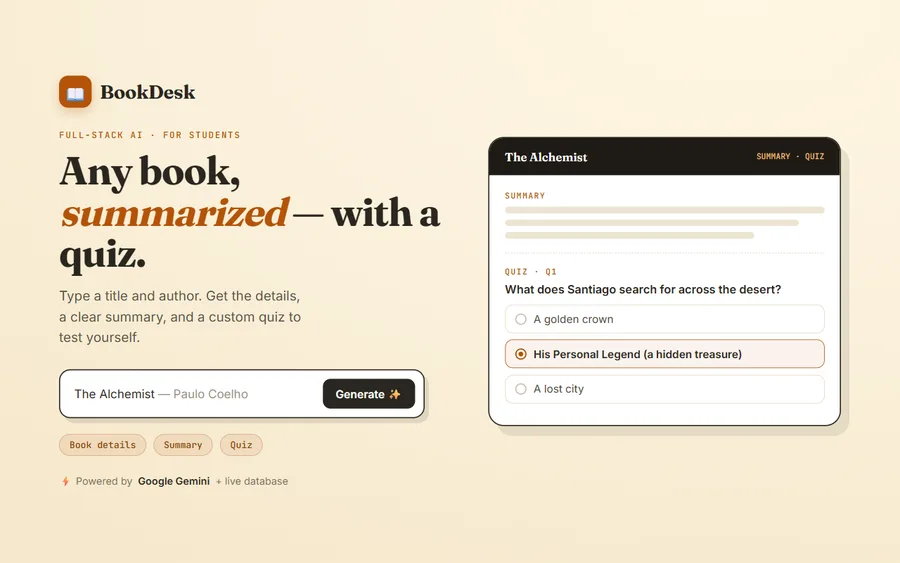
Live online · Abu Dhabi, island and mainland
Live, teacher-led coding classes for children, teenagers and adults across Abu Dhabi. Five to eight students on a video call with one teacher, writing and running real code for an hour every week, in slots timed for capital evenings and weekends.
Because the classes are online, a student in Khalifa City and a student on Reem Island sit in the same small class with the same teacher. Nobody crosses a bridge for it, and nobody waits in traffic on Sheikh Zayed Bridge to learn a for loop.
4.9 rating across 547+ Google reviews
01 · Courses
Every course below runs as a weekly live cohort, and every card opens the full syllabus, schedule and fees. Pick the band first; the free demo settles the exact course.
Children type real Python early: turtle drawings, dice games, quiz programs, plus a truthful first look at what AI actually does behind the screen.
View syllabus
A child describes a program, an AI assistant drafts it, and the child learns the harder skill: checking whether the draft really does what was asked.
View syllabus
The chatbots and image tools kids already whisper about at school, explored with a teacher present and clear rules about where these tools go wrong.
View syllabus
A complete grounding: variables to functions to files to APIs, ending in projects the teenager chose, built and can explain without notes.
View syllabus

Real datasets and real training runs. Teens build classifiers, watch them fail on edge cases, and learn to ask why the model got it wrong.
View syllabus
AI coding agents taken seriously: write a precise brief, read every line that comes back, and own the result the way an engineer has to.
View syllabus
Zero to competent in one track: syntax, data structures, object-oriented design and the working habits that make code worth showing to someone.
View syllabus
Regression through neural networks with the mathematics explained rather than waved away, practised on datasets that push back a little.
View syllabus
Large language models in working practice: prompting that holds up, API integration, retrieval, and small applications that run end to end.
View syllabus
02 · The format
Six facts describe the whole format. There is no seventh hiding in the fine print.
A
Each class is a live video call where students share their screen and write code with the teacher watching. Mistakes get caught while the thought is still fresh, not marked a week later.
B
Batches hold five to eight students so the teacher hears from each one, every single week. Families who want a private pace can take the same syllabus one-on-one.
C
Weekday classes run in the evening band, about 4:00 to 9:00 PM GST, once school buses and office traffic are done. Saturday and Sunday slots serve the weekend. The UAE keeps one timezone all year, so a slot chosen in September is still right in June.
D
Classes run in English, the working language of most Abu Dhabi schools. Many of our students speak Arabic, Hindi, Urdu or Malayalam at home; our teachers explain plainly and ask students to say ideas back.
E
Courses close with working software: a game, an automation script, a trained model. The student can run it again next year, improve it, or show it to a sceptical uncle.
F
The first class is free and identical to every paid one, same teacher, same batch format. If that hour does not convince you, nothing we write here should.
03 · Local context
Abu Dhabi plans in decades. The emirate that holds the federal government, the country's largest sovereign funds and its energy headquarters has spent recent years building the other half of its future: Hub71 gathers technology startups downtown, the Technology Innovation Institute publishes open AI models under the Falcon name, and universities from Khalifa University to NYU Abu Dhabi and Sorbonne Abu Dhabi anchor a research corridor that did not exist a generation ago. A child growing up here will finish school in a city where writing software is treated as ordinary professional equipment, the way drafting a memo once was.
School introduces the subject; it rarely supplies the hours. Computing lessons shared among twenty five students leave little time for the unglamorous middle of learning to program, which is writing something, watching it fail, and fixing it while someone experienced looks on. A weekly class of five to eight exists to supply exactly those hours. That practice, repeated over months, is the whole product.
Private education in the emirate is regulated by ADEK, and the school map it oversees is unusually varied: British and American schools on the island and in Khalifa City, Indian-curriculum schools with long waiting lists, IB schools on Saadiyat and beyond. We do not partner with any school and follow no single board. The coursework runs beside all of them, and the overlaps are concrete rather than decorative:
Abu Dhabi's geography spreads families wide: the island, Reem and Saadiyat, Khalifa City, Al Reef, Mohammed Bin Zayed City, and Al Ain a hundred and sixty kilometres inland. An after-school activity that requires a drive quietly excludes most of that map. An online class does not care about the map at all. The student from Al Ain and the student from the Corniche log into the same hour with the same teacher, and neither family spends an evening in the car.
The capital's employers, government and semi-government bodies, the energy sector, the financial firms around ADGM, the startups inside Hub71, increasingly expect Python, data handling and AI tooling somewhere on a CV. We will not tell you a course changes a career by itself; nobody honest says that. What an evening track gives a working adult is evidence: scripts that run, a model you trained, projects you can open in an interview and walk through line by line. Classes sit after office hours, the workload is steady, and the teacher assumes you are there for the real thing.
04 · The curriculum
The nine courses above sit on one line of progression. Students join wherever their age and experience place them; the free demo is where the teacher finds that point.
Making the screen obey Ages 6 to 9
Sequences, loops and conditions learned by building things a child actually wants to exist. Typed code arrives early and gently. The test of progress at this age is behavioural: the child drags a parent over to show what they made.
Real Python, from a blank file Ages 9 to 14
Variables, types, functions, lists and dictionaries, with turtle graphics keeping the first programs visible on screen. Somewhere in this stage the error message stops being a scolding and becomes an instruction, which is the moment a programmer appears.
Data first, then models Ages 13 to 18
Files, APIs and real datasets before any machine learning, then machine learning taught honestly: what training does, what a model cannot know, why it fails where it fails. The closing project is a model the teenager trained and can defend out loud.
Adult competence College and career
Automation, data work, generative AI APIs and coding agents such as Codex and Claude Code, for people with lectures in the morning or a job in hand.
No placement promises, because we do not make claims we cannot keep. Graduates leave with projects that run and the ability to explain them, which is what interviews actually examine.
05 · Plain reasons
Instructors here teach for a living, and a student keeps their teacher through the course wherever possible. A teacher who remembers last week's struggle teaches this week better.
Five to eight students is not a promotional line, it is the product. Attention is what tuition buys, and attention divided by forty is a webinar.
Every course ends in software that exists and runs. A finished project teaches judgement in a way a completed worksheet never will.
Completion certificates name the project that earned them. They slot into school portfolios and university applications without exaggerating anything.
Progress updates arrive in sentences: what was covered, what the student found hard, what comes next. Not a percentage in a portal.
You watch a full, ordinary class first. The risk of trying us is one hour of an evening, and we think that hour argues well for itself.
06 · Verified reviews
We teach live and online, so students from the United Arab Emirates join the same small batches as our community worldwide. These are real, verified reviews, and the full set lives on our Wall of Love.
"My child Dhairya is really enjoying the Modern Age Coders classes. This is his first online class and he eagerly looks forward to it. I can already see his improvement, and the teachers are very cooperative and listen to our suggestions. Overall, I am very happy with the class."
Sonam Oswal
Parent of Dhairya
"Modern Age Coders has been a game-changer for me. I struggled to grasp IT concepts and coding before joining, but their classes transformed everything. I can now confidently write complex programs with ease."
Samridho Mondal
Student
"Mivaan enjoys the class. He understands the concepts and completes his tasks with excitement. He has started taking real interest in coding. Truly an amazing class."
Shradha Saraf
Parent of Mivaan
"Modern Age Coders have wonderful teachers who teach in a clear, easy and practical way. The teacher boosts students' confidence, keeps them updated with technology, and inspires them to learn without hesitation."
Sonu Goyal
Parent
07 · Nearby guides
This page covers Abu Dhabi. The guides below answer the neighbouring questions.
The country guide: how one set of live online classes serves students in all seven emirates, and what stays constant wherever you live.
Read the guide
The Dubai page, for families down the E11: same courses, same format, written for the city's own school landscape.
Read the guide
For Sharjah families weighing quality against cost, with the commute taken out of the equation entirely.
Read the guide
A parent's guide to ages six to twelve: first classes, progress, and what a child actually builds month by month.
Read the guide
08 · Fees
Billing is monthly and in US dollars. Since the dirham is pegged to the dollar, the AED figures below do not wander.
Group classes
$40 per month
about AED 150 per month
One-on-one classes
$100 per month
about AED 370 per month
No registration fee, no long lock-in, no hidden charges. If the demo does not earn the enrolment, you owe nothing at all.
09 · Questions
10 · Free demo class
The demo is a complete live class, not a highlight reel. The student writes code that runs before the hour ends, and you watch it happen. Then you decide, with something concrete to decide on.
Prefer WhatsApp? Message us and a mentor replies during Abu Dhabi daytime hours.
4.9 rating across 547+ Google reviews