CHE / K / 01
Scratch for Kids
Zero to a finished game of their own.
Open the syllabusHessen · Coding and Informatik · Ages 10 to 19
In Hessen, no pupil has to learn Informatik. Not in Grundschule, not in grades 5 to 10, at none of the Land's seven secondary school types. The Gesellschaft für Informatik also reports that no binding plan to introduce the subject is known. Some Gymnasien offer an hour a week from grade 7; many pupils never meet it until the Oberstufe. This page explains the rules, the 2027 Landesabitur days, the holidays, and a project on how Hessen's land is used.
Online since 2020 · 10,000+ students worldwide · live lessons in English with one mentor
In short
Modern Age Coders runs coding classes for pupils in Hesse aged about 10 to 19: live online, in English, in a class of 15 to 20 or one to one, with the same mentor every week, who keeps to the pupil's speed and accent. Since Informatik is not compulsory at any school type in Hessen, our Informatik Companion course gives pupils the grounding that school leaves to chance.
Where Hessen pupils start
A course for the years when Hessen offers little or no Informatik, one for the Oberstufe and the Landesabitur, and one for contests.
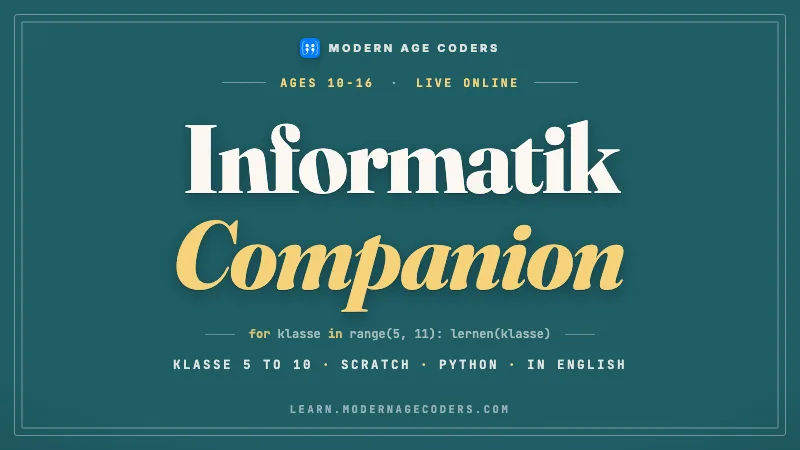
CHE / 01
For 10 to 16. The programming, algorithms and data work that a Hessen timetable may never include, in two live lessons a week.
Open the syllabus →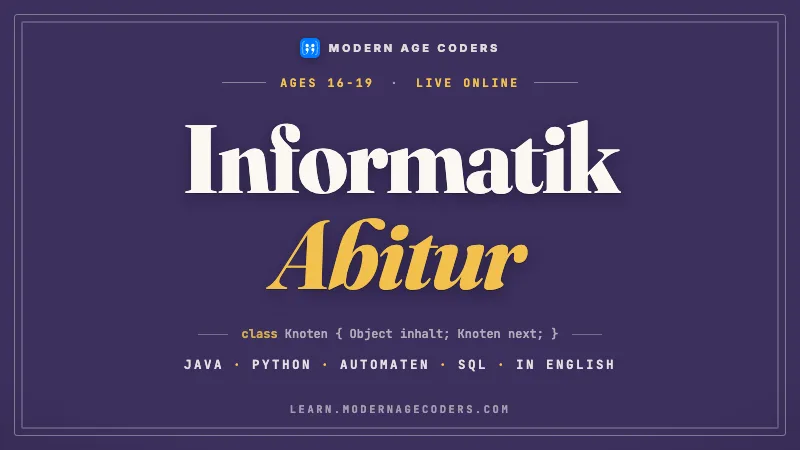
CHE / 02
For the Grundkurs or the Leistungsfach. Modelling, data structures and databases, rehearsed on paper for a central exam.
Open the syllabus →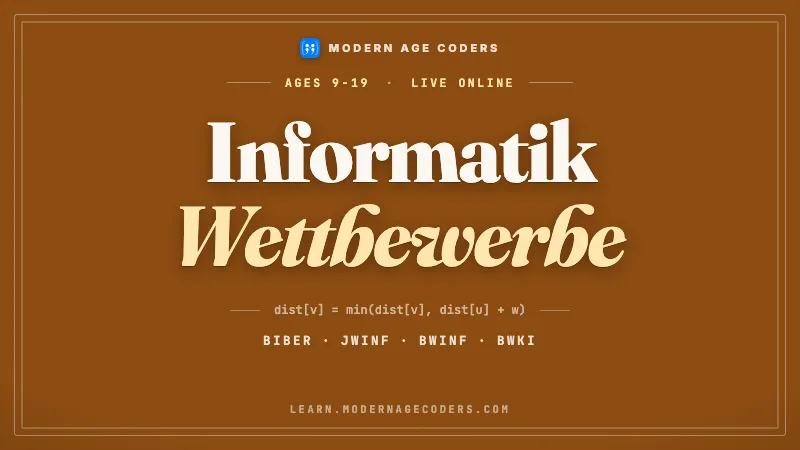
CHE / 03
From 9 to 19. Our own puzzles in the Biber style, then algorithm problems of Bundeswettbewerb difficulty.
Open the syllabus →Informatik in Hessen
No. The rules below are summarised from the Gesellschaft für Informatik's Informatik-Monitor 2026/27, which compiles each Land's regulations. Modern Age Coders is independent of the GI and of the Hessian ministry.
After Grundschule, Hessen has seven secondary school types: Hauptschule, Mittelstufenschule, verbundene Haupt- und Realschule, Realschule, integrated and cooperative Gesamtschule, and Gymnasium. The monitor states that across all of them there is no compulsory Informatik.
At the Gymnasium, Informatik can be offered as an elective of one hour a week from grade 7. In the Haupt- and Realschule tracks it can be set up as a Wahlpflicht subject, but the monitor notes there is no curriculum of its own for those tracks.
From 2022/23 Hessen trialled a subject called "Digitale Welt" at pilot schools. The monitor reports that from 2026/27 it may only be offered within the all-day programme, so it is no longer part of those schools' timetables.
Nationally, the GI names Hessen among six Länder with no compulsory Informatik for all, and among three where no binding plan to introduce it is known.
| Stage | Informatik |
|---|---|
| Grundschule, grades 1 to 4 | No subject |
| Gymnasium, from grade 7 | Optional Wahlunterricht, one hour a week, if offered |
| Haupt- and Realschule tracks | Wahlpflicht possible, without its own curriculum |
| Einführungsphase | Two to three hours if offered; no prior Informatik needed |
| Qualifikationsphase | Grundkurs of two or three hours, or Leistungsfach of five |
Source: Gesellschaft für Informatik, Informatik-Monitor 2026/27, Hessen page and national comparison, read 2 November 2026. The Gymnasium middle years run for five years (grades 5 to 9) or six (grades 5 to 10), or both in parallel.
The monitor's remark about the Einführungsphase is telling: no prior knowledge from the Sekundarstufe I is required. It has to be that way, because for many pupils there was none. A pupil who arrives in grade 10 or 11 already able to program, read data and reason about algorithms starts the Oberstufe course with a real advantage, and that is what our Companion course builds.
The Hessen page gives about 10 percent of Sekundarstufe II pupils taking Informatik in 2024/25 and about 5 percent of Abitur candidates with it as an exam subject. In 2025/26 the Land had 485 qualified Informatik teachers, about 2 percent of its teaching staff.
Oberstufe and Landesabitur
Hessen's Landesabitur sets Informatik centrally, the same paper across the Land, and the ministry has published the days for 2027.
A Leistungsfach in Informatik is examined in writing. A Grundkurs taken without a break through the Einführungs- and Qualifikationsphase can be the third, written exam subject, the fourth, oral one, or the fifth, as a presentation, special learning achievement or oral exam.
The monitor adds that Informatik counts towards the overall Abitur grade like any other exam subject, and can partly replace a natural science in the course requirements.
The written tasks are set centrally and are the same throughout Hessen. Practical work on a computer is not permitted.
The only aids are a list of operators, the instruction verbs that tell a candidate what kind of answer is wanted, and a dictionary. Everything else must be in the candidate's head and pen.
| Day | Leistungskurs | Grundkurs |
|---|---|---|
| Thursday 15 April 2027 | None | Informatik and other Grundkurs subjects |
| Friday 16 April 2027 | Biology | Biology |
| Monday 19 April 2027 | Informatik and other Leistungskurs subjects | None |
| Tuesday 27 April 2027 | German | German |
| Friday 30 April 2027 | English | English |
| Wednesday 5 May 2027 | Mathematics | Mathematics |
Source: Hessisches Ministerium für Kultus, Bildung und Chancen, Termine Landesabitur, read 3 November 2026. The written exams run from 15 April to 5 May 2027 and the resits, also set centrally, from 18 May to 3 June 2027; Informatik resits are on 18 May (Grundkurs) and 20 May 2027 (Leistungskurs).
A central paper written by hand, with an operator list and nothing else, rewards a particular kind of practice: reading an operator and answering exactly that, writing code that is correct without a compiler, and explaining a design in words. We train those habits beside the school course. The Landesabitur and the school's grades decide the result; we teach, and award no German qualifications.
English-medium lessons
Every lesson is taught live and in English; we offer no German-language classes. That is said up front so no family is surprised at the first lesson.
Work and study bring families to Hessen from across the world. Their children can learn Informatik in the language they think in, while school continues in German or in an international programme.
For a pupil at a German school, an English coding lesson doubles as English practice. Mentors keep explanations simple, write new words on screen, and recognise German terms like Leistungsfach or Wahlunterricht.
Programming languages are written with English keywords. Learning them in English simply removes a translation step.
Our mentors work from India and teach on live video. The standard is identical everywhere: one mentor who follows the pupil from week to week, the pupil writing the code, and reasoning that the pupil can explain, never an answer copied from a solutions page or an AI tool.
A Land-wide project
The Hessisches Statistisches Landesamt publishes its Kreiszahlen, a workbook of figures for every Kreis, twice a year. Table 38 shows how the Land's surface is used. Before any program can answer a question about it, the pupil has to read two small German words in the header.
We downloaded the October 2026 edition of the Hessische Kreiszahlen on 3 November 2026 and exported Table 38, "Bodenfläche in Hessen 2025 nach Nutzungsart", to bodenflaeche_2025.tsv. The series is listed under CC BY on Open Data Hessen, and the workbook allows reproduction with the source named. The figures are in hectares, as at 31 December 2025.
For each Kreis and for the whole Land there is a total, then columns for settlement, transport, vegetation, farmland, forest and water.
Above the columns, the table says "davon", meaning "of which, making up the whole". Above farmland and forest it says "darunter", meaning "among which, a selection". Farmland and forest are part of vegetation, not separate from it.
Version 1 ignores the header and adds every column for the Land. The result is about 1.8 times the size of Hessen.
import csv

areas = {}
with open("bodenflaeche_2025.tsv", encoding="utf-8") as src:
    for row in csv.reader(src, delimiter="\t"):
        if len(row) > 8 and row[0].isdigit() and row[2].isdigit():
            areas[(row[0], row[1])] = [int(x) for x in row[2:9]]

total, settled, transport, vegetation, farmland, forest, water = areas[("000000", "Land Hessen")]
print("Total area:", total, "ha")
print("Sum of all six columns:", settled + transport + vegetation + farmland + forest + water, "ha")
It prints Total area: 2111563 ha and Sum of all six columns: 3826423 ha.
The program has counted most of the land twice: once as vegetation, and again as farmland or forest. Version 2 follows the header. It adds only the "davon" columns, checks that farmland and forest fit inside vegetation, and then tests every row of the table the same way.
print("Sum of the davon columns:", settled + transport + vegetation + water, "ha")
print("Farmland + forest inside vegetation:", farmland + forest, "of", vegetation, "ha")

gaps = {key[1]: v[1] + v[2] + v[3] + v[6] - v[0] for key, v in areas.items()}
print("Rows off by rounding:", sum(1 for g in gaps.values() if g), "largest gap:", max(abs(g) for g in gaps.values()), "ha")
It prints Sum of the davon columns: 2111563 ha, Farmland + forest inside vegetation: 1714860 of 1740399 ha and Rows off by rounding: 13 largest gap: 1 ha.
For the whole Land the "davon" columns add up exactly. In 13 rows they are out by a single hectare, which is what you expect when every column is rounded to whole hectares on its own. That is the right moment to tell pupils a rule statisticians live by: published parts are rounded separately, so they do not always add up to the published total, and nobody should "fix" the total to match.
kreise = {key[1]: v for key, v in areas.items() if key[0][0] in "456" and key[0][1:3] != "00"}
share = {name: v[5] / v[0] * 100 for name, v in kreise.items()}
print("Kreise and kreisfreie Städte:", len(kreise))
for name in sorted(share, key=share.get, reverse=True)[:3]:
    print(name, round(share[name], 1), "% forest")
It prints Kreise and kreisfreie Städte: 26, Odenwaldkreis 56.3 % forest, Rheingau-Taunus-Kreis 53.9 % forest and Hochtaunuskreis 49.1 % forest.
| Column | Hectares | Header word |
|---|---|---|
| Total (insgesamt) | 2,111,563 | |
| Settlement (Siedlung) | 201,575 | davon |
| Transport (Verkehr) | 140,731 | davon |
| Vegetation | 1,740,399 | davon |
| of which farmland (Landwirtschaft) | 867,266 | darunter |
| of which forest (Wald) | 847,594 | darunter |
| Water (Gewässer) | 28,858 | davon |
Data: Hessisches Statistisches Landesamt, Hessische Kreiszahlen, October 2026, Table 38, source given there as the Hessisches Landesamt für Bodenmanagement und Geoinformation, reference date 31 December 2025; downloaded 3 November 2026. Shares, sums and checks are ours. The 26 rows in Version 3 are the Landkreise and kreisfreie Städte, chosen by their area codes.
School year 2026/27
The Hessen dates, first to last holiday day. Lessons can continue during the holidays or pause, as your family prefers.
| Holiday | First day | Last day |
|---|---|---|
| Autumn | 5 October 2026 | 17 October 2026 |
| Christmas | 23 December 2026 | 12 January 2027 |
| Easter | 22 March 2027 | 2 April 2027 |
| Summer | 28 June 2027 | 6 August 2027 |
Source: KMK, Ferien im Schuljahr 2026/2027, version of 9 October 2025, Hessen row. Hessen lists no winter holiday and no Whitsun break for 2026/27, and four movable holiday days (bewegliche Ferientage). Summer dates are agreed long in advance by the KMK.
Destatis puts Hessen's population at 6,280,793 on 31 December 2024 and that of Wiesbaden, the Land capital, at 288,850. Frankfurt am Main is larger, with 756,021; the other cities above 100,000 are Kassel, Darmstadt and Offenbach am Main.
Online, a pupil in the Vogelsberg and one in Frankfurt's centre attend the same class.
Hessen's summer holidays in 2027 begin on 28 June, among the earliest in Germany, and the school year ends correspondingly early.
For the Abitur class, the written papers run from 15 April to 5 May 2027, which leaves the Easter holidays, 22 March to 2 April, as the last long stretch for revision.
Class times
Hessen afternoons fall in the Indian evening. These three rows illustrate the gap between the clocks; families choose their own slot when they book.
| Hessen | India (winter, until 28 March 2027) | India (summer, from 28 March 2027) |
|---|---|---|
| 13:30 | 18:00 | 17:00 |
| 17:15 | 21:45 | 20:45 |
| Sunday 12:00 | 16:30 | 15:30 |
The Einheitenzeitgesetz sets German legal time: MEZ (UTC+1) through the winter, MESZ (UTC+2) in summer. Winter time began on 25 October 2026 and summer time starts on 28 March 2027. India does not change its clocks (UTC+5:30), so it is four and a half hours ahead of Hessen in winter, three and a half in summer.
Milestones
Five stages of our own, used to place a pupil from Hessen in the right class and to describe what they have learned.
| Stage | Usual grade | What the pupil can do |
|---|---|---|
| 1. Algorithms | 5 to 6 | Plan a task step by step and spot the step that is missing |
| 2. First Python | 6 to 7 | Loops, decisions and small functions |
| 3. Reading tables | 7 to 9 | Read a statistics table, including its header, and compute correctly from it |
| 4. Data and databases | 9 to 10 | Clean a public file, summarise it, write simple SQL |
| 5. Oberstufe | 10 to 13 | Model with classes and data structures, written by hand against an operator list |
The land-use project is stage 3. Reading "davon" and "darunter" correctly is as useful in a newspaper as in Informatik.
Reports say what your child can now do and what comes next.
Read the header before you add the columns.
If your total is bigger than the whole, something has been counted twice.
More courses
Live in English, with one mentor throughout, in a class or one to one.
CHE / K / 01
Zero to a finished game of their own.
Open the syllabusCHE / K / 02
Typed code with turtle art, games and small AI ideas.
Open the syllabusCHE / K / 03
Real scripts in Luau for games they design.
Open the syllabusCHE / T / 01
Every core idea of Python, step by step.
Open the syllabusCHE / T / 02
Statistics tables, charts and first models.
Open the syllabusCHE / T / 03
Querying tables like the ones statistics offices publish.
Open the syllabusCHE / U / 01
Object orientation for the Oberstufe and beyond.
Open the syllabusCHE / U / 02
Lists, trees and graphs, explained and traced.
Open the syllabusCHE / U / 03
Ready for the Landesabitur maths paper on 5 May 2027.
Open the syllabusHow classes run
Weekdays or weekends, flexible: choose your batch, or for a very personalised plan choose 1-on-1 at your convenience, weekend mornings or weekdays.
Early afternoon
Straight after a short school day.
Evening
For older pupils with a full timetable.
1-on-1
Arranged with the mentor around school and exams.
The pupil keeps one mentor who knows their progress.
Clear, unhurried, with key words written down.
Pupils write and run the code themselves.
Planned around the Land's holidays and Landesabitur.
A short note to parents at regular intervals.
A class of 15 to 20, or a private mentor.
Student work
Examples of student work are below; the student labs page has many more.

AI and ML
An AI nutrition coach that reads what you eat and works you toward a target.

AI and ML
A chatbot that answers mathematics and programming questions, built and deployed by a student.

AI and ML
An assistant that helps a young person recognise unsafe situations online.

Web app
A weather forecasting site with live conditions for any location.
Fees
Eight live classes a month, billed monthly, with no fixed term. The euro figures shown are based on the European Central Bank reference rate; the payment is processed in US dollars, so your bank converts it and the statement amount can be slightly different.
Free first class
Free
no card required
Group batch
€90
a month, eight live classes, charged in US dollars
One to one
€134
a month, eight live classes, charged in US dollars
What families say
Google reviews from parents and students, as they wrote them.
★★★★★
"The one step solution for my son. Modern Age Coders make learning coding so simple that kids love it. The teachers explain complex concepts clearly with practical exercises and interactive content."
Ria Mukherjee
Parent
★★★★★
"Modern Age Coders has been a game-changer for me. I struggled to grasp IT concepts and coding before joining, but their classes transformed everything. I can now confidently write complex programs with ease."
Samriddha Mondal
Student
★★★★★
"One of the most wonderful education centres out there. Education is not limited to school syllabus but focuses on skill development."
Vansh Agarwal
Student
★★★★★
"My child Dhairya is really enjoying the Modern Age Coders classes. This is his first online class and he eagerly looks forward to it. I can already see his improvement, and the teachers are very cooperative."
Sonam Oswal
Parent of Dhairya
★★★★★
"Modern Age Coders have wonderful teachers who teach in a clear, easy and practical way. The teacher boosts students' confidence and inspires them to learn without hesitation."
Sonu Goyal
Parent
★★★★★
"I highly recommend this computer coding class! The teachers are incredibly knowledgeable and passionate about coding."
Ritu Kedia
Parent
Hessen families ask
No. We teach only in English, live, in every class. Mentors speak at the pupil's pace, adjust to their accent, and understand German school terms such as Leistungsfach or Wahlunterricht if a pupil uses them.
No. The Informatik-Monitor 2026/27 of the Gesellschaft für Informatik states that there is no compulsory Informatik at any school type in Hessen, and that no binding plan to introduce it is known.
Sometimes. According to the Informatik-Monitor, a Gymnasium can offer Informatik as one hour a week of Wahlunterricht from grade 7. Whether it does depends on the school.
Hessen trialled it at pilot schools from 2022/23. The Informatik-Monitor reports that from 2026/27 it can only be offered within the all-day programme, so it is no longer on those schools' timetables.
The Kultusministerium lists the Grundkurs paper on Thursday 15 April 2027 and the Leistungskurs paper on Monday 19 April 2027. The maths papers are on Wednesday 5 May 2027.
No. The Informatik-Monitor states that practical work on a computer is not permitted and that the only aids are an operator list and a dictionary.
Weekdays or weekends, flexible: choose your batch, or for a very personalised plan choose 1-on-1 at your convenience, weekend mornings or weekdays. A lesson at 17:15 in Wiesbaden is 21:45 in India during the winter months.
No. We are not part of the school system and award no grades or German qualifications. The school and the Landesabitur decide those.
Mentors in India, live over video and in English. Your child keeps the same mentor.
Once a month. Euro amounts shown use the European Central Bank reference rate; the charge is in US dollars and your bank converts it. The first class is free and needs no card.
Elsewhere on this site
More for families in Hessen.
Our Germany pages in one list.
Hessen beside the rest of Germany.
The Oberstufe subject explained.
IB, IGCSE and AP computing in Germany.
Why our pupils think first.
A live lesson, step by step.
More guides: Coding classes in North Rhine-Westphalia · Coding classes in Lower Saxony · Coding classes in Land Bremen · Coding classes in Bavaria · Coding classes in Saxony-Anhalt · Coding classes in Schleswig-Holstein · Coding classes in Baden-Württemberg · Coding classes in Saarland · Coding classes in Rhineland-Palatinate · Coding and maths in Berlin · Coding and maths in Hamburg · Coding classes in Saxony · Coding classes in Thuringia · Coding classes in Brandenburg · Coding classes in Mecklenburg-Vorpommern
Start here
Your child's first class is free: a short problem to reason about, then a first piece of code. The mentor judges level and English along the way and suggests the course and class to join.
For background, read how we teach or look through all courses.
WhatsApp us · +91 91233 66161 · connect@modernagecoders.com
Live, online and in English, with mentors based in India. Send us a WhatsApp message, in English, for the fastest answer.
A priority demo is a full class of about 45 to 60 minutes. After the class the mentor sends a written skill report and a personal learning roadmap on WhatsApp. If you enrol, the demo fee is adjusted against your first month's fee. Share your demo Order ID with us on WhatsApp and we take it off.
Book a priority demo