Home / Coding Classes in the Netherlands
Dutch schools only just got a digital literacy curriculum, so nobody can tell you what your child covers
The short answer
Until this reform there was no compulsory digital literacy or informatics in Dutch primary or lower secondary education. The Ministry of Education, Culture and Science asked SLO to develop core objectives in 2022 and the curriculum was finalised in March 2024: nine core objectives in three domains. Modern Age Coders teaches live online coding to ages 6 to 67 in the Netherlands from USD 100 a month, and the first class is free.
That is an unusual thing for a provider to lead with, because it is not a complaint about Dutch schools. It is the reason the honest answer to "how much coding does my child already get" is that it depends on your school and how far it has got with implementation. In Hong Kong you can look the number up. Here you have to ask.
Modern Age Coders teaches from India. The Netherlands moves between CET and CEST while Indian Standard Time never shifts, so the gap is four and a half hours in winter and three and a half in summer. Lessons are online and no Dutch location is claimed. If model building rather than programming foundations is what you want, that is a separate page: AI and machine learning classes in the Netherlands. The five-rung track from Python to agents and GitHub, written against the informatica figures and the Groningen AI factory, is the AI and Python Academy for the Netherlands.
No card. No obligation. We call, we do not spam.
Facts last verified 17 August 2026. Teaching is online; no Dutch location is claimed.
Four sensible starting points, not one course for everybody
Four entry points, read against a curriculum that is only now becoming compulsory: a groep 3 to 5 child whose school may not have started yet, a groep 6 to 8 pupil ready for domain B work, a VO student moving into typed code, and an adult. Because provision varies so much between Dutch schools, we place on what a learner can do rather than on what year they are in.
Kids Coding Blocks Masterclass
Sequencing, conditions and debugging before syntax becomes the distraction.
See the syllabus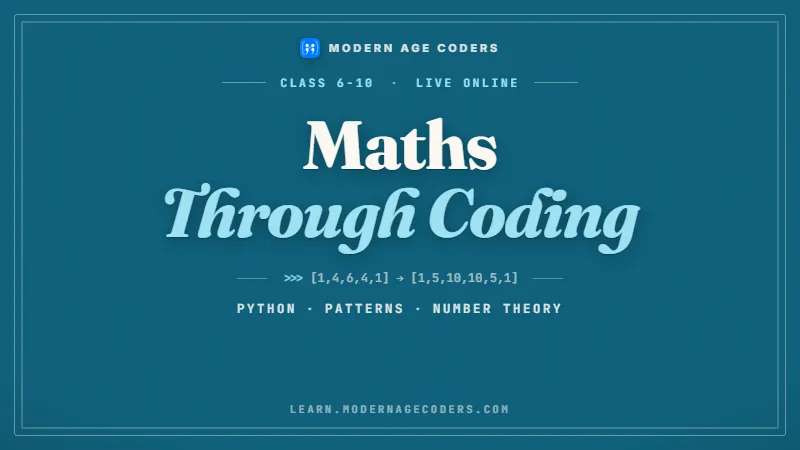
Maths Through Coding
Variables, coordinates and patterns become things a learner can run and test.
See the syllabus
Python Complete Masterclass for Teens
A structured move from logic to functions, data and independent programs.
See the syllabus
HTML and CSS for Beginners
Designing and making something that exists afterwards, which is the whole of domain B and the part children remember.
See the syllabusThat is four of more than a hundred. The rest, sorted by age and subject, sit on the course atlas, and the order we teach them in is on the coding roadmap.
The four we are known for
Python, AI, vibe coding and agentic coding
These run underneath everything above. Every one is live and online, placed by ability rather than by age, and the first class is free.
Vibe Coding for Teens
Python, web and AI projects where the learner still owns the thinking.
See the syllabus
AI and Machine Learning for Teens
Train a model, read what it learned, and be able to say why it is wrong.
See the syllabus
Codex and Claude Code
Run AI coding agents on real work without losing control of the codebase.
See the syllabusNine core objectives, three domains, finalised in 2024
A short timeline, because the dates are the part that matters.
The starting position is worth stating plainly, because most marketing in this sector implies the opposite. The Netherlands has had no compulsory education in digital literacy or informatics in primary or lower secondary schooling. Not a thin version of it. None required.
In 2022 the Dutch Ministry of Education, Culture and Science tasked SLO, the Netherlands Institute for Curriculum Development, with developing core objectives for digital literacy across primary and lower secondary education. In March 2024 that curriculum was finalised. It sets out nine core objectives grouped into three domains.
| Domain | What it covers | Where a coding class sits |
|---|---|---|
| A. Practical knowledge and skills | Using digital technology capably | Partly. A useful side effect rather than the target |
| B. Designing and making | Building things with digital technology | Squarely. This is the whole of what we do |
| C. Interaction between digital technology, media, people and society | Judgement, consequence, media and information literacy | Indirectly, through the data project below |
Digital literacy in the Dutch definition is ICT skills, media literacy, information literacy and computational thinking taken together, with computational thinking integrated through all of them rather than parked in one corner. That is a better definition than most countries manage, and it happens to describe the order we teach in: the reasoning is the subject and the code is how you practise it.
Why a finalised curriculum does not tell you what your child is doing
Core objectives being finalised in March 2024 is a starting gun, not a description of classrooms. Whether a given school has staff who can teach domain B, timetable space to do it in, and equipment to do it with, is a separate question with a separate answer per school. So there is no national hours figure to quote you, and any provider implying there is has invented it. Ask your child's school directly. It is a fair question and they will have an answer.
Sources: OECD Review of Digital Education Policy in the Netherlands on the curriculum framework and the absence of compulsory provision, and K-8 Digital Literacy Curriculum in the Netherlands for the 2022 SLO commission, the March 2024 finalisation, and the nine core objectives across three domains. Verified 17 August 2026.
Designing and making is the one schools will struggle with
Not because Dutch schools are weak, but because of what that domain costs to deliver.
Of the three domains, two can largely be taught inside existing lessons by existing teachers. Using digital technology capably fits into almost any subject. Thinking about media, information and consequence fits naturally into language and citizenship work, and Dutch schools were doing versions of it long before it was a core objective.
Designing and making does not fit anywhere. It needs sustained time on the same task across weeks, a teacher who can read a learner's broken code and say something useful about it, and enough repetition that a child stops being afraid of an error message. Those are the three things a school timetable is worst at providing to a single subject, and no amount of goodwill in a curriculum document changes that.
Groep 3 to 5
Before most schools reach any of this. Ordering, counting and predicting what a thing will do before running it.
Groep 6 to 8
Where domain B work becomes possible. Making something real, and being able to explain why it works.
First years of VO
The best window in the Dutch system. Blocks into Python, with no examination pressure yet.
The one thing we will not claim is that this substitutes for school. It does not award anything, it does not affect the streaming decision at the end of groep 8, and it is not on any Dutch certificate. It is contact time on the domain that is hardest to timetable, which is a smaller and more honest claim than most of this industry makes.
Nothing here requires travel. Learners join from Amsterdam, Rotterdam, The Hague, Utrecht, Eindhoven, Groningen, Almere and Tilburg on identical terms.
What the Dutch framework asks for, and which course answers it
Left is the framework or the constraint. Right is what we would actually teach against it.
Building things with digital technology, across primary and lower secondary.
Eight lessons a month on exactly this, with something finished and explainable at the end of each block.
Not a separate topic. Integrated across ICT skills, media literacy and information literacy.
The same ordering. Decomposition, prediction and debugging before syntax, and the data project below is entirely about judgement.
Which means a learner's starting point is genuinely unpredictable from their school year.
Placement by observed ability in the free class, never by year group. In this market that matters more than anywhere else we teach.
The streaming decision into VMBO, HAVO or VWO, and a year already full.
We would advise waiting. Groep 6 and 7 are better, and the first year of VO is better still. Nothing here affects that decision.
The clock moves twice a year while Indian Standard Time does not.
Weekend and late-afternoon slots are the easiest to arrange. Weekday evenings are agreed case by case, and the time is confirmed before payment.
If you have asked your child's school what they cover and were not sure what to make of the answer, that is a useful conversation to have with us.
Ask on WhatsApp Book the free classA course ladder that leaves room for school
It starts with making something and being able to explain it. It only turns technical once a learner can find their own mistake without a teacher pointing at the line. For a VO student in an examination year the ladder narrows deliberately, and for a groep 8 pupil facing the streaming decision we would not add anything new at all. Adults enter at the point their goal and prior knowledge support.
Builders
Ages 6 to 10
Problem solvers
Ages 11 to 13
Independent programmers
Ages 14 to 18
Applied study
College and adult, 18 to 67
The complete catalogue is on the course atlas, and the method is set out on how we teach.
The policy that gets credit for things it could not have caused
Every market page here works through one analytical trap. The Dutch one is a mistake governments and newspapers make constantly.
The learner is given two dates and a question. The digital literacy core objectives were finalised in March 2024. Suppose a national measurement of pupil skill is taken in 2026 and the result is better than the last one. Did the new curriculum work?
Every learner says yes, or at least probably. The dates are in the right order, the direction is right, and the story writes itself.
Consider who the 2026 pupils are. A learner measured in the last year of primary school in 2026 spent most of their schooling before March 2024. Whatever they can do, the great majority of it was taught by teachers working without the core objectives, because those objectives did not exist yet. The policy cannot have caused most of what is being measured. It had not happened for most of the time in question.
The error is not that the conclusion is definitely wrong. It might be partly right at the margins. The error is that the reasoning does not support it, and nothing in the numbers distinguishes "the curriculum worked" from "these children were already improving" or "the test changed" or "the schools that implemented first were the strongest schools anyway".
So the learner writes a program that takes a policy date and a measurement date and reports how much of each cohort's schooling actually fell inside the policy. For a 2026 primary leaver the answer is a small fraction. Then they write the sentence they would be willing to defend, which turns out to be much duller and much more useful than the one they started with.
This is deliberately not a correlation-and-causation exercise in the usual sense. Both things are real and the order is correct. The problem is exposure: the cause was present for only part of the period it is being credited with, and once a learner has seen that once they start asking about it everywhere, including in claims made by companies like this one.
What should a child learn now that AI writes the code?
The Dutch framework answers this without setting out to. There is no domain called programming. There is a domain called designing and making, and computational thinking runs through all three.
Give an AI the two dates from the project above and ask whether the curriculum worked, and it will produce a balanced, readable, professional paragraph. Ask it directly and it may even mention that correlation is not causation, because that phrase is everywhere in its training. What it will not reliably do is notice the specific thing that matters here: that a 2026 primary leaver was barely exposed to a 2024 policy, so the question is close to unanswerable with the data given. That takes holding the cohort in your head, and nobody prompted for it.
Deciding what to build, working out which comparison is even valid, and refusing to publish a conclusion the numbers do not support. That is the work. It is learnable, it is what the project trains, and it becomes more valuable as generated prose gets more fluent.
The longer argument, with evidence: is coding still worth learning in 2026? The teaching order is on the coding roadmap, and what a lesson looks like is on how we teach.
How this runs, and where the clock is genuinely awkward
Live teaching, live questions, live code review. Nothing pre-recorded.
Free first class
One task pitched at the learner, then a specific recommendation. No fee, no card.
Five to eight
Grouped by what a learner can currently do. In this market that is the only sensible basis.
One to one
For a narrow adult goal, or a school year already too full to take a group slot.
Twice a week
Normally eight lessons a month. One a week is a reasonable request and often the right one.
A gap that moves
India is four and a half hours ahead in Dutch winter and three and a half in summer.
What is needed
A laptop or desktop, stable internet, working audio, a current browser. Nothing to buy.
Being straight about scheduling
This is the market in which we are least willing to publish a fixed weekly slot, and it would be easy to pretend otherwise. The Netherlands changes clocks and India does not, so a recurring booking that works in November is an hour out in April. Weekend slots and late-afternoon Dutch times are the easiest to arrange. Weekday evenings are agreed case by case. Every time is confirmed on the free call before any payment, and if we cannot offer one that suits your week we will say so rather than book you into something that will fail in a month.
What do coding classes in the Netherlands cost?
No enrolment charge, nothing to buy, no minimum term.
For a learner who works well hearing how others approached the same problem, at the shared level of a five to eight person group.
For a narrow goal, an awkward week, or a starting point that no current group happens to match.
Two live lessons a week on either plan. The figure is in USD because there is a single published international rate and no separate Dutch one. The free session settles the course and the slot first, and payment is arranged after that rather than before.
Pauses, plan changes and missed classes are covered on the pricing page.
What families say
Rated 4.9 across 547 Google reviews. These are real reviews, reproduced as written.
★★★★★
"The one step solution for my son. Modern Age Coders make learning coding so simple that kids love it. The teachers explain complex concepts clearly with practical exercises and interactive content."
Ria Mukherjee
Parent
★★★★★
"Modern Age Coders has been a game-changer for me. I struggled to grasp IT concepts and coding before joining, but their classes transformed everything. I can now confidently write complex programs with ease."
Samriddha Mondal
Student
★★★★★
"One of the most wonderful education centres out there. Education is not limited to school syllabus but focuses on skill development."
Vansh Agarwal
Student
★★★★★
"My child Dhairya is really enjoying the Modern Age Coders classes. This is his first online class and he eagerly looks forward to it. I can already see his improvement, and the teachers are very cooperative."
Sonam Oswal
Parent of Dhairya
★★★★★
"Modern Age Coders have wonderful teachers who teach in a clear, easy and practical way. The teacher boosts students' confidence and inspires them to learn without hesitation."
Sonu Goyal
Parent
★★★★★
"I highly recommend this computer coding class! The teachers are incredibly knowledgeable and passionate about coding."
Ritu Kedia
Parent
More, with photographs and student work, on the wall of love.
Questions Dutch families ask before booking
Including two answers that are against our own interest: wait a year, and no we have no office here.
Is digital literacy compulsory in Dutch schools yet?
The core objectives were finalised in March 2024, after the Ministry of Education, Culture and Science asked SLO to develop them in 2022. Before that there was no compulsory digital literacy or informatics in primary or lower secondary education at all. What that means in practice is that provision depends on your school and on how far it has got with implementation, so the honest answer to what your child is already covering is that you would have to ask them.
What are the three domains, and which one does a coding class touch?
Nine core objectives grouped into three domains: practical knowledge and skills, designing and making, and the interaction between digital technology, media, people and society. A coding class sits squarely in the second one. Designing and making is what a learner does here every week, and it is the domain that needs the most contact time and the most equipment, which is exactly why schools find it the hardest to deliver.
Where does computational thinking fit in?
Dutch digital literacy is defined as ICT skills, media literacy, information literacy and computational thinking together, with computational thinking running through all of them rather than sitting in a box of its own. That is a good definition and it matches how we teach: the reasoning is the subject and the code is how you practise it.
What time are classes, and does the time difference change?
It does change, and this is the market where we are least willing to promise a fixed slot. The Netherlands moves between CET and CEST, while Indian Standard Time never shifts, so India is four and a half hours ahead in winter and three and a half in summer. Weekend slots and late-afternoon Dutch slots are the easiest to arrange, weekday evenings are agreed case by case, and every time is confirmed on the free call before any payment.
How much do coding classes in the Netherlands cost?
The first class is free. Group tuition is USD 100 per month for two live lessons each week, normally eight lessons monthly, in a group of five to eight compatible learners. Private tuition is USD 150 per month for one learner with one teacher on the same usual frequency. There is no enrolment fee, nothing to buy and no minimum term.
Do you have a location in the Netherlands?
No. No Dutch office, branch or classroom is claimed. Every lesson is live online from India. A learner needs a laptop or desktop, stable internet, working audio and a current browser. The phone number on this page is Indian, and email or WhatsApp are the practical ways to reach us.
Is coding still worth learning now that AI writes it?
The Dutch curriculum answers this without meaning to. It does not have a domain called programming. It has a domain called designing and making, and it threads computational thinking through everything else. Deciding what to build and judging whether the result is right is the part that survives, because a generated answer arrives with the same confidence whether it is correct or not.
My child is in groep 8 and the streaming decision is coming. Should we start now?
Probably not, and we would rather say so. The year a child is being placed into VMBO, HAVO or VWO is a poor year to add a new commitment, and nothing we teach affects that decision. Groep 6 and 7 are much better, and the first year of VO is better still. If you want to start anyway, one lesson a week rather than two.
Do you teach in English, and is that a problem here?
Classes are in English. In the Netherlands that is rarely the obstacle it might be elsewhere, and for learners at bilingual or international schools it is an advantage. Programming keywords are English regardless of the language of instruction. The teacher slows down on terminology rather than assuming it.
What happens after we send the form?
Somebody reads it and contacts you to arrange the free session. No card, no charge, and sending the form books a conversation rather than a place in a class.
Ask before booking
Use WhatsApp for a question about Dutch timings or go straight to the form. The course, the format and a slot that survives a clock change are settled before any payment.
One task, then a straight recommendation
The first session costs nothing. A learner is given a single problem suited to their age, and the teacher watches how they approach it rather than whether they finish. Because Dutch provision varies so widely between schools, this matters here more than in most markets: the school year tells us very little, and fifteen minutes of watching tells us most of it.
You can also use the contact page, or read about us first.
Email works well from the Netherlands given the time difference, and WhatsApp is quickest. The number is Indian, not a Dutch office.