Home / United Kingdom / Coding Classes in Birmingham
Everybody says Birmingham is the youngest city in Europe. Nobody says how they measured it
The short answer
Birmingham's 2021 Census resident population was 1,144,900, up 6.7 per cent or 71,900 people since 2011, and that figure is checkable. The claim that it is the youngest city in Europe is repeated everywhere, including by the University of Birmingham's own analysis, without a published method. Modern Age Coders teaches live online coding and maths to ages 6 to 67 in Birmingham, against the English national curriculum, from USD 100 a month. The first class is free.
We open on that gap because it is the habit this page is about. There is a difference between a number you can check and a sentence you can quote, and a family choosing where to spend two evenings a week deserves the first kind.
Modern Age Coders teaches from India. The gap to the UK is four and a half to five and a half hours depending on the season, which makes an after-school Birmingham slot genuinely workable. Lessons are online and no Birmingham centre is claimed.
No card. No obligation. We call, we do not spam.
Facts last verified 17 August 2026. Teaching is online; no Birmingham centre is claimed.
Four sensible starting points, not one course for everybody
Four entry points for a city with over four hundred schools and enormous variation between them. A primary beginner, a learner who needs maths to become something they can run, a secondary student moving into typed code, and an adult. Which one fits is decided by watching a learner work, not by which school they attend.
Kids Coding Blocks Masterclass
Sequencing, conditions and debugging before syntax becomes the distraction.
See the syllabus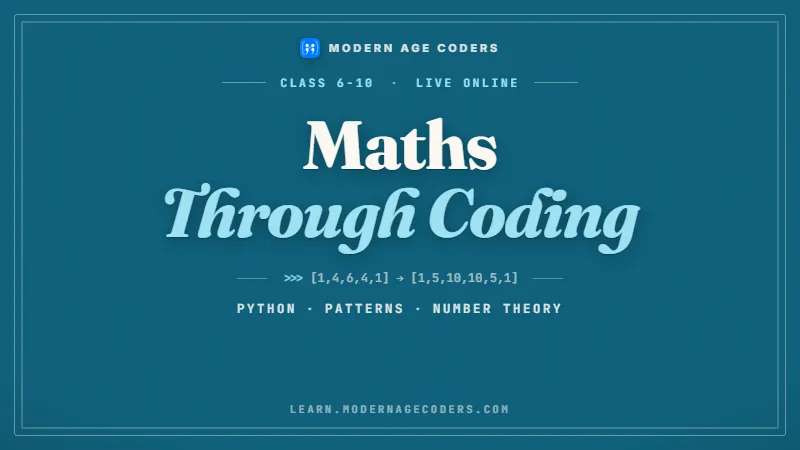
Maths Through Coding
Variables, coordinates and patterns become things a learner can run and test.
See the syllabus
Python Complete Masterclass for Teens
A structured move from logic to functions, data and independent programs.
See the syllabus
HTML and CSS for Beginners
The quickest route to something that exists afterwards and can be shown to somebody, which is what keeps a learner coming back.
See the syllabusThat is four of more than a hundred. The rest, sorted by age and subject, sit on the course atlas, and the order we teach them in is on the coding roadmap.
The four we are known for
Python, AI, vibe coding and agentic coding
These run underneath everything above. Every one is live and online, placed by ability rather than by age, and the first class is free.
Vibe Coding for Teens
Python, web and AI projects where the learner still owns the thinking.
See the syllabus
AI and Machine Learning for Teens
Train a model, read what it learned, and be able to say why it is wrong.
See the syllabus
Codex and Claude Code
Run AI coding agents on real work without losing control of the codebase.
See the syllabusOne number that reconciles, and one claim that cannot be tested
Both are worth putting in front of a parent, for opposite reasons.
Start with the number that holds up. The 2021 Census recorded Birmingham's resident population at 1,144,900, an increase of 6.7 per cent, or 71,900 people, since 2011.
That set of figures passes the simplest test there is. Take the total, subtract the increase, and you get 1,073,000 for 2011. Divide 71,900 by 1,073,000 and you get 6.70 per cent. The parts agree with the whole, which is not something you can assume, and is the first thing worth checking about any published trio of numbers.
Now the claim. Birmingham is the youngest major city in Europe, with under 25s accounting for nearly 40 per cent of its population. It appears in city marketing, in property brochures, in news pieces, and in the University of Birmingham's own City-REDI economic analysis. In the version we read, it is asserted without a source citation and without a stated methodology.
Three unstated choices, each of which changes the answer
Which Birmingham? The city council area, the built-up area, and the wider travel-to-work area have different populations and different age profiles. Which cities were compared? Europe has several hundred places that call themselves cities, and the answer depends entirely on which ones made the list. And which threshold? Under 25 and under 30 give different rankings, and both numbers circulate. None of those three is usually specified, which means the claim cannot be checked, confirmed or refuted by anybody reading it.
To be clear, none of this means the claim is false. Birmingham may well be young by any reasonable definition. The point is narrower and more useful: a sentence that cannot be checked is not evidence, however often it is repeated and however respectable the person repeating it. That distinction is the single most valuable thing in this page, and it is also the subject of the teaching project further down.
Sources: 2021 Census resident population and change for Birmingham as published in local reporting of the census first results, and University of Birmingham City-REDI, Birmingham Economic Review for the youngest-city-in-Europe claim, which that analysis states without citation or method. Verified 17 August 2026. We attempted Birmingham City Council's own census document directly and it was not retrievable, so the population figure is reported as published rather than as read from the council PDF.
Over four hundred schools, and no two starting points alike
The useful consequence of a very large school system is variation, not scale.
Birmingham has more than four hundred schools. For a provider that means one thing above all: the school a child attends tells us very little about what they can do, and the year group tells us less. Two Year 6 pupils a mile apart can arrive having done a term of real programming or nothing at all, and both will describe it as having done coding at school.
So placement here works the same way it does in every market we treat honestly. A learner attempts one problem while a teacher watches how they approach it, and the recommendation follows from that rather than from a form. In a city this size the alternative is guessing at scale.
Key Stage 1 and 2
The years with the most room and the least pressure. If you have a choice about when to start, start here.
Key Stage 3
Still open, and the best point to move from blocks into typed code without an exam in the way.
Key Stage 4
Narrow and light, or wait. Nothing we teach appears on a GCSE certificate and we would not pretend otherwise.
Computing is statutory in the English national curriculum and the school is responsible for it. What a weekly class adds is frequency on the building side, which is the part a timetable can give least sustained time to. Learners join from across the city, including Handsworth, Sparkhill, Selly Oak, Erdington, Sutton Coldfield, Bournville and Kings Heath, without anybody travelling.
What a Birmingham family needs, and which course answers it
Left is the situation. Right is what we would do about it.
Part of the English national curriculum, delivered by the school, and not ours to duplicate.
Sustained weekly time on designing, building and debugging, with something finished at the end of each block.
Enormous variation in what a learner has already met, invisible from a year group.
Placement by observed ability from a task, never by school, year or postcode.
Room in the timetable and no public examinations yet.
Where we would start given the choice. Blocks into Python, with maths made concrete alongside.
Already full, and nothing external counts toward the grade.
One lesson a week on something specific, or an honest recommendation to wait.
India runs four and a half to five and a half hours ahead depending on the season.
After-school slots work here, and we aim for a time that survives the clock change rather than one that suits autumn.
If your child is at Key Stage 2 and you are weighing this against other options, the free session answers it faster than any brochure.
Ask on WhatsApp Book the free classA course ladder that leaves room for school
It begins with building something and being able to say why it works. The technical rungs wait until a learner can locate their own error without help. For Key Stage 4 the ladder narrows to protect GCSE time. For Key Stage 2 it is deliberately broad, because those years have room that later years do not. Adults enter at the point their goal and prior knowledge support.
Builders
Ages 6 to 10
Problem solvers
Ages 11 to 13
Independent programmers
Ages 14 to 18
Applied study
College and adult, 18 to 67
The complete catalogue is on the course atlas, and the method is set out on how we teach.
The boundary is part of the statistic
Every market page here works through one analytical trap. Birmingham's is the one we very nearly fell into while writing this page.
While researching, we found a figure that looked ideal: around 538,290 students in schools. A big, specific, quotable number for a page about a big city.
Read the label properly and it is students in Birmingham and the West Midlands Metropolitan County. That county also contains Coventry, Wolverhampton, Dudley, Sandwell, Solihull and Walsall. Quoting it as a Birmingham figure would have inflated the city by several other cities, and almost nobody would have noticed.
The learner is given several real statistics whose labels name different geographies: a council area, a metropolitan county, a built-up area, a travel-to-work area. They are asked to build a table comparing them, and quickly discover they cannot, because the rows are not about the same place. The programming task that follows is to attach a geography field to every figure and to make the comparison function refuse to compare two records whose geographies differ.
That refusal is the lesson. Most tools will happily divide any two numbers you hand them. A function that checks whether the comparison is meaningful before performing it is a small amount of extra code and the difference between analysis and nonsense.
Then the same idea goes back to the claim at the top of the page. Is Birmingham the youngest city in Europe? The learner is asked to write a function that answers it, and finds they cannot even start, because the function needs three parameters nobody has supplied: which boundary, which comparison set, and which age threshold. Discovering that a question is unanswerable as posed, and being able to say precisely which definition is missing, is a more useful outcome than an answer would have been.
The geographies and labels in this exercise are real and are the ones we encountered. The 538,290 figure is quoted only as the example of the trap, and is not used anywhere on this page as a Birmingham statistic.
What is left for a person if AI writes the code?
Ask any assistant whether Birmingham is the youngest city in Europe. You will almost certainly get a yes with the under-25 figure attached, because that sentence appears thousands of times in the material these systems learned from. Repetition is exactly what they are good at reproducing.
What you will rarely get unprompted is the observation that the claim has no published method, and that answering it properly needs a boundary, a comparison set and a threshold that nobody has specified. Not because the machine is stupid. Because the question did not ask for that, and it has no reason to volunteer that its answer rests on definitions it cannot see either.
So the work that stays with people is upstream of the code: deciding what a claim would have to mean before it could be tested, noticing when two numbers describe different places, and being willing to report that a question is unanswerable as asked. Those are teachable, they are what the project above trains, and they get more valuable as generated answers get more confident rather than less.
We have set the full case out separately, with the evidence attached: is coding still worth learning in 2026? If you would rather see the sequence we teach in, that is the coding roadmap, and how we teach describes an actual lesson.
How this runs from Birmingham
Live teaching, live questions, live code review. Nothing pre-recorded.
The opening session
A single problem, watched rather than marked, and a recommendation you can argue with. Costs nothing.
Small groups
Between five and eight, sorted by what a learner can do rather than where they live. In a city of four hundred schools that is the only workable basis.
Alone with a teacher
Better when the target is precise, when a GCSE year is already full, or when no group time survives contact with the family calendar.
Two sessions weekly
Which comes to about eight in a month. Halving that during an exam term is a normal request, not a concession.
The gap is small
Four and a half hours in summer, five and a half in winter, so nothing here happens at an unreasonable hour on either side.
Kit
A computer that is not a phone, a connection that holds, a microphone that works. There is nothing to purchase from us.
Choosing a slot that survives October
British Summer Time shifts and Indian Standard Time does not, so the gap is four and a half hours for part of the year and five and a half for the rest. It is a small enough difference that it rarely breaks anything, but it does move a booking by an hour twice a year. We would rather agree a time that works on both sides of that than the one that happens to suit the month you enquired in. Mention school hours, existing commitments and any exam dates on the free call.
What do coding classes in Birmingham cost?
No enrolment charge, nothing to buy, no minimum term.
For a learner who gains from hearing how others approached the same problem, at the shared level of a five to eight person group.
For a specific target, a GCSE year, or a starting point no current group happens to match.
Both plans run to two live lessons a week, and the session that decides which of them fits costs nothing. The figure is in USD because one rate covers every country we teach in, so there is no Birmingham price to negotiate. How you settle it comes after the course and the time are fixed, never before.
Pauses, plan changes and missed classes are covered on the pricing page.
What families say
Rated 4.9 across 547 Google reviews. These are real reviews, reproduced as written.
★★★★★
"The one step solution for my son. Modern Age Coders make learning coding so simple that kids love it. The teachers explain complex concepts clearly with practical exercises and interactive content."
Ria Mukherjee
Parent
★★★★★
"Modern Age Coders has been a game-changer for me. I struggled to grasp IT concepts and coding before joining, but their classes transformed everything. I can now confidently write complex programs with ease."
Samriddha Mondal
Student
★★★★★
"One of the most wonderful education centres out there. Education is not limited to school syllabus but focuses on skill development."
Vansh Agarwal
Student
★★★★★
"My child Dhairya is really enjoying the Modern Age Coders classes. This is his first online class and he eagerly looks forward to it. I can already see his improvement, and the teachers are very cooperative."
Sonam Oswal
Parent of Dhairya
★★★★★
"Modern Age Coders have wonderful teachers who teach in a clear, easy and practical way. The teacher boosts students' confidence and inspires them to learn without hesitation."
Sonu Goyal
Parent
★★★★★
"I highly recommend this computer coding class! The teachers are incredibly knowledgeable and passionate about coding."
Ritu Kedia
Parent
More, with photographs and student work, on the wall of love.
Questions Birmingham families ask before booking
Starting with the one about the city's favourite statistic.
Is Birmingham really the youngest city in Europe?
It is repeated everywhere, including by the University of Birmingham's own analysis, and we could not find anybody who publishes how it was measured. Which boundary counts as Birmingham, which European cities were in the comparison, and whether the threshold is under 25 or under 30 all change the answer, and none of the three is usually stated. What is solidly sourced is the 2021 Census population of 1,144,900, up 6.7 per cent on 2011. We would rather give you the checkable number than the quotable one.
Does this replace school computing?
No. Computing is part of the English national curriculum and your child's school is responsible for delivering it. Nothing here appears on a report, earns a qualification or counts toward a GCSE. What a weekly class adds is sustained time on building and debugging, which is the part a school timetable can give least of to any one subject.
Birmingham has hundreds of schools. Does the school my child attends change what you do?
Only through what the learner can already do, which we find out by watching rather than by asking. With over four hundred schools in the city the variation between them is large, and a year group tells us very little on its own. Fifteen minutes of a learner attempting a problem tells us most of it.
What time are classes from Birmingham?
Workable, and better than most of our markets. India is five and a half hours ahead of the UK in winter and four and a half during British Summer Time, so a class after school here is a late evening for the teacher rather than the middle of the night. The exact slot is agreed on the free call, and we aim for one that survives the clock change rather than one that only suits autumn.
How much do coding classes in Birmingham cost?
The first class is free. Group tuition is USD 100 per month for two live lessons each week, normally eight lessons monthly, in a group of five to eight compatible learners. Private tuition is USD 150 per month for one learner with one teacher on the same usual frequency. There is no enrolment fee, nothing to buy and no minimum term.
Do you have a centre in Birmingham?
No. No Birmingham office, centre or classroom is claimed. Every lesson is live online from India. A learner needs a laptop or desktop, stable internet, working audio and a current browser. The phone number on this page is Indian rather than a UK number.
Is coding still worth learning now that AI writes it?
This page is built on a claim that everybody repeats and nobody defines, which is the best possible argument. An AI will happily tell you Birmingham is the youngest city in Europe, because that sentence is all over its training data. It will not usually tell you the claim has no published method, because nothing in the question asked it to check. Working out what a claim would have to mean before you could test it is the durable skill, and it is what a class teaches.
Which year groups get the most from this?
Key Stage 2 and the start of Key Stage 3, if you have the choice. Those years have room in them and very little assessment pressure, and starting there leaves time for a learner who turns out to enjoy it to get somewhere real. Key Stage 4 is fine, but the honest advice is narrow and light rather than a full ladder.
What ages do you teach, and do you take adults?
Six to sixty-seven, and both ends are used. Below about nine the work is ordering, counting and predicting rather than typing. Adults usually arrive with a specific task in mind rather than a syllabus, and they are a normal part of the intake rather than a side line.
What happens after we send the form?
Somebody reads it and contacts you to arrange the free session. No card, no charge, and sending the form books a conversation rather than a place in a class.
Ask before booking
Use WhatsApp for a question about Birmingham timings or go straight to the form. Course, format and a slot that survives the clock change are settled before any payment.
One task, and a recommendation you can check
Nothing is charged for the opening session. A learner is handed one problem suited to their age, and what the teacher is reading is the approach rather than the result. With this many schools in one city, watching somebody work is the only method that survives contact with reality. You get back a recommendation specific enough to argue with, including the reasoning behind it.
You can also use the contact page, or read about us first.
WhatsApp is quickest and costs nothing from the UK. The number is Indian, not a Birmingham office.