CMV / KID / 01
Scratch programming
First games and stories in blocks.
Open the syllabusMecklenburg-Vorpommern · Coding and Informatik · Klasse 5 to Abitur
Mecklenburg-Vorpommern rarely tops national league tables, but in school Informatik it is near the front. Every pupil has Informatik und Medienbildung in every grade from 5 to 10, the Land already meets the six-hour recommendation, and two in five Oberstufe pupils take the subject. This page sets out those rules and the central Abitur, the holidays for 2026/27, how our live classes in English take a keen pupil further, and a project that measures the Baltic islands from nothing but their corner coordinates.
Teaching live online since 2020 · over 10,000 students worldwide · English-only classes with a mentor who stays
In short
Modern Age Coders offers coding classes for Mecklenburg-Vorpommern as live online lessons in English, for school pupils from around 10 as well as adults, with a choice of private lessons or batches of fifteen to twenty. Pupils already have Informatik und Medienbildung every year from grade 5, so our Informatik Companion course takes them further, and Oberstufe pupils prepare Python or Java for the centrally set Abitur.
Starting points in Mecklenburg-Vorpommern
One that builds on the weekly school lesson, one for the Oberstufe and its central exam, and one that joins programming to school maths, as the island project does.
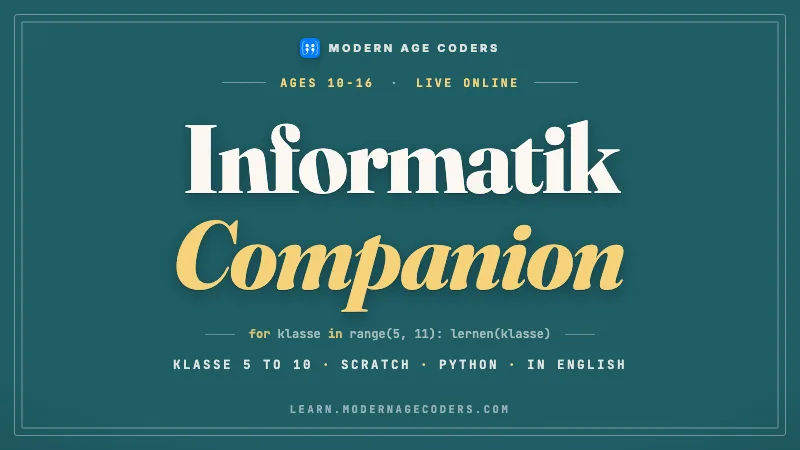
CMV / 01
Around 10 to 16. Longer programs, data and algorithms than one weekly lesson allows, so the informatics half of Informatik und Medienbildung becomes real fluency.
Open the syllabus →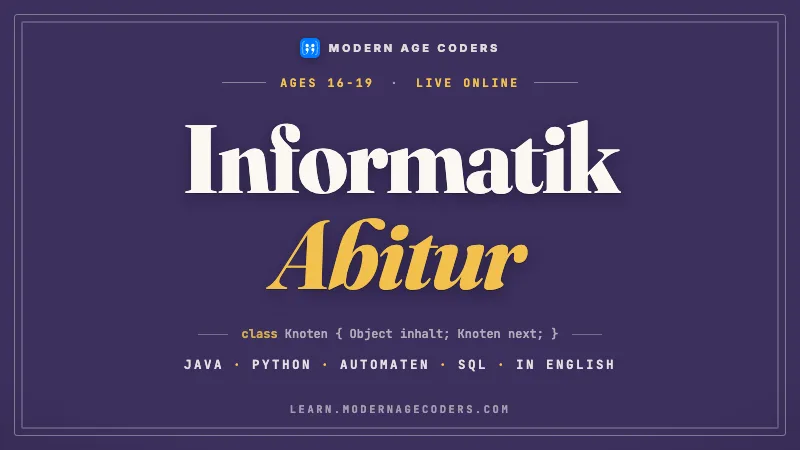
CMV / 02
Around 16 to 19. Java or Python, data structures, automata and databases, with timed written tasks of the compulsory-plus-choice kind the commission sets.
Open the syllabus →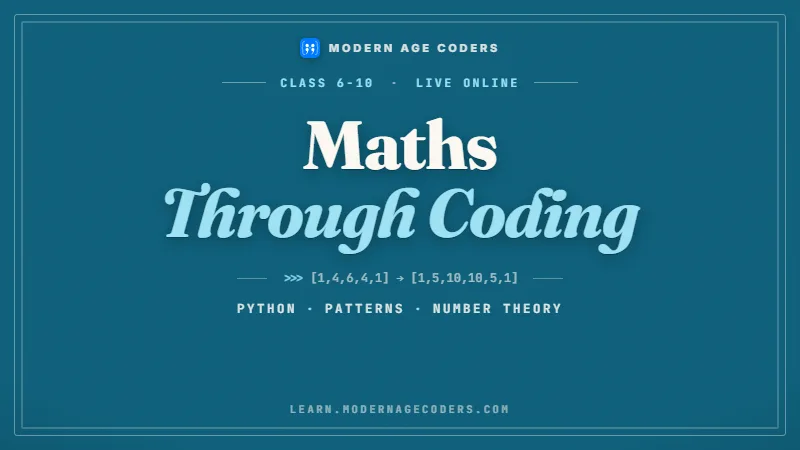
CMV / 03
Around 10 to 15. Geometry, number and data explored in Python, from areas and coordinates to patterns, a natural partner for school maths.
Open the syllabus →Informatik in Mecklenburg-Vorpommern
Yes, in every year from grade 5 to grade 10 and at every school type, as the GI's Informatik-Monitor 2026/27 records.
| Stage | Grades | What the rules give |
|---|---|---|
| All school types | 5 to 10 | Informatik und Medienbildung, at least one lesson a week every year |
| All school types | 5 to 10 | Further Informatik electives possible (Wahlpflicht) |
| Oberstufe, Grundkurs | Qualifikationsphase | Three lessons a week; written or oral exam, or a special project |
| Oberstufe, Leistungskurs | Qualifikationsphase | Five lessons a week; written exam |
Source: Gesellschaft für Informatik, Informatik-Monitor 2026/27, Mecklenburg-Vorpommern page, read 2 November 2026. Curricula exist for Informatik und Medienbildung in grades 5 to 10 at the Regionale Schule, the Gesamtschule and the Gymnasium, and for Informatik in the Qualifikationsphase. The Oberstufe at the Gesamtschule and the Gymnasium runs as G8, with grade 10 as the Einführungsphase.
The GI's national summary names Mecklenburg-Vorpommern, Saarland and Thuringia as the three Länder meeting the medium-term recommendation of six compulsory Informatik hours in lower secondary, and pairs Mecklenburg-Vorpommern with Saxony as the leaders in the Oberstufe.
Its Mecklenburg-Vorpommern page puts Informatik in the timetable of 40 % of the Land's Oberstufe pupils in 2024/25 (KMK data), well over twice the roughly 15 % across Germany; 6 % of the year's Abitur candidates chose it as an exam subject.
The monitor reports 419 Informatik teachers in the Land for 2024/25, 6 % of all teachers, with 7 newly hired in 2025/26. Informatik can replace a pupil's second science in the Oberstufe, though not the first.
With Informatik every week from grade 5, a pupil arrives at the Oberstufe with a base many pupils elsewhere lack. Our lessons build on that base rather than repeat it.
Mecklenburg-Vorpommern has 1,573,597 residents, 98,308 of them in Schwerin, the Land capital (Destatis, 31 December 2024); Rostock, on the coast, is its largest city. After four years of Grundschule, pupils pass through a two-year Orientierungsstufe in grades 5 and 6, usually at a Regionale Schule or Gesamtschule, before continuing at a Regionale Schule, a Gesamtschule or a Gymnasium. The KMK lists the Regionale Schule as a school that combines two tracks.
The Informatik Abitur
Centrally, by a commission of teachers and the subject adviser, with compulsory and optional tasks. The details come from the Informatik-Monitor.
| Level | Compulsory tasks | Optional tasks | Exam type |
|---|---|---|---|
| Grundkurs | One | One of two | Written as third exam subject, or oral |
| Leistungskurs | Two | One of two | Always written |
Source: Gesellschaft für Informatik, Informatik-Monitor 2026/27, Mecklenburg-Vorpommern page, read 2 November 2026. All tasks may include practical parts. Permitted aids are the Tafelwerk (formula book) used at the school and supplements supplied by the exam commission (Tafelwerksergänzungen). The 2027 exam dates could not be fetched from the education ministry's server, so this page prints none; your school has them.
Because a candidate chooses one of two optional tasks, part of the skill is deciding quickly which one suits them. That decision is easier for a pupil who has seen many kinds of problem: data structures, automata, databases, algorithms.
Practical parts are allowed in every task, the monitor notes, so working fluently at a computer matters as much as writing clearly.
Oberstufe pupils practise with original tasks in the same compulsory-plus-choice pattern, timed, then talk through why one optional task was the better pick. They write and test code, and they write short explanations in German exam style.
Abitur results rest on the school course alone. Our role is extra practice; school work is never written or marked by us.
Taught in English
No. They are live and in English only. Our mentors are based in India and adjust to the learner.
There is no German-language option. For a pupil in Rostock, Greifswald or a village on the coast that means coding and English practice together; for an English-speaking family it is simply the natural language.
A mentor slows down, repeats in other words and waits for an answer. Within a few weeks they know how a pupil speaks and what makes them stuck.
School uses German terms: Algorithmus, Datenbank, Automat, and in maths Flächeninhalt or Koordinate. Ideas are explained in English, with the German term named.
A Baltic island project
The Land's surveying office publishes its topographic base data as open data, including every island as a polygon of coordinates. Our pupils use it to learn a piece of maths that feels like a magic trick, the shoelace formula, and a habit that keeps it honest: test a formula on shapes you can check by hand before you trust it on real data.
We requested the island layer (AX_Insel) from the web feature service of the Landesamt für innere Verwaltung M-V on 3 November 2026. It is published under Creative Commons BY 4.0 with the credit © GeoBasis-DE/M-V, which allows reuse with that credit. Our script saved its 608 records as inseln_mv.json: a name and a list of corner points in metres (the ETRS89 UTM zone 33 grid used in the Land).
A polygon's area is not stored in the file. We have to compute it.
Walk round the corners in order. For each pair of neighbouring corners, multiply each x by the next y and subtract the next x times this y; add all of these up and halve the result. Because the formula multiplies coordinates crosswise, like the laces of a shoe, it is called the shoelace formula.
It is easy to get a sign or an index wrong, so Version 1 tests it on two shapes whose areas any pupil can work out by hand.
def shoelace(ring):
    """Area of a polygon from its corners, in the units of the coordinates squared."""
    total = 0
    for (x1, y1), (x2, y2) in zip(ring, ring[1:] + ring[:1]):
        total += x1 * y2 - x2 * y1
    return abs(total) / 2

square = [(0, 0), (1000, 0), (1000, 1000), (0, 1000)]       # 1 km by 1 km, in metres
triangle = [(0, 0), (4000, 0), (0, 3000)]                    # legs of 4 km and 3 km
print("Square:", shoelace(square) / 1_000_000, "km2")
print("Triangle:", shoelace(triangle) / 1_000_000, "km2")
It prints: Square: 1.0 km2 and Triangle: 6.0 km2.
A 1 km by 1 km square should be 1 km² and a right triangle with legs of 4 km and 3 km should be half of 12, so 6 km². Both match, and the conversion from square metres to square kilometres (divide by 1,000,000, not 1,000) is checked along the way. Now the formula has earned some trust.
import json

with open("inseln_mv.json", encoding="utf-8") as f:
    islands = json.load(f)

records = [(i["name"] or "(no name)", shoelace(i["polygons"][0]["exterior"]) / 1_000_000) for i in islands]
largest = max(records, key=lambda r: r[1])
print("Island records:", len(records))
print("Largest single record:", largest[0], round(largest[1], 1), "km2")
It prints: Island records: 608 and Largest single record: Usedom 32.9 km2.
The largest single record is a piece of Usedom of 32.9 km², which cannot be the whole island. A look at the names shows why: Rügen and Usedom are each stored as many separate pieces, and 311 small records have no name at all. Version 3 adds the pieces up by name.
from collections import defaultdict

area, pieces = defaultdict(float), defaultdict(int)
for name, km2 in records:
    area[name] += km2
    pieces[name] += 1
for name in ["Rügen", "Usedom", "Poel", "Hiddensee", "(no name)"]:
    print(name, pieces[name], "pieces", round(area[name], 1), "km2")
It prints: Rügen 95 pieces 932.4 km2, Usedom 40 pieces 373.6 km2, Poel 5 pieces 34.8 km2, Hiddensee 4 pieces 17.0 km2 and (no name) 311 pieces 2.7 km2.
| Island | Records in the file | Area by shoelace, km² |
|---|---|---|
| Rügen | 95 | 932.4 |
| Usedom | 40 | 373.6 |
| Poel | 5 | 34.8 |
| Hiddensee | 4 | 17.0 |
| Unnamed islets | 311 | 2.7 |
Data: Landesamt für innere Verwaltung Mecklenburg-Vorpommern, WFS ATKIS Basis-DLM, feature type AX_Insel, licence CC BY 4.0, © GeoBasis-DE/M-V, retrieved 3 November 2026. Areas are our own shoelace calculations from the published corner coordinates and our own sums of the pieces; they are not official area statistics. In this layer every outline runs anticlockwise and none has a hole, which we checked before using the absolute value.
Holidays
Two weeks off in February and an early summer mark the Land's calendar; our classes keep running in the breaks unless a family stops them.
| Break | Period |
|---|---|
| Herbstferien | 15 to 24 October 2026 |
| Weihnachtsferien | 21 December 2026 to 2 January 2027 |
| Winter | 8 to 19 February 2027 |
| Easter | 24 March to 2 April 2027 |
| Single days and Whitsun | 7 May 2027, and 14 to 18 May 2027 |
| Summer | 5 July to 14 August 2027 |
Listed in the KMK overview of holidays for 2026/2027 (as of 9 October 2025) and in the KMK summer arrangement for 2025 to 2030.
February's two free weeks (8 to 19 February 2027) are long enough for a short course, and many families in the Land use part of it that way. The summer holiday that ends on 14 August 2027 brings pupils back to school early compared with the south of Germany.
Contests
The national ones, through school.
A weekly Informatik lesson from grade 5 is good preparation for the Informatik-Biber, the free puzzle contest that Bundesweite Informatikwettbewerbe runs for grades 3 to 13, this year from 9 to 20 November 2026 with schools handling entry. Older pupils can enter the first round of the 45th Bundeswettbewerb Informatik until 23 November 2026, the route into the national olympiad team. Our contest lessons use problems we write ourselves, never the organisers' tasks, and we have no tie to BWINF.
Class times
After school on weekdays, or early on a Saturday; the booking page lists the options in your own clock.
| Mecklenburg-Vorpommern | India up to 27 March 2027 | India from 28 March 2027 |
|---|---|---|
| 14:15 | 18:45 | 17:45 |
| 17:45 | 22:15 | 21:15 |
| Saturday 09:00 | 13:30 | 12:30 |
Germany uses UTC+1 in winter and UTC+2 in summer, as set by the Einheitenzeitgesetz; the 2026 change back was on 25 October and the 2027 change forward is on 28 March. India keeps UTC+5:30 all year, so it is four and a half hours ahead until the change and three and a half after. These times only illustrate; batches are set with each family.
Milestones
Steps we defined ourselves, used for placement and for progress notes; they do not stand in for school marks.
| Step | Typical grade | The learner can |
|---|---|---|
| 1. Coordinates | 5 to 6 | Plot points and move a sprite to given x and y values |
| 2. Functions | 7 to 8 | Write a Python function and test it with inputs whose answer is known |
| 3. Formulas in code | 9 | Turn a maths formula into code, such as the shoelace area, and check it by hand |
| 4. Real data | 10 | Read structured data, group it and explain surprises |
| 5. Exam choices | Qualifikationsphase | Pick the better of two optional tasks quickly and solve it fully |
The island project is step 3: a pupil learns to trust a formula only after it has passed a test they can check themselves.
We report what your child made and can explain, not hours online.
Before you run a formula on real data, try it on a square.
If the biggest piece looks too small, ask whether the thing you measure is stored in pieces.
More courses
Live in English with the same mentor each week, in a batch of fifteen to twenty or one to one.
CMV / KID / 01
First games and stories in blocks.
Open the syllabusCMV / KID / 02
Python projects with a little AI.
Open the syllabusCMV / KID / 03
Problem solving with our own tasks.
Open the syllabusCMV / TEEN / 01
Java classes and objects, step by step.
Open the syllabusCMV / TEEN / 02
Teens chart and question real data.
Open the syllabusCMV / TEEN / 03
Contest puzzles, all written by us.
Open the syllabusCMV / ADULT / 01
Programming for adult beginners.
Open the syllabusCMV / ADULT / 02
The maths behind data work.
Open the syllabusCMV / ADULT / 03
Scripts and AI tools for work.
Open the syllabusHow classes run
Weekdays or weekends, flexible: choose your batch, or for a very personalised plan choose 1-on-1 at your convenience, weekend mornings or weekdays.
Weekdays
Afternoon and early evening slots, German time.
Weekends
Saturday or Sunday mornings.
1-on-1
A time arranged with the mentor.
The same teacher, who knows what the learner did last week.
Programs that use the maths pupils learn at school.
Compulsory and optional tasks, timed, for the Oberstufe.
School vocabulary named with the English.
Short updates after each block of lessons.
Fifteen to twenty learners, or one to one.
Student work
Some of what learners who stuck with it have built; the student labs page has more.

AI and ML
An AI nutrition coach that reads what you eat and works you toward a target.

AI and ML
A chatbot that answers mathematics and programming questions, built and deployed by a student.

AI and ML
An assistant that helps a young person recognise unsafe situations online.

Web app
A weather forecasting site with live conditions for any location.
Fees
Eight live lessons make up each month. Prices on this page appear in euro, converted at the European Central Bank reference rate, although payment is taken in US dollars, so the conversion is your bank's and the final amount can vary a little.
Free first class
Free
no card required
Group batch
€90
a month, eight live classes, charged in US dollars
One to one
€134
a month, eight live classes, charged in US dollars
What families say
Google reviews by parents and students, quoted as they stand.
★★★★★
"The one step solution for my son. Modern Age Coders make learning coding so simple that kids love it. The teachers explain complex concepts clearly with practical exercises and interactive content."
Ria Mukherjee
Parent
★★★★★
"Modern Age Coders has been a game-changer for me. I struggled to grasp IT concepts and coding before joining, but their classes transformed everything. I can now confidently write complex programs with ease."
Samriddha Mondal
Student
★★★★★
"One of the most wonderful education centres out there. Education is not limited to school syllabus but focuses on skill development."
Vansh Agarwal
Student
★★★★★
"My child Dhairya is really enjoying the Modern Age Coders classes. This is his first online class and he eagerly looks forward to it. I can already see his improvement, and the teachers are very cooperative."
Sonam Oswal
Parent of Dhairya
★★★★★
"Modern Age Coders have wonderful teachers who teach in a clear, easy and practical way. The teacher boosts students' confidence and inspires them to learn without hesitation."
Sonu Goyal
Parent
★★★★★
"I highly recommend this computer coding class! The teachers are incredibly knowledgeable and passionate about coding."
Ritu Kedia
Parent
Families in Mecklenburg-Vorpommern ask
No. Teaching is always in English, live, from mentors working in India; they match the speed and accent your child needs and mention German school words where useful.
Yes. The Informatik-Monitor 2026/27 says Informatik und Medienbildung is taught at all school types in grades 5 to 10, at least one lesson a week each year.
One weekly lesson, shared with media education, gives a good base. Pupils who want the Leistungskurs, a contest or their own projects need more practice than the timetable gives.
Centrally, by a commission of teachers and the subject adviser. The Grundkurs paper has one compulsory and one of two optional tasks; the Leistungskurs has two compulsory and one of two optional tasks, and practical parts are allowed.
Yes, as the third exam subject, according to the Informatik-Monitor. It can also be an oral fourth or fifth subject, or a special project instead.
No. Abitur marks come from school only; what we offer is practice, with no grade or certificate attached.
Weekdays or weekends, flexible: choose your batch, or for a very personalised plan choose 1-on-1 at your convenience, weekend mornings or weekdays. Slots after about 14:15 suit most school days.
Our batches hold fifteen to twenty, sorted by level; private lessons pair one learner with one mentor.
We show the monthly fee in euro at the European Central Bank reference rate and charge it in US dollars; your bank converts it, so small differences are normal. The first lesson is free.
No. We run independently; the education ministry, the Landesamt für innere Verwaltung, BWINF and the Land's schools have nothing to do with our classes.
Elsewhere on this site
More for families in Mecklenburg-Vorpommern.
Every page we have for Germany.
The Land beside the other fifteen.
The Oberstufe subject in English.
Contests for the 2026/27 year.
Reasoning before shortcuts.
A live lesson in detail.
More guides: Coding classes in North Rhine-Westphalia · Coding classes in Lower Saxony · Coding classes in Land Bremen · Coding classes in Hesse · Coding classes in Bavaria · Coding classes in Saxony-Anhalt · Coding classes in Schleswig-Holstein · Coding classes in Baden-Württemberg · Coding classes in Saarland · Coding classes in Rhineland-Palatinate · Coding and maths in Berlin · Coding and maths in Hamburg · Coding classes in Saxony · Coding classes in Thuringia · Coding classes in Brandenburg
Start here
During the first lesson the learner solves a single small coding problem suited to their grade, and the mentor watches the reasoning and listens for how comfortably English is followed. A course and batch recommendation follows.
Read on first if you like: what a lesson looks like, and the course catalogue.
WhatsApp us · +91 91233 66161 · connect@modernagecoders.com
Every lesson is a live video call with a mentor in India, held in English. Questions? A WhatsApp message gets the fastest reply.
A priority demo is a full class of about 45 to 60 minutes. After the class the mentor sends a written skill report and a personal learning roadmap on WhatsApp. If you enrol, the demo fee is adjusted against your first month's fee. Share your demo Order ID with us on WhatsApp and we take it off.
Book a priority demo