Table of Contents
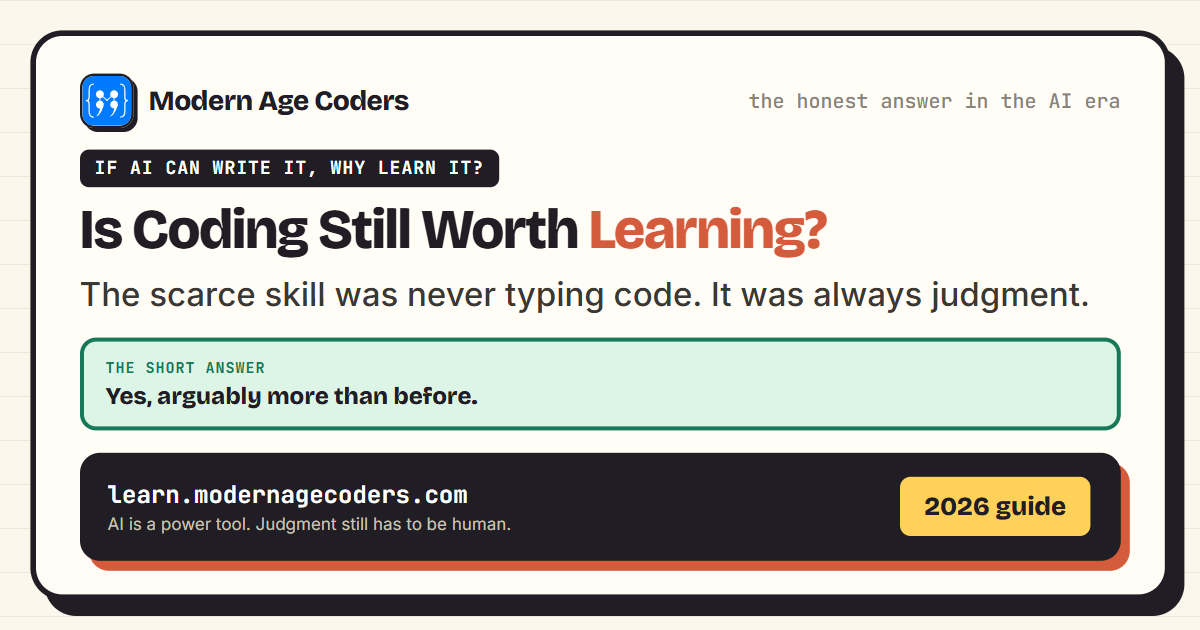
If you are thinking about switching into tech, you have probably heard two loud and opposite messages: that coding is a golden ticket, and that AI has made learning to code pointless. Both are wrong, and the truth sits in between, which is where the real opportunity is.
Learning to code as a career change in 2026 can absolutely be worth it. But the version of the goal that made sense five years ago has changed, and going in with the old picture is how people waste a year. Here is the honest breakdown.
The short answer
Yes, it is still worth it, if you learn properly rather than chasing a shortcut. AI has not removed the need for people who understand code. It has shifted the valuable work from writing every line by hand toward directing AI, checking its output and fixing what it gets wrong. Those jobs need real understanding, and demand for that judgment is holding up. A career changer who learns the fundamentals and adds modern AI tools is well positioned.
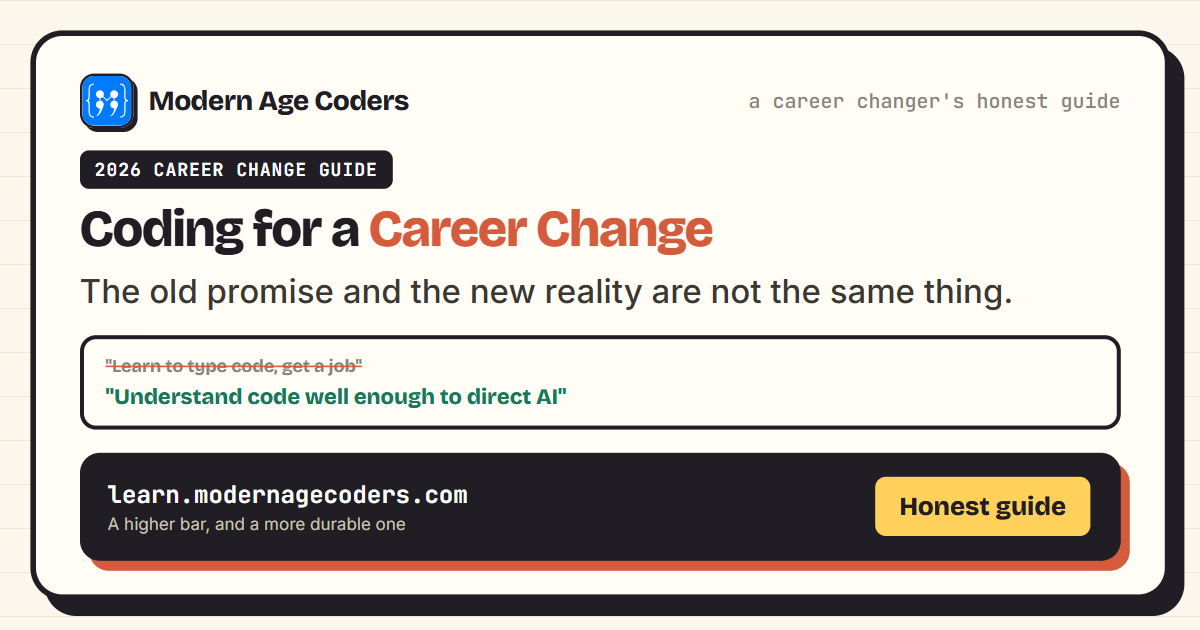
The old promise was learn to type code and get a job. The new reality is understand code well enough to direct and check a machine that types it for you. That is a higher bar, but it is also a more durable one.
What AI actually changed for career changers
Entry-level work that was purely about writing routine code has become easier to automate, which is the part of the hype that is true. But the work of deciding what to build, structuring a solution, verifying that it is correct and fixing subtle failures has not gone anywhere, and it is exactly the work that pays. The people who thrive are the ones who can use AI to move faster while staying fully in control of the code. That means understanding is now the whole game, and shortcuts that skip it lead nowhere.
Is it too late to start?
No. Adults learn to code and change careers successfully at every age, and in some ways it is easier now: AI tools act as an always-available tutor that can explain code and speed up practice. What matters is not your age but how you learn. Building genuine understanding and a portfolio of real projects beats rushing through tutorials, at 25 or 45.
What you should actually learn
| Learn | Why it matters |
|---|---|
| Fundamentals first | How programs are structured, logic, data. Lets you direct and check AI, and never goes out of date |
| One language, deeply | Python is a strong start. Depth in one beats a shallow tour of five |
| Modern AI coding tools | Use them the way professionals do, to work faster while verifying everything they produce |
| A specialisation with demand | Web development, data and AI, or backend, for example. Pick a direction and build in it |
| The ability to show your work | A small portfolio of real, explainable projects beats any certificate alone |
A realistic timeline
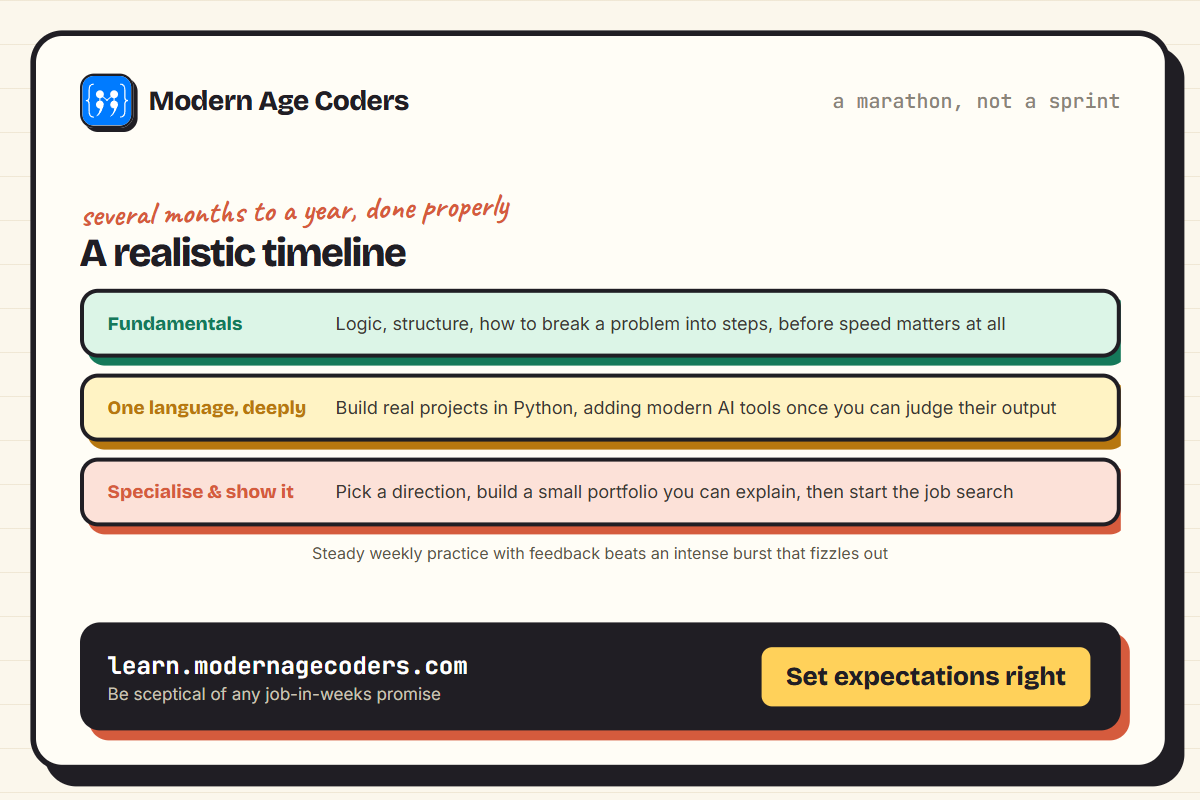
Be wary of anyone promising a job in a few weeks. Studying seriously alongside a job, most career changers need several months to a year to reach a level where they can build real things and speak about them with confidence. Consistent weekly practice with feedback beats an intense burst that fizzles out. The honest version of this path is a marathon at a steady pace, not a sprint, and the people who treat it that way are the ones who make the switch.
The traps to avoid
- The get-rich-quick pitch. Any course promising a six-figure salary in a few weeks is selling a fantasy. Real skill takes real time.
- Vibe coding your way through. Letting AI build everything while you learn nothing feels productive and leaves you unable to pass an interview or hold a job.
- Collecting certificates instead of building. Employers hire on demonstrated ability. Build things you can show and explain.
- Learning alone with no feedback. It is the slowest path. A mentor who reviews your work and answers why gets you there far faster.
Children do not need another app that teaches them to copy code. They need a mentor who teaches them to think.
, Shivam Khemka, Founder of Modern Age Coders
The bottom line
Learning to code for a career change in 2026 is worth it, precisely because AI has raised the value of people who genuinely understand code. Learn the fundamentals, build real projects, add AI tools on top, and give it the honest time it takes. At Modern Age Coders we teach coding and maths to all ages, 6 to 67, including working adults and career changers, live and in small batches with real projects. We are rated 4.9 across 547 Google reviews, and there is a free demo class before you pay.
Yes, if you learn properly. AI has shifted the valuable work from typing every line to directing and checking a machine that writes code, which still requires real understanding. Demand for that judgment is holding up, so a career changer who learns the fundamentals and adds modern AI tools is well positioned.
No. Adults change careers into tech successfully at every age, and AI tutors make practice faster than before. What matters is how you learn, not your age. Building genuine understanding and a portfolio of real projects beats rushing tutorials, whether you are 25 or 45.
Be sceptical of a-job-in-weeks promises. Studying seriously alongside a job, most career changers need several months to a year to build real things and speak about them confidently. Steady weekly practice with feedback beats an intense burst that fades. Treat it as a marathon at a steady pace.
Yes, as a tutor and a tool, not as a substitute for understanding. Use AI to explain code and speed up practice, but read and verify everything it produces. Letting AI build everything while you learn nothing, sometimes called vibe coding, feels productive and leaves you unable to pass an interview or hold the job.
Start with fundamentals, then one language deeply such as Python, then modern AI coding tools, then a specialisation with demand such as web development or data and AI. Build a small portfolio of real projects you can explain. Demonstrated ability matters far more to employers than certificates alone.