SEM / 1a
11 plus maths preparation (CSSE)
All of Key Stage 2 to Year 5, for a full paper.
Open the syllabusSouthend-on-Sea · CSSE 11+ mathematics paper · Live online, small groups or one to one
In Southend, the 11 plus is the test set by the Consortium of Selective Schools in Essex, the CSSE, and its structure is refreshingly plain. There are two papers. One is English. The other is mathematics, on its own, for sixty minutes. The consortium says the two are standardised and weighted "each being worth 50% of the marks". There is no reasoning paper for maths to hide inside and nothing else to share the clock with: an hour of Key Stage 2 maths, without a calculator, counting for half. A paper that long and that heavy has room for every strand of the primary curriculum, including the small statements that busy classrooms rush past. One of those, reading Roman numerals, sits in Year 5 alongside place value to a million. This page sets out what the CSSE and the council publish, then teaches that corner of Year 5 properly.
Maths only · We do not teach the English paper · No connection with the CSSE or any Southend school
In short
Southend-on-Sea City Council says four grammar schools, Southend High School for Boys, Southend High School for Girls, Westcliff High School for Boys and Westcliff High School for Girls, admit only through the 11+, while Shoeburyness High School, St Bernard's High School and St Thomas More High School take part of their intake that way. All use the CSSE test: an English paper of sixty minutes plus ten minutes' reading, and a Mathematics paper of sixty minutes, each worth half the marks and based on Key Stage 2, with no calculators. The CSSE makes no offer to a child with a total standardised score under 303. For September 2027 entry the test was on Saturday 19 September 2026; the CSSE will publish 2028-entry dates by Easter 2027. We teach the maths, live online. Lesson one is on us; after it, lessons run at USD 100 a month in a group or USD 150 a month individually.
Starting in Southend
An hour of maths rewards breadth. Pick by which strands your child has not yet met properly.
SOUTHEND / A
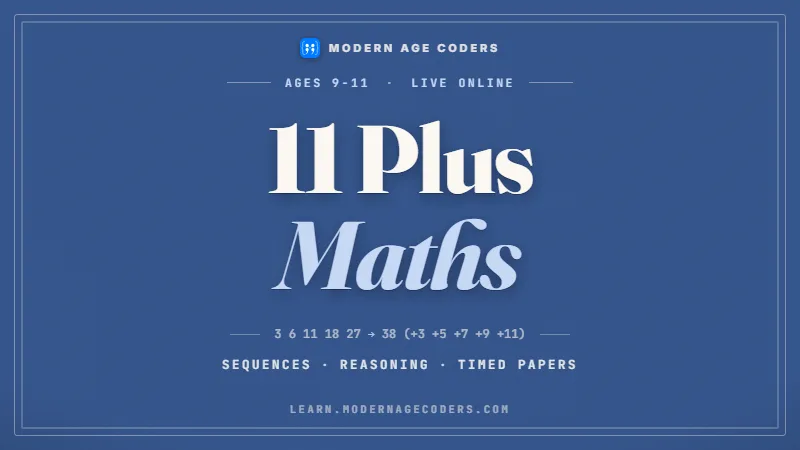
Every Key Stage 2 strand to Year 5, from place value and Roman numerals to measures and data.
Open the syllabus →
SOUTHEND / B
An hour without a calculator is a stamina test for mental and written methods alike.
Open the syllabus →
SOUTHEND / C
For children in Year 4 who need earlier strands secured before Year 5 work.
Open the syllabus →The CSSE test
The CSSE runs the examination for ten schools in Southend and Essex; Southend-on-Sea City Council explains which Southend schools use it. Read on 26 September 2026.
| Step | Date | As published |
|---|---|---|
| Registration opened | Tuesday 12 May 2026 | Online with the CSSE, not with each school. |
| Registration closed | Friday 19 June 2026 | The CSSE's absolute deadline. |
| Tests | Saturday 19 September 2026 | English and Mathematics, at the nominated test centre. |
| Reserve day | Tuesday 29 September 2026 | For religious, illness or exceptional circumstances only. |
| Results | Monday 12 October 2026 | Emailed after the close of business. |
The CSSE describes its test in two sentences on its home page: "The candidates sit two tests. One in English and one in Mathematics." The English paper lasts sixty minutes with ten minutes of additional reading time; "The Mathematics paper will last sixty minutes." Its guide adds that the papers are standardised and weighted, "each being worth 50% of the marks", and that they are "based on Key Stage 2 of the National Curriculum".
The consortium was formed in 1993 so that children applying to more than one selective school sit one test rather than several. Calculators "of any description" are not permitted. Free English and maths familiarisation papers are downloadable from the CSSE website.
Southend-on-Sea City Council's booklet explains the local picture: the four grammar schools "only admit pupils through the selection test", while three other schools admit a proportion of their intake through it, in addition to their main criteria.
The CSSE says offers are not made to any child with a total standardised score under 303, and that its office "deals only with examination administration". For 2028 entry, it says registration opens next year and dates will be published by Easter 2027. Admissions after the test are for the schools and the council.
Sources: CSSE, home page and CSSE 11+ Examination page, with the 11+ Information Guide, Selective Test 2027 Entry; Southend-on-Sea City Council, secondary schools admissions booklet 2026-27 (the most recent we could read). Modern Age Coders has no connection with the CSSE, the council or any Southend school.
Half the marks
In many 11 plus tests, maths is a section squeezed between others. In the CSSE test it is a paper of its own, and that changes what preparation should look like.
A short maths section has to be selective about topics. A sixty-minute paper does not. It can visit place value, all four operations, fractions, decimals and percentages, measures, geometry and statistics, and still have time for the smaller statements in the curriculum that rarely get a lesson of their own.
So the risk in Southend is not unfamiliar content. It is a gap: one strand a child has never really learned because it only got a week in class. On an hour-long paper, gaps are found.
With each paper worth half the marks, a strong English score cannot carry a weak maths one as easily as it might where maths is a quarter. We say that not to predict anything, since the CSSE sets its cut-offs from each year's results, but to explain why maths deserves an equal share of preparation time.
An hour without a calculator is also a matter of stamina. Children who are accurate for twenty minutes and careless for the last forty lose marks that have nothing to do with knowledge.
Our answer is a checklist of every Year 5 statement in the national curriculum, ticked off only when a child can answer a fresh question on it correctly without help. The next section shows one of the statements families are most surprised to find on it.
The lesson
The Year 5 curriculum asks pupils to "read Roman numerals to 1,000 (M) and recognise years written in Roman numerals", right next to reading and comparing numbers to a million. Both are about place value.
| Skill | Our question | Answer and reasoning |
|---|---|---|
| Read a year | The CSSE was formed in 1993. Write 1993 in Roman numerals. | MCMXCIII: M (1,000) + CM (900) + XC (90) + III (3) |
| Recognise a year | What year is MMXXVII? | 2027: MM (2,000) + XX (20) + VII (7) |
| Compare | Which is larger: CDXLIV or CCCXCIX? | CDXLIV, which is 444; CCCXCIX is 399 |
| Order | Put 405,090, 450,009 and 409,500 in order, smallest first. | 405,090, then 409,500, then 450,009 |
| Round | Round 748,500 to the nearest 100,000. | 700,000: the ten-thousands digit is 4 |
Roman numerals look like a history lesson, but the reason they are in Year 5 maths is place value. Our system uses position: the 9 in 1993 is worth 900 because of where it sits. Roman numerals use subtraction instead: C before M means a hundred less than a thousand. Working out why CM is 900 and MC is 1,100 makes children think hard about what each symbol is worth.
The common errors are predictable. Children read IX as 11, or write 1993 as MDCCCCLXXXXIII by adding everything. On a multiple-choice or written paper, both lose the mark.
Numbers to a million go wrong in a different way. 405,090 and 450,009 have the same digits in a different order, and children who compare from the right, or who miss a zero, rank them wrongly. We teach comparing from the left, place by place, which works for any size of number.
Rounding uses the same habit: look one place to the right of the place you are rounding to. For 748,500 to the nearest 100,000, the digit that decides is the 4 in the ten-thousands place, so it rounds down.
Sources: national curriculum in England, mathematics, Year 5 number and place value (statutory requirements); CSSE Information Guide for the 1993 founding date. The questions are Modern Age Coders' own.
How we prepare
Three things matter for a sixty-minute, calculator-free paper worth half the score.
Every Year 5 statement, taught and checked. Small ones like Roman numerals, thousandths and converting units of time get the same attention as long multiplication.
Timed practice grows from twenty minutes to a full hour over the summer, so accuracy in the last quarter matches accuracy in the first.
Without a calculator, written methods have to be quick and reliable, and mental arithmetic has to cover everything else.
The CSSE publishes free familiarisation papers and sells practice packs. Use the free papers to see the format. We do not reproduce CSSE material; our questions are our own, written to Key Stage 2.
The CSSE guide also notes that practice tests sold by booksellers are "based at a similar level but are not of the same format as the 11+ papers". We treat all practice papers as practice, not as a forecast.
The English paper is the other half of the total. We do not teach English for the test and say so before any family books with us.
We give no advice on the choice between the four grammar schools and the three partially selective ones, priority areas or places. The council and the schools publish those rules.
Southend's schools
The council names the Southend schools that admit through the CSSE test. We list them only to show which test this page covers.
| School | Places through the test |
|---|---|
| Southend High School for Boys | All |
| Southend High School for Girls | All |
| Westcliff High School for Boys | All |
| Westcliff High School for Girls | All |
| Shoeburyness High School | A proportion |
| St Bernard's High School | A proportion |
| St Thomas More High School | A proportion |
The other three CSSE schools are in Colchester and Chelmsford; see our Essex 11 plus page for those. The test is the same.
For coding and computing in the city, see our Southend coding page.
Lessons are live on video. A child in Leigh-on-Sea, Westcliff or Shoeburyness is taught with children at the same level of Year 5 maths from across the country, in groups of five to ten.
We have no connection with the CSSE, Southend-on-Sea City Council or any of these schools.
Source: Southend-on-Sea City Council, secondary schools admissions booklet 2026-27.
Towards September 2027
For a child in Year 5 now, the next CSSE test should fall in September 2027; the consortium will publish dates by Easter 2027.
| When | Stage | Evidence of progress |
|---|---|---|
| Autumn, Year 5 | 1. Number and place value | Numbers to a million, rounding and Roman numerals read without errors |
| Winter, Year 5 | 2. Operations and fractions | Written and mental methods fast and accurate, no calculator |
| Spring and summer, Year 5 | 3. Measures, shape, data | Every remaining Year 5 statement ticked off with a fresh question |
| Summer holiday | 4. The full hour | Sixty minutes of mixed maths, as accurate at the end as at the start |
Coverage matters most on a long paper. If time is short, we find the gaps first and fill those before anything else.
At the free lesson we will say honestly what can be done.
A child who can work for an hour without a calculator is ready for secondary maths. Some continue with maths through coding.
Others enjoy the problem-solving challenges on our competitions calendar.
Course list
By stage, with each syllabus a click away.
SEM / 1a
All of Key Stage 2 to Year 5, for a full paper.
Open the syllabusSEM / 1b
Fast, calculator-free arithmetic.
Open the syllabusSEM / 1c
The earlier strands, secured.
Open the syllabusSEM / 1d
Place value made visible.
Open the syllabusSEM / 2a
The step up from primary maths.
Open the syllabusSEM / 2b
Foundation and higher tiers.
Open the syllabusSEM / 2c
Problems beyond the syllabus.
Open the syllabusSEM / 3a
Write a Roman numeral converter.
Open the syllabusSEM / 3b
Logic in blocks.
Open the syllabusSEM / 3c
The first typed language.
Open the syllabusSEM / 4a
Faster arithmetic, on firm ground.
Open the syllabusSEM / 4b
Maths put to work.
Open the syllabusLesson times
Our lessons are taught live from India. For primary children we use early evening and weekend morning slots by the UK clock, and adjust our own hours for British Summer Time.
After school
Early in the evening, before fatigue.
Saturday and Sunday mornings
For fuller weekday diaries.
School holidays
Extra lessons to build stamina.
Continuity that catches recurring slips.
Short, honest notes to parents.
Children matched by level.
CSSE material is never reproduced.
For filling particular gaps quickly.
No English coaching and no admissions advice.
Student work
Four projects by students at our school, built on primary number work like this. More on the student labs page.
AI and ML
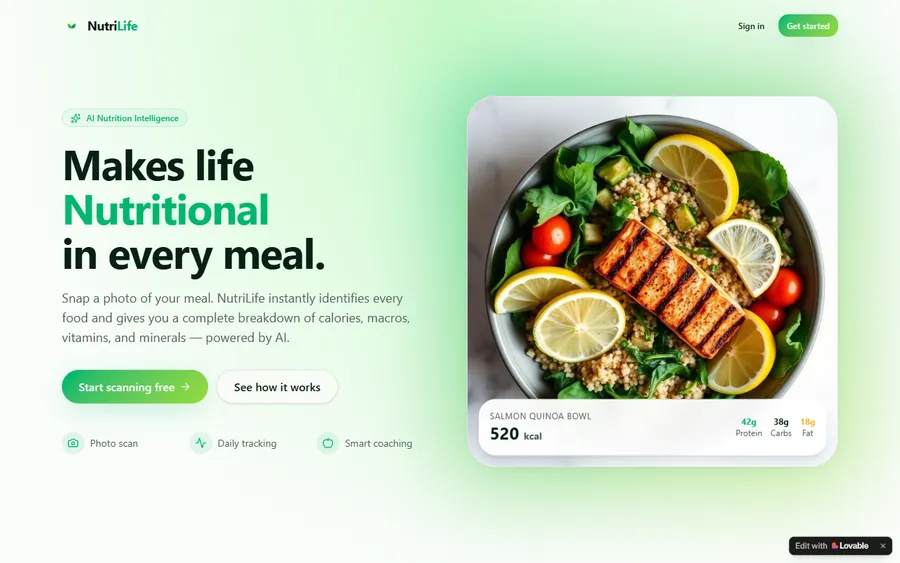
An AI nutrition coach that reads what you eat and works you toward a target.
AI and ML
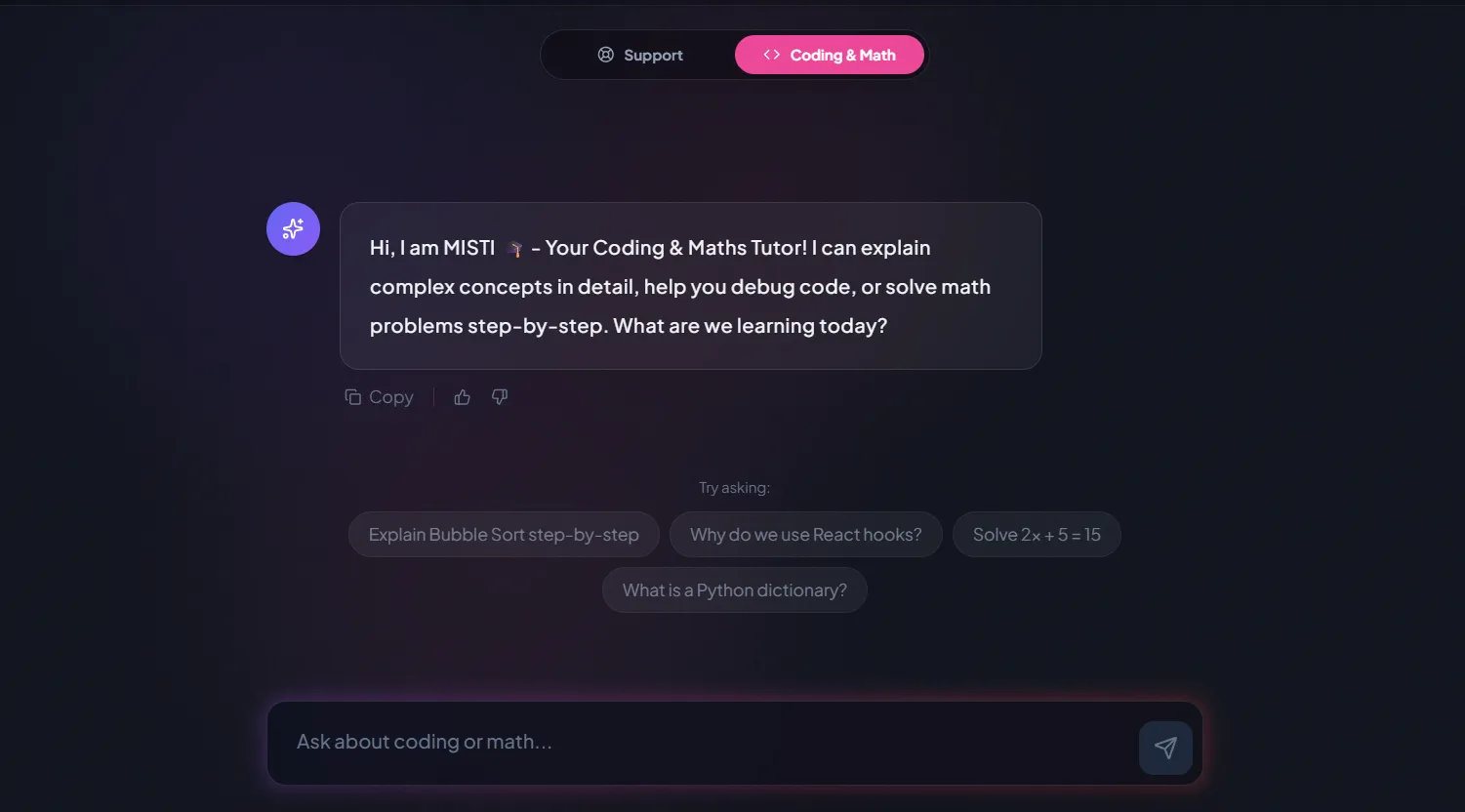
A chatbot that answers mathematics and programming questions, built and deployed by a student.

AI and ML
An assistant that helps a young person recognise unsafe situations online.
Web app
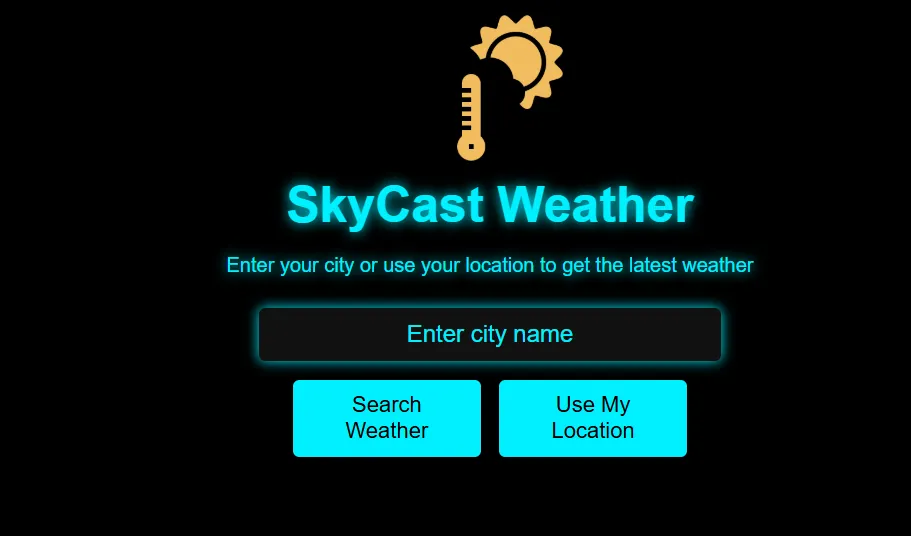
A weather forecasting site with live conditions for any location.
Fees
Families outside India pay one monthly US dollar price. Nothing to join, and you can stop at any point.
Free first class
USD 0
no card required
Group batch
USD 100
a month, billed in US dollars
One to one
USD 150
a month, billed in US dollars
What families say
Reviews from parents on Google, exactly as posted.
★★★★★
"The one step solution for my son. Modern Age Coders make learning coding so simple that kids love it. The teachers explain complex concepts clearly with practical exercises and interactive content."
Ria Mukherjee
Parent
★★★★★
"Modern Age Coders has been a game-changer for me. I struggled to grasp IT concepts and coding before joining, but their classes transformed everything. I can now confidently write complex programs with ease."
Samriddha Mondal
Student
★★★★★
"One of the most wonderful education centres out there. Education is not limited to school syllabus but focuses on skill development."
Vansh Agarwal
Student
★★★★★
"My child Dhairya is really enjoying the Modern Age Coders classes. This is his first online class and he eagerly looks forward to it. I can already see his improvement, and the teachers are very cooperative."
Sonam Oswal
Parent of Dhairya
★★★★★
"Modern Age Coders have wonderful teachers who teach in a clear, easy and practical way. The teacher boosts students' confidence and inspires them to learn without hesitation."
Sonu Goyal
Parent
★★★★★
"I highly recommend this computer coding class! The teachers are incredibly knowledgeable and passionate about coding."
Ritu Kedia
Parent
Southend CSSE questions
The CSSE says candidates sit two tests, one in English and one in Mathematics, and that the Mathematics paper lasts sixty minutes. Its guide says the tests are based on Key Stage 2 of the National Curriculum.
The CSSE guide says the two papers are standardised and weighted, each being worth 50% of the marks.
No. The CSSE guide says calculators of any description are not permitted.
The council says Southend High School for Boys, Southend High School for Girls, Westcliff High School for Boys and Westcliff High School for Girls admit only through it, and Shoeburyness, St Bernard's and St Thomas More admit a proportion of their intake through it.
The CSSE says offers are not made to any child who has scored under a total standardised score of 303. We never treat that as a target or predict scores.
The CSSE says registration opens next year and important dates will be published by Easter 2027. For 2027 entry the test was on Saturday 19 September 2026.
The CSSE offers free familiarisation papers on its website and sells practice packs. We write our own questions and do not reproduce CSSE material.
No, only the mathematics. We also do not advise on applications or places.
Because reading Roman numerals to 1,000 is a Year 5 statement in the national curriculum, and a sixty-minute paper has room for every Year 5 statement.
There is no charge for the first lesson. After that it is USD 100 a month in a group or USD 150 a month for one to one, month by month.
Nearby
The other CSSE schools, coding in Southend, and our national 11 plus page.
The CSSE schools in Colchester and Chelmsford.
Programming for the city's children and teens.
An overview of 11 plus maths in England.
Across the estuary, a different test.
Maths challenges for enthusiasts, by date.
Every UK area we write about.
Start here
Share your child's year group and which maths topics feel shaky. We teach a real lesson, then give you an honest report.
Prefer to explore? Each course page has a full syllabus, how we teach explains our lessons, and the roadmap charts what follows.
WhatsApp us · +91 91233 66161 · contact@modernagecoders.com
WhatsApp brings the quickest reply. Our team is in India, our phone number is Indian, and we have no office in Essex.