Table of Contents
Abacus, Vedic maths and mental maths are three of the most popular maths programmes parents consider, and the marketing for each promises a genius child who calculates at lightning speed. The reality is more useful and more honest: each is good at one thing, none of them is the whole of maths, and the right choice depends on your child's age and what you actually want them to get out of it.
The short answer
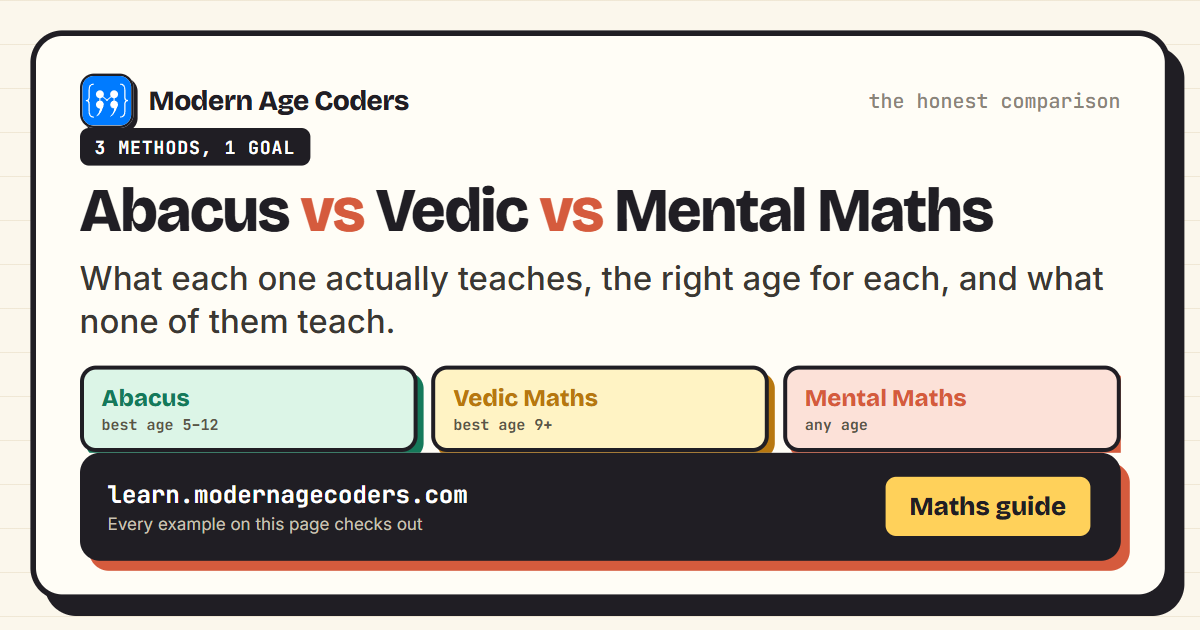
All three build fast, confident arithmetic. Abacus is best for young children first learning to calculate, using a physical tool that later becomes a mental image. Vedic maths suits older children who already calculate and want clever shortcuts for speed. Mental maths is really the shared goal of both: doing calculation in your head. What none of them teaches on its own is the deeper reasoning, problem solving and concepts that school and exams actually test. Speed is a nice bonus. Understanding is the real prize.
What each one actually is
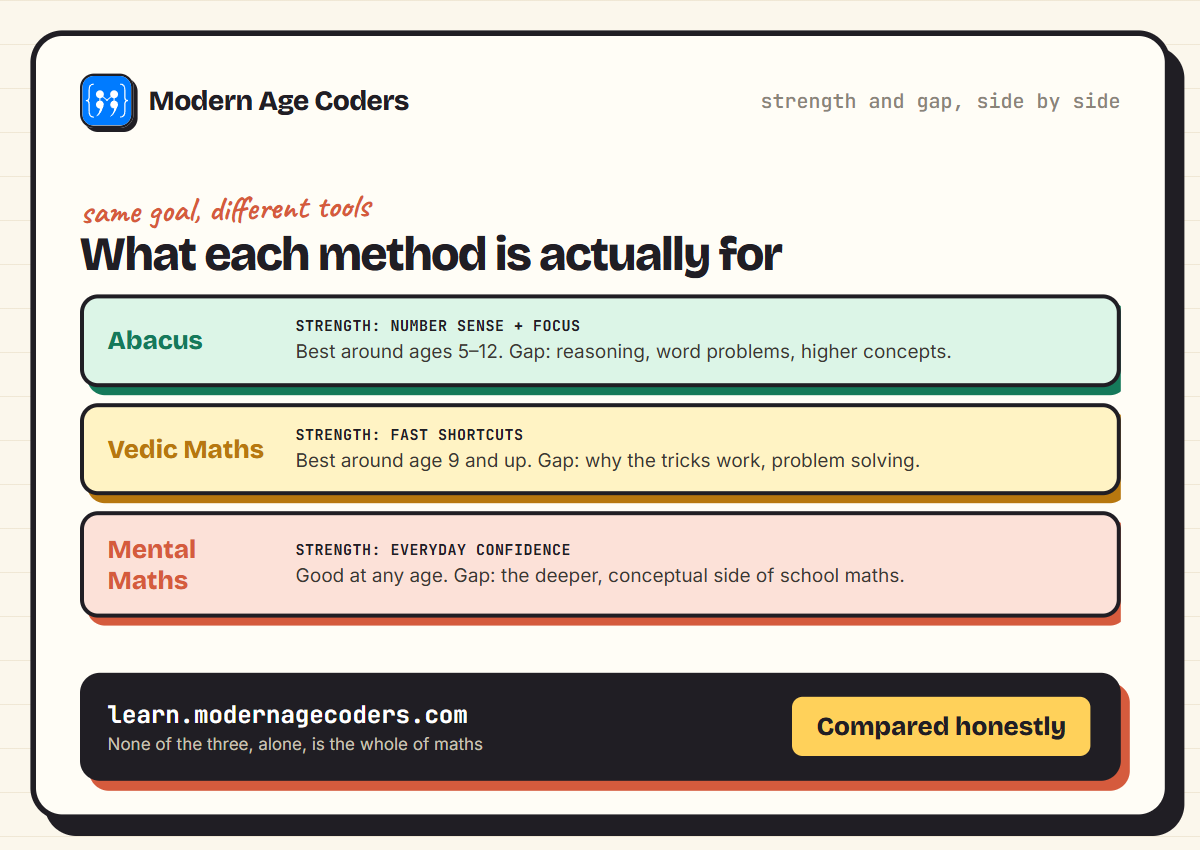
- Abacus: children learn to calculate on a physical bead frame, then gradually picture the beads in their head to do sums mentally. It is strong for building early number sense, concentration and calculation speed, and it suits younger children, often from around ages 5 to 12.
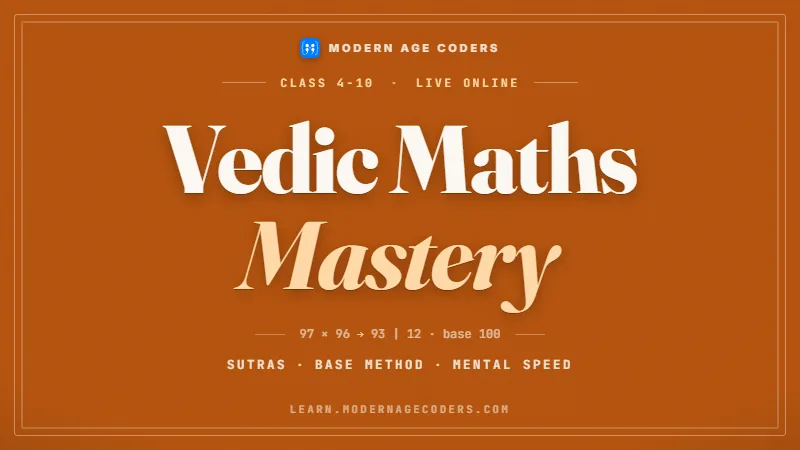
- Vedic maths: a collection of mental calculation techniques and shortcuts, rooted in an old Indian system, for doing arithmetic like multiplication and squaring quickly. It works best for children who can already calculate and want to go faster, usually a little older, and is popular for competitive exam speed.
- Mental maths: the broad ability to calculate in your head with good number sense, rather than a single branded programme. Abacus and Vedic maths are two routes to it; so is plenty of everyday practice.
An abacus is really a place value machine: each rod is worth ten times the one to its right. If that idea is shaky, it is worth fixing before any method. Place value explained shows how to teach it with objects, why zero matters, and how lakhs and crores compare with millions.
A quick comparison
| Method | Best age | Main strength | What it does not teach |
|---|---|---|---|
| Abacus | Around 5 to 12 | Early number sense, focus, calculation speed | Reasoning, word problems, higher concepts |
| Vedic maths | Around 9 and up | Fast arithmetic shortcuts and tricks | Why the tricks work, problem solving, proofs |
| Mental maths | Any age | Everyday calculation and confidence | The deeper, conceptual side of school maths |
A real Vedic maths trick, worked out
It helps to see one of these tricks actually working rather than take the promise on faith. Here is a genuine Vedic technique for multiplying two numbers close to a base like 100, the kind of trick that makes the method popular for exam speed.
| Step | What you do | This example: 97 x 96 |
|---|---|---|
| 1. Pick the base | Choose the round number both factors sit near | Base is 100 |
| 2. Find the deficiency | How far below the base is each number | 97 is -3, 96 is -4 |
| 3. Cross-subtract | Subtract one deficiency from the other number | 97 - 4 = 93 |
| 4. Multiply the deficiencies | Multiply the two deficiency numbers | 3 x 4 = 12 |
| 5. Combine | Left part and right part side by side | 93 and 12 gives 9,312 |
That is 97 x 96 = 9,312, worked out in a few seconds once the pattern is familiar, versus the longer written multiplication a calculator-free exam would otherwise demand. This is a genuinely useful shortcut. What it does not teach is why the trick works, which is the algebra of (100-a)(100-b), or how to approach a word problem that never mentions multiplication at all. That gap is the whole point of this article.
Why does the trick always work? Write the numbers as 100 - a and 100 - b. Then (100 - a)(100 - b) = 100(100 - a - b) + ab, which is exactly the two parts of the answer. That one line is a proof: it covers every pair of numbers at once, not just the ones you tried. Our guide to how to write a maths proof explains the idea further.
What none of them teaches
This is the part the brochures skip. Fast arithmetic is genuinely useful and builds confidence, but school and exams are not mostly about calculating quickly. They are about understanding concepts, reading and solving word problems, reasoning through multi-step questions, and explaining why an answer is right. A child can be a lightning-fast calculator and still struggle with a Class 8 word problem, because the two are different skills. Speed programmes are a fine addition. They are not a substitute for actually understanding maths.
So which should you choose?
- For a young child, roughly 5 to 10, who is just getting comfortable with numbers, abacus is a strong, playful start that builds focus and number sense.
- For an older child who already calculates well and wants speed for exams or competitions, Vedic maths adds useful shortcuts, like the one worked out above.
- For any child, the most valuable thing is not a speed method at all. It is understanding: concepts, problem solving and reasoning, taught by someone who checks that the child truly gets it, not just that they answer fast.
- If you can only invest in one thing, invest in understanding. Speed can be added later; a shaky foundation is much harder to fix.
Three questions to settle it
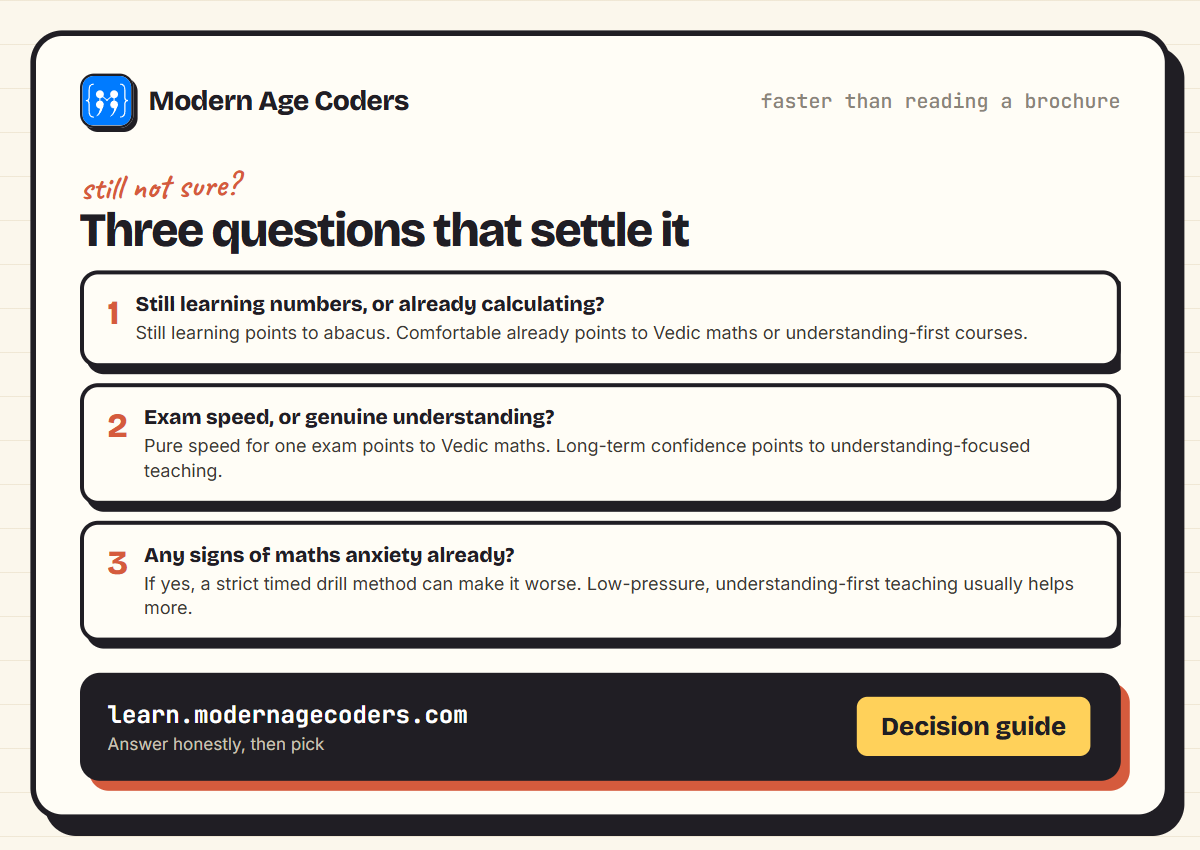
- Is my child still learning what numbers mean, or already calculating comfortably? Still learning points to abacus. Already comfortable points to Vedic maths or straight to understanding-focused maths.
- Is the goal exam speed, or is it genuinely enjoying and understanding maths? Pure speed for a specific exam points to Vedic maths. Long-term confidence points to a course built around understanding.
- Does my child already show signs of maths anxiety or dislike? If yes, a strict drill-based speed programme can make that worse. Understanding-first, low-pressure teaching usually helps more than another timed method.
Children do not need another app that teaches them to copy code. They need a mentor who teaches them to think.
, Shivam Khemka, Founder of Modern Age Coders
The bottom line
Abacus, Vedic maths and mental maths all build speed and confidence, and any of them can be a good fit at the right age. Just do not mistake fast arithmetic for real maths. The skill that carries a child through school, exams and beyond is understanding: concepts, reasoning and problem solving. At Modern Age Coders we teach maths, and coding and maths together, live and in small batches for ages 6 to 67, with a focus on genuine understanding rather than tricks. We are rated 4.9 across 547 Google reviews, and there is a free demo class before you pay.
Frequently Asked Questions
Neither is simply better; they suit different ages and goals. Abacus is best for young children, roughly 5 to 12, learning to calculate and build number sense on a physical tool. Vedic maths suits older children who already calculate and want speed shortcuts. Both build fast arithmetic, and neither, on its own, teaches the deeper reasoning school actually tests.
Abacus generally suits younger children, often from around ages 5 to 12, when learning to calculate and building concentration and number sense are most valuable. Older children who already calculate well usually get more from speed techniques like Vedic maths, or better still, from work on understanding and problem solving.
They help with the calculation part and with confidence, but school maths is mostly about concepts, word problems and reasoning, which these speed methods do not teach on their own. A child can calculate quickly and still struggle with problem solving, so treat these programmes as a useful addition, not a replacement for understanding.
Mental maths is the broad ability to calculate in your head with good number sense, not a single branded course. Abacus and Vedic maths are two routes to strong mental maths, and so is regular practice. The goal is the same: confident calculation without reaching for a calculator.
Understanding, not speed. Concepts, reading and solving word problems, and reasoning through multi-step questions are what school, exams and real life reward. Fast arithmetic is a helpful bonus, but if you can only focus on one thing, focus on genuine understanding, taught by someone who checks the child truly gets it.
Yes, and for most families that combination works well. Abacus or Vedic maths for calculation speed alongside a course focused on concepts and problem solving covers both halves of the picture, as long as the schedule leaves room to actually enjoy the subject rather than turning every evening into a maths class.
The techniques are legitimate shortcuts for arithmetic, and using a Vedic method to reach a correct answer quickly is generally fine. But most school and board exams still require you to show working in the format they teach, so treat Vedic maths as a mental speed tool and a way to check your work, not a full replacement for the methods a syllabus expects on paper.