BCM / 1a
11 plus maths, Dorset Consortium
Year 5 maths for Paper One.
Open the syllabusBournemouth, Christchurch and Poole · Dorset Consortium 11+ maths · Live online, small groups or one to one
As we write, on Saturday 26 September 2026, children across Bournemouth, Christchurch and Poole are sitting the Dorset Consortium's entrance tests for the four grammar schools. For their younger brothers and sisters in Year 5, the maths paper is about to change, and in a helpful direction. Last cycle the GL maths paper ran for fifty minutes, and Poole Grammar School described it as covering most of Key Stage 2 "up to level 5, with some questions aimed at level 6". From September 2027 the provider becomes Quest Assessments, maths is "Paper One", forty minutes long, and Bournemouth School describes its content as Key Stage 2 "but excluding work covered in Year 6". A shorter paper with a clear Year 5 ceiling is a sharper target. This page sets out what the schools and Quest publish, then teaches one Year 5 geometry topic that fits it: regular and irregular polygons.
Maths only · We do not teach English or verbal reasoning · No connection with the consortium or its schools
In short
Bournemouth School, Bournemouth School for Girls, Parkstone Grammar School and Poole Grammar School form the Dorset Consortium and share one set of entrance tests. For September 2027 entry they were GL Assessment papers in maths (50 minutes), English (45) and verbal reasoning (50), all multiple choice, sat on Saturday 26 September 2026 with results on 16 October. For children now in Year 5, the consortium moves to Quest Assessments: three papers of 40 minutes in one session, with maths as Paper One, and Bournemouth School says the maths will exclude work covered in Year 6. Quest lists registration from April 2027 and the exam in September 2027. Poole Grammar School's proposed policy gives 3 September 2027 as its registration deadline and 15 October 2027 for results. We teach the maths, live online. Our first session costs nothing; families who continue pay USD 100 monthly for a small class or USD 150 monthly for a private teacher.
Where to start in BCP
With a Year 5 ceiling and forty minutes, depth in Year 5 is everything. Choose by where the gaps are.
BCP / 1
The whole Year 5 curriculum, including geometry, for a forty-minute multiple-choice paper.
Open the syllabus →
BCP / 2
Forty minutes is shorter than last cycle's fifty; quick recall matters more.
Open the syllabus →
BCP / 3
For a child who still hesitates over Year 3 or Year 4 skills such as times tables and place value.
Open the syllabus →The Dorset Consortium tests
Bournemouth School and Poole Grammar School publish the details for both cycles; Quest Assessments publishes the new format with the four schools. Read on 26 September 2026.
| September 2027 entry | September 2028 entry | |
|---|---|---|
| Provider | GL Assessment | Quest Assessments |
| Maths | 50 minutes | Paper One, 40 minutes |
| Other papers | English 45 minutes; verbal reasoning 50 minutes | English and verbal reasoning, 40 minutes each |
| Maths content | Most of Key Stage 2, some questions "aimed at level 6" | Key Stage 2 "excluding work covered in Year 6" |
| Registration | 13 April to noon, 4 September 2026 | From April 2027; PGS proposes noon, 3 September 2027 |
| Test and results | Saturday 26 September 2026; results 16 October 2026 | September 2027; PGS proposes results on 15 October 2027 |
Bournemouth School says "All students wishing to join our school in Year 7 must sit an entrance test", and that the consortium exists so children can be considered by all four schools without sitting more than one set of tests. Poole Grammar School confirms that "All four BCP grammar schools use the same entrance tests".
For 2027 entry the three GL papers "are multiple choice; students mark their answers on a pre-printed sheet". Poole Grammar School's policy says an aggregate of the three age-standardised scores decides whether a boy meets the required standard.
For 2028 entry, Quest describes "Three papers, sat in the same session with a short supervised break. Each paper lasts 40 minutes", with "Paper One" maths, and questions that are multiple choice from usually five options. Bournemouth School adds: "From September 2027, we will continue to test mathematics, English and verbal reasoning; no content beyond the Year 5 National Curriculum will be tested."
Poole Grammar School is consulting on its admissions policy for 2028 entry, so its proposed dates may change. For children who move to the area late, Bournemouth School runs late registration to 29 January 2027 and late testing in February for the 2027 cycle. Places are the schools' business, not ours.
Sources: Bournemouth School, joining Year 7; Poole Grammar School, admissions to Year 7, with its 2027 policy and proposed 2028 policy; Quest Assessments, Dorset Consortium 11+ Assessment. BCP Council's pages do not describe the tests, and Parkstone Grammar School's admissions page was unavailable when we tried. Modern Age Coders has no connection with the consortium, its schools, GL, Quest or the council.
The Year 5 ceiling
The change in wording between the two cycles is small on the page and large for families.
Poole Grammar School described the GL maths paper as covering "most aspects of Key Stage 2 up to level 5, with some questions aimed at level 6". National curriculum levels were withdrawn from primary assessment some years ago, and "level 6" was always a loose description. Families understandably read it as "some secondary maths", and preparation drifted into Year 6 and beyond.
For a test sat in the September of Year 6, that drift cost time that Year 5 topics needed.
For 2028 entry, Bournemouth School describes the maths as Key Stage 2 "but excluding work covered in Year 6", and says no content beyond the Year 5 curriculum will be tested. That is a definite ceiling: everything in the Year 5 programme of study, and nothing after it.
Paired with a forty-minute paper instead of fifty, it means fewer minutes on narrower content. The way to use that is depth: every Year 5 topic secure and quick, including the ones classrooms rush.
Maths also moves to the front. Quest lists it as Paper One, the first of three in the session. A child starts the morning with maths, fresh, rather than meeting it after an hour of English and reasoning. We practise cold starts so the first questions of the day are as accurate as any.
The lesson
The Year 5 curriculum asks children to "distinguish between regular and irregular polygons based on reasoning about equal sides and angles". It is a small statement with plenty of room for good multiple-choice questions.
| Idea | Our question | Answer and reasoning |
|---|---|---|
| What regular means | A shape has all sides equal and all angles equal. What is it called? | A regular polygon: both conditions are needed |
| Equal sides only | A rhombus has four equal sides. Is it regular? | Not unless its angles are also equal, which makes it a square |
| Equal angles only | A rectangle has four equal angles. Is it regular? | Only if its sides are equal too: then it is a square |
| Perimeter from one side | A regular hexagon has sides of 7 cm. What is its perimeter? | 42 cm: six equal sides |
| Working backwards | A regular polygon has perimeter 48 cm and sides of 6 cm. How many sides? | 8: it is a regular octagon |
| Irregular | A triangle has sides of 5, 5 and 8 cm. Regular or irregular? | Irregular: not all sides are equal |
The key word in the curriculum is "reasoning". A child should not recognise a regular shape by how it looks, since a drawing on a test page may not be accurate, but by what is marked or stated: equal sides, equal angles, or both. Regular needs both.
The rhombus and rectangle rows are the heart of it. Each has one kind of equality but not the other, so each is irregular, except in the special case where it becomes a square. Children who understand those two examples can handle any polygon question.
The perimeter rows connect shape to measurement, which Year 5 also covers. Once a polygon is known to be regular, one side length gives the whole perimeter, and the perimeter plus a side gives the number of sides. On a forty-minute paper, those are quick marks for a child who knows what regular means.
On multiple-choice questions, the wrong options usually come from seeing rather than reasoning: calling a rhombus regular because it looks neat, or an irregular pentagon regular because it is drawn nearly symmetrical. We train the habit of checking the labels before trusting the picture.
Source: national curriculum in England, mathematics, Year 5 geometry, properties of shapes (statutory requirements). The questions are our own.
Our approach
A new provider means old practice books no longer match. The maths underneath has not moved.
Every strand of the Year 5 curriculum taught to depth, since the ceiling is now definite.
Timed maths papers of forty minutes, not fifty, so the pace matches Paper One.
Quest questions usually offer five choices on an OMR sheet; we practise that layout late in the year.
Quest publishes familiarisation booklets and guidance with the four schools. Use those to see the format. We do not reproduce Quest or GL material, and our questions are our own.
English and verbal reasoning are the other two papers. We teach neither for the test.
Because the aggregate of all three papers decides whether a child meets the standard, according to Poole Grammar School's policy, a weak maths paper can hold back strong English. We aim for maths that is never the weak one.
We do not advise on which school to name, catchment or places. The schools publish their own policies, and Poole Grammar School is consulting on its 2028 policy now.
Across the conurbation
Two schools in Bournemouth and two in Poole share one testing day. The list is here purely to make the scope of the page clear.
| Consortium member | Where |
|---|---|
| Bournemouth School | Bournemouth |
| Bournemouth School for Girls | Bournemouth |
| Parkstone Grammar School | Poole |
| Poole Grammar School | Poole |
Lessons are live on video, so a child in Christchurch, Boscombe, Broadstone or Ferndown is taught the same way, in groups of five to ten matched by level.
Our UK page lists every city and county where we write about coding and maths.
The schools' town names in the table are ours, given as a rough guide.
We have no connection with the consortium, any of its schools, Quest, GL or BCP Council, and we do not advise on applications or places.
Towards September 2027
Registration from April 2027, the exam in September 2027: early in Year 6 for today's Year 5.
| When | Stage | You will see |
|---|---|---|
| Autumn, Year 5 | 1. Number | Place value, the four operations and fractions secure |
| Winter, Year 5 | 2. Shape and measures | Polygons, angles, area and perimeter reasoned, not guessed |
| Spring, Year 5 | 3. The rest of Year 5 | Statistics, decimals and conversions complete |
| Summer holiday | 4. Paper One practice | Forty minutes of five-option questions, first thing in the morning |
The Year 5 ceiling helps a late starter: there is a fixed body of content, and we cover the biggest parts first.
At the free lesson we will give you an honest view.
Shape reasoning grows into secondary geometry and proof. Some pupils continue with maths through coding and draw regular polygons in code.
Others look for the national challenges on our competitions calendar.
Courses
Primary preparation, secondary follow-on, coding and teenage options, each card opening its syllabus.
BCM / 1a
Year 5 maths for Paper One.
Open the syllabusBCM / 1b
Speed for a forty-minute paper.
Open the syllabusBCM / 1c
The foundations under Year 5.
Open the syllabusBCM / 1d
Number sense for younger children.
Open the syllabusBCM / 2a
Geometry, algebra and proof.
Open the syllabusBCM / 2b
For every exam board.
Open the syllabusBCM / 2c
For strong, curious pupils.
Open the syllabusBCM / 3a
Draw regular polygons with loops.
Open the syllabusBCM / 3b
Turn angles into shapes.
Open the syllabusBCM / 3c
The first typed language.
Open the syllabusBCM / 4a
Speed on firm foundations.
Open the syllabusBCM / 4b
Maths behind modern software.
Open the syllabusWhen we teach
We teach live from India, and fix primary lessons in UK time: after school on weekdays, or early at the weekend. The spring and autumn clock changes are our problem, not yours.
After school
Early evening, before tiredness.
Weekend mornings
Good rehearsal for a morning exam.
Holidays
Short extra sessions.
Who learns how your child thinks.
Brief notes on what is secure and what is not.
Matched on level.
No Quest or GL material copied.
For a stubborn topic.
No English or reasoning coaching; no admissions advice.
Student work
A few years after Year 5, our students design and ship their own software; four examples sit below, and the student labs page lists the rest.
AI and ML
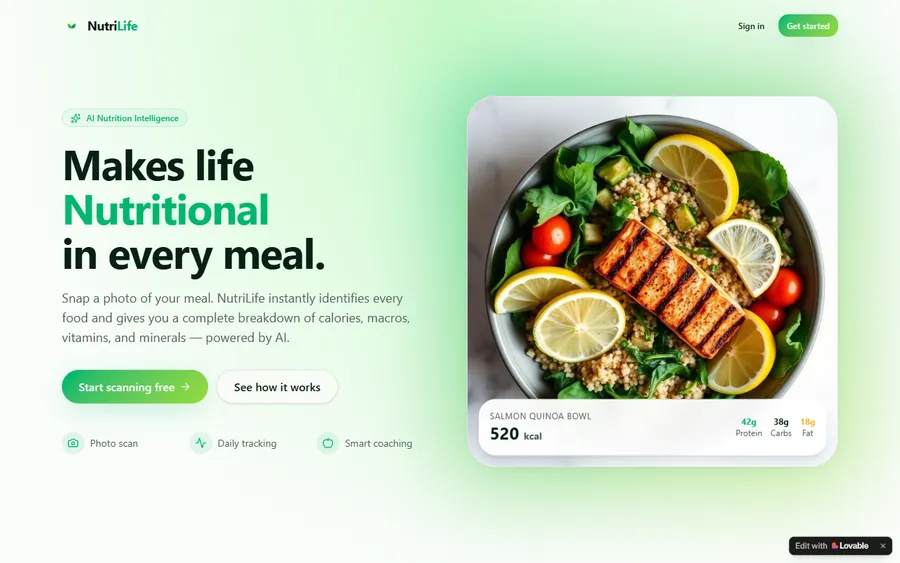
An AI nutrition coach that reads what you eat and works you toward a target.
AI and ML
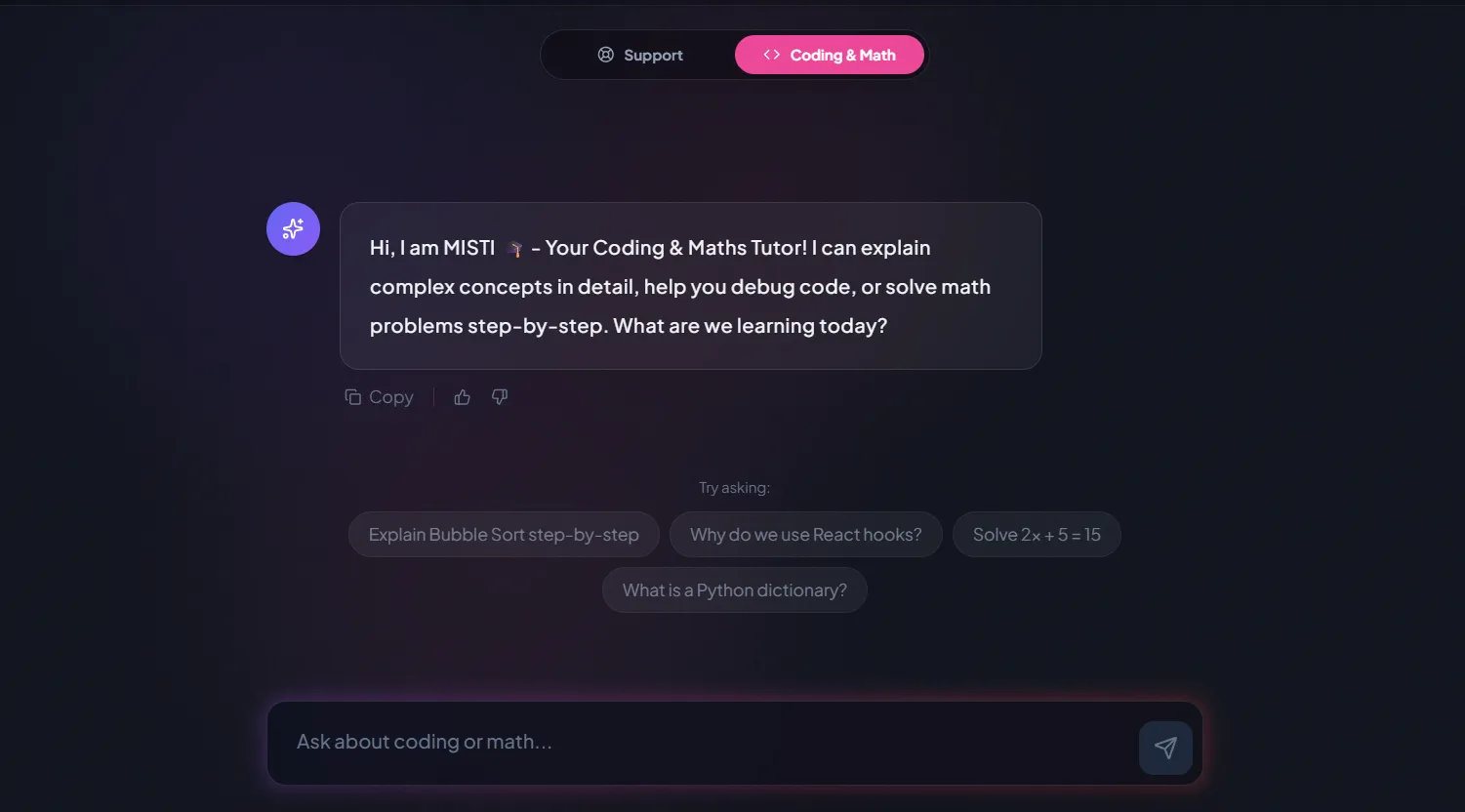
A chatbot that answers mathematics and programming questions, built and deployed by a student.

AI and ML
An assistant that helps a young person recognise unsafe situations online.
Web app
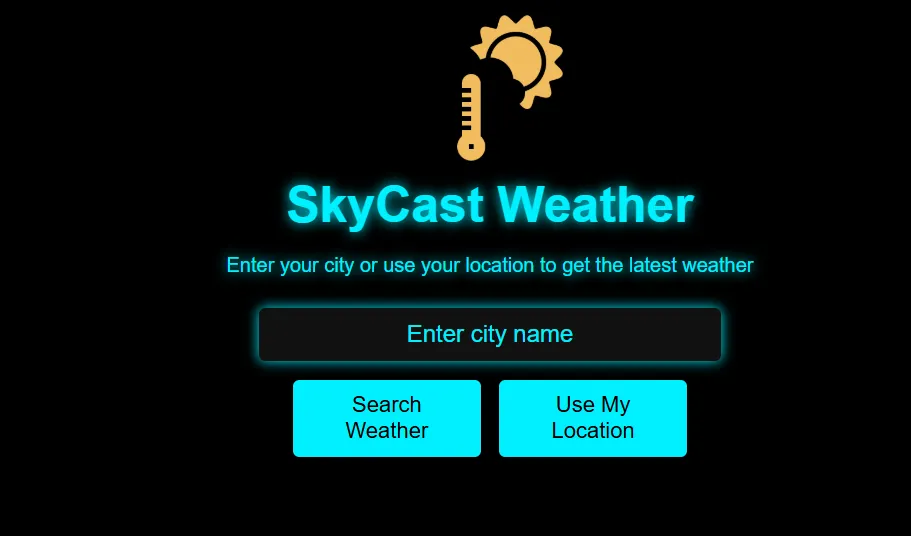
A weather forecasting site with live conditions for any location.
Fees
The same monthly US dollar price for every family outside India. No joining fee and no fixed term.
Group batch
USD 100
a month, billed in US dollars
One to one
USD 150
a month, billed in US dollars
What families say
In families' own words, as posted to our Google listing.
★★★★★
"The one step solution for my son. Modern Age Coders make learning coding so simple that kids love it. The teachers explain complex concepts clearly with practical exercises and interactive content."
Ria Mukherjee
Parent
★★★★★
"Modern Age Coders has been a game-changer for me. I struggled to grasp IT concepts and coding before joining, but their classes transformed everything. I can now confidently write complex programs with ease."
Samriddha Mondal
Student
★★★★★
"One of the most wonderful education centres out there. Education is not limited to school syllabus but focuses on skill development."
Vansh Agarwal
Student
★★★★★
"My child Dhairya is really enjoying the Modern Age Coders classes. This is his first online class and he eagerly looks forward to it. I can already see his improvement, and the teachers are very cooperative."
Sonam Oswal
Parent of Dhairya
★★★★★
"Modern Age Coders have wonderful teachers who teach in a clear, easy and practical way. The teacher boosts students' confidence and inspires them to learn without hesitation."
Sonu Goyal
Parent
★★★★★
"I highly recommend this computer coding class! The teachers are incredibly knowledgeable and passionate about coding."
Ritu Kedia
Parent
BCP questions
Yes. Poole Grammar School says all four use the same entrance tests, and Bournemouth School describes the Dorset Consortium as Bournemouth School, Bournemouth School for Girls, Parkstone Grammar School and Poole Grammar School.
Yes. The consortium moves to Quest Assessments from September 2027, for 2028 entry. Quest lists three papers of 40 minutes, with maths as Paper One.
Bournemouth School says the maths is based on Key Stage 2 work but excluding work covered in Year 6, and that no content beyond the Year 5 National Curriculum will be tested.
A GL Assessment paper of 50 minutes, multiple choice, sat on Saturday 26 September 2026 with results on 16 October 2026.
Quest lists registration opening in April 2027. Poole Grammar School's proposed policy gives noon on Friday 3 September 2027 as its deadline; the policy is under consultation.
Poole Grammar School's policy says an aggregate of the three age-standardised scores determines whether a boy meets the required standard. We do not predict scores or advise on places.
Yes. Quest says all questions are multiple choice, usually from five options, on an OMR answer sheet.
No. We teach maths only.
No. We write our own questions and do not reproduce familiarisation material.
The first lesson is free. Continuing costs USD 100 a month in a group or USD 150 a month one to one.
Related
Along the coast and beyond: another south-west test, the national overview, and programming for young children.
The national overview.
Another south coast test, English and maths only.
Programming for Hampshire children.
Where a primary child begins.
Maths challenges through the year.
Every UK area we cover.
Start here
Tell us your child's year and which school you have in mind. We teach a real lesson and then give you an honest account of it.
Reading first? Every syllabus is online, how we teach explains our lessons, and the roadmap shows the path ahead.
WhatsApp us · +91 91233 66161 · contact@modernagecoders.com
For a fast reply, WhatsApp us. Lessons come from our teachers in India; the number is Indian, and there are no premises in Bournemouth, Poole or elsewhere in the UK.