Vedic Maths Mastery
The same sums, done in a third of the time, with a method you can check.
Syllabus updated August 2026
Questions? WhatsApp +91 91233 66161 or email connect@modernagecoders.com
Recordings are free with a Google sign-in. These recordings show how we teach, not the exact syllabus of this course.
Our promise
The world's best learning experience, open to everyone.
- World-class instructorsEvery class is taught by an instructor who specialises in that exact field.
- No compromise on qualityEvery lesson, project and piece of feedback is held to the highest standard.
- Education for everyoneLearners aged 6 to 67, from first-time beginners to working professionals, in 25+ countries.
If you want the highest quality, Modern Age Coders is the right choice.
Book a Priority DemoHow long this course takes
This course runs 6 months (24 weeks) at 2 live classes/week + 20-30 minutes of drill practice most days. The range allows for background and pace: a complete beginner uses the full span, and a student with prior knowledge finishes sooner. The syllabus below is planned to the shorter end, with margin kept for revision.
For personalised duration planning, call +91 91233 66161 and we'll map a schedule to your goals.
At a glance
- Who it is for
- Beginner friendly, ages 8 to adult.
- Prerequisites
- Comfortable addition and subtraction, and multiplication tables up to 10. That is genuinely all
- Format
- Live, interactive classes with a real instructor, never pre-recorded videos. Live classes run about one hour.
- Language
- English or Hindi, depending on the batch.
- Duration
- 6 months (24 weeks)
- Weekly commitment
- 2 live classes/week + 20-30 minutes of drill practice most days
- Class size
- Group batches of 5 to 10 students, mini batches of 3 to 4, or 1-on-1.
- Certificate
- Certificate from Modern Age Coders, awarded on passing the final assessment
- Watch first
- Free recordings of real classes for ages 13 and up, free with a Google sign-in. These recordings show how we teach, not the exact syllabus of this course.
- Live demo
- Optional. Enrol directly on this page, or book a Priority Demo: a full live class of about 45 to 60 minutes with a mentor reserved for you.
- Questions
- WhatsApp +91 91233 66161 or email connect@modernagecoders.com.
How we teach
Deep understanding. Real projects. Expert guidance.
Learn coding, AI and maths through careful explanations, practical demonstrations, and hands-on problem-solving. Our instructors guide you from the foundations to advanced ideas, helping you understand what happens, why it happens, and how to build it yourself.
You will explore concepts step by step, write and improve code, investigate mistakes, ask questions, and apply your knowledge to meaningful projects. Lessons are designed around active participation, thoughtful feedback, and growing independence.
Expert-led live teaching, with practical participation built into every lesson.
- Students explain their thinking.
- Instructors demonstrate, then guide practice.
- Learners code, solve, or build during lessons.
- Questions and misconceptions get attention.
- Assignments receive useful feedback.
- Progress is checked before advancing.
How to join Vedic Maths Mastery: Speed Calculation with All 16 Sutras
Four steps from this page to the first class. See a full class first with a Priority Demo, or choose a plan and enrol today.
Rated 4.9 across 547 Google reviews. Monthly billing, cancel any time.
How enrolment works
See a full class first (optional)
Book a Priority Demo: a live class of about 45 to 60 minutes with a mentor reserved for you, today or tomorrow. After the class the mentor sends a written skill report and a personal learning roadmap on WhatsApp. If you enrol, the demo fee is adjusted against your first month's fee. Share your demo Order ID with us on WhatsApp and we take it off.
Book a Priority DemoDemo fee ₹499Choose a plan
Group batch (5 to 10 students), mini batch (3 to 4 students, India only) or 1-on-1 with your own mentor. Every plan is live online, and each class runs about one hour. The cards below show classes per week and the monthly fee in your currency.
Enrol and pay the first month
Press Enrol Now on your plan, fill in the student's name, email and phone, and pay through secure Razorpay checkout: UPI, cards or net banking in India, and debit or credit card from any other country.
Fix your class timings
After payment, message us on WhatsApp or call +91 91233 66161 with the student's name, the course and your preferred time slot. We confirm the batch, send the class link and schedule the first class at your chosen time.
Billing is monthly and you can cancel any time.
International Students (Outside India)
Billed monthly in US dollars, the same price in every country. Contact us with any questions.
Questions before you enrol? Talk to our team.
Ask about class timings, the right level for your child, what they need to know already, or payment. Parents and adult learners can reach us on WhatsApp, by email or by phone.
Program Overview
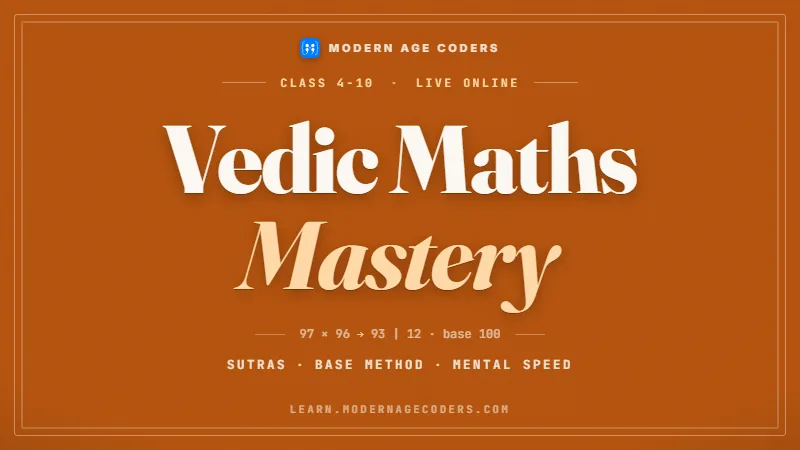
Vedic maths is a system of calculation shortcuts organised around 16 sutras, short working rules like Nikhilam (all from 9 and the last from 10) and Urdhva-Tiryagbhyam (vertically and crosswise). Used well, they turn sums like 97 x 96 or 998 squared into a few seconds of mental work. This 6-month live course teaches the system the way a maths teacher would: every shortcut is shown, practised against the clock, and then explained, because a student who knows why a trick works can trust it in an exam and adapt it when the numbers change.
The course runs in one straight line: multiplication shortcuts first, because they pay off fastest, then squares and cubes, then division including the flag method, then fractions, decimals and percentages at speed, and finally the algebra applications of the same sutras. Week 1 starts with a timed diagnostic; week 24 ends with the same style of paper, so every student can see exactly how much faster and more accurate they have become. We are honest about what this course is: it makes arithmetic faster and frees up exam time. It does not replace school maths, and it will not turn anyone into a prodigy. It rewards steady drill, and we structure that drill for you.
What Makes This Program Different
- Every shortcut comes with its reason: students see the algebra behind Nikhilam and the duplex method, so the rules stick instead of jumbling together
- Timed drills from week 1, with a personal speed log so progress is measured against your own diagnostic, not against a claim
- We teach judgement, not just tricks: which sutra fits which sum, and when the ordinary school method is actually the better choice
- Digit-sum checking is built in from the start, so speed never comes at the cost of accuracy
- Mixed-age friendly: the same system is drilled at school-exam pace for children and at competitive-exam pace for older students
- Live small-group classes where the teacher watches you calculate, catches bad habits early, and adjusts the drill sheets to your errors
Your Learning Journey
Career Progression
Detailed Course Curriculum
Explore the complete week-by-week breakdown of what you'll learn in this comprehensive program.
Topics Covered
- Timed diagnostic paper: 30 mixed sums, your before picture for the whole course
- What the 16 sutras are and how this course walks through them
- Nikhilam Navatashcaramam Dashatah: all from 9 and the last from 10
- Instant subtraction from 100, 1000 and 10000 using complements
- Left-to-right working: why Vedic methods read numbers the way we say them
- Digit sums (Beejank) as a ten-second answer check
Projects You Build
- Personal speed log opened: diagnostic scores recorded by sum type, to be updated all course
Practice & Assignments
40 complement subtractions from 100, 1000 and 10000, target under 5 minutes with every answer digit-sum checked
Topics Covered
- Multiplying numbers just under 100: 97 x 96 in one line
- The two-part answer: cross subtraction on the left, deficiency product on the right
- Base 1000 and base 10: 988 x 997, 8 x 7 done the Nikhilam way
- Handling carries when the right-hand part overflows
- Why it works: the algebra of (base - a)(base - b), shown honestly
- Spotting when a sum is close enough to a base for Nikhilam to be worth it
Projects You Build
- One-page proof poster: a student's own explanation of why Nikhilam works, with one worked example per base
Practice & Assignments
30 Nikhilam multiplications near 100 and 1000, target under 8 minutes, misses redone with the algebra written out
Topics Covered
- Numbers just above the base: 104 x 103, 1002 x 1015
- Mixed cases, one above and one below: 105 x 97 and the negative right-hand part
- Vinculum digits: writing 98 as 100 minus 2 inside a calculation
- Anurupyena, the working base idea: multiplying near 50, 200, 250 and 500
- Choosing the base that makes the sum smallest
- Speed drill technique: reading the sum, picking the method, then writing
Projects You Build
- Worked set: 20 mixed base multiplications with the chosen base and method noted next to each
Practice & Assignments
35 mixed above/below/working-base multiplications, target under 10 minutes, with the base choice justified for any five
Topics Covered
- Ekadhikena Purvena: squares of numbers ending in 5, done in two seconds
- Antyayordashake'pi: same start, last digits adding to 10, such as 43 x 47
- Multiplying by 11 and by 12 with single-pass rules
- Multiplying by 5, 25 and 50 as fractions of powers of 10
- Pattern recognition drills: which of the five patterns fits, or none
- Consolidation of month 1: complements, Nikhilam, working bases, patterns
Projects You Build
- Pattern wall chart: all month 1 shortcuts on one sheet in the student's own words and examples
Practice & Assignments
50-question pattern-spotting sheet mixing all month 1 techniques, target under 15 minutes
Assessment
Month 1 speed check: timed mixed paper, scores logged against the week 1 diagnostic
Topics Covered
- Urdhva-Tiryagbhyam for 2-digit x 2-digit: the three-step cross pattern
- Where each part of the answer comes from, mapped to long multiplication
- Carry discipline: keeping the running answer clean
- One-line working: 34 x 72 without intermediate rows
- Checking with digit sums after every sum, as a habit not an afterthought
- When Nikhilam beats Urdhva-Tiryagbhyam and the reverse
Projects You Build
- Cross-pattern diagram set: the student draws the crosswise structure for five sums before solving them
Practice & Assignments
40 two-digit by two-digit crosswise multiplications, target under 12 minutes at 90 percent accuracy
Topics Covered
- The five-step cross pattern for 3-digit x 3-digit
- Mixed sizes: 3-digit x 2-digit by padding with a zero
- Managing bigger carries without losing the thread
- Writing less: moving from full working to compact working
- Common crosswise errors and how the digit-sum check catches them
- Speed strategy: which digit pairs to multiply first
Projects You Build
- Worked set: 15 three-digit crosswise multiplications with compact working shown
Practice & Assignments
25 three-digit crosswise multiplications, target under 15 minutes, every answer digit-sum checked
Topics Covered
- Dropping the pen: holding the cross pattern in your head for 2-digit sums
- Chunking: multiplying 68 x 7 as 60 x 7 plus 8 x 7, said aloud
- Doubling and halving: 16 x 35 as 8 x 70
- Multiplying by 125, 75 and 15 through fraction thinking
- Estimation first: knowing roughly what the answer must be before starting
- Building a personal mental-maths warm-up routine
Projects You Build
- Mental drill routine card: a 5-minute daily warm-up the student designs and follows
Practice & Assignments
Daily 5-minute no-paper drills: 20 two-digit multiplications spoken or typed, streaks recorded in the speed log
Topics Covered
- Full multiplication mix under exam timing: patterns, bases, crosswise, mental
- Error triage: was it method choice, a carry slip, or rushing
- Reading your speed log: what actually got faster since week 1
- Accuracy floors: why we never trade below 90 percent accuracy for speed
- Personal weak-spot drill sheets, built from your own error log
- Setting the phase 2 targets with the teacher
Projects You Build
- Speed lab paper one: a timed 60-question multiplication paper, marked and logged the same day
Practice & Assignments
Redo every speed lab miss untimed with full working, then a second 20-question timed set on just those types
Assessment
Phase 1 milestone: timed multiplication paper compared line by line with the week 1 diagnostic
Topics Covered
- Yavadunam: squaring by deficiency, 98 squared in one line
- Squaring just above the base: 104 squared, 1012 squared
- Working bases again: 48 squared using base 50
- The algebra behind it: (base + d) squared, expanded and matched to the rule
- Squares of numbers ending in 5 revisited and extended to 3 digits
- Choosing between Yavadunam and the ending-in-5 rule
Projects You Build
- Worked set: squares of every number from 91 to 109 by the fastest route, method noted for each
Practice & Assignments
30 near-base squares across bases 50, 100, 500 and 1000, target under 10 minutes
Topics Covered
- The duplex (Dwandwa) of a number: definition and drill
- Squaring any 2-digit number with duplexes
- Squaring 3-digit numbers: the five duplex terms in order
- Keeping carries straight in duplex work
- Duplex squares against near-base squares: picking the faster tool
- Digit-sum checking squares, including the common square-check traps
Projects You Build
- Duplex table: the student builds a reference table of duplexes for 1 to 3 digit forms with examples
Practice & Assignments
25 general squares of 2 and 3 digit numbers by duplex, target under 12 minutes at 90 percent accuracy
Topics Covered
- Square roots of perfect squares: pairing digits and reading the first digit
- Last-digit analysis: which digits can end a perfect square and what they tell you
- Deciding between the two candidate roots quickly
- Cubes near a base: 98 cubed and 102 cubed by the Nikhilam-style rule
- The proportional (Anurupyena) cube rule for 2-digit numbers
- Recognising perfect squares and cubes on sight
Projects You Build
- Root-finder sheet: 20 perfect squares up to 5 digits, roots found and verified by squaring back
Practice & Assignments
20 square roots of perfect squares and 10 near-base cubes, target under 15 minutes
Topics Covered
- Cube roots of perfect cubes up to 6 digits from the two ends
- Why cube last digits are honest: the 0 to 9 cube-ending map
- Mixed powers drill: squares, cubes and roots on one sheet
- Where powers shortcuts show up in school exams and MCQ papers
- Month 3 consolidation: one method chart for all powers work
- Speed log review: powers section opened and baselined
Projects You Build
- Powers method chart: every squares, cubes and roots technique on one page with a worked example each
Practice & Assignments
Mixed 40-question powers paper covering all month 3 techniques, target under 18 minutes
Assessment
Month 3 milestone: timed powers paper, results logged and weak types tagged for drilling
Topics Covered
- Dividing by 9: the pattern that starts the whole method
- Nikhilam division with divisors just below a base: 89, 98, 888
- Quotient and remainder columns, and moving carries between them
- When the remainder column overflows and how to fix it
- Why it works: complements doing subtraction's job in division
- Speed comparison against long division on the same sums
Projects You Build
- Side-by-side set: 10 divisions worked both by long division and Nikhilam with times recorded for each
Practice & Assignments
25 Nikhilam divisions with divisors near 10, 100 and 1000, target under 12 minutes
Topics Covered
- Paravartya Yojayet for divisors just above a base: 12, 112, 1023
- Transposing digits: turning the divisor's excess into negative multipliers
- Working with negative intermediate digits without panic
- Nikhilam or Paravartya: reading the divisor and choosing in two seconds
- Remainder checks with digit sums
- The algebra behind Paravartya, shown for divisor 12
Projects You Build
- Choice drill sheet: 20 divisions labelled Nikhilam or Paravartya before solving, choices reviewed in class
Practice & Assignments
25 Paravartya divisions with divisors near 10, 100 and 1000, target under 14 minutes
Topics Covered
- Dhvajanka, the flag digit: general division for any divisor
- Setting up the flag: splitting the divisor into main digit and flag
- The subtract-and-divide rhythm, worked slowly then at pace
- Two-digit flags for harder divisors
- Decimal answers: continuing the division past the point
- Why the flag method matters: one method that always works
Projects You Build
- Worked set: 12 flag-method divisions including two carried to three decimal places
Practice & Assignments
20 flag-method divisions with mixed divisors from 13 to 87, target under 20 minutes
Topics Covered
- Divisibility tests for 2 through 12, consolidated and drilled
- Osculation: Ekadhikena-based tests for 7, 13, 19 and other awkward primes
- Remainder thinking: Navashesh checks for division answers
- Full division mix under time: Nikhilam, Paravartya, flag, divisibility
- Error triage on division work
- Phase 3 targets set with the teacher
Projects You Build
- Speed lab paper two: a timed 50-question powers and division paper, marked and logged the same day
Practice & Assignments
Redo all speed lab misses untimed, then 15 divisibility questions on primes 7, 13 and 19 by osculation
Assessment
Phase 2 milestone: timed powers and division paper, logged against months 3 and 4 baselines
Topics Covered
- Ekadhikena Purvena on fractions: 1/19 written out in seconds
- The one-more-than-the-previous multiplier, forwards and backwards
- 1/7 and the cyclic pattern family
- Auxiliary fractions: converting awkward denominators before dividing
- Terminating or recurring: reading the denominator to know in advance
- Where recurring-decimal questions appear in school papers
Projects You Build
- Decimal expansion chart: 1/7, 1/13, 1/17, 1/19 expanded by sutra and verified by flag division
Practice & Assignments
15 recurring-decimal expansions by the Ekadhikena method, each verified against straight division
Topics Covered
- Adding and subtracting fractions crosswise, no LCM hunt for two terms
- When the LCM is still worth finding, honestly
- Comparing fractions instantly by cross multiplication
- Multiplying and dividing mixed numbers with vinculum thinking
- Simplifying early: spotting common factors before multiplying
- Fraction chains: working three-term expressions left to right
Projects You Build
- Worked set: 20 fraction additions and comparisons done crosswise with times against the textbook method
Practice & Assignments
30 mixed fraction operations, target under 15 minutes, five of them written both ways to compare
Topics Covered
- Percentages as fractions: the 12.5 percent equals one-eighth family
- Flipping the sum: 8 percent of 50 as 50 percent of 8
- Percentage change chains done mentally
- Ratio splitting at speed for word problems
- Profit, loss and simple interest set up as one-line calculations
- Estimation guards: catching a wrong percentage before it costs marks
Projects You Build
- Percent-fraction equivalence card: the conversion table every student memorises, self-tested twice
Practice & Assignments
40 mental percentage and ratio questions, target under 12 minutes, no written working allowed
Topics Covered
- Multiplying decimals with base methods: 9.8 x 9.7 via 98 x 97
- Placing the decimal point by estimation, not rules memorised blind
- Dividing decimals with the flag method
- Mixed arithmetic under time: the full toolkit on one paper
- Error triage across fraction, decimal and percentage work
- Month 5 consolidation chart
Projects You Build
- Speed lab paper three: a timed 50-question fractions, decimals and percentages paper, marked and logged
Practice & Assignments
Redo all speed lab misses untimed, then a 20-question timed set on your two weakest question types
Assessment
Month 5 milestone: timed mixed arithmetic paper, logged against the phase baselines
Topics Covered
- Urdhva-Tiryagbhyam on binomials: (x + 3)(x + 7) crosswise
- Multiplying larger polynomials by the same cross pattern
- Paravartya for dividing polynomials by (x - a)
- The connection made explicit: the arithmetic sutras were algebra all along
- Checking polynomial products with substitution
- Where this helps in school algebra chapters
Projects You Build
- Bridge sheet: five arithmetic shortcuts and their algebraic twins worked side by side
Practice & Assignments
20 polynomial multiplications and 10 Paravartya polynomial divisions, checked by substitution at x equals 2
Topics Covered
- Sunyam Samyasamuccaye: spotting when a common factor makes the answer zero
- One-line solutions to equation types that usually take five lines
- Simultaneous equations by cross-multiplication patterns
- Anurupye Sunyamanyat: proportional coefficients and what they force
- Recognising equation types on sight before solving
- Honest limits: equations where the shortcuts do not apply
Projects You Build
- Equation type-spotting sheet: 15 equations sorted by fastest method before any solving
Practice & Assignments
25 equations mixing shortcut types and standard types, with the method named before each solution
Topics Covered
- Method triage: 40 mixed questions, decide the method in five seconds each
- Exam mapping: where each technique saves time in school and MCQ papers
- Where standard methods win and showing full working is required
- Building your personal shortcut handbook: what goes in, what gets dropped
- Mock speed test under full exam conditions
- Reviewing the mock: method choices, not just answers
Projects You Build
- Personal shortcut handbook draft: every technique the student actually uses, in their own words and examples
Practice & Assignments
Full 60-question mock speed test under timing, then a written half-page on your three best method choices
Topics Covered
- Final timed paper: same structure as the week 1 diagnostic, full toolkit allowed
- Before and after: reading your speed log across all 24 weeks
- Accuracy audit: error rate then versus now
- Finishing the shortcut handbook: the take-away artifact of the course
- Keeping the speed: a 10-minute weekly maintenance routine
- Where to go next: exam-prep courses that use these skills daily
Projects You Build
- Capstone speed test with a written before-and-after comparison against the week 1 diagnostic
- Finished personal shortcut handbook, reviewed by the teacher
Practice & Assignments
Design your own maintenance drill sheet and run it once; bring the timing to the final class
Assessment
Course milestone: capstone speed test and handbook review, plus course-completion certificate review
Projects You'll Build
Build a professional portfolio with 10+ artifacts, from a week 1 speed log to a complete self-written shortcut handbook real-world projects.
Weekly Learning Structure
Certification & Recognition
Technologies & Skills You'll Master
Comprehensive coverage of the entire modern web development stack.
Support & Resources
Career Outcomes & Opportunities
Transform your career with industry-ready skills and job placement support.
Prerequisites
Who Is This Course For?
Career Paths After Completion
Course Guarantees
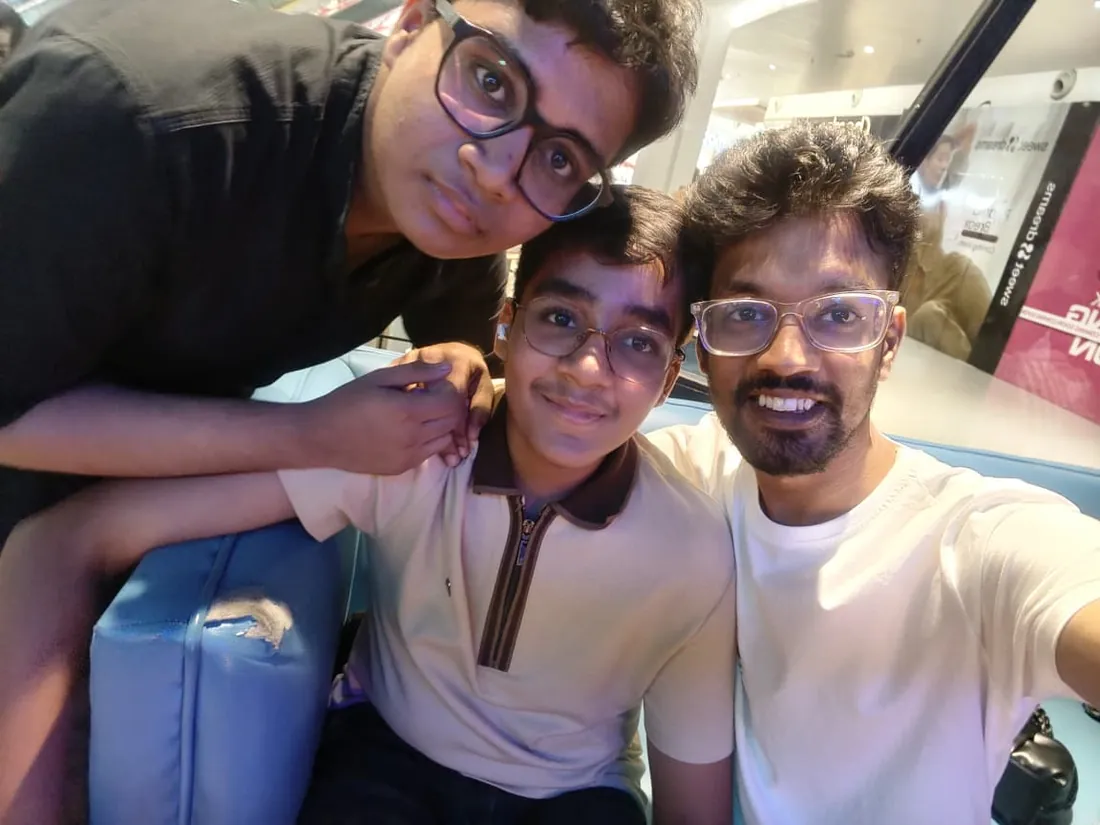
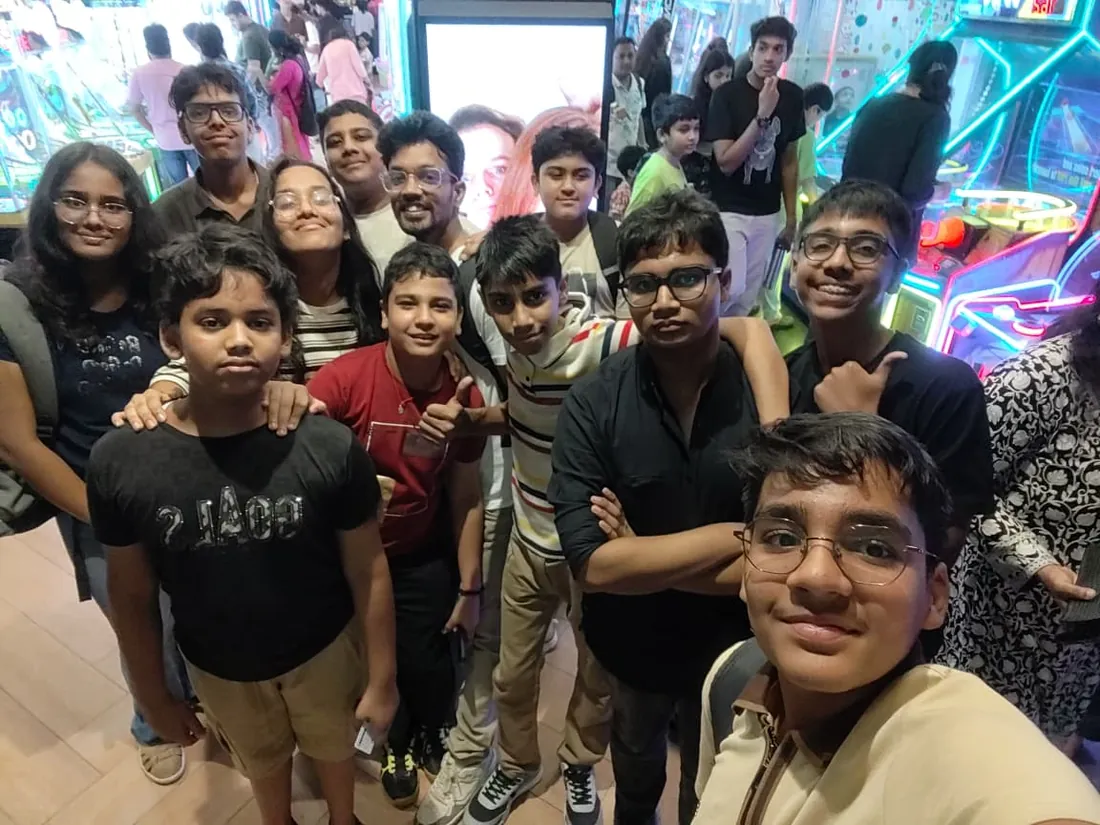
Real students. Real moments. Real joy.
These are our actual student meetups. No stock photos, no filters. Swipe through and meet the community you'll be joining.





































What families say
Straight from the parents and students who learn with us. Rated 4.9 across 547 Google reviews.
“Mivaan enjoys the class. He understands the concepts and completes his tasks with excitement. He started taking interest in coding… truly amazing class.”
“I absolutely love it here! I made new friends and learned important valuable coding skills while having the fun of my life. It's not just coding here, it's outings, bonding and most importantly preparing you for your future. Definitely five stars.”
“What stands out most is how excited my son is before every class. He looks forward to learning, problem-solving, and sharing what he's built. I've noticed a big boost in his confidence!”
“Modern Age Coders has been a game-changer for me! I struggled to grasp IT concepts and coding before joining, but their classes transformed everything. I'm now the topper in my class and can confidently write complex programs with ease.”
“Modern Age Coder have wonderful teachers who teach in a clear, easy and practical way. The teacher boosts students' confidence, keeps them updated with technology, and inspires them to learn without hesitation.”
“The one step solution for my son. Modern Age Coders make learning coding so simple that kids love it.”
“Coding classes here make learning very interesting and conceptual. The teachers teach us in a very easy-to-understand and efficient manner.”
“One of the most wonderful education centres out there. Education is not limited to school syllabus but focuses on skill development. Learning here has been a wonderful journey and still continuing.”
“I highly recommend this computer coding class! The teachers are incredibly knowledgeable and passionate about coding. They make every session engaging and insightful.”
“My child Dhairya is really enjoying the Modern Age Coder IT classes. This is his first online class, and he eagerly looks forward to it.”
“Very good classes. Don't worry about coding. They teach the best, especially Shivam sir.”
“Very good classes. Makes learning very easy and interactive.”
Hear it from our students
Real parents and students in their own words, on our public YouTube channel.
Straight answers about Vedic Maths Mastery: Speed Calculation with All 16 Sutras
- Who should take this course?
- Beginner friendly, ages 8 to adult. It suits students in classes 3 to 10 who lose exam time to slow arithmetic and want it back; older students preparing for arithmetic-heavy mcq exams where a saved minute per section matters; adults who want to sharpen mental arithmetic, sometimes in the same batch as their child.
- What will they learn and build?
- Vedic maths is a system of calculation shortcuts organised around 16 sutras, short working rules like Nikhilam (all from 9 and the last from 10) and Urdhva-Tiryagbhyam (vertically and crosswise). Used well, they turn sums like 97 x 96 or 998 squared into a few seconds of mental work.
- How deeply are topics covered?
- The course runs 6 months (24 weeks) at 2 live classes/week + 20-30 minutes of drill practice most days, across 3 phases listed week by week in the syllabus below. A structured, well-paced curriculum taught step by step, with hands-on practice in every session.
- Who teaches it?
- Modern Age Coders mentors, who teach the live classes themselves. You can watch them at work in the free class recordings before you decide.
- How do practice, feedback and assessment work?
- Classwork every session, a task after every class, monthly reviews that mix in earlier topics, and a final exam covering the whole course that decides the certificate: real knowledge and real work, with a free retest after revision if needed. Doubt support between classes over WhatsApp, so you are never left stuck. A certificate you earn by passing the final assessment, with a free retest after revision if needed.
- What does it cost?
- Three monthly plans: a group batch, a mini batch and 1-on-1. Prices are shown in your currency in the plans section. Monthly billing, cancel any time.
- When can classes take place?
- Live classes are scheduled around your week. Group batches meet at a fixed weekly slot; 1-on-1 students choose their own. International students are scheduled in their own timezone. Ask on WhatsApp for the current slots.
- Can I watch the teaching before deciding?
- Yes. Full recordings of real 13 and up classes are free to watch, free with a Google sign-in. These recordings show how we teach, not the exact syllabus of this course. Some classes are in English and some in Hindi; everyone follows at their own pace. Watch a class end to end, like you are in it. Sessions are interactive and each moment builds on the last.
- Can I enroll without a live demo?
- Yes. Choose a plan on this page and enrol directly; a demo is not required. If you would like to see a full class with a mentor first, book a Priority Demo.
- How do I reach you with a question?
- WhatsApp +91 91233 66161, email connect@modernagecoders.com, or call +91 91233 66161. Tell us the student's age and what they have learned so far, and we will point you to the right plan and batch.
Common Questions About Vedic Maths Mastery: Speed Calculation with All 16 Sutras
Get answers to the most common questions about this comprehensive program
Still have questions? We're here to help!
Contact UsRelated Courses You May Like
Continue your learning journey with these recommended programs
 Web Development
React Masterclass: JavaScript to Production React
React course for college students and professionals: JavaScript foundations, React with hooks, state...
Explore Course Kids Coding
Coding for Kids: Scratch to Games, Apps and AI
Coding for kids aged 6-12: live online classes from first Scratch game to mobile apps, Minecraft and...
Explore CourseRelated Articles & Guides
Deepen your knowledge with these hand-picked articles
 Mathematics
8 min read
Mathematics
8 min read
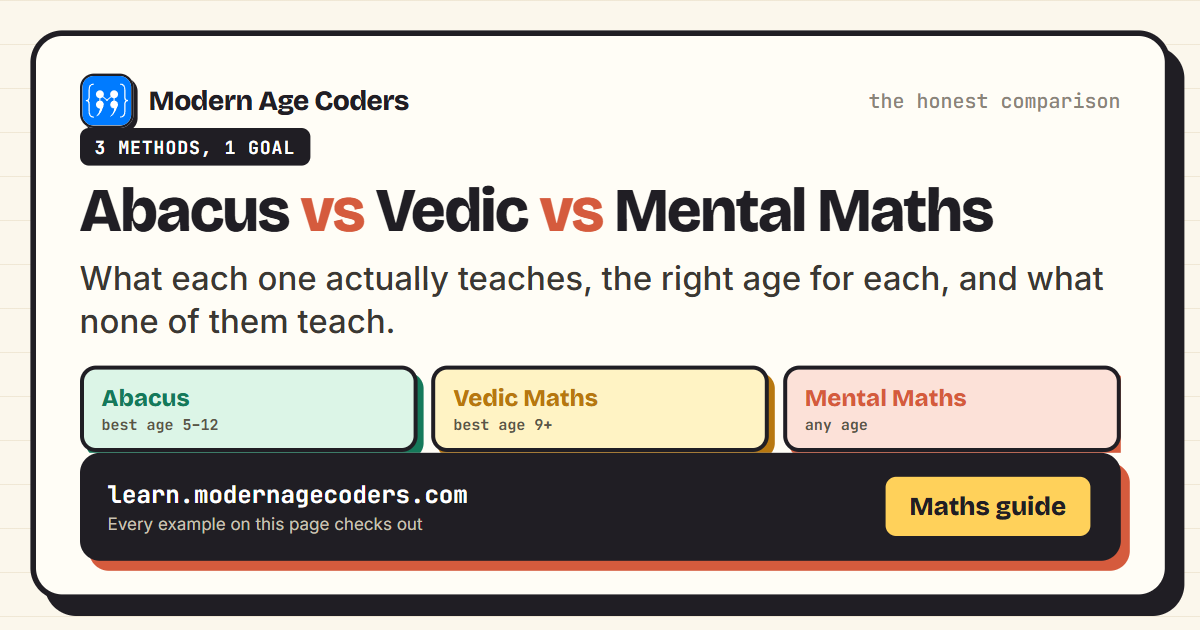
Abacus vs Vedic vs Mental Maths: A Clear Comparison
Abacus, Vedic maths, and mental maths compared: what each teaches, the right age, real worked exampl...
Read Article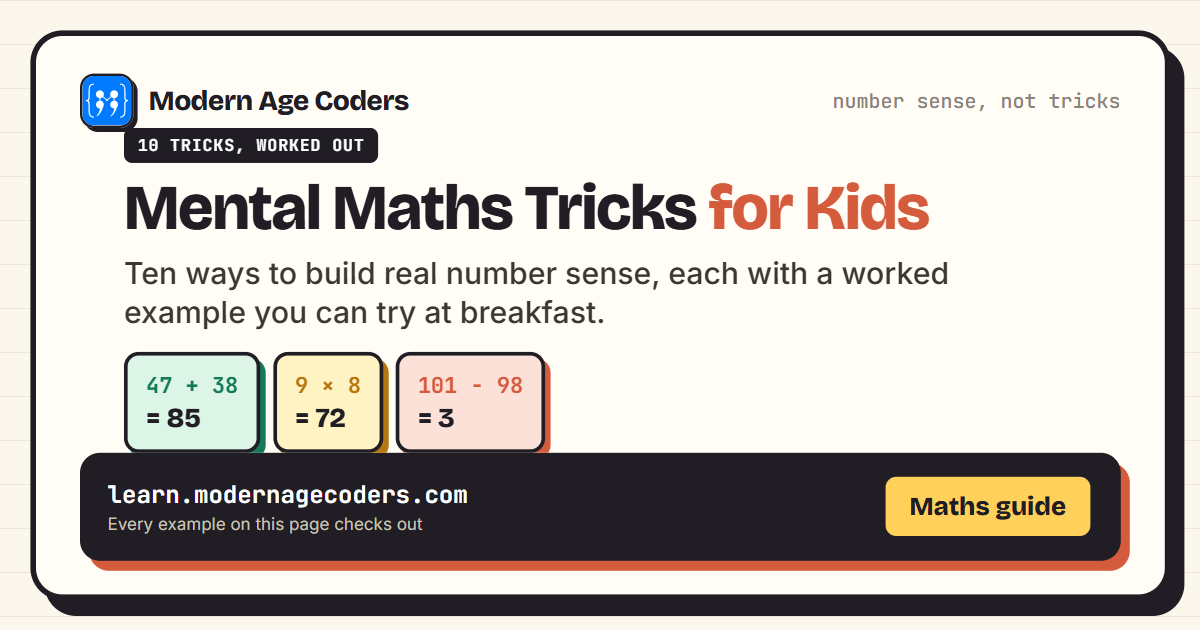 Mathematics
7 min read
Mathematics
7 min read
10 Mental Maths Tricks for Kids, With Worked Examples
Ten mental maths tricks for kids, each with a worked example, plus a daily practice plan by age and ...
Read ArticleReady to start Vedic Maths Mastery: Speed Calculation with All 16 Sutras?
Book a Priority Demo to see a full live class with a mentor reserved for you, today or tomorrow. Or choose a plan and enrol now.
Questions? WhatsApp +91 91233 66161 or email connect@modernagecoders.com