UK / ISP / 01
11 plus maths preparation
Year 5 maths for independent and grammar school tests.
Open the syllabusLondon · Independent school 11 plus · Years 5 and 6
Many London independent schools choose their Year 7 pupils with an entrance test sat in Year 6, and the largest shared one is the London 11+ Consortium assessment: a single 100-minute online test, designed with Quest Assessments, that counts for every member school a child applies to. Maths opens it, with 20 adaptive minutes. Modern Age Coders teaches that maths live online, in a class or one to one, through our 11 plus maths preparation course.
From the London 11+ Consortium site, read 31 October 2026 · Not connected with the consortium or any school
What is the London 11+ Consortium test?
It is a shared entrance assessment for 13 London independent schools, sat once in Year 6 and sent to every member school the child applies to. The consortium describes it as 100 minutes in total, taken online, with six sections in a fixed order: 20 minutes of maths, 10 of non-verbal reasoning, 20 of English and 10 of verbal reasoning, a break, then 15 minutes of problem solving and 25 of creative comprehension. Maths and both reasoning sections are adaptive. The maths uses the Year 5 national curriculum, "with opportunities for additional challenge". For September 2027 entry the test falls on 27 November, 1 December or 3 December 2026. Modern Age Coders teaches the maths, live online, with practice we write ourselves.
Where to start
Depth matters more than speed in an adaptive section. Choose by what your child needs most. Each card opens a full syllabus.
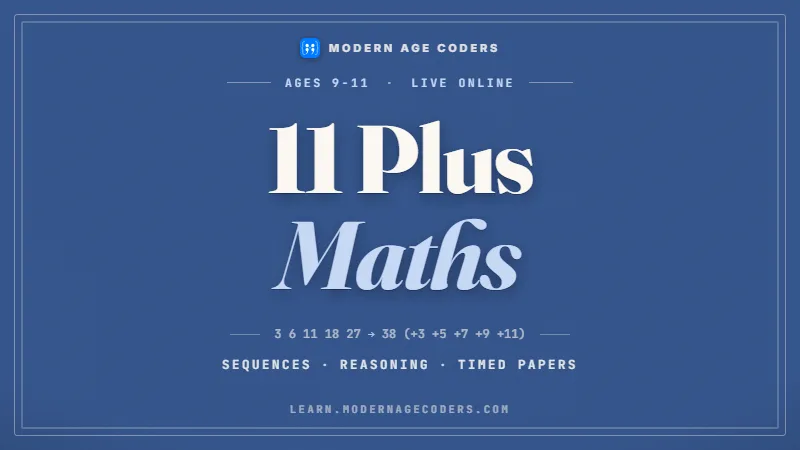
LDN / 01
The core course for entrance tests: the Year 5 curriculum taught to the depth an adaptive section reaches.
Open the syllabus →
LDN / 02
Unfamiliar, multi-step problems, the kind the consortium's problem-solving section is built from.
Open the syllabus →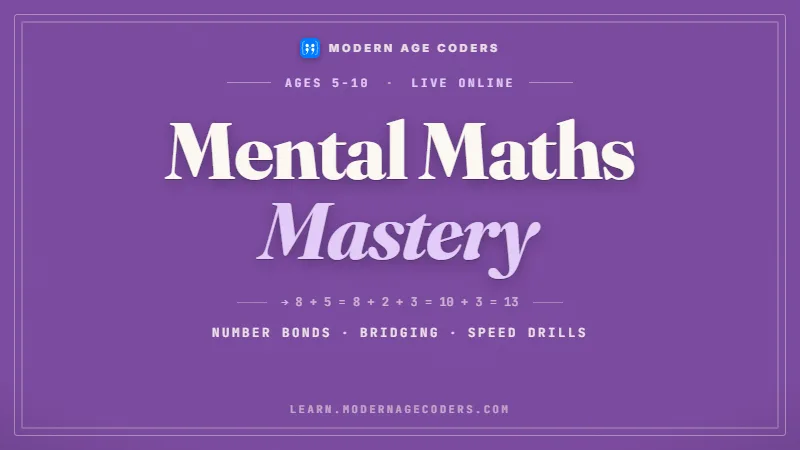
LDN / 03
Twenty minutes is short; fluent recall leaves time for the harder questions an adaptive test serves up.
Open the syllabus →London routes
There is no single London independent 11 plus. Schools use a shared consortium test, a bought-in test from a provider, their own written papers, or a mix, and many add an interview.
| Route | Who sets it | What the source says |
|---|---|---|
| A shared consortium test | The London 11+ Consortium, with Quest Assessments | One online test of 100 minutes, results shared with every member school applied to |
| A pre-test from ISEB | The Independent Schools Examinations Board | Common Pre-Tests "are taken by pupils in Year 6 or 7, and provide an age-standardised measure of ability" |
| A Cambridge computer test | Cambridge Insight (formerly CEM) | Cambridge Select Insight is designed for "selective independent schools" among others, for 11+ and 13+ entry |
| A bespoke provider test | Quest Admissions and others | Quest says it builds tests "Bespoke and branded to your school" |
| The school's own papers | Each school | Written maths and English papers, often with an interview; details only on each school's site |
A child applying to several schools can meet more than one route in the same autumn. The rule we give families is simple: list the schools, then write next to each one the test it uses, the date and whether there is a second stage. The rest of this page goes deep on the consortium test, because it is the one route whose maths section is published in detail, and because it is shared across 13 schools. For written papers set by individual schools, see our Common Entrance maths page; for the subject in general, our 11 plus maths page.
Sources: The London 11+ Consortium; ISEB; Cambridge Insight, entrance assessments; Quest Admissions. Modern Age Coders is not connected with the consortium, its schools, ISEB, Cambridge or Quest.
The consortium test
Six sections in a fixed order, three adaptive and three not, with a break after the fourth. Each section is locked once finished, and the on-screen clock counts only minutes.
| Order | Section | Minutes | Adaptive? |
|---|---|---|---|
| 1 | Maths | 20 | Yes |
| 2 | Non-verbal reasoning | 10 | Yes |
| 3 | English (comprehension of a specially written fiction text, then standard English in context) | 20 | No |
| 4 | Verbal reasoning | 10 | Yes |
| Break | Up to 30 | ||
| 5 | Problem solving | 15 | No |
| 6 | Creative comprehension (several sources in different formats) | 25 | No |
The consortium says the exam "is 100 minutes long (1 hour 40 minutes)" with a 30-minute break in the middle. By our own arithmetic, the three adaptive sections take 40 of those 100 minutes and maths alone is a fifth of the time. The non-adaptive sections change for each of the three test days, "to ensure the security of the test", and results are standardised across the three sittings. The adaptive sections are different for every candidate anyway, since each next question depends on the last answer.
The consortium explains that extra time is given section by section "because once a section has been completed, candidates cannot go back to amend it." So a child must use the whole 20 maths minutes for maths.
Candidates see a clock that counts down "in minutes" for each section, chosen "not to count down in seconds" so it does not distract, and "They will not be given any additional time warnings."
The test runs on "iPads, PCs, laptops and chrome books", and the consortium says the device "does not make any difference". There is no extended writing, so typing speed does not count.
Usually in the child's current primary or prep school, which runs it to the consortium's rules: a start inside a set window, one of the three dates, and the break after verbal reasoning for everyone.
If the current school cannot host it, the family names a first and second choice consortium school as a centre, and both must be schools the child has applied to.
The test is one of "three complementary assessment approaches". The others are a common reference form from the current head and an interview that each senior school runs in its own way.
Some member schools select for interview from the test results and some do not; the consortium tells families to check each school's own site.
Source: The London 11+ Consortium, home page, Code of Practice and FAQs, read 31 October 2026.
The maths section
Year 5 national curriculum maths, nothing from Year 6, made harder by depth rather than by new topics. Because the section adapts, a strong child keeps meeting harder questions.
The consortium is precise about content: "The questions are based on the National Curriculum for Year 5 and we do not test anything on the Year 6 curriculum." Its reason is fairness, since "different schools will teach the Year 6 curriculum in different orders". Then comes the line that matters most for preparation: "Because we have many very able candidates taking the Consortium exam, we provide stretch and challenge through the style and depth of the questions we ask." In other words, a child will not meet algebra or ratio from Year 6, but will meet Year 5 ideas such as fractions, multiplication, measures and shape asked in ways that need two or three steps of thought.
| Year 5 topic | A routine question | A deeper question on the same idea (ours) |
|---|---|---|
| Multiplication and factors | What is 24 times 6? | How many factor pairs does 36 have, and why does one of them repeat a number? |
| Fractions | What is three fifths of 40? | Which is larger, seven tenths or thirteen twentieths, and by how much? |
| Decimals and place value | Write 2.05 km in metres | Multiply 3.4 by 25 without written long multiplication |
| Measures and time | How many minutes in 2.5 hours? | How many 45-minute slots fit between 07:00 and 21:00? |
| Angles | Angles on a straight line add to what? | Two angles on a line are 63 and 48 degrees; find the third |
| Problem solving | Add three numbers | In how many ways can 10 be made from three different whole numbers? |
An adaptive section has no fixed "hard part at the end". Questions rise in difficulty after correct answers and ease after wrong ones, so a child may meet a demanding question in the first minute.
That rewards steady accuracy over racing. A careless slip on an easy question pulls the next one down; a careful right answer lifts it.
Section five, 15 minutes, "tests the ability of candidates to use words and numbers to solve multi-step problems". It is not adaptive, and the consortium notes that candidates "are likely to complete different numbers of questions in the time available."
The creative comprehension section asks children to use information from several sources at once, which often includes reading tables, timetables or charts.
Worked examples, written by us
Three original problems in the style of the stretch the consortium describes: Year 5 content, more than one step. None is from the consortium test or its familiarisation material.
A school buys 7 boxes of 24 pencils and gives 15 pencils to each of its 9 classes. How many are left? Two calculations, kept separate: 7 times 24 is 168 pencils bought; 9 times 15 is 135 given out. 168 minus 135 leaves 33. Writing each step as a sentence ("bought", "given", "left") stops the classic slip of subtracting 15 from 168.
A two-digit number has digits that add to 11. Reversing the digits makes it 27 larger. What is it? List the candidates with digit sum 11: 29, 38, 47, 56, 65, 74, 83, 92. Reversal only increases a number whose tens digit is smaller. Test 47: 74 minus 47 is 27. Answer 47. A systematic list beats guessing every time.
A pool opens from 07:00 to 21:00 and lanes are booked in 45-minute slots back to back. How many full slots fit in a day? 14 hours is 840 minutes; 840 divided by 45 is 18 remainder 30. The answer is 18, not 19 and not 18.7: half a slot cannot be booked. Deciding what the remainder means is the step adaptive questions test.
| Question (ours) | Answer | How to think |
|---|---|---|
| 3.4 multiplied by 25 | 85 | Times 25 is times 100 then divide by 4: 340 divided by 4 is 85. No long multiplication needed. |
| How many factor pairs does 36 have? | 5 | 1 and 36, 2 and 18, 3 and 12, 4 and 9, 6 and 6. Stop at 6, because the pairs would start repeating. |
| Which is larger, seven tenths or thirteen twentieths? | Seven tenths, by one twentieth | Seven tenths is fourteen twentieths. Common denominators make the size difference visible. |
| Two angles on a straight line are 63 and 48 degrees. What is the third angle on that line? | 69 degrees | 63 plus 48 is 111; 180 minus 111 is 69. Add the known parts first, then subtract once. |
| Write 2.05 km in metres. | 2050 m | The 0 in the tenths place is the trap: 2.05 km is 2 km and 50 m, not 2 km and 500 m. |
| In how many ways can 10 be written as the sum of three different whole numbers above 0, ignoring order? | 4 | 1+2+7, 1+3+6, 1+4+5, 2+3+5. Fix the smallest number and count upwards so nothing is missed or repeated. |
The common thread is method before arithmetic: name each quantity, list possibilities in order, check units, and decide what a remainder means before writing an answer. These are the habits the consortium's own phrase, "style and depth", points to, and they are useful far beyond one test.
Key dates
Registrations close on Friday 6 November 2026, and the test runs on one of three dates at the end of November and start of December 2026. Offers arrive in February 2027.
| Step | Date |
|---|---|
| Closing date for registrations, and for evidence of access arrangements | Friday 6 November 2026 |
| Assessment, on one of three dates | Friday 27 November, Tuesday 1 December or Thursday 3 December 2026 |
| Offers sent to arrive | Friday 12 February 2027 |
| Deadline to accept | 12 noon on Wednesday 3 March 2027 |
For families planning ahead to September 2028 entry, expect a similar pattern a year later, but confirm on the consortium's site once it publishes, since dates are set each year. Overseas applicants can travel to sit at a member school or ask a consortium school's admissions team about sitting abroad.
What the schools say
No. It says a child "does not need special tuition or intensive practice", and it actively discourages interview coaching. Families should weigh that before booking anyone, including us.
The home page sets out the aim: "We are concerned about the pressure the 11+ application system can place on young children and the damage to learning which relentless 'teaching to the test' produces."
On preparation, the FAQ says the test checks the Year 5 maths curriculum and reading of an extended fiction passage, "skills that your daughter will be developing in school anyway", and on non-verbal and verbal reasoning, "any gains quickly become very marginal". On interviews: "We actively discourage preparation for the interview."
Teaching, not coaching. If a child in Year 5 is unsure of fractions, factors, measures or multi-step problems, that is a gap in ordinary school maths, worth closing for Year 7 whatever happens in December.
We do not prepare children for interviews, we do not claim to know the consortium's questions, and we never present our practice as theirs. We will not predict a result.
Timeline
The consortium test falls in the autumn term of Year 6. Our four stages count back from that sitting; they are a plan, not the consortium's.
| When | Stage | Secure when |
|---|---|---|
| Year 4 | 1. Fluency | Tables to 12, place value and number bonds recalled without pause |
| Year 5 | 2. The Year 5 curriculum | Fractions, decimals, factors, measures and angles all taught and understood |
| Year 5, summer | 3. Depth | Two- and three-step problems solved by naming quantities and listing systematically |
| Autumn of Year 6 | 4. Familiarisation | The consortium's own materials done; 20-minute on-screen sets finished without rushing |
Starting in September of Year 6 still leaves time for stage 3, which is where most marks in an adaptive section are won or lost.
We tell you honestly after the first lesson what is realistic.
Depth in Year 5 maths makes Year 7 easier. Curious children often continue with maths through coding.
Our UK competitions calendar lists puzzles and challenges for the spring.
All related courses
Sorted by stage. Each card links to its syllabus.
UK / ISP / 01
Year 5 maths for independent and grammar school tests.
Open the syllabusUK / ISP / 02
Rebuilds any wobbly foundations before entrance work.
Open the syllabusUK / ISP / 03
Pattern and spatial thinking for children aged 6 to 9.
Open the syllabusUK / ISP / 04
Multi-step problems for able young mathematicians.
Open the syllabusUK / ISP / 05
Fluent recall that protects time in a short section.
Open the syllabusUK / ISP / 06
Patterns in calculation, explained.
Open the syllabusUK / ISP / 07
The pre-algebra and geometry of Years 7 and 8.
Open the syllabusUK / ISP / 08
Python projects that make maths ideas concrete.
Open the syllabusHow lessons run
Weekdays or weekends, flexible: choose your batch, or for a very personalised plan choose 1-on-1 at your convenience, weekend mornings or weekdays. Lessons are taught from India, which keeps the same clock all year, so the time difference to London is four and a half hours in summer and five and a half in winter. We quote every slot in UK time.
After school
The usual time for Year 5 children.
Weekend morning
A longer session for problem solving.
Half term
Extra lessons before a November sitting.
Year 5 topics pushed to two and three steps.
Twenty-minute practice read from a screen, as on the day.
Counting and puzzle questions solved in order.
No consortium or school questions reproduced.
A class of 15 to 20, or private lessons.
The consortium discourages it, and so do we.
Student work
Work from students at our school after their entrance year. More on student labs.

AI and ML
An AI nutrition coach that reads what you eat and works you toward a target.

AI and ML
A chatbot that answers mathematics and programming questions, built and deployed by a student.

AI and ML
An assistant that helps a young person recognise unsafe situations online.

Web app
A weather forecasting site with live conditions for any location.
Fees
A monthly fee, displayed in the currency we use for UK families. The first lesson is free, and joining costs nothing.
Free first class
USD 0
no card required
Group batch
USD 100
a month, billed in US dollars
One to one
USD 150
a month, billed in US dollars
What families say
Reviews from parents on our Google profile, left as they wrote them.
★★★★★
"The one step solution for my son. Modern Age Coders make learning coding so simple that kids love it. The teachers explain complex concepts clearly with practical exercises and interactive content."
Ria Mukherjee
Parent
★★★★★
"Modern Age Coders has been a game-changer for me. I struggled to grasp IT concepts and coding before joining, but their classes transformed everything. I can now confidently write complex programs with ease."
Samriddha Mondal
Student
★★★★★
"One of the most wonderful education centres out there. Education is not limited to school syllabus but focuses on skill development."
Vansh Agarwal
Student
★★★★★
"My child Dhairya is really enjoying the Modern Age Coders classes. This is his first online class and he eagerly looks forward to it. I can already see his improvement, and the teachers are very cooperative."
Sonam Oswal
Parent of Dhairya
★★★★★
"Modern Age Coders have wonderful teachers who teach in a clear, easy and practical way. The teacher boosts students' confidence and inspires them to learn without hesitation."
Sonu Goyal
Parent
★★★★★
"I highly recommend this computer coding class! The teachers are incredibly knowledgeable and passionate about coding."
Ritu Kedia
Parent
London 11 plus questions
It is a group of 13 London independent schools that share one entrance test for Year 7. A child sits the test once, and the results go to every member school they have applied to.
The consortium says it is 100 minutes in total, with a break of up to 30 minutes in the middle. It is split into six timed sections, starting with 20 minutes of maths.
Yes. The consortium says maths, verbal reasoning and non-verbal reasoning are adaptive, so the questions adjust to each answer. English, problem solving and creative comprehension are not.
Year 5 national curriculum maths and nothing from Year 6. The consortium adds stretch through the style and depth of the questions, because many very able children sit it.
No. The consortium says that once a section is completed, candidates cannot go back to amend it, which is why extra time is given section by section.
On one of Friday 27 November, Tuesday 1 December or Thursday 3 December 2026. Registrations close on Friday 6 November 2026 and offers arrive on Friday 12 February 2027.
The consortium designed it with its test provider, Quest Assessments, together with curriculum specialists from its own schools. It was first sat in December 2022 for September 2023 entry.
The consortium says no special tuition or intensive practice is needed and recommends its familiarisation materials. We teach Year 5 maths with depth for children who have real gaps, and we never coach for interviews.
Weekdays or weekends, flexible: choose your batch, or for a very personalised plan choose 1-on-1 at your convenience, weekend mornings or weekdays. Each slot is confirmed in UK time.
No. Modern Age Coders is independent, has never seen the consortium's questions and writes all of its own practice. We do not predict results or promise places.
Related pages
Other tests London families meet, and the subject itself.
Entrance maths, whichever school sets it.
Written 11+ and 13+ papers for independent schools.
A north London grammar area moving to a Quest-written test.
A London borough with state grammar schools.
Selective state schools in south west London.
The hub for all our UK pages.
Part of the guide: UK selective school maths tests: 7+, 11+, 13+ and 16+
More guides: UK maths exam boards and specification codes · UK maths year by year, Reception to Year 11 · UK university admissions: maths tests and computing applications · UK maths enrichment, competitions and able pupils
Start here
Tell us your child's year and the schools on your list. We will note which test each one uses, teach a real lesson, and give you an honest read on the maths.
Prefer to look first? The 11 plus maths course page sets out the full syllabus, and how we teach explains our approach.
WhatsApp us · +91 91233 66161 · connect@modernagecoders.com
WhatsApp reaches us fastest, at no cost from a UK number. Our team answers from India on a number starting +91.
A priority demo is a full class of about 45 to 60 minutes. After the class the mentor sends a written skill report and a personal learning roadmap on WhatsApp. If you enrol, the demo fee is adjusted against your first month's fee. Share your demo Order ID with us on WhatsApp and we take it off.
Book a priority demo