HTM / 1
11 plus maths, Hertfordshire
Year 5 maths for both routes.
Open the syllabusHertfordshire · Academic ability tests for partially selective schools · Live online, small groups or one to one
Hertfordshire does not have grammar schools in the Kent or Buckinghamshire sense. What it has, in the county council's words, are schools that "select a percentage of their places based on academic ability". Two routes matter most for maths. The South West Herts Schools Consortium, "a group of seven partially selective schools", runs one academic test for six of them: a maths paper and a verbal reasoning paper, with "English and Non-Verbal Reasoning ... not required". And Dame Alice Owen's School, which admits "Up to 65 children selected by academic ability" out of 200, runs its own two-part examination in which maths appears only in Part II. One small detail in the consortium's instructions shapes how we teach: "Some questions may require marking two answers." This page sets out what the council, the consortium and the school publish, then teaches the Year 5 mental maths that suits both routes.
Maths only · We do not teach verbal reasoning or English · No connection with any Hertfordshire school
In short
Hertfordshire County Council says some schools select a percentage of their places by academic ability. The South West Herts Schools Consortium runs an academic test for Parmiter's, Queens', Rickmansworth, St Clement Danes, Watford Grammar School for Boys and Watford Grammar School for Girls: GL papers in mathematics and verbal reasoning of roughly 45 minutes to an hour each, answered on an OMR sheet, with some questions needing two answers. For 2027 entry, registration ran from 1 April to 5 June 2026, the test was on Saturday 5 September 2026, and scores arrive on 15 October. Dame Alice Owen's School runs its own examination: a verbal reasoning Part I on 1 September 2026, then, for the top 325, English and a one-hour maths paper written by the school on 26 September 2026. We teach the maths for both, live online. Try one lesson without charge; if you continue, a small-group place is USD 100 monthly and one to one teaching USD 150 monthly.
Hertfordshire starting points
One route has a GL multiple-choice maths paper; the other a paper the school writes itself. Choose by how flexible your child's maths is.
HERTS / 1
Year 5 maths for the consortium paper and Dame Alice Owen's Part II, both formats.
Open the syllabus →
HERTS / 2
Mental multiplication and division that makes two-answer questions quick.
Open the syllabus →
HERTS / 3
For confident children facing a school-written paper with no published samples.
Open the syllabus →The consortium test
The South West Herts academic test is narrower than most 11 plus tests. That makes the maths paper a large part of it.
| South West Herts Consortium | Dame Alice Owen's School | |
|---|---|---|
| Registration | 1 April to 5 June 2026; no late entries | 29 April to 10 June 2026 |
| Papers | Maths; verbal reasoning (GL) | Part I verbal reasoning (GL); Part II English and maths |
| Maths paper | Prepared for the consortium, Key Stage 2 | One hour, written by the school |
| Test dates | Saturday 5 September 2026 | Part I 1 September; Part II 26 September 2026 |
| Who sits the maths | Every academic candidate | The top 325 from Part I |
| Scores | Notified 15 October 2026 | Combined and ranked |
The consortium says: "Children applying under the Academic Criterion will take Mathematics and Verbal Reasoning tests, provided by GL Assessment." Maths papers "are prepared specifically for the Consortium and are based on the Key Stage 2 curriculum". Its test details page says each test takes "approximately 45 minutes to one hour", with a short break between.
The familiarisation page is explicit: "English and Non-Verbal Reasoning are not required for the test." It also warns that the practice materials "are not intended to replicate the timings or number of questions on the papers candidates will take on test day".
Answers go on an OMR sheet, and the instructions include a line that deserves attention: "Two Correct Answers: Some questions may require marking two answers. Be sure to read the instructions carefully." A child who marks one answer on a two-answer question, or two on a one-answer question, loses the mark whatever their maths.
At Dame Alice Owen's, maths is only in Part II, a one-hour paper written by the school for the 325 highest-ranked from the verbal reasoning in Part I. No samples of that paper are published, so depth across the Key Stage 2 curriculum is the only preparation.
The lesson
The Year 5 curriculum asks children to "multiply and divide numbers mentally, drawing upon known facts". Known facts make ordinary questions quick, and they make two-answer questions manageable.
| Question | Known fact used | Answer |
|---|---|---|
| 25 × 16 | 25 × 4 = 100, and 16 = 4 × 4 | 400 |
| 36 × 5 | × 5 is half of × 10 | 180 |
| 4,800 ÷ 40 | 48 ÷ 4 = 12, then adjust for the zeros | 120 |
| 99 × 7 | 100 × 7 minus 7 | 693 |
| Choose two: which are multiples of 12? 84, 94, 108, 112 | 12 × 7 = 84; 12 × 9 = 108 | 84 and 108 |
Each of the first four rows can be done with long multiplication or division, slowly. Each can also be done in a few seconds from a fact the child already knows. 25 × 16 becomes 25 × 4 × 4, which is 100 × 4. Dividing 4,800 by 40 becomes 48 divided by 4, with the zeros handled by place value.
That speed matters on a paper whose length and question count are not published, and it matters more on the two-answer questions, where every option has to be checked rather than just the first plausible one.
The last row shows the two-answer format. Looking at four numbers and deciding which two are multiples of 12 means testing all four: 84 and 108 are (12 × 7 and 12 × 9), while 94 is not even divisible by 4 and 112 is 12 × 9 plus 4. A child with the twelve times table secure does it in seconds; a child without it guesses.
We practise two-answer questions deliberately, with the instruction in bold at first and then in ordinary type, so reading "choose two" becomes automatic. Marking exactly two, no more and no fewer, is part of the skill.
Sources: national curriculum in England, mathematics, Year 5 multiplication and division (statutory requirements); South West Herts Schools Consortium, academic ability test instructions. The questions are our own.
Our approach
A GL paper with published samples and a school paper with none need the same thing underneath: Year 5 maths known deeply.
Every Year 5 topic taught until it is quick and flexible, since neither route publishes question counts or weightings.
Two-answer questions, single-answer questions and written answers practised side by side, so the instruction always gets read.
For the school-written Dame Alice Owen's paper, problems in unfamiliar forms, so nothing on the day looks alien.
The consortium provides a free download of GL familiarisation booklets for maths and verbal reasoning. Use them to see the format; the consortium itself warns they do not match the real timing or question count. We do not reproduce them.
Verbal reasoning is the other consortium paper, and Dame Alice Owen's Part I is verbal reasoning too. We do not teach it. Families should plan for it separately.
Dame Alice Owen's School describes its tests as designed to identify the most able candidates and warns that children of average or below average ability are likely to find them very challenging. We will be honest with you about where your child stands.
We give no advice on which schools to apply to, the share of places each fills by ability, or priority areas. The council and schools publish those.
Watford, Rickmansworth and Potters Bar
The council and the consortium name the schools. We list them only to make the scope of this page clear.
| School | Ability route |
|---|---|
| Parmiter's School | South West Herts academic test |
| Queens' School | South West Herts academic test |
| Rickmansworth School | South West Herts academic test |
| St Clement Danes School | South West Herts academic test |
| Watford Grammar School for Boys | South West Herts academic test |
| Watford Grammar School for Girls | South West Herts academic test |
| Dame Alice Owen's School | Its own two-part examination |
Croxley Danes School belongs to the consortium but tests for music only, so it does not use the academic test. The council lists other Hertfordshire schools that test for aptitude or ability, and families should check each school's own arrangements.
Whether home is Bushey, Abbots Langley, Chorleywood or Hatfield, the lesson arrives the same way: on a screen, live, in a class of up to ten children working at the same stage.
Towards September 2027
Both routes test in the first weeks of Year 6, and registration closes in June of Year 5. Here is the year before.
| When | Stage | You will see |
|---|---|---|
| Autumn, Year 5 | 1. Known facts | Tables to 12 × 12 and their divisions instant |
| Winter, Year 5 | 2. Mental strategies | Multiplies and divides mentally from facts, confidently |
| Spring, Year 5 (register by early June) | 3. The rest of Year 5 | Fractions, measures, shape and data as secure |
| Summer holiday | 4. Formats | Two-answer questions, timed GL-style papers, and unseen written problems |
The consortium test falls in the first week of September, so the summer is the last chance. Facts first, formats second.
By the end of the trial lesson you will know, frankly, how much of that summer is needed.
Mental agility carries straight into secondary algebra. Some children continue with maths through coding.
Others try the national challenges on our competitions calendar.
Courses
Arranged by stage, each linked to a syllabus.
HTM / 1
Year 5 maths for both routes.
Open the syllabusHTM / 2
Speed for two-answer questions.
Open the syllabusHTM / 3
For a school-written paper.
Open the syllabusHTM / 4
Years 1 to 5, secured.
Open the syllabusHTM / 5
The first secondary years.
Open the syllabusHTM / 6
Foundation and higher.
Open the syllabusHTM / 7
Number sense by hand.
Open the syllabusHTM / 8
Multiples and factors, found by code.
Open the syllabusHTM / 9
Logic for young coders.
Open the syllabusHTM / 10
The first typed language.
Open the syllabusHTM / 11
More shortcuts, built on facts.
Open the syllabusHTM / 12
Maths in modern tools.
Open the syllabusLesson times
We teach live from India and book Hertfordshire primary pupils into early-evening or weekend-morning slots on the UK clock; clock changes are handled by our teachers.
After school
Early in the evening.
Weekend morning
When children are fresh.
Summer holidays
Useful before an early-September test.
Who knows your child's habits.
A few frank lines after lessons.
Grouped by level.
No GL or school material copied.
For specific gaps.
No verbal reasoning or English coaching; no admissions advice.
Student work
Four published projects by our students, all of whom once learned their tables. More on the student labs page.
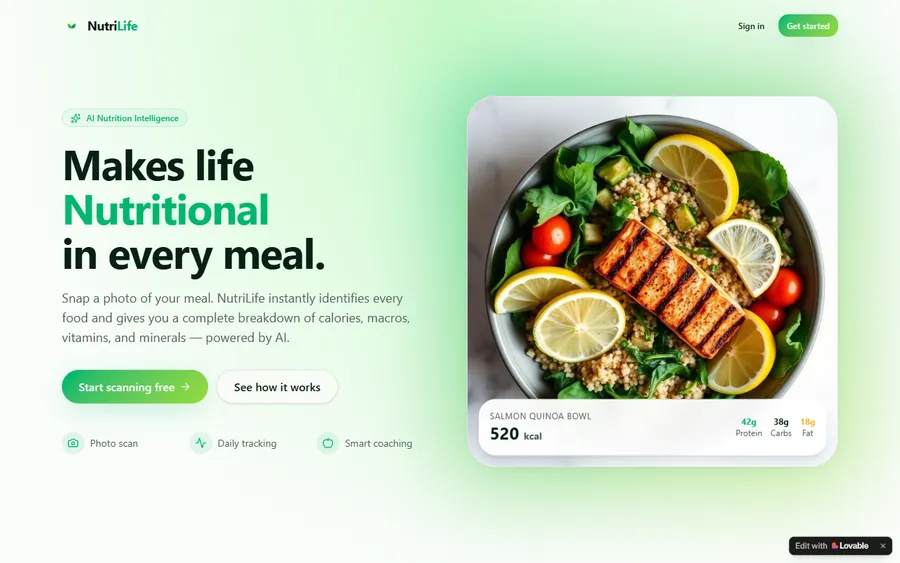
AI and ML
An AI nutrition coach that reads what you eat and works you toward a target.
AI and ML
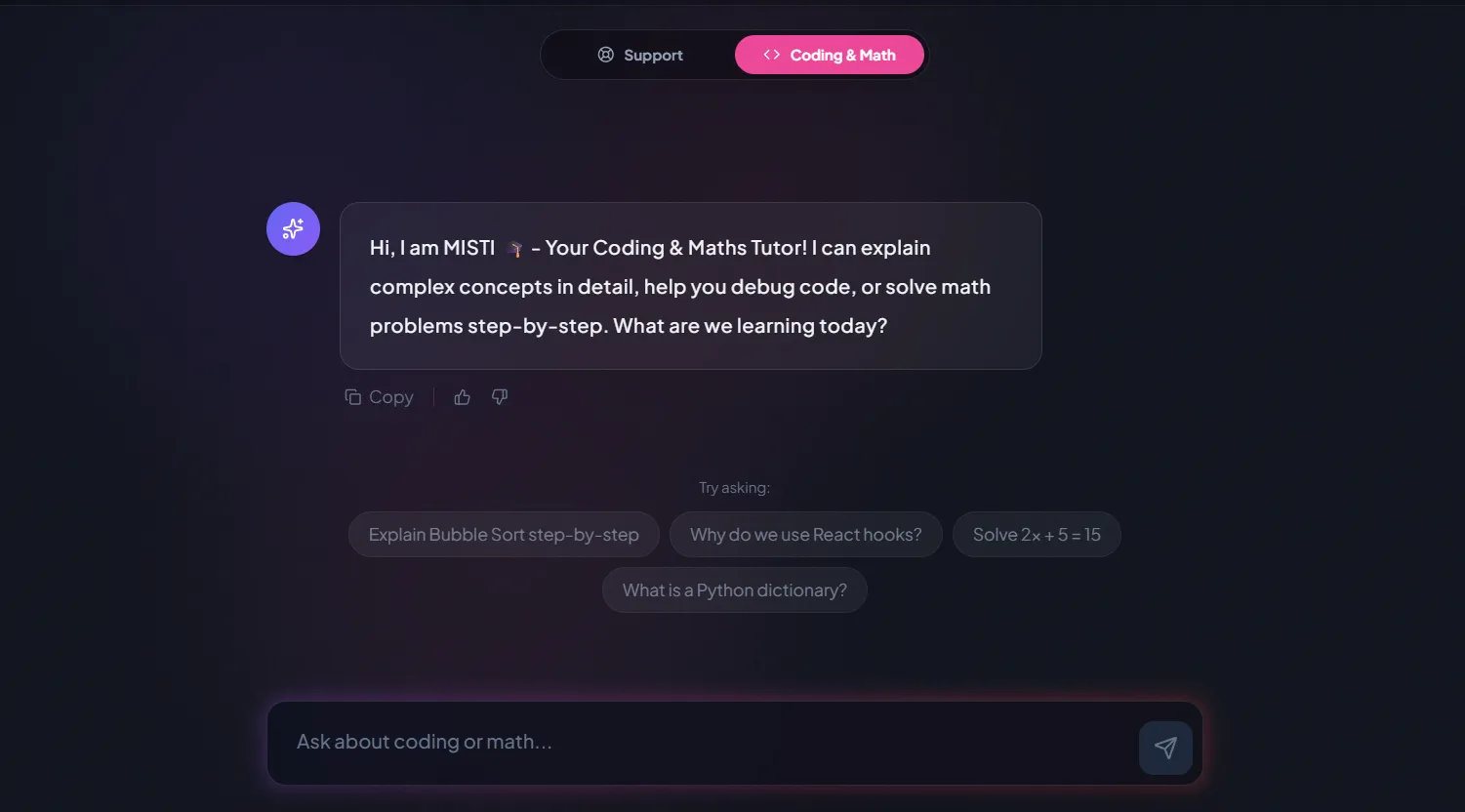
A chatbot that answers mathematics and programming questions, built and deployed by a student.
AI and ML
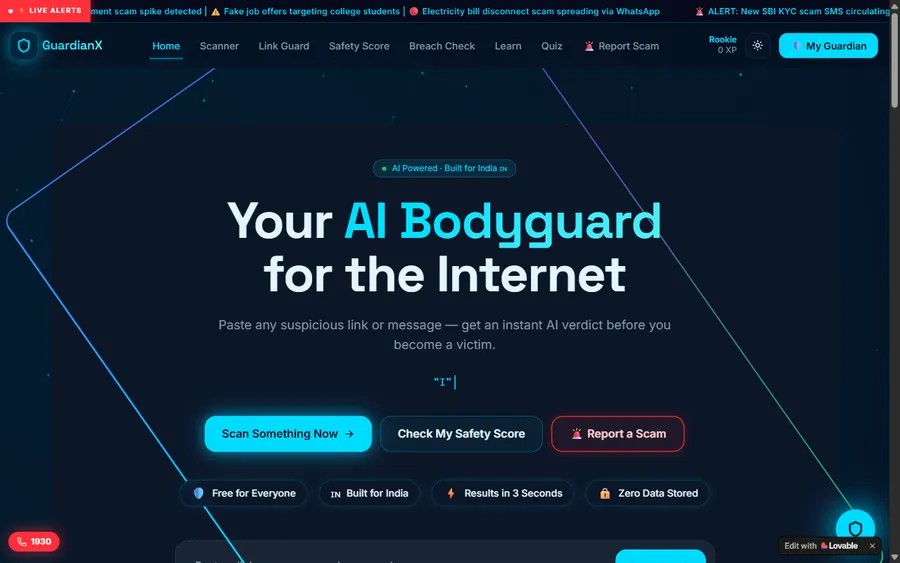
An assistant that helps a young person recognise unsafe situations online.
Web app
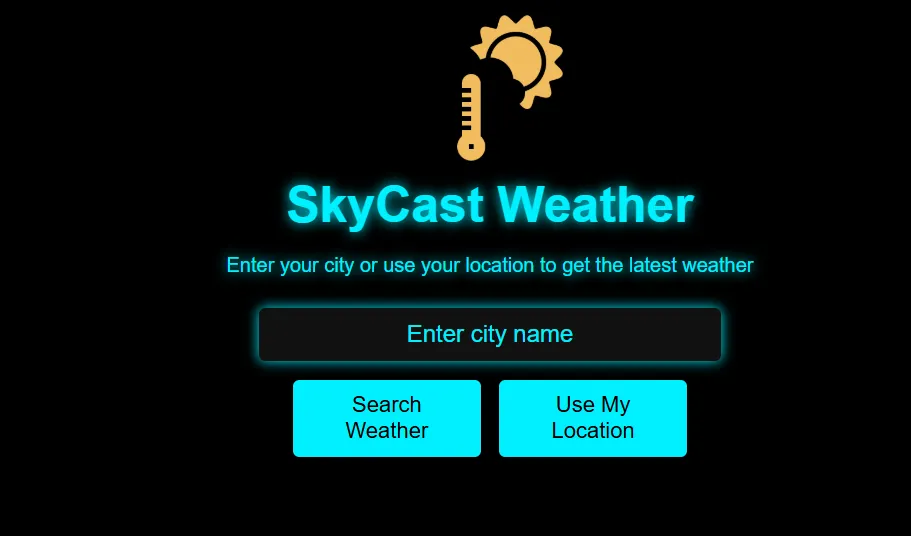
A weather forecasting site with live conditions for any location.
Fees
Families outside India pay one monthly US dollar price. No joining fee; stop any month.
Group batch
USD 100
a month, billed in US dollars
One to one
USD 150
a month, billed in US dollars
What families say
Straight from parents' Google reviews.
★★★★★
"The one step solution for my son. Modern Age Coders make learning coding so simple that kids love it. The teachers explain complex concepts clearly with practical exercises and interactive content."
Ria Mukherjee
Parent
★★★★★
"Modern Age Coders has been a game-changer for me. I struggled to grasp IT concepts and coding before joining, but their classes transformed everything. I can now confidently write complex programs with ease."
Samriddha Mondal
Student
★★★★★
"One of the most wonderful education centres out there. Education is not limited to school syllabus but focuses on skill development."
Vansh Agarwal
Student
★★★★★
"My child Dhairya is really enjoying the Modern Age Coders classes. This is his first online class and he eagerly looks forward to it. I can already see his improvement, and the teachers are very cooperative."
Sonam Oswal
Parent of Dhairya
★★★★★
"Modern Age Coders have wonderful teachers who teach in a clear, easy and practical way. The teacher boosts students' confidence and inspires them to learn without hesitation."
Sonu Goyal
Parent
★★★★★
"I highly recommend this computer coding class! The teachers are incredibly knowledgeable and passionate about coding."
Ritu Kedia
Parent
Hertfordshire questions
Not in the usual sense. The county council says some schools select a percentage of their places based on academic ability. The South West Herts Schools Consortium describes its members as partially selective.
The consortium says academic candidates take mathematics and verbal reasoning tests from GL Assessment, of roughly 45 minutes to an hour each. English and non-verbal reasoning are not required.
The consortium's instructions say some questions may require marking two answers, so children must read each question's instructions carefully.
For 2027 entry it was on Saturday 5 September 2026, with registration from 1 April to 5 June 2026 and scores on 15 October 2026. Dates for 2028 entry are published by the consortium.
It runs its own examination: Part I verbal reasoning for all candidates, then Part II English and a one-hour maths paper written by the school for the top 325. It admits up to 65 children by academic ability.
Parmiter's, Queens', Rickmansworth, St Clement Danes and the two Watford Grammar Schools. Croxley Danes is in the consortium but tests for music only.
The consortium says its familiarisation materials are generic and not intended to replicate the timings or number of questions on the day.
No. Verbal reasoning, English and every question about places sit outside our lessons, which are about mathematics.
No. We write our own questions.
Lesson one is on us. Continuing pupils pay USD 100 per month for a class place or USD 150 per month for individual teaching, month to month.
Related
Two boroughs over the border, a fully selective county next door, and the wider picture.
Three schools just over the border.
Latymer's test, changing for 2028 entry.
A fully selective county to the west.
The national overview.
Maths challenges through the year.
Every UK area we cover.
Start here
Tell us your child's year and which route you are considering. We teach a real lesson and then give you an honest account of it.
If you would like to look around before talking to us, the courses each carry a syllabus, our method is written up, and a roadmap links primary maths to programming.
WhatsApp us · +91 91233 66161 · contact@modernagecoders.com
WhatsApp is the quickest way to reach us. Our team, teachers and phone number are all in India; there is no Watford or Hertfordshire office.