UK / QAP / 01
11 plus maths preparation
The Year 5 curriculum, taught for entrance-test wording.
Open the syllabusEngland · Quest Assessments 11 plus · Years 4 and 5
Quest Assessments is a UK test provider, part of the education company Atom Learning, that builds a separate 11 plus for each grammar school area or independent school that hires it. At Modern Age Coders, a live teacher covers that Quest maths with your child over video, either in a class of 15 to 20 or on their own, using our 11 plus maths preparation course. The first job is to read your own area's Quest page, because the maths might be a paper of its own or half of a paper shared with non-verbal reasoning.
From Quest, council and consortium pages, read 31 October 2026 · Not connected with Quest Assessments or any school
What is the Quest 11 plus?
It is an 11 plus test written by Quest Assessments, a UK provider that is part of Atom Learning, for whichever grammar schools or independent schools commission it. Quest says plainly that "Every school will use different papers and follow different structures for their assessments." Its parents' guide says the test assesses what children have covered "up to the end of Year 5", that most papers use an OMR answer sheet marked with a pencil line, and that some questions ask for more than one answer. Bexley and Wirral set two papers of about 50 minutes; Dorset's consortium sets three 40-minute papers with maths first. Modern Age Coders teaches the Year 5 maths and the answer-sheet habits these tests need, live online, using practice questions we write ourselves.
Choose a starting point
Start where your child is weakest, not where the test begins. Tap a card to read what it covers.
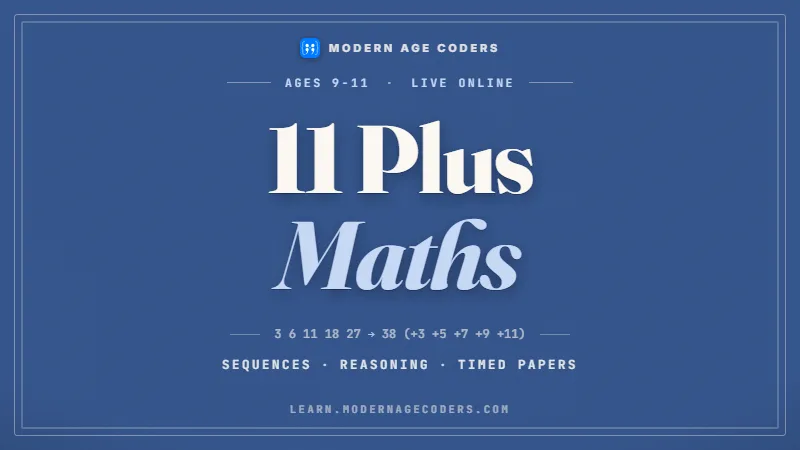
QST / 01
The core course: Year 5 number, fractions, measures and problem solving, taught for questions worded in unfamiliar ways.
Open the syllabus →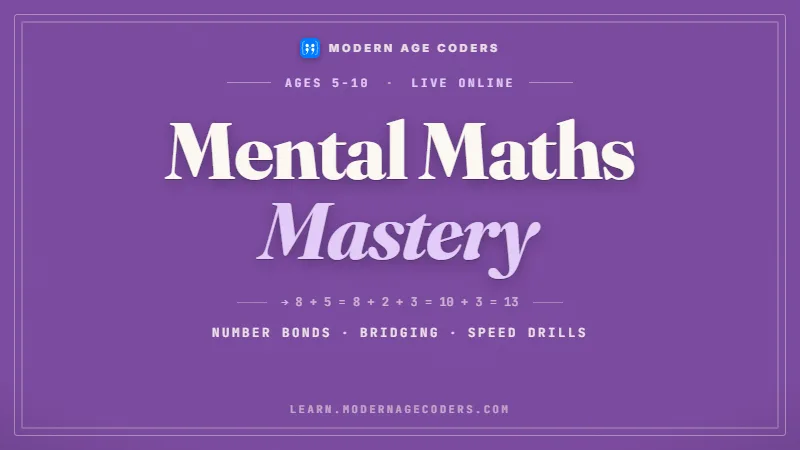
QST / 02
Forty or fifty minutes go quickly when every sum is written out; secure recall gives time back for checking options.
Open the syllabus →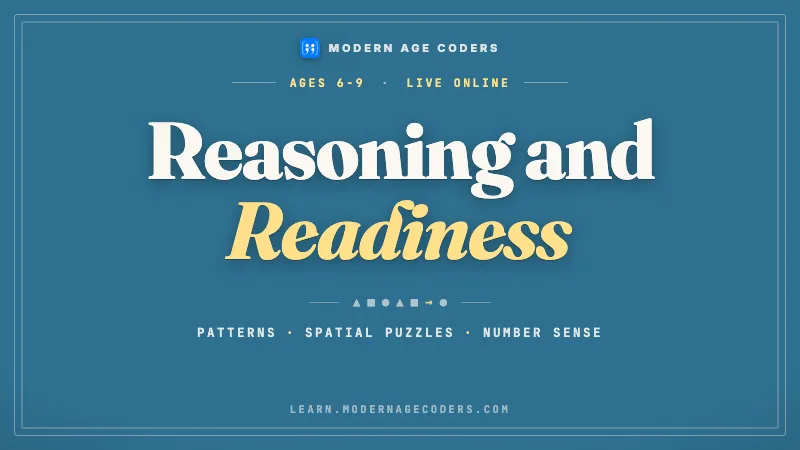
QST / 03
For younger children, ages 6 to 9, who would gain from pattern and spatial puzzles long before any Quest paper.
Open the syllabus →Who Quest is
A test company that designs entrance assessments to order for grammar schools and independent schools, and also sells classroom progress tests. It is part of Atom Learning, which runs a home-learning platform.
Quest's parent guidance page describes two sides to its admissions work. "Grammar schools use Quest Admissions assessments to identify pupils who are naturally suited to a grammar school environment", and "Quest Admissions is an exam provider used by UK independent schools." For both, the warning is the same: "Every school will use different papers and follow different structures for their assessments." The admissions page aimed at schools lists what Quest offers its customers, including tests that are "Bespoke and branded to your school", delivered on "Paper and online", for "Main entry and in-year" admissions and "For ages 7+ to 16+". It says Quest is "Trusted by 130+ schools".
Quest publishes its own five steps: it meets the school to discuss entry requirements, designs an assessment suite for the school to review, works with the school on the candidate experience, runs the test and processes results, and returns full reports on each candidate.
So when a family asks "what is on the Quest paper", the honest answer is "whatever your area agreed with Quest". The local page is the only reliable guide.
Not Quest. Bexley Council states that "Quest Assessments cannot provide information directly to parents or respond to individual concerns"; questions go to the council's School Admissions Team.
The same pattern holds elsewhere: the school or consortium runs registration and results, and Quest supplies the papers.
Sources: Quest Assessments, parent guidance and Quest Admissions; London Borough of Bexley, about the test; all read 31 October 2026. Modern Age Coders is not connected with Quest Assessments, Atom Learning or any school.
Area by area
Four published Quest designs, four different places for the maths. Read across the table before you buy anything labelled "Quest style".
| Area or school | Papers | Where the maths sits | Next sitting published |
|---|---|---|---|
| Bexley Selection Test (London Borough of Bexley) | Two non-adaptive paper assessments, around 50 minutes each | Paper two, "Numerical Reasoning and Non-verbal Reasoning" | Results early October 2027 |
| Wirral Consortium | Two papers in one session, about 50 minutes each | Paper two, "Mathematics and Non-verbal reasoning" | Results mid-October 2027 |
| Dorset Consortium | Three papers, 40 minutes each | Paper one, Mathematics, on its own | Exam September 2027; registration opens April 2027 |
| One Enfield grammar school | Two non-adaptive written assessments | Paper one, Mathematics, multiple choice | Test September 2027 |
The Dorset design is the longest. By our own arithmetic its three 40-minute papers add up to 120 minutes of questions in one session, with a short supervised break, and maths comes first, when children are freshest. In Bexley and Wirral the maths shares its paper with non-verbal reasoning, so a child switches from fractions to shape patterns inside one booklet. In the Enfield school's design maths is again a paper of its own, while the second paper holds English and a written task. Bexley names its maths "numerical reasoning" and the council defines it as content "not exceeding what children are expected to learn by the end of Year 5". That ceiling matches Quest's own parents' guide, which says the test covers school work "up to the end of Year 5, so there's no need for them to learn Year 6 topics".
Dorset's consortium page with Quest gives registration from April 2027 and an exam in September 2027. Our Bournemouth, Christchurch and Poole page records the provider in use before that.
Bexley emails results from 4pm on Friday 2 October 2026 for this year's cohort. Wirral's page with Quest gives results in mid-October 2027 for the next one.
The London 11+ Consortium of independent schools designed its online test with Quest. It is a very different shape: one 100-minute online sitting with adaptive maths, described on the consortium's own site.
Sources: Quest Assessments with the London Borough of Bexley, the Wirral Consortium, the Dorset Consortium and an Enfield grammar school, read 31 October 2026. Local detail: Bexley, Wirral, Enfield, Slough, Plymouth, Kingston.
The answer sheet
With one horizontal pencil line through the box beside the chosen answer, nothing else. Quest spells the rules out because a correct answer marked the wrong way may not be read.
Quest's guidance for parents explains that "Most 11+ papers use OMR (Optical Mark Recognition) answer sheets", so a child "won't write out answers" but will "draw a line through a box beside the answer they've chosen". It then lists what not to do: "Do not shade in the whole rectangle", "Do not tick the box" and "Do not put a cross through the box". Mistakes are rubbed out, and "Each question number must match the number on the answer sheet." The maths familiarisation booklet shows rows labelled A to E, the five-option layout children should expect.
| Quest's rule | The usual mistake | Our drill |
|---|---|---|
| A single horizontal line through the box | Shading the box fully, as on some school worksheets | Ten rows marked against a timer, checked for line shape, before any maths |
| Rub out and re-mark if you change your mind | Two lines on one row, so neither counts | Practise erasing cleanly with a soft eraser, not crossing out |
| Question number must match the sheet | Skipping a hard question in the booklet but not on the sheet | Leave a small dot on the row you skip; check numbers every five questions |
| Some questions ask for more than one answer | Marking the first correct option and moving on | Read the stem twice; count how many answers it asks for before marking |
Quest's parents' guide warns that children "might be asked to select more than one answer - remind your child to always double check what the question asks them to do". It is the single biggest difference between a Quest paper and the older one-answer formats.
In Quest's own maths familiarisation booklet, one of the 20 sample questions has four correct options in the answer key. We do not reproduce it; the booklet is free from Quest.
Quest publishes free familiarisation booklets for English, maths, verbal reasoning and non-verbal reasoning, each with a sample OMR sheet. The maths booklet says of its questions: "These questions will not appear in your real assessment."
Children from families who qualify for the government's extra school funding for disadvantaged pupils can also ask for a free Atom Home account through Quest's parent guidance page, once their primary school confirms eligibility.
Quest or FSCE
No. They are two separate providers that both arrived in English grammar school testing in recent years, and families often mix them up. Check which one your area names.
| Quest Assessments | FSCE (Future Stories Community Enterprise Ltd) | |
|---|---|---|
| Who they are | "part of the education company Atom Learning" | A company whose tests are "written by Grammar Schools, for Grammar Schools" |
| Who uses them | Grammar schools and "UK independent schools"; Bexley, Wirral, Dorset and others | Grammar schools; Gloucestershire's grammar schools for the 2028 intake |
| Ages | "For ages 7+ to 16+" | 11+ and in-year tests |
| Stated aims | Fair, accessible, bespoke tests following Ofqual guidance | "We support tutor-free summers" and new test content every year |
| Free material | Familiarisation booklets for four subjects, OMR sheet | Each school publishes its own guidance; see our area pages |
Gloucestershire County Council says that for the 2028 intake "the test provider they use will be Future Stories Community Enterprise (FSCE)", and that the grammar schools plan the test for Saturday 3 July 2027, so a Gloucestershire family should not prepare in a Quest format. Our pages for Gloucestershire, Reading, Essex and Calderdale cover FSCE areas in detail. The underlying maths, school work to the end of Year 5, is much the same for both providers; the layouts are not.
Sources: FSCE Ltd; Gloucestershire County Council, grammar schools; Quest Assessments parent guidance and admissions pages. All read 31 October 2026.
Worked examples, written by us
Three original Year 5 problems, two of them in a select-every-correct-option style. None comes from a Quest booklet or paper. Watch the checking, not just the answer.
Which of these are multiples of both 3 and 4: 12, 18, 24, 30, 36? A number divisible by both 3 and 4 is divisible by 12, so test each against 12. 12 yes, 18 no, 24 yes, 30 no, 36 yes. Three answers: 12, 24 and 36. A child who marks 12 and moves on loses the question, because the stem never said "which one".
Which of these equal 0.75: three quarters, six eighths, nine twelfths, seven ninths, 75 hundredths? Simplify each. Six eighths and nine twelfths both reduce to three quarters; 75 hundredths is 0.75 by place value. Seven ninths is 0.777..., close but not equal. Four answers. Simplifying first is quicker than turning every fraction into a decimal.
A ribbon 3.6 m long is cut into pieces of 45 cm. How many pieces? Convert first: 3.6 m is 360 cm. Then 360 divided by 45: 45 times 8 is 360, so 8 pieces. Dividing 3.6 by 45 gives nonsense, and that wrong number often appears among the options. Units before arithmetic is the rule.
| Question (ours) | Answer | The reasoning |
|---|---|---|
| Which of these are prime: 9, 11, 15, 17, 21, 23? | 11, 17 and 23 | Check each for a factor other than 1 and itself: 9 is 3 times 3, 15 is 3 times 5, 21 is 3 times 7. Three primes, so three marks on the sheet. |
| Write MCMXC as a number. | 1990 | M is 1000, CM is 900, XC is 90. Roman numerals to 1000 are on the Year 5 curriculum and easy marks if practised. |
| Round 46,350 to the nearest thousand. | 46,000 | Look only at the hundreds digit, 3, which is under 5, so round down. The tens and ones do not matter. |
| An L-shape is a 10 cm by 6 cm rectangle with a 4 cm by 3 cm corner removed. What is its area? | 48 square centimetres | Whole rectangle 60, minus the missing 12. Subtracting a missing piece is faster than splitting the L into two rectangles. |
| Which of these are square numbers: 16, 24, 36, 50, 64? | 16, 36 and 64 | 4 squared, 6 squared and 8 squared. 24 and 50 sit between squares. Another multi-answer row. |
| A bag of flour holds 1.5 kg. How many 125 g scoops does it hold? | 12 | 1.5 kg is 1500 g, and 125 goes into 1000 eight times and into 500 four times. |
Half of this practice set has more than one correct option. That is deliberate: in our experience the costly error on a multi-answer paper is not a wrong sum but a stopped search. Children learn to count how many answers a stem allows, check every option against the condition, and only then draw their lines on the sheet.
What Quest advises
Quest's own guidance puts school learning first and warns against "excessive tutoring". We agree, and keep our offer to the maths and the format.
The parents' guide says: "The best preparation is steady, meaningful learning over time" and "not last-minute cramming or excessive tutoring." It suggests practising maths "in fun, everyday ways", such as cooking and shopping, with "small, regular sessions rather than long hours".
Area pages written with Quest repeat the theme: a strong grounding in school learning, wide reading, and the ability to apply knowledge to new contexts.
A child who reaches the summer of Year 5 unsure of fractions, measures or multi-step problems is missing things school expects, test or no test. Fixing that is useful for Year 7 as much as for September.
So we teach Year 5 maths properly, add the OMR and multi-answer habits, and stop. We do not claim knowledge of any Quest paper, and we do not sell "Quest papers".
Timeline
Quest grammar areas in the table register children during Year 5 and test them early in Year 6. Our four stages work back from that; your area supplies the exact dates.
| When | Stage | Secure when |
|---|---|---|
| Year 4 | 1. Number facts | Tables, number bonds and place value come back without hesitation |
| Year 5, autumn to spring | 2. Year 5 content | Fractions, measures and multi-step problems come out right at the first attempt |
| Year 5, summer | 3. Quest format | Free booklets done; line-marking and multi-answer rows done without slips |
| Summer holidays | 4. Your area's layout | Timed sections in the local paper order finished with time to check |
Stage 2 still comes before stage 4. The format takes days to learn; the maths takes months.
After the first lesson we will tell you honestly which stage your child has reached.
Year 5 maths done well carries straight into Year 7. Some children go on to maths through coding.
For children who enjoyed the puzzles, our UK competitions calendar has the next challenge.
All related courses
Arranged by when they help most. Open any card for the syllabus.
UK / QAP / 01
The Year 5 curriculum, taught for entrance-test wording.
Open the syllabusUK / QAP / 02
Quick recall so minutes are left for checking.
Open the syllabusUK / QAP / 03
Firm foundations for children who need them first.
Open the syllabusUK / QAP / 04
A hands-on route into fast calculation.
Open the syllabusUK / QAP / 05
Number tricks with reasons behind them, for pattern lovers.
Open the syllabusUK / QAP / 06
The Year 6 papers that follow the 11 plus.
Open the syllabusUK / QAP / 07
Key Stage 3 ground, started early.
Open the syllabusUK / QAP / 08
Small Python programs that test a maths idea.
Open the syllabusUK / QAP / 09
Stretch problems for children who finish early.
Open the syllabusHow lessons run
Weekdays or weekends, flexible: choose your batch, or for a very personalised plan choose 1-on-1 at your convenience, weekend mornings or weekdays. The teaching team sits in India, where clocks never change, so lessons run four and a half hours behind India time in the British summer and five and a half in winter; we always confirm the slot in UK time.
After school
Most Year 4 and 5 children learn here.
Weekend morning
Space for a full timed section.
School holidays
Short, frequent lessons before September.
Maths alone, or paired with non-verbal reasoning, as your area sets it.
Clean OMR lines, matched row numbers, safe skips.
Every option checked when a stem allows more than one.
Nothing copied from Quest or any school.
Join a class of 15 to 20 children working at one level, or book lessons alone with a teacher.
Places and pass marks belong to schools and councils.
Student work
Projects by our students, most of them well past the 11 plus now. See more on student labs.

AI and ML
An AI nutrition coach that reads what you eat and works you toward a target.

AI and ML
A chatbot that answers mathematics and programming questions, built and deployed by a student.

AI and ML
An assistant that helps a young person recognise unsafe situations online.

Web app
A weather forecasting site with live conditions for any location.
Fees
A monthly fee in the currency we show families in the UK. Your first lesson is free and there is nothing to pay to join.
Free first class
USD 0
no card required
Group batch
USD 100
a month, billed in US dollars
One to one
USD 150
a month, billed in US dollars
What families say
What parents wrote on our Google profile, as written.
★★★★★
"The one step solution for my son. Modern Age Coders make learning coding so simple that kids love it. The teachers explain complex concepts clearly with practical exercises and interactive content."
Ria Mukherjee
Parent
★★★★★
"Modern Age Coders has been a game-changer for me. I struggled to grasp IT concepts and coding before joining, but their classes transformed everything. I can now confidently write complex programs with ease."
Samriddha Mondal
Student
★★★★★
"One of the most wonderful education centres out there. Education is not limited to school syllabus but focuses on skill development."
Vansh Agarwal
Student
★★★★★
"My child Dhairya is really enjoying the Modern Age Coders classes. This is his first online class and he eagerly looks forward to it. I can already see his improvement, and the teachers are very cooperative."
Sonam Oswal
Parent of Dhairya
★★★★★
"Modern Age Coders have wonderful teachers who teach in a clear, easy and practical way. The teacher boosts students' confidence and inspires them to learn without hesitation."
Sonu Goyal
Parent
★★★★★
"I highly recommend this computer coding class! The teachers are incredibly knowledgeable and passionate about coding."
Ritu Kedia
Parent
Quest 11 plus questions
It is an entrance test written by Quest Assessments for a particular grammar school area or independent school. Quest says every school uses different papers and structures, so the Quest test in Bexley is not the same as the one in Dorset.
Quest says it is part of the education company Atom Learning. It provides entrance tests for grammar and independent schools and separate progress tests for classrooms.
Quest's parents' guide says the test covers what children have learned in school up to the end of Year 5, with maths that may include problem solving, arithmetic and reasoning. There is no need to learn Year 6 topics.
It depends on the area. Dorset's consortium sets three 40-minute papers with maths first; Bexley and Wirral set two papers of about 50 minutes, with maths sharing paper two with non-verbal reasoning.
Draw one horizontal pencil line through the box beside your answer. Quest says not to shade the whole rectangle, tick it or cross it, and to rub out cleanly if you change your mind.
Yes. Quest's guidance says children might be asked to select more than one answer, so they should check what each question asks before marking the sheet.
Quest publishes free familiarisation booklets for maths, English, verbal and non-verbal reasoning on its parent guidance page, with a sample OMR sheet. It says those questions will not appear in the real test.
No. FSCE, Future Stories Community Enterprise, is a separate provider whose tests are written by grammar schools for grammar schools. Gloucestershire's grammar schools will use FSCE for the 2028 intake.
Weekdays or weekends, flexible: choose your batch, or for a very personalised plan choose 1-on-1 at your convenience, weekend mornings or weekdays. Every time is confirmed in UK time.
No, and nobody outside the schools should. We teach Year 5 maths and the Quest answer format using questions we write ourselves, and we never promise a score or a place.
Related pages
Local pages go deeper into each test.
Numerical reasoning in the Bexley Selection Test.
Maths in paper two with non-verbal reasoning.
The Dorset consortium and its change of provider.
An FSCE county from the 2028 intake.
The subject, whoever writes the test.
All of our UK pages.
Part of the guide: UK selective school maths tests: 7+, 11+, 13+ and 16+
More guides: UK maths exam boards and specification codes · UK maths year by year, Reception to Year 11 · UK university admissions: maths tests and computing applications · UK maths enrichment, competitions and able pupils
Start here
Let us know the year group and the area or school your child is applying to. We teach one real lesson in that Quest layout and then tell you what we found.
Rather read first? See the 11 plus maths preparation course for the topic list, or how we teach for the method behind it.
WhatsApp us · +91 91233 66161 · connect@modernagecoders.com
Messaging us on WhatsApp is quickest and free from any UK mobile. Our team replies from India, on a number beginning +91.
A priority demo is a full class of about 45 to 60 minutes. After the class the mentor sends a written skill report and a personal learning roadmap on WhatsApp. If you enrol, the demo fee is adjusted against your first month's fee. Share your demo Order ID with us on WhatsApp and we take it off.
Book a priority demo