RBM / A1
11 plus maths preparation
The full Year 5 curriculum, not one paper style.
Open the syllabusRedbridge · 11 plus for Ilford and Woodford County High · Live online, small groups or one to one
Redbridge Council's 11 plus page contains a sentence most test organisers would not write. After pointing families to GL Assessment's free familiarisation materials, it adds that "the free materials might not match the exact test your child will take. Differences could include the number of questions, types of questions, or difficulty." We think that is an honest and useful warning, and it has a clear consequence for maths. If the practice papers are not a reliable picture of the test, then the thing to prepare is not a practice-paper style; it is the maths itself, the primary curriculum up to the end of Year 5. This page sets out what the council publishes about the test, and then works through one part of that curriculum that turns up everywhere in word problems: measures and converting between units.
Maths only · We do not teach verbal or non-verbal reasoning · Not linked to Redbridge Council or its schools
In short
The London Borough of Redbridge runs the 11 plus for its two grammar schools, Ilford County High School for Boys and Woodford County High School for Girls, with GL Assessment as the provider. There are two papers: English and Verbal Reasoning, and Mathematics and Non-Verbal Reasoning. The council's admission arrangements set a minimum threshold score of 104 for all applicants. For September 2027 entry, families registered between 1 May and 5pm on 15 June 2026, and the test was on Friday 18 September 2026; the council says to register in Year 5 for a test in Year 6. It also warns that free practice materials might not match its test in the number, type or difficulty of questions. So we teach the maths curriculum rather than a paper style, live online. There is no fee for the first lesson; after that a group place costs USD 100 a month and one to one USD 150 a month.
Starting in Redbridge
Since the practice papers may differ from the real one, choose by the gaps in the maths, not by paper scores.
REDBRIDGE / A
Every Year 5 topic, including the measures and conversions that fill word problems.
Open the syllabus →
REDBRIDGE / B
For children whose place value, decimals or tables are not yet solid enough to build on.
Open the syllabus →
REDBRIDGE / C
Multiplying and dividing by 10, 100 and 1,000 in the head, which is most of converting units.
Open the syllabus →The Redbridge 11 plus
Redbridge Council runs registration and testing and publishes both a parents' page and formal admission arrangements. Both read on 26 September 2026.
| Step | Date | What the council says |
|---|---|---|
| Registration | 1 May to 5pm, Monday 15 June 2026 | Registered in Year 5; no late registrations. Adjustment requests also closed on 15 June. |
| Invitation | Start of September 2026 | An email with a photo ID form and a letter giving the time, place, test duration and what can be brought. |
| Test | Friday 18 September 2026 | The completed photo ID form must be brought; without it a child cannot sit the test. |
| Results | Mid-October 2026 | A child's position by total standardised score is given before the 31 October preference deadline. |
The test has two papers, in the council's words: "English and Verbal Reasoning" and "Mathematics and Non-Verbal Reasoning". GL Assessment provides it. The council does not publish the length of each paper on its page; the invitation letter sent in September gives the duration.
The admission arrangements state that "Admission to the two selective (grammar) schools is based on the optional selection procedure only", and set "a "minimum threshold score" of 104 for all applicants". Applicants below that score are not added to the ranked list.
Before registering, the council asks families to check whether they live in the schools' common catchment area, using the council's online map. That, and how children are ranked for places, is admissions, and we leave it to the council's documents.
The council also publishes data on registrations, the number of children who sat the test and scores, for families who want the background. We do not reproduce it here and do not use it to predict anything.
Sources: London Borough of Redbridge, Redbridge 11 plus; Redbridge Determined Admission Arrangements 2027-28. Modern Age Coders has no connection with Redbridge Council, GL Assessment, Ilford County High School or Woodford County High School.
An honest warning
Redbridge's sentence about familiarisation materials is worth reading closely, because it tells families where not to put their faith.
Redbridge points families to GL's free familiarisation materials and to practice papers on GL's website, which "can help students get used to the format and style of the questions". Then it warns: "The 11 plus test can vary between areas, the free materials might not match the exact test your child will take. Differences could include the number of questions, types of questions, or difficulty."
Three things, then, may differ: how many questions, what kinds, and how hard. That is most of what a practice paper can teach a child about a test.
Practice papers still have a job: getting a child used to a booklet, an answer sheet and a clock. What they cannot do, on the council's own account, is tell a family what the Redbridge maths will look like in detail.
The one thing that cannot vary between areas is the curriculum a child has been taught. So we build preparation on the Year 5 national curriculum, topic by topic, and use practice papers only for format and timing, late on.
There is a trap in the opposite direction too. A child who does many practice papers of one style can become quick at that style and brittle outside it. When the real paper has a different number of questions, or a question type they have not seen, the rhythm breaks. A child who knows the curriculum well does not depend on the rhythm.
The lesson
Whatever form the Redbridge maths takes, word problems about length, mass, capacity, time and money will be in it. Year 5 measurement is where they live.
| Year 5 skill | Our question | Answer and method |
|---|---|---|
| Convert metric units | How many metres is 2.35 km? | 2,350 m: multiply by 1,000 |
| Measure with decimals | Four cartons each hold 750 ml. How many litres altogether? | 3 litres: 4 × 750 = 3,000 ml |
| Approximate imperial equivalents | Roughly how many centimetres is 12 inches? | About 30 cm, using 1 inch as roughly 2.5 cm |
| Perimeter of composite shapes | An L-shape is made from a 6 m by 4 m rectangle with a 2 m by 1 m corner removed. What is its perimeter? | 20 m, the same as the full rectangle |
| Converting time | How many minutes are there in 2.5 hours? | 150 minutes |
| Scaling | A recipe for 4 uses 300 g of flour. How much for 10? | 750 g: 75 g per person |
The national curriculum asks Year 5 pupils to "convert between different units of metric measure" and to "use all four operations to solve problems involving measure ... using decimal notation, including scaling". The first three rows are conversions; the last is scaling, which Year 5 does with simple multiplication and division before ratio arrives in Year 6.
The curriculum also asks for "approximate equivalences between metric units and common imperial units such as inches, pounds and pints". These are approximate on purpose, and questions about them usually say so. The skill is knowing a sensible rough equivalent and using it.
The perimeter row is our favourite, because it catches strong children. Removing a corner from a rectangle does not change its perimeter: the two sides of the notch replace exactly the lengths removed. Children who compute every edge get 20 m the long way; children who see why get it in seconds and can check their answer.
Underneath almost every conversion is place value: multiplying or dividing by 10, 100 or 1,000. That is why a Year 5 measures lesson with us often turns, for ten minutes, into a place value lesson. It is the part that fails most often.
Source: national curriculum in England, mathematics, Year 5 measurement (statutory requirements). All questions in the table are Modern Age Coders' own.
How we prepare
This is how the council's warning shapes a year of lessons with us.
We work through the Year 5 curriculum in order, number, fractions, measures, geometry and statistics, and a topic is not finished until it is quick and correct.
Each topic is practised in several forms: plain calculation, a word problem, a multiple-choice question and a question written backwards. No single style becomes a habit.
In the summer before the test, timed mixed papers train stamina and pace. By then the maths is secure, and the paper is a rehearsal, not a lesson.
The Mathematics and Non-Verbal Reasoning paper mixes two kinds of question. We teach only the mathematics. Families who want help with non-verbal reasoning should look elsewhere, and we say so before anyone books.
We do not reproduce GL familiarisation papers or any test content. Our questions are written for the curriculum.
We are also careful about the minimum threshold of 104. It is a published rule of the admission arrangements, not a target we coach towards, and we never predict a child's score.
Older brothers and sisters are welcome in our secondary classes, where the approach is exactly the same: the curriculum, taught properly, rather than a style of paper.
Ilford, Woodford and around
Ilford County High School and Woodford County High School share the Redbridge test. We list them only to show which test this page covers.
| School | Who it admits |
|---|---|
| Ilford County High School | Boys |
| Woodford County High School | Girls |
Both schools use the one test on one day, so a family applying to either is preparing for the same papers.
For coding and computing in the borough, see our Redbridge coding page.
Lessons are live on video, and groups are matched by level, so a child in Gants Hill, Barkingside or Woodford Green learns with children at the same stage of Year 5 maths from anywhere in the country.
We have no connection with either school or with the council, and we give no advice on the catchment area, applications or places.
Source: London Borough of Redbridge, Redbridge 11 plus, read 26 September 2026.
A year of work
For a child in Year 5 now, the council's pattern points to registration around May to June 2027 and a test early in Year 6. The council publishes the exact dates.
| When | Stage | You can see it when |
|---|---|---|
| Autumn, Year 5 | 1. Place value and decimals | Multiplies and divides by 10, 100 and 1,000 without hesitation |
| Winter, Year 5 | 2. Measures | Converts units and solves measure problems with decimals correctly |
| Spring, Year 5 | 3. The rest of Year 5 | Fractions, geometry and statistics are as secure as number |
| Summer holiday | 4. Papers, for format | Finishes a timed paper calmly, whatever its length or layout |
There is still time if the order holds: place value, then measures and the rest of Year 5, then papers.
We will give you our honest estimate at the free lesson.
Measures and conversions run straight through secondary science and maths. Some pupils continue into maths through coding, where units become variables.
Pupils who relish problems try the national challenges listed on our competitions calendar.
Courses
Grouped by stage; each links to its syllabus.
RBM / A1
The full Year 5 curriculum, not one paper style.
Open the syllabusRBM / A2
Place value and decimals, made secure.
Open the syllabusRBM / A3
Quick conversions by powers of ten.
Open the syllabusRBM / A4
Hands-on place value for younger pupils.
Open the syllabusRBM / B1
Compound measures, ratio and algebra.
Open the syllabusRBM / B2
Taught to the exam board specification.
Open the syllabusRBM / B3
Problems that reward real understanding.
Open the syllabusRBM / C1
Write a unit converter; test it on real values.
Open the syllabusRBM / C2
Logic and sequence for younger coders.
Open the syllabusRBM / C3
The step up to typed code.
Open the syllabusRBM / D1
Fast methods for secure calculators.
Open the syllabusRBM / D2
Data, units and models in practice.
Open the syllabusWhen lessons run
Lessons are taught live from India. For primary children we use early evening and weekend morning slots in UK time, and we shift our own hours when the UK clocks change.
Weekdays, early evening
An hour that fits between school and bedtime.
Weekend mornings
Good for children who flag after school.
Holidays
Brief extra lessons when school is closed.
One person, week after week, who knows the child's habits.
Short notes that say what is going well and what is not.
Grouped by level for the right pace.
No GL or council material is reproduced.
For a stubborn topic or a child who prefers it.
No reasoning coaching and no admissions advice.
Student work
Four projects by students at our school, all built on the place value and measures they once learned. More on the student labs page.
AI and ML
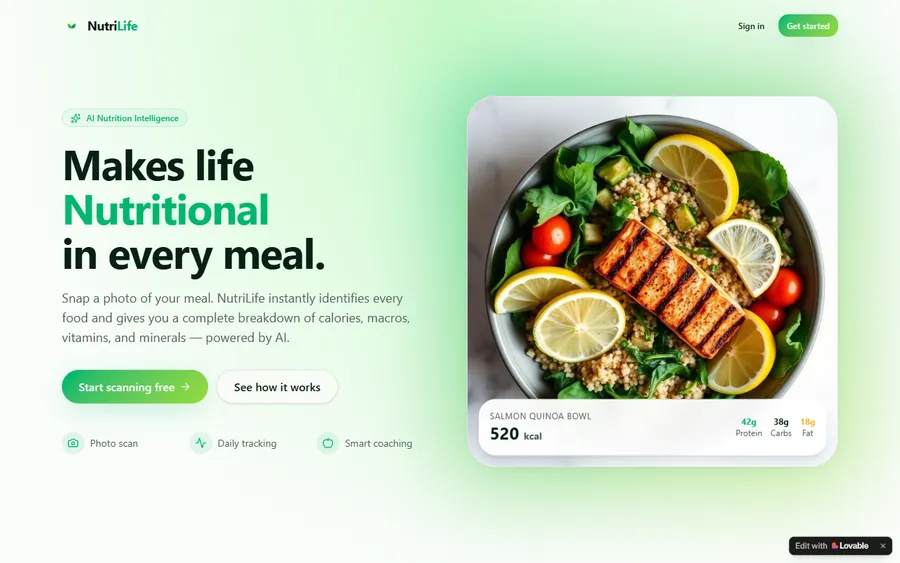
An AI nutrition coach that reads what you eat and works you toward a target.
AI and ML
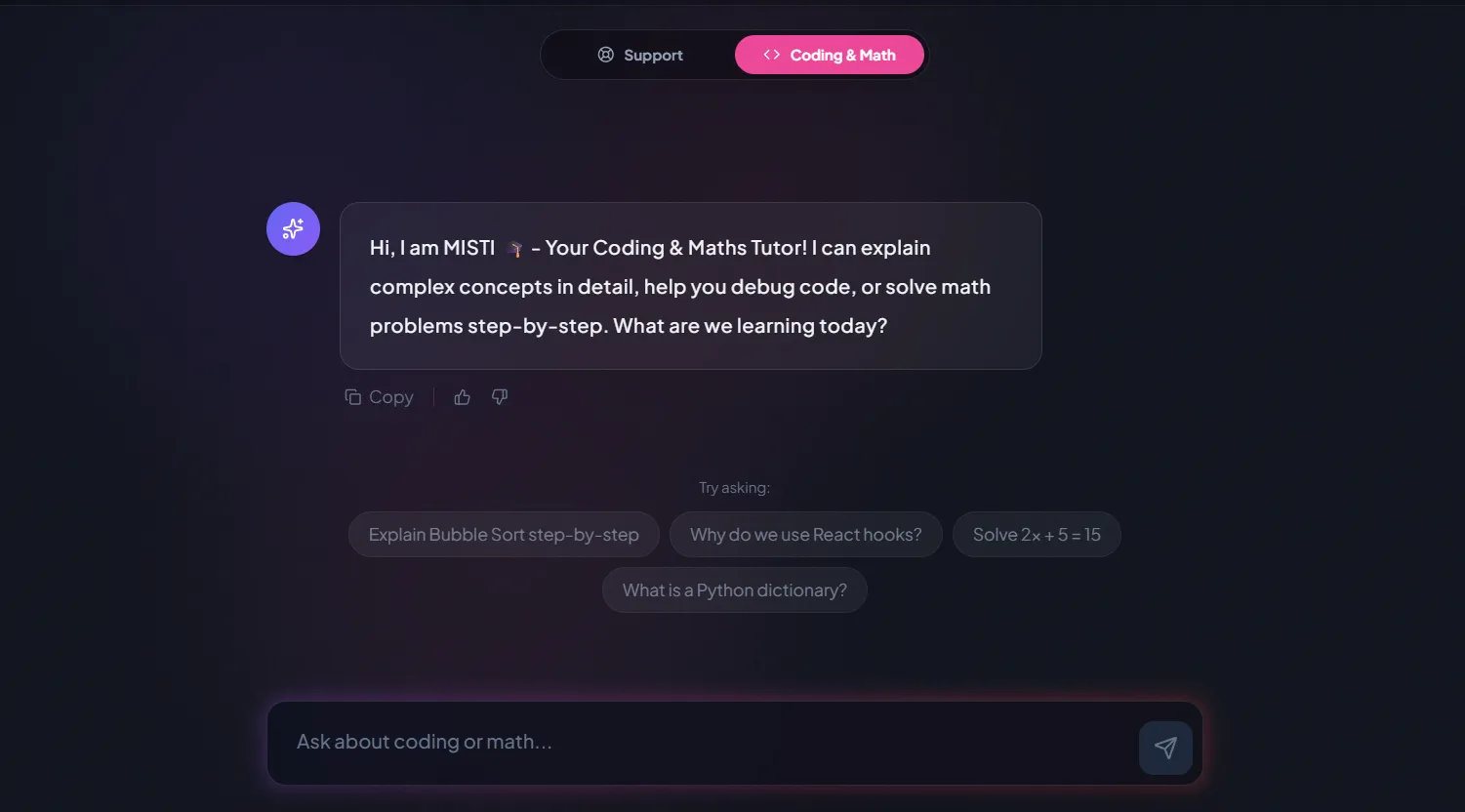
A chatbot that answers mathematics and programming questions, built and deployed by a student.
AI and ML
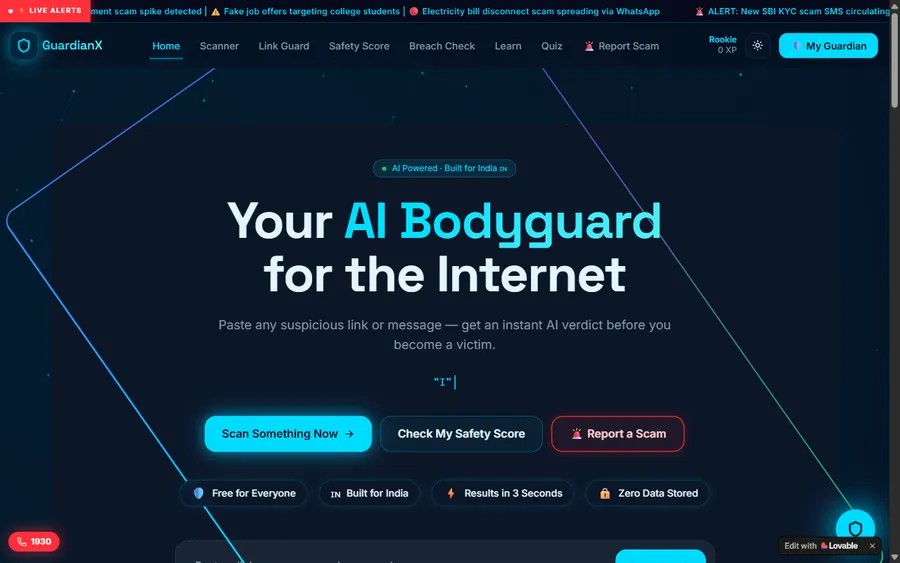
An assistant that helps a young person recognise unsafe situations online.
Web app
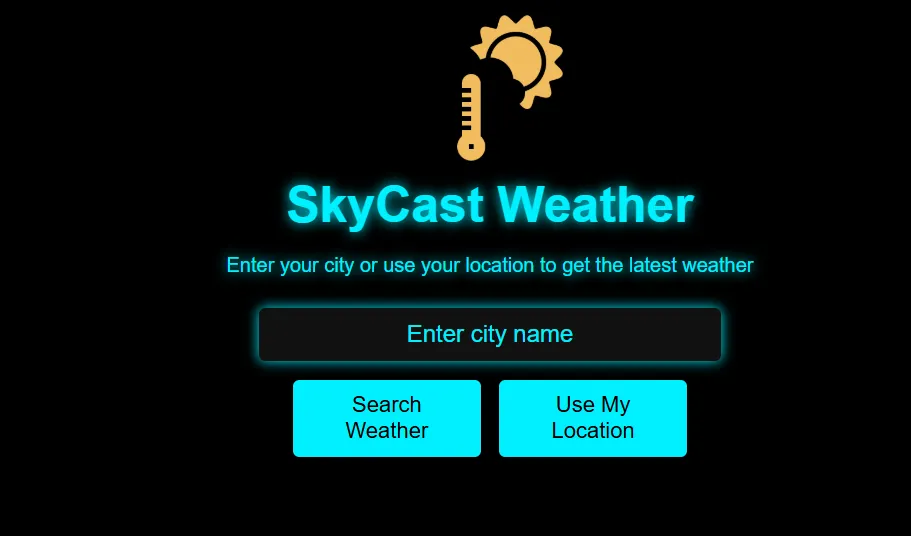
A weather forecasting site with live conditions for any location.
Fees
One monthly price in US dollars, the same for families everywhere outside India. No joining fee; leave whenever you wish.
Free first class
USD 0
no card required
Group batch
USD 100
a month, billed in US dollars
One to one
USD 150
a month, billed in US dollars
What families say
Reviews left by parents on Google, quoted without changes.
★★★★★
"The one step solution for my son. Modern Age Coders make learning coding so simple that kids love it. The teachers explain complex concepts clearly with practical exercises and interactive content."
Ria Mukherjee
Parent
★★★★★
"Modern Age Coders has been a game-changer for me. I struggled to grasp IT concepts and coding before joining, but their classes transformed everything. I can now confidently write complex programs with ease."
Samriddha Mondal
Student
★★★★★
"One of the most wonderful education centres out there. Education is not limited to school syllabus but focuses on skill development."
Vansh Agarwal
Student
★★★★★
"My child Dhairya is really enjoying the Modern Age Coders classes. This is his first online class and he eagerly looks forward to it. I can already see his improvement, and the teachers are very cooperative."
Sonam Oswal
Parent of Dhairya
★★★★★
"Modern Age Coders have wonderful teachers who teach in a clear, easy and practical way. The teacher boosts students' confidence and inspires them to learn without hesitation."
Sonu Goyal
Parent
★★★★★
"I highly recommend this computer coding class! The teachers are incredibly knowledgeable and passionate about coding."
Ritu Kedia
Parent
Redbridge questions
The council says the test has two papers: English and Verbal Reasoning, and Mathematics and Non-Verbal Reasoning. It is provided by GL Assessment.
The council does not give paper lengths on its page; the invitation letter sent at the start of September states the test duration.
Not necessarily. Redbridge Council says the free materials might not match the exact test, and that differences could include the number of questions, types of questions or difficulty.
The council's admission arrangements set a minimum threshold score of 104 for all applicants. We do not treat it as a target or predict scores.
Dates for 2028 entry had not been published when we checked on 26 September 2026. For 2027 entry, registration ran from 1 May to 15 June 2026 and the test was on Friday 18 September 2026.
Ilford County High School for Boys and Woodford County High School for Girls, according to the council.
The council says the completed 11 plus photo ID form must be brought, and the invitation letter lists what can and cannot be taken in.
No. We teach the mathematics only. We also do not advise on the catchment area or applications.
No. Our practice questions are our own, written to the national curriculum.
The first lesson is on us. Regular lessons are USD 100 a month in a small group or USD 150 a month one to one, with no minimum commitment.
Nearby
Coding in Redbridge, our national 11 plus page, and other London selective areas.
Programming lessons for children and teens in the borough.
Our national page on 11 plus maths.
A school test changing provider for 2028 entry.
South-east London's numerical reasoning test.
National maths challenges with their dates.
Every UK area we cover.
Start here
Tell us your child's school year and which maths topics feel wobbly. We teach a real lesson and then tell you honestly what we noticed.
Want to read more first? Browse the course syllabuses, read how we teach, or follow the roadmap.
WhatsApp us · +91 91233 66161 · contact@modernagecoders.com
WhatsApp gets the fastest reply. We are an Indian school with an Indian phone number and no UK office.