UK / CPP / 01
11 plus maths preparation
Year 5 and 6 number and problem solving for entrance tests of every kind.
Open the syllabusEngland · CEM and Cambridge Select Insight · Years 5 to 9
CEM, the Centre for Evaluation and Monitoring, now trades as Cambridge Insight inside Cambridge University Press & Assessment, and its entrance test is called Cambridge Select Insight. Our live online teachers at Modern Age Coders cover the maths behind a CEM-style numerical section, in classes of 15 to 20 or one to one, through the 11 plus maths preparation course. First, check that your child is sitting a CEM test at all: in several grammar areas the old CEM paper has been replaced by another provider.
From Cambridge Insight and council pages, read 31 October 2026 · Not connected with Cambridge or any school
What is the CEM 11 plus now?
CEM was a university assessment centre founded in 1983 that joined Cambridge in 2019 and was renamed Cambridge Insight in 2025, according to its own history page. Its entrance test today is Cambridge Select Insight, a computer assessment of about 60 minutes with numerical, verbal and non-verbal sections, sold to selective independent schools, grammar schools, partially selective schools and schools that use fair banding, for entry into Years 7 to 10. Cambridge sells no practice papers for it and says it endorses no tuition. Several grammar areas that once used a CEM paper have changed provider; Warwickshire moved to GL Assessment for 2023 entry. Modern Age Coders teaches the number skills a numerical section draws on, live online, with practice questions we write ourselves.
Choose a starting point
The right first course depends on whether the gap is speed, method or reasoning. Each card opens a full syllabus.
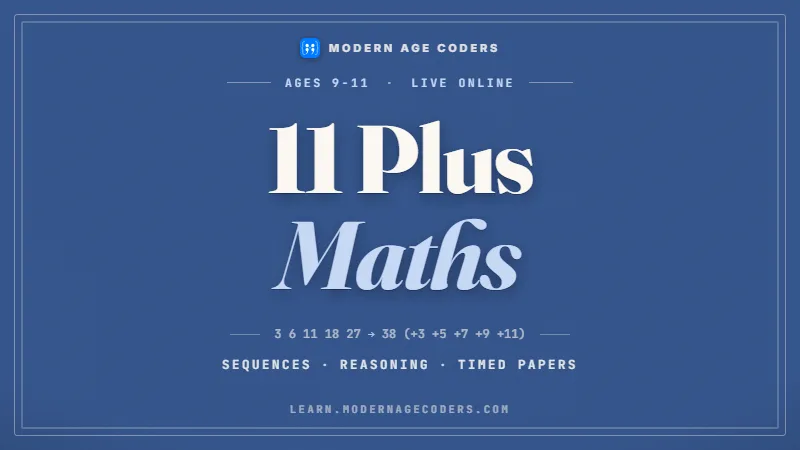
CEM / 01
Our main entrance course: number, fractions and multi-step problems, taught so unfamiliar wording does not throw a child.
Open the syllabus →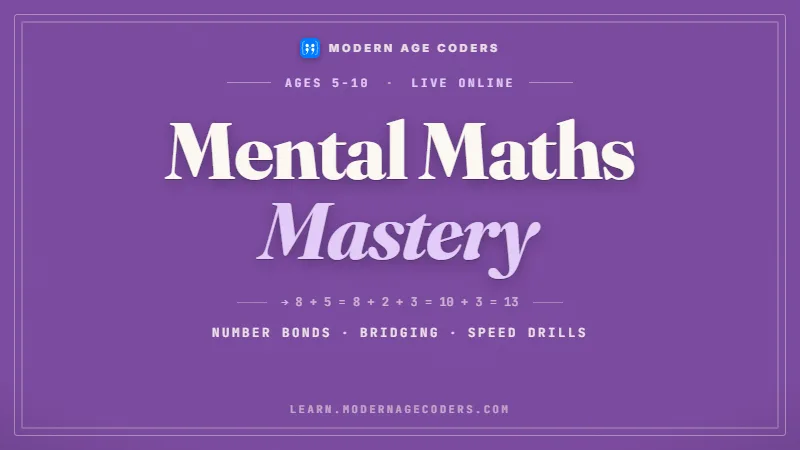
CEM / 02
A short computer test leaves no time for long written sums, so quick recall and estimation carry real weight.
Open the syllabus →
CEM / 03
For 13+, late transfer and Year 8 to 10 entry, where the same test family meets older children.
Open the syllabus →CEM today
Not in the way most practice books suggest. CEM is now a brand of Cambridge University Press & Assessment called Cambridge Insight, and it sells mainly classroom assessments, with one entrance product for selective schools.
Parents still type "CEM 11 plus past papers" because, for a decade, CEM papers were the grammar school test in several English counties. The organisation behind them has a long history. Its own timeline records the "First monitoring system established in Newcastle" in 1983, a move to Durham in 1996, then "CEM joins Cambridge" in 2019 and, in 2025, "Cambridge CEM becomes Cambridge Insight". The website at cem.org now describes itself as "Cambridge Insight (formerly CEM)" and lists baseline tests for ages 3 to 19, a wellbeing check and a single entrance product.
Baseline assessments such as MidYIS, Yellis and Alis, which schools use to understand pupils after they arrive, not to choose them. Cambridge says it assesses 480,000 students each year in 127 countries across its products.
Its parents page is blunt about these tests: they "are designed to be taken without any need for preparation or study in advance", and there are no practice versions for sale.
Cambridge Select Insight, the product that used to be called CEM Select. It is a computer-based entrance assessment that a school buys, downloads to its own network and runs in its own rooms.
This is the only Cambridge Insight product built to decide who gets a place, and it is the one a family is most likely to meet if a school mentions "the CEM test" today.
Sources: Cambridge Insight, history, information for parents and FAQs, read 31 October 2026. Pages on cambridge.org returned HTTP 403 to us and are not quoted. Modern Age Coders is not connected with Cambridge University Press & Assessment, Cambridge Insight or any school.
Cambridge Select Insight
A one-hour computer test in three parts that schools buy and run themselves, with results in three days. The table sets out everything Cambridge publishes about it.
| Feature | What Cambridge publishes | What it means for a child |
|---|---|---|
| Entry points | "Suitable for entry into Years 7, 8, 9 and 10"; "Suitable for 11+, 13+, late transfer and fair banding" | The same family of test can meet a ten-year-old or a fourteen-year-old |
| Length | "Avg Duration: 60 minutes" | A short sitting, so pace matters more than stamina |
| Sections | "Numerical, Verbal and Non-verbal ability" | Maths is one of three parts, not a whole paper |
| Delivery | "Digital (download)", completed "at a computer and guided by on-screen instructions" | Questions are read on a screen, not in a booklet |
| Adaptive or not | Parents page: "Insight Entrance Assessments are not adaptive" | Every candidate in a sitting sees the same level of questions |
| Results | "Feedback is available to download from the secure website within 72 hours" | Results go to the school, which decides what to share |
| Access | "25% extra time versions for candidates with special educational needs" | Ask the school about extra time well before the date |
| Practice | "we do not provide any commercially available practice materials (including practice or past papers)" | Any "official CEM past paper" for sale is not from Cambridge |
Cambridge Select Insight: Evaluate gives age-standardised results and "year-on-year comparability". Cambridge Select Insight: Challenge offers several versions and reports raw scores, including section totals, so a school can rank its own candidates.
Cambridge Select Insight: Mid-Year Transfer is described as "designed explicitly as a late-transfer test for Grammar schools" for entry into Years 8, 9 and 10, benchmarked against the school's existing pupils.
Cambridge says it introduces "new assessment paradigms to reduce the predictability of assessment content" and writes the content separately from its other tests, so familiarity with one Cambridge product gives no head start on another.
One more detail matters for reading results. Cambridge's FAQ explains that standardised scores "are based on a mean score of 100 and a standard deviation of 15". By our own arithmetic, that puts a score of 115 one standard deviation above the average for the age group, and a score of 130 two above. Schools that use the Evaluate version see age-standardised scores of this kind; schools that use Challenge see raw marks and rank them. Either way, the school sets its own threshold and Cambridge publishes none.
Source: Cambridge Select Insight, entrance assessments, read 31 October 2026. Cambridge also quotes heads of schools that use the test; we do not repeat those testimonials.
Grammar areas
None of the grammar areas we have read for this site names CEM or Cambridge as its current 11 plus provider. The clearest public record of the change is Warwickshire's.
On 11 March 2022 Warwickshire County Council announced that children then in Year 5 "will now take an 11+ exam from GL Assessment", and explained why: "the previous contract with CEM came to an end". The new provider was chosen in a joint procurement with the King Edward VI Foundation in Birmingham, because Warwickshire and the Birmingham grammar schools share one test. The council added that the GL papers "will test the same four competencies of Maths, English, Verbal and Non-Verbal Reasoning as the CEM papers have in previous years", and that "intensive coaching or tuition is not needed or encouraged."
| Area | Provider named for the latest published test | Our area page |
|---|---|---|
| Birmingham and the West Midlands Grammar Schools group | GL Assessment: "The test is provided by GL Assessment", two papers of about 50 to 60 minutes | Birmingham page |
| Warwickshire | GL Assessment from 2023 entry, after the CEM contract ended (council news, March 2022) | Warwickshire page |
| Gloucestershire | Future Stories Community Enterprise (FSCE) for the 2028 intake, test planned for Saturday 3 July 2027 | Gloucestershire page |
| Bexley | "Quest Assessments is the Bexley Selection Test provider" | Bexley page |
Bookshops still sell "CEM style" practice, tutors still advertise it, and some independent schools still buy Cambridge Select Insight for 11+ and 13+ entry. So the word lingers even where the test has gone.
If a school or council page names Cambridge Select Insight, this page applies. If it names GL, Quest or FSCE, the provider page or area page for that test is the better guide.
Read the admissions page of the school or council, not a tutor's summary, and look for the provider's name and the year of entry it applies to. Providers change at contract ends, so a page about 2027 entry can differ from one about 2028.
Gloucestershire's council page, for example, gives the 2027 intake test date as Saturday 12 September 2026 and then names a different provider for the 2028 intake.
Sources: Warwickshire County Council news, 11 March 2022; West Midlands Grammar Schools, The Entrance Test; Gloucestershire County Council, grammar schools; London Borough of Bexley, about the test; all read 31 October 2026. Area details: Warwickshire, Birmingham, Gloucestershire, Bexley. FSCE also writes tests for some schools in Reading and Calderdale, as those pages record.
Preparing honestly
Cambridge says a child should not practise for it, and sells nothing to practise with. What a family can do is make sure the maths underneath is secure and the screen format is not a shock.
Cambridge's parents page answers the question directly: "We strongly advise against practising before an Insight assessment, and we do not provide nor recommend any practice materials." It also explains what happens instead. "Each section of the assessment will include introductory information with examples that allow students to familiarise with the style and format of questions. The introductory examples are not timed, and repeats are permitted." The entrance page adds that "All candidates receive standardised familiarisation materials designed to prevent undue anxiety".
Arithmetic and reasoning are ordinary school maths, and a child who is shaky on fractions or multi-step word problems in Year 5 is short of things the national curriculum expects anyway. That is worth teaching whatever test lies ahead.
We also teach the habits a short numerical section rewards: estimating before calculating, checking an answer against the question, and moving on from a question that is taking too long.
We have never seen a Cambridge Select Insight question, and neither has any tutor outside the schools that buy it. We will not sell "CEM papers" or present our questions as the real thing.
We do not promise a score or a place. Each school sets its own threshold and its own interview, and Cambridge publishes no pass mark.
Worked examples, written by us
Three original problems at the top of the primary curriculum, of the kind a numerical reasoning section draws on. None is from a Cambridge test, and none imitates one. The point is the route.
Mia is three times as old as her brother. In four years she will be twice as old as him. How old is her brother now? Draw his age as one bar and hers as three. Four years later each bar gains the same 4. For hers to be exactly two of his, three bars plus 4 must equal two bars plus 8, so one bar is 4. He is 4 and she is 12. Check: in four years they are 8 and 16, and 16 is twice 8.
A number is multiplied by 4, then 7 is taken away, and the result is 45. What was the number? Undo the last step first: add 7 to get 52. Then undo the first step: divide by 4 to get 13. Check forwards: 13 times 4 is 52, minus 7 is 45. Children who try numbers at random waste a minute here; children who reverse the steps take fifteen seconds.
Five test scores have a mean of 14. Four of them are 12, 15, 9 and 18. What is the fifth? The mean tells you the total: five scores averaging 14 add up to 70. The four known scores make 54, so the fifth is 16. The habit to build is turning every mean into a total straight away, because totals can be added and subtracted and means cannot.
| Question (ours) | Answer | How to think |
|---|---|---|
| What is 7 times 8 minus 6 times 9? | 2 | Multiplication before subtraction: 56 minus 54. The trap is working left to right as a calculator chain. |
| What is the smallest whole number that 4, 6 and 9 all divide into? | 36 | Try multiples of the largest number, 9: 18 fails for 4, 27 fails for 2, 36 passes all three. |
| A square has a perimeter of 28 cm. What is its area? | 49 square centimetres | One side is 28 divided by 4, which is 7, and 7 times 7 is 49. Perimeter and area are different questions about the same square. |
| A game has 48 levels and Ravi has finished three eighths of them. How many are left? | 30 | One eighth is 6, three eighths is 18, and 48 minus 18 is 30. Or find five eighths directly: 5 times 6. |
| Next term: 1, 3, 7, 13, 21, ... | 31 | The gaps are 2, 4, 6, 8, so the next gap is 10. Look at the differences when the terms themselves show no pattern. |
| Three corners of a rectangle are at (1, 2), (7, 2) and (7, 6). Where is the fourth, and what is the area? | (1, 6); 24 square units | Opposite sides match, so the fourth corner shares x with (1, 2) and y with (7, 6). The sides are 6 and 4 units long. |
Every item above can be done without a calculator in under a minute once the method is settled, and each has one place where children usually slip: the order of operations, a common multiple tested on only two of three numbers, area confused with perimeter, the fraction left rather than the fraction done, a pattern read from terms instead of gaps, and a coordinate pair written the wrong way round. In lessons we spend the time on the slip, because that is what transfers to a question nobody has seen before.
Beyond 11 plus
Yes. Cambridge sells the same entrance family for 13+ entry to independent schools and for transfer into Years 8, 9 and 10 at grammar schools, so the maths moves up with the child.
Cambridge lists 13+ alongside 11+ for both independent-school versions, Evaluate and Challenge. A candidate at 13 has met Key Stage 3 number and algebra, so a numerical section can reasonably expect negative numbers, simple equations, percentages of amounts and ratio problems with three parts.
Our lower secondary maths course covers that ground. For 13+ entry that uses Common Entrance or scholarship papers rather than a Cambridge test, see our Common Entrance maths page.
The Mid-Year Transfer version is for grammar schools admitting into Years 8, 9 and 10, and Cambridge says the results are "age-standardised and benchmarked against your existing pupils". A child joining in Year 9 is therefore compared with children already in that school's Year 9.
For families moving into a grammar area mid-way through secondary school, the useful preparation is the school's own maths scheme for the years already taught, which the school can usually tell you.
Timeline
A Cambridge Select Insight sitting is set by each school, often in the autumn or winter before entry. The stages below are ours, built from the primary curriculum, and they hold whatever the date.
| When | Stage | Secure when |
|---|---|---|
| Year 4 | 1. Facts | Times tables to 12 and number bonds come back instantly, without finger counting |
| Year 5 | 2. Methods | Fractions of amounts, decimals and written methods come out right with awkward numbers |
| Late Year 5 | 3. Reasoning | Unfamiliar word problems are drawn as bars or tables before any sum is written |
| Weeks before the test | 4. Screen and pace | Short timed sets read from a screen are finished calmly, with stuck questions left and returned to |
With a month to go, stage 2 is still worth more than stage 4. A child who can do the maths will cope with the screen.
We will tell you plainly in the first lesson which stage your child is really at.
The reasoning keeps paying off in Year 7. Some children carry it into maths through coding.
Puzzle-minded children can try the challenges in our UK competitions calendar.
All related courses
Grouped by age and purpose. Every card opens its syllabus.
UK / CPP / 01
Year 5 and 6 number and problem solving for entrance tests of every kind.
Open the syllabusUK / CPP / 02
Fast, reliable calculation in the head, which short sections reward.
Open the syllabusUK / CPP / 03
For gaps in place value, tables or fractions that need rebuilding first.
Open the syllabusUK / CPP / 04
Arithmetic and reasoning papers at the end of Year 6.
Open the syllabusUK / CPP / 05
Calculation patterns for children who like to find shortcuts.
Open the syllabusUK / CPP / 06
Harder, unfamiliar problems for the child who wants more.
Open the syllabusUK / CPP / 07
Key Stage 3 number, algebra and geometry for older entry points.
Open the syllabusUK / CPP / 08
Equations and expressions, built step by step.
Open the syllabusUK / CPP / 09
Python used to test ideas and see why a method works.
Open the syllabusHow lessons run
Weekdays or weekends, flexible: choose your batch, or for a very personalised plan choose 1-on-1 at your convenience, weekend mornings or weekdays. Our teachers work from India, which does not change its clocks, so the gap to UK time is four and a half hours in British summer time and five and a half in winter. Every lesson time we give you is in UK time.
After school
The usual slot for Years 5 and 6.
Weekend morning
Room for a longer reasoning session.
Holidays
Shorter, more frequent lessons before a sitting.
Questions shown on screen, the way a computer test presents them.
Bars, tables and working backwards come before any timer.
Nothing copied from Cambridge or any school.
Every wrong answer traced to the step that went wrong.
A group of 15 to 20 at one level, or one teacher for one child.
Thresholds and places belong to schools, not to us.
Student work
Projects by students at our school, many of whom started with maths. More on student labs.

AI and ML
An AI nutrition coach that reads what you eat and works you toward a target.

AI and ML
A chatbot that answers mathematics and programming questions, built and deployed by a student.

AI and ML
An assistant that helps a young person recognise unsafe situations online.

Web app
A weather forecasting site with live conditions for any location.
Fees
One monthly fee, shown in the currency we use for families in the UK. The first lesson is free and nothing is charged to join.
Free first class
USD 0
no card required
Group batch
USD 100
a month, billed in US dollars
One to one
USD 150
a month, billed in US dollars
What families say
Parents on our Google profile, in their own words.
★★★★★
"The one step solution for my son. Modern Age Coders make learning coding so simple that kids love it. The teachers explain complex concepts clearly with practical exercises and interactive content."
Ria Mukherjee
Parent
★★★★★
"Modern Age Coders has been a game-changer for me. I struggled to grasp IT concepts and coding before joining, but their classes transformed everything. I can now confidently write complex programs with ease."
Samriddha Mondal
Student
★★★★★
"One of the most wonderful education centres out there. Education is not limited to school syllabus but focuses on skill development."
Vansh Agarwal
Student
★★★★★
"My child Dhairya is really enjoying the Modern Age Coders classes. This is his first online class and he eagerly looks forward to it. I can already see his improvement, and the teachers are very cooperative."
Sonam Oswal
Parent of Dhairya
★★★★★
"Modern Age Coders have wonderful teachers who teach in a clear, easy and practical way. The teacher boosts students' confidence and inspires them to learn without hesitation."
Sonu Goyal
Parent
★★★★★
"I highly recommend this computer coding class! The teachers are incredibly knowledgeable and passionate about coding."
Ritu Kedia
Parent
CEM questions
CEM is now called Cambridge Insight, and its entrance test is Cambridge Select Insight, which some selective independent and state schools buy. In the grammar areas we have read, the county-wide 11 plus now comes from GL Assessment, Quest Assessments or FSCE instead.
It is a computer-based entrance test from Cambridge University Press and Assessment, previously sold as CEM Select. Cambridge describes it as about 60 minutes long with numerical, verbal and non-verbal sections, for entry into Years 7 to 10.
Not from Cambridge. Its entrance page says it does not provide any commercially available practice materials, including practice or past papers, and its parents page says the tests can only be bought by schools and local authorities.
No. Cambridge's parents page says Insight entrance assessments are not adaptive, unlike its classroom baseline tests, which do adapt to each answer.
Cambridge does not publish a syllabus. It says the test measures mathematical skills that rely on genuine understanding rather than repetition, so we teach upper primary number, fractions, ratio and data, and how to reason through unfamiliar problems.
Cambridge advises against practising and gives every candidate familiarisation material. The honest help is secure school maths, reading questions on a screen, and calm handling of questions that look new.
Cambridge says feedback is available to the school within 72 hours. The school decides what to share with families and sets its own threshold.
Cambridge offers 25 per cent extra-time versions for candidates with special educational needs. Ask the school early, since it runs the sitting and needs evidence.
Weekdays or weekends, flexible: choose your batch, or for a very personalised plan choose 1-on-1 at your convenience, weekend mornings or weekdays. Times are confirmed in UK time.
No. Modern Age Coders is an independent online school. We have never seen a Cambridge Select Insight question and we write all of our own practice material.
Related pages
If your test is not a Cambridge one, start here instead.
The subject itself, whatever the provider.
A former CEM area that moved to GL.
A county changing provider for the 2028 intake.
A Quest Assessments area in south east London.
Written papers for 11+ and 13+ independent entry.
Every UK page we publish, in one place.
Part of the guide: UK selective school maths tests: 7+, 11+, 13+ and 16+
More guides: UK maths exam boards and specification codes · UK maths year by year, Reception to Year 11 · UK university admissions: maths tests and computing applications · UK maths enrichment, competitions and able pupils
Start here
Tell us your child's year group and which school or area they are applying to. We will check which test applies, teach a real lesson, and tell you what we saw.
Want the detail first? Our 11 plus maths course page lists every topic, and how we teach sets out the method.
WhatsApp us · +91 91233 66161 · connect@modernagecoders.com
WhatsApp is the fastest way to reach us and costs nothing from a UK phone. Replies come from our team in India on a +91 number.
A priority demo is a full class of about 45 to 60 minutes. After the class the mentor sends a written skill report and a personal learning roadmap on WhatsApp. If you enrol, the demo fee is adjusted against your first month's fee. Share your demo Order ID with us on WhatsApp and we take it off.
Book a priority demo