CDM / 01
11 plus maths, Halifax
Year 5 maths for mixed papers.
Open the syllabusCalderdale · Halifax Grammar Schools admissions test · Live online, small groups or one to one
Calderdale's two grammar schools, North Halifax Grammar School and The Crossley Heath School, share one admissions test, and the order in which it is marked says a great deal about the maths. Crossley Heath's policy lists three papers: two that each mix "Mathematics and English", and a third in creative writing. The first two are marked by computer and standardised, a qualifying standard is agreed, and only then are the creative writing papers of children who met it read. Maths, in other words, is part of the gate. The same policy is unusually clear about content: children "are not tested beyond the Year 5 curriculum or on non-verbal reasoning, as these subjects are not taught in school." This page sets out what the schools and the test provider, FSCE, publish, then teaches a Year 5 skill that runs through almost every question: calculating with large numbers, mentally and on paper.
Maths only · We do not teach English or creative writing · No connection with either Halifax school
In short
The Halifax Grammar Schools, North Halifax Grammar School and The Crossley Heath School, run one joint admissions test in September of Year 6. The provider is FSCE, and Crossley Heath's policy lists Paper 1 and Paper 2, each a test in mathematics and English, and Paper 3 in creative writing. The schools say the test has both multiple-choice and written-response questions, that the maths and English are computer-marked and age-standardised, and that only children with an eligible score have their creative writing assessed. Nothing beyond Year 5 is tested, and there is no non-verbal reasoning. For September 2027 entry, registration ran from 20 March to 26 June 2026 and the test was on Saturday 19 September 2026, with results by 16 October. We teach the maths, live online. We charge nothing for the first lesson; regular tuition is USD 100 per month in a group or USD 150 per month individually.
Calderdale starting points
Maths is part of the gate that decides whether the writing is read. Choose by where the maths is least secure.
HALIFAX / 1
Year 5 maths for mixed papers with multiple-choice and written answers.
Open the syllabus →
HALIFAX / 2
FSCE tests maths through written and mental methods, with no calculators.
Open the syllabus →
HALIFAX / 3
For children whose place value needs work before Year 5 topics.
Open the syllabus →The Halifax test
Calderdale Council's admissions pages blocked our reader, so this page relies on the schools' own pages, Crossley Heath's admissions policy and FSCE's documents. Read on 26 September 2026.
| Step | Date | As published |
|---|---|---|
| Registration opens | Friday 20 March 2026 | Online, through either school's website. |
| Registration closes | Friday 26 June 2026 | Crossley Heath gives 11pm that day. |
| Test information | By Monday 7 September 2026 | Venue and timetable sent to parents. |
| Admissions tests | Saturday 19 September 2026 | At the Halifax Grammar Schools. |
| Supplementary test | Later in September 2026 | At The Crossley Heath School. |
| Results | By Friday 16 October 2026 | Not an offer of a place. |
The schools say "The Test evaluates application of knowledge and skills in English and Maths as well as exploring imaginative flair through Creative Writing" and that it "consists of both multiple-choice and written response questions". North Halifax Grammar School describes the tests as "four elements across two tests".
Crossley Heath's admissions policy spells out the papers: "Paper 1 - a test in Mathematics and English", "Paper 2 - a test in Mathematics and English", and Paper 3 in creative writing. A child may only take the test once.
FSCE's FAQ says the maths and English are marked using optical mark recognition, with people checking unclear or amended answers, and that "There is NO non-verbal reasoning in our tests". Its parents' guide says maths is tested "through written and mental methods of calculation (no calculators)".
Crossley Heath's FAQ says "There is no pass mark": a qualifying standard is agreed each year and candidates are ranked. Ranking rules and priorities are the schools' to publish and explain.
Sources: North Halifax Grammar School, school admissions, admissions test format and 2027 timeline; The Crossley Heath School, admissions, its admissions policy for entry in 2027 and FAQ; FSCE's FAQ and parents' familiarisation guide. Calderdale Council's pages were not readable to us. Modern Age Coders has no connection with either school, FSCE or the council.
Maths first
Crossley Heath's policy sets out the marking order, and it puts maths near the front of the queue.
The policy says that after the tests "paper 1 and paper 2 are marked, age weighted and standardised and awarded a score. A qualifying standard will then be agreed by the Halifax Grammar Schools for these papers." Then: "Students meeting the qualifying standard for English and Mathematics will then have their Creative Writing paper judged."
So the maths and English in Papers 1 and 2 come first. A child's creative writing, however good, is only read if those papers reach the standard.
Maths cannot be the weak link. A child who writes beautifully but loses marks on arithmetic may never have the writing seen. That is the practical reason to make Year 5 maths secure, not the only reason, but a clear one.
Because maths and English are mixed within each paper, a child also has to switch between them without losing accuracy. We practise short mixed sessions so the first maths question after an English passage is answered as carefully as any other.
The policy's content statement is also worth quoting in full: "Children are not tested beyond the Year 5 curriculum or on non-verbal reasoning, as these subjects are not taught in school. This means that all children who take the test in the autumn term of Year 6 will have learnt the content covered in the exam." That is a promise about fairness, and a clear instruction about what to prepare: the Year 5 curriculum, and nothing beyond it.
The lesson
The Year 5 curriculum asks children to "add and subtract whole numbers with more than 4 digits, including using formal written methods" and to "add and subtract numbers mentally with increasingly large numbers". FSCE tests maths without calculators, so both matter.
| Calculation | Strategy | Answer |
|---|---|---|
| 46,300 + 8,900 | Add 9,000, then take away 100 | 55,200 |
| 70,000 - 26,450 | Count up: 26,450 to 30,000 is 3,550; then 40,000 more | 43,550 |
| 128,475 - 99,999 | Take away 100,000, then add 1 back | 28,476 |
| 3,600 + 2,850 + 400 | Reorder: 3,600 + 400 = 4,000 first | 6,850 |
| 305,062 - 187,395 | Columns, exchanging across the zeros; check 305,000 - 187,000 = 118,000 | 117,667 |
The first four rows are mental strategies, and each one turns an awkward number into an easy one. Adding 8,900 is adding 9,000 and taking 100 away. Subtracting from 70,000 is easier by counting up. Taking 99,999 away is taking 100,000 and giving one back. These are not tricks; they are place value used well.
Children who know two or three such strategies choose between them in a second, and they rarely need a written method for numbers like these. That saves time for the questions that do need writing out.
The last row does need a written method: columnar subtraction, which Year 5 formalises, with exchanges across zeros. That is where errors live, so we practise it until it is dull, and always pair it with an estimate: 305,000 minus 187,000 is about 118,000, so an answer of 217,667 or 11,767 is wrong before it is checked.
On multiple-choice questions the estimate often finds the answer on its own. On written-response questions it catches the slip before it becomes a lost mark.
Source: national curriculum in England, mathematics, Year 5 addition and subtraction (statutory requirements). The examples are our own.
Our approach
FSCE says its test aims to remove any need for tutoring, and the schools say it covers only what school teaches. Here is where we fit.
Every strand taught to depth, because the policy says that is exactly what the test covers.
Multiple-choice and written responses, practised on the same topics so neither is a weakness.
Short sessions switching between reading and maths, to match two papers that mix English and maths.
FSCE's FAQ says a tutor is not needed and that it does not endorse commercial practice papers. We think families should hear that clearly. What we offer is good teaching of Year 5 maths, which many families want for its own sake; if you can provide it at home, you do not need us for this test.
The schools publish an FSCE familiarisation guide with sample questions. Use it to see the format. We do not reproduce it.
We do not teach English or creative writing. Both matter here, especially since the writing is judged for those who reach the standard, so families should plan for them separately.
We give no advice on applications, ranking or places. The schools' admissions policies set those out.
Halifax and the Calder valley
The two schools run the test jointly. We list them only to show which test this page covers.
| Grammar school | Part in the joint process |
|---|---|
| North Halifax Grammar School | Registration and main testing |
| The Crossley Heath School | Registration, main testing and the supplementary sitting |
Lessons are live on video, so a child in Brighouse, Sowerby Bridge, Hebden Bridge or Elland is taught the same way, in groups of five to ten matched by level.
For coding lessons in West Yorkshire and beyond, our Leeds coding page and UK page cover more.
Crossley Heath says it has no defined catchment area. How that affects places is for the school to explain.
Neither school, FSCE nor Calderdale Council has any link with Modern Age Coders, and we keep out of applications and places.
Towards September 2027
Registration usually opens at the end of March in Year 5 and closes in late June, the schools say; the test follows in September of Year 6.
| When | Stage | You will see |
|---|---|---|
| Autumn, Year 5 | 1. Place value to a million | Large numbers read, compared and rounded correctly |
| Winter, Year 5 | 2. Calculation | Mental strategies chosen well; columnar methods right first time |
| Spring, Year 5 (register by late June) | 3. The rest of Year 5 | Fractions, measures, shape and data secure |
| Summer holiday | 4. Mixed papers | Maths answered accurately between English sections, in both answer styles |
Calculation runs through so many questions that it earns the first weeks when time is short.
The trial lesson ends with a straight answer on what the remaining months can realistically achieve.
Fluent calculation underpins everything in secondary maths. Some pupils continue with maths through coding.
Others try the national maths challenges on our competitions calendar.
Courses
Grouped by stage, each opening its syllabus.
CDM / 01
Year 5 maths for mixed papers.
Open the syllabusCDM / 02
Strategies that save the written method for when it is needed.
Open the syllabusCDM / 03
Place value first.
Open the syllabusCDM / 04
For younger children.
Open the syllabusCDM / 05
Number, algebra and geometry.
Open the syllabusCDM / 06
For every exam board.
Open the syllabusCDM / 07
For children who want harder problems.
Open the syllabusCDM / 08
Big-number arithmetic in Python.
Open the syllabusCDM / 09
Logic in blocks.
Open the syllabusCDM / 10
The first typed language.
Open the syllabusCDM / 11
Speed on secure foundations.
Open the syllabusCDM / 12
Maths in software.
Open the syllabusLesson times
Lessons come live from India. Calderdale primary pupils have early-evening or weekend-morning slots, fixed by the UK clock; any clock-change adjustment happens on our side.
Early evening
Soon after school finishes.
Weekend mornings
A fresh hour.
Holidays
Short extra sessions.
The same teacher all year.
Short notes that say what needs work.
Five to ten, grouped by level.
No FSCE material reproduced.
One to one for a particular gap.
No English or writing coaching; no admissions advice.
Student work
Years after their own Year 5, our students publish software of their own; four samples follow, with more on our student labs showcase.
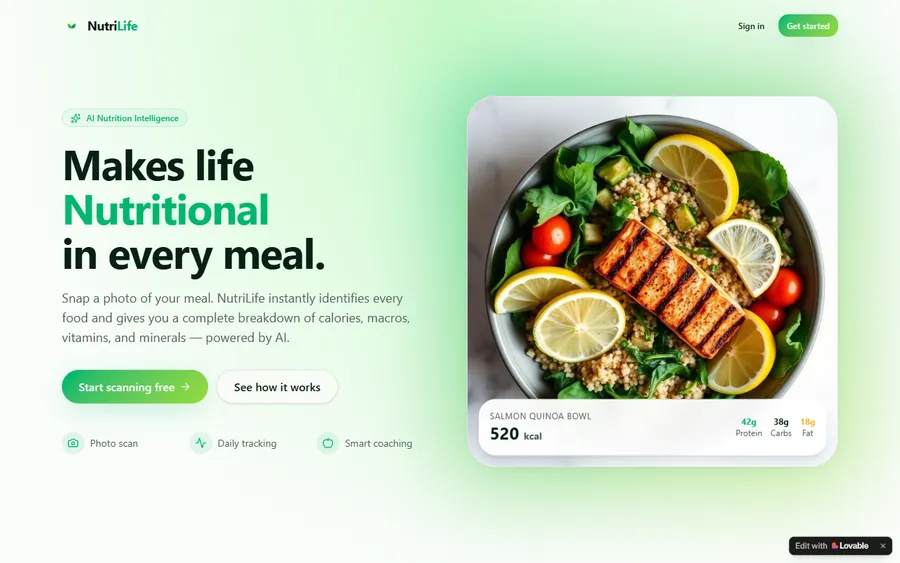
AI and ML
An AI nutrition coach that reads what you eat and works you toward a target.
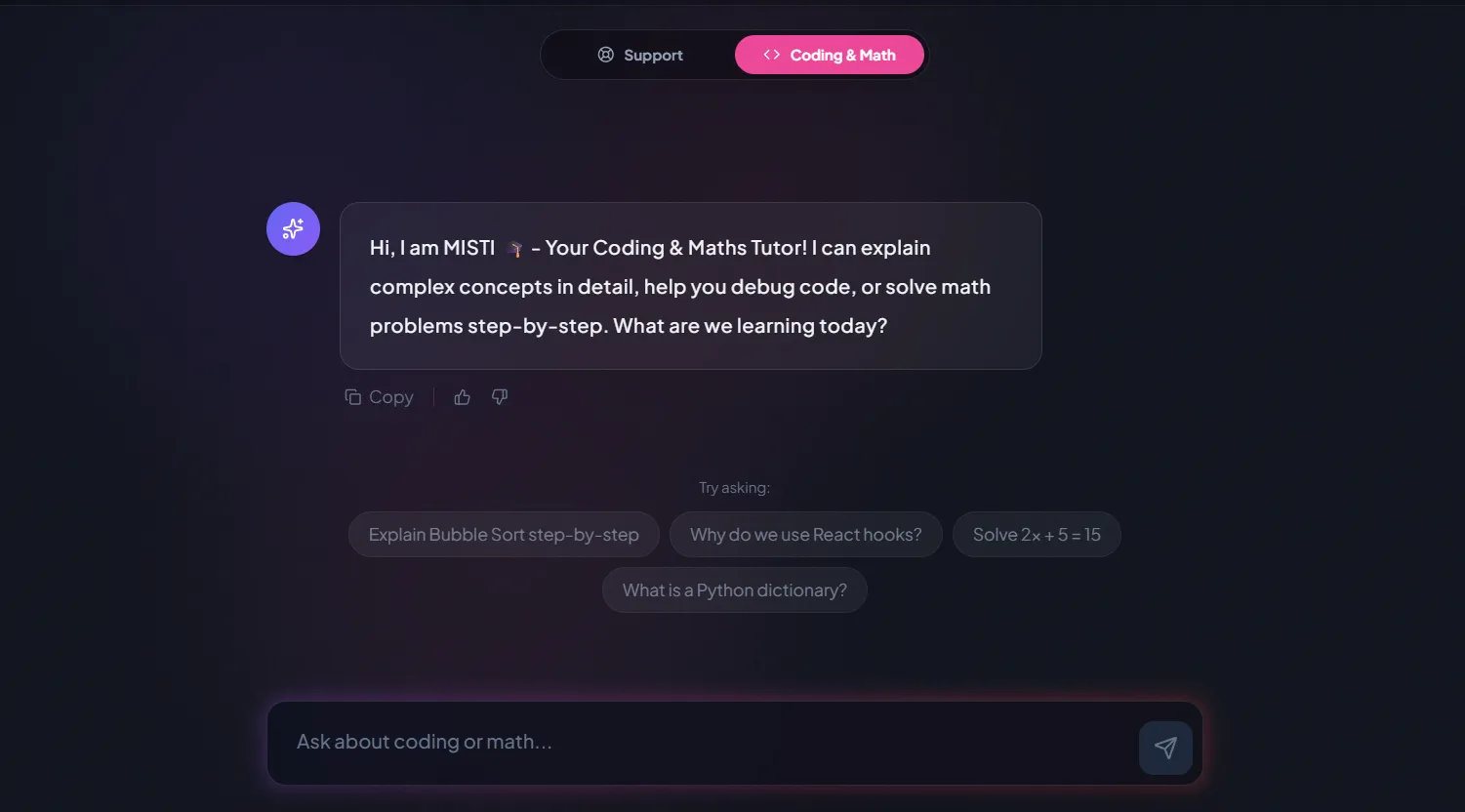
AI and ML
A chatbot that answers mathematics and programming questions, built and deployed by a student.

AI and ML
An assistant that helps a young person recognise unsafe situations online.
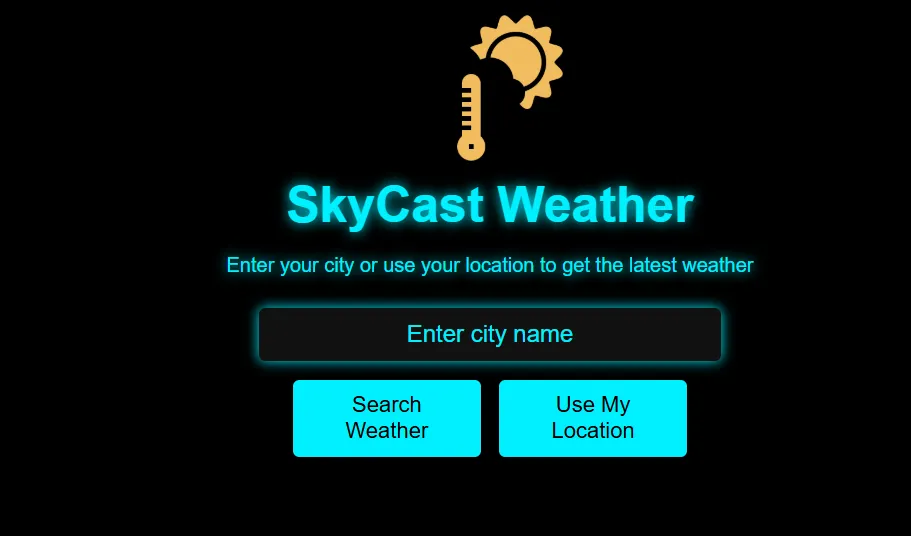
Web app
A weather forecasting site with live conditions for any location.
Fees
One monthly US dollar fee for families outside India. No joining fee; you may stop at any time.
Group batch
USD 100
a month, billed in US dollars
One to one
USD 150
a month, billed in US dollars
What families say
Families' Google reviews, word for word.
★★★★★
"The one step solution for my son. Modern Age Coders make learning coding so simple that kids love it. The teachers explain complex concepts clearly with practical exercises and interactive content."
Ria Mukherjee
Parent
★★★★★
"Modern Age Coders has been a game-changer for me. I struggled to grasp IT concepts and coding before joining, but their classes transformed everything. I can now confidently write complex programs with ease."
Samriddha Mondal
Student
★★★★★
"One of the most wonderful education centres out there. Education is not limited to school syllabus but focuses on skill development."
Vansh Agarwal
Student
★★★★★
"My child Dhairya is really enjoying the Modern Age Coders classes. This is his first online class and he eagerly looks forward to it. I can already see his improvement, and the teachers are very cooperative."
Sonam Oswal
Parent of Dhairya
★★★★★
"Modern Age Coders have wonderful teachers who teach in a clear, easy and practical way. The teacher boosts students' confidence and inspires them to learn without hesitation."
Sonu Goyal
Parent
★★★★★
"I highly recommend this computer coding class! The teachers are incredibly knowledgeable and passionate about coding."
Ritu Kedia
Parent
Halifax test questions
Crossley Heath's policy lists Paper 1 and Paper 2, each a test in mathematics and English, and Paper 3 in creative writing. The schools say there are multiple-choice and written-response questions.
No. Maths is mixed with English in Papers 1 and 2. North Halifax Grammar School describes the tests as four elements across two tests.
The schools say all papers except creative writing are marked by computer and age-standardised, and only students with an eligible score from the English and maths papers have their creative writing assessed.
Crossley Heath's policy says children are not tested beyond the Year 5 curriculum or on non-verbal reasoning. FSCE says maths is tested through written and mental calculation, with no calculators.
Crossley Heath's FAQ says there is no pass mark; a qualifying standard is agreed and candidates are ranked.
Nothing for 2028 entry was online at our 26 September 2026 check. Crossley Heath's FAQ describes the usual pattern: registration from about the end of March in Year 5 until late June, then the test early in Year 6.
No. FSCE says a tutor is not needed and that it does not endorse commercial practice papers. We teach Year 5 maths and make no claim to know the test.
No. Our lessons are maths lessons; the English sections, the creative writing paper and the admissions process are outside what we do.
North Halifax Grammar School and The Crossley Heath School, jointly.
A trial lesson is on us. Families who stay pay monthly: USD 100 for a class of five to ten, USD 150 for lessons with a teacher to themselves.
Related
Coding in Leeds, another FSCE area, and our national page.
Programming for West Yorkshire children.
Another area moving to the FSCE test.
Over the Pennines, a GL consortium test.
The national overview.
Maths challenges through the year.
Every UK area we write about.
Start here
Tell us the school year and how calculation is going. We teach a proper lesson and then say plainly what we saw.
Browsing first? See each course syllabus, read how we teach, or follow the roadmap.
WhatsApp us · +91 91233 66161 · contact@modernagecoders.com
Messages on WhatsApp get answered soonest. Everything runs from India, the phone number included; there is no West Yorkshire office.