ENM / 1.0
11 plus maths preparation
Key Stage 2 maths for a multiple-choice paper.
Open the syllabusEnfield · The Latymer School 11 plus maths · Live online, small groups or one to one
If your child is in Year 5 this year and you are thinking about The Latymer School, the test they will sit is not the one Enfield children sat earlier this month. Latymer has announced that from September 2027, for 2028 entry, its assessment will be provided by Quest Assessments and will have three sections: Mathematics, English Comprehension and English Writing. Verbal reasoning, half of last cycle's first paper, is gone. Quest describes the new mathematics as Paper One, multiple choice, sat in the same session as the English. Advice written for the old test, including much of what circulates among parents, is about to go out of date. This page sets out both the old arrangement and the new one, as the school and Quest publish them, and then teaches a slice of the Year 5 maths that sits underneath either: fractions.
Maths only · We do not teach English for the assessment · No connection with Latymer or Quest
In short
The Latymer School in Edmonton is Enfield's selective grammar school, and it sets its own test. For September 2027 entry, sat on 3 to 5 September 2026, the maths was a 30-minute multiple-choice booklet by GL Assessment, paired with 30 minutes of verbal reasoning, then a 60-minute English paper set by the school; the English was marked only for the top 700 on maths and verbal reasoning combined. For September 2028 entry the school has switched to Quest Assessments, and the assessment has three sections: Mathematics, English Comprehension and English Writing. Quest lists mathematics as Paper One, multiple choice, with registration from March to June 2027 and the test in September 2027. The school expects Key Stage 2 competence. We teach that maths, live online. Book a first lesson at no charge; a group place after that is USD 100 a month, and one to one lessons USD 150 a month.
Where to begin for Latymer
With verbal reasoning gone, maths stands on its own. Choose by what is shakiest now.
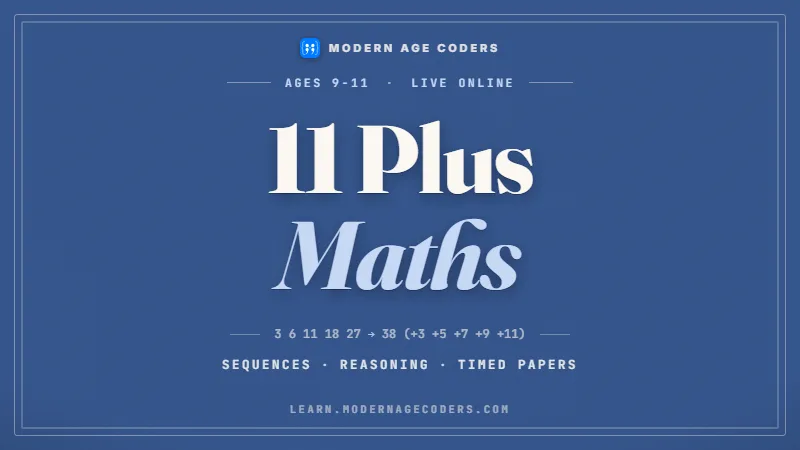
ENFIELD / 1
The Key Stage 2 content the school expects, fractions and all, practised as multiple choice.
Open the syllabus →
ENFIELD / 2
For a Year 4 child whose tables, place value or fractions are not yet reliable.
Open the syllabus →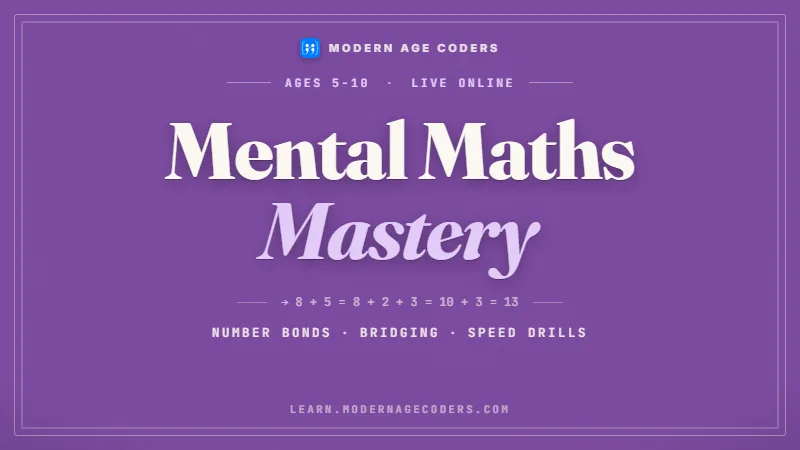
ENFIELD / 3
Recall and mental methods for a timed paper with no calculator.
Open the syllabus →What changes for 2028 entry
The Latymer School announced the change on its admissions pages; Quest Assessments publishes the paper structure. Both read on 26 September 2026.
| September 2027 entry (sat September 2026) | September 2028 entry (to be sat September 2027) | |
|---|---|---|
| Provider | GL Assessment for maths and verbal reasoning; English set by the school | Quest Assessments |
| Sections | Mathematics, verbal reasoning, English | Mathematics, English Comprehension, English Writing |
| Maths format | 30-minute multiple-choice booklet | Paper One, multiple choice |
| Registration | 17 March to 2 June 2026 | March to June 2027, according to Quest |
| Test | 3, 4 or 5 September 2026 | September 2027 |
The school's wording is short: "From September 2027 (for 2028 entry), our 11+ assessments will be provided by Quest Assessments." The assessment "will consist of three sections: Mathematics, English Comprehension and English Writing".
Quest's own page for the Latymer assessment describes "two non-adaptive written assessments, both sat in a single session", with Paper One mathematics and Paper Two English and writing. "The English and mathematics papers use multiple-choice questions, while the writing paper is entirely written."
The practical consequences follow from the table. Verbal reasoning is not listed, so time spent on it is time a Year 5 child will not need. Maths is a whole paper of its own, the first one of the session, rather than half of a combined booklet. And whatever parents have heard about a 30-minute maths section describes last cycle, not the next one.
Quest has not published the length of the new maths paper or how the sections will be weighted, and the school has not yet published its 2028 admission procedures in detail. We do not guess at either.
Sources: The Latymer School, 2028 admissions and 2027 admissions, with the admission procedures for September 2027 and the test guidance notes for September 2026; Quest Assessments, The Latymer School 11+ Assessment. Modern Age Coders has no connection with the school, Quest Assessments or Enfield Council.
The cycle just finished
Families with older children, or those reading older advice, will know the previous arrangement. Here it is, as the school published it, so the difference is clear.
For 2027 entry, the school's admission procedures describe "a Mathematics questions booklet and a Verbal Reasoning questions booklet; both will be multiple-choice format set by GL Assessment. It will be 60 minutes in duration (30 minutes Mathematics & 30 minutes Verbal Reasoning)". The English paper, 60 minutes of reading and creative writing, was set by the school.
The test guidance notes added practical details: a clock visible in the room, no calculators, no rulers, and "Rough paper will be provided for workings out", which is more generous than several other areas' tests.
Maths and verbal reasoning were scored first, by machine, combined and ranked. The procedures say that "In normal terms the top 700 applicants will be deemed selective", and that the English paper is marked for those applicants, with a wider threshold for looked-after children.
In that system, 30 minutes of maths decided, with verbal reasoning, whether a child's English was even read. Under the new structure the sections change, and the school will publish how they are combined. What does not change is that the maths has to be secure.
The admission procedures also limit entry to applicants living in the school's published Inner Area postcodes. That is admissions, and we leave it to the school's documents, but it is worth checking before any preparation begins.
A slice of Paper One
The school expects "competence in skills appropriate to Key Stage 2 English and Mathematics". Fractions are where that competence is most often thinner than it looks.
| Year 5 skill | Our question | Answer and the idea |
|---|---|---|
| Compare and order fractions whose denominators are multiples of the same number | Which is larger, 3/4 or 7/12? | 3/4, because 3/4 = 9/12 |
| Mixed numbers and improper fractions | Write 17/4 as a mixed number. | 4 1/4: four wholes and a quarter |
| Add fractions, including answers above 1 | What is 2/5 + 4/5? | 6/5 = 1 1/5, the curriculum's own example |
| Multiply fractions and mixed numbers by whole numbers | What is 4 × 1 3/4? | 7: four lots of 1 and four lots of 3/4 |
| Decimals as fractions | Write 0.71 as a fraction. | 71/100, again the curriculum's example |
| Order a set | Put 1/2, 3/8, 3/4 and 5/8 in order, smallest first. | 3/8, 1/2, 5/8, 3/4, all in eighths |
Every row uses one idea: rewrite fractions so they share a denominator, then compare, add or order the numerators. The Year 5 curriculum phrases it carefully, asking children to compare and order fractions "whose denominators are all multiples of the same number", which is exactly the condition that makes the rewriting easy.
On a multiple-choice paper, the wrong options are usually the answers produced by the classic errors: adding the denominators (2/5 + 4/5 = 6/10), or comparing by the size of the numbers alone (7/12 looks bigger than 3/4 because 7 and 12 are bigger). A child who knows why those are wrong discards them at once.
The multiplication row is the one Year 5 children find newest. 4 × 1 3/4 can be done as 4 lots of 1 plus 4 lots of 3/4, which is 4 + 3 = 7. We teach it with a picture first, as the curriculum suggests, "supported by materials and diagrams", before any rule.
Fractions also sit inside word problems about measures and money, where a child may not notice them. A question about three quarters of a 2 metre ribbon is a fractions question in disguise, and we practise finding the fraction hidden in the words.
Source: national curriculum in England, mathematics, Year 5 fractions (including decimals and percentages), statutory requirements and examples. The practice questions are ours.
Preparing for a new test
A change of provider unsettles families. For maths, it changes much less than it seems.
The school expects Key Stage 2 competence under either provider. The maths a child needs in September 2027 is the maths of Year 5 and before, whoever prints the paper.
Quest has said the maths is multiple choice, on an answer sheet, as Paper One. It also offers familiarisation booklets with sample questions and an answer sheet. Use them when they are available.
Practice built around a 30-minute maths-and-verbal booklet trains the wrong rhythm. We practise maths as a paper in its own right, not as half of one.
Quest's advice to families is sensible and we repeat it: a strong grounding in what the child is already learning at school, wide reading, and short, regular learning rather than long sessions. For maths, that means steady weekly work through Year 5, not a crash course in the summer.
We do not reproduce Quest familiarisation material, GL papers or Latymer's specimen English papers. Our questions are our own, written to the Year 5 curriculum and the published format.
The English sections, comprehension and writing, now make up two of the three. We do not teach English for the assessment, and families should plan for that separately.
Enfield has only one selective school. The council's guide notes that Enfield Grammar School, despite the name, describes itself as "a truly comprehensive school", so it does not use this or any selection test.
Enfield and beyond
Latymer sits in Edmonton, and its published Inner Area reaches well beyond Enfield's borough boundary. Our teaching reaches anywhere.
Because the Inner Area covers postcodes across north and east London as well as parts of Hertfordshire, families preparing for Latymer are not all in Enfield. The assessment is the same for all of them.
For coding and computing in the borough, see our Enfield coding page.
Lessons are live on video and grouped by level, so a child in Edmonton or Enfield Town is taught with children at the same stage of Year 5 maths from wherever they live.
We have no connection with The Latymer School, Quest Assessments or Enfield Council, and we do not advise on registration, the Inner Area or places.
Towards September 2027
Quest lists registration in March to June 2027 and the test in September 2027, early in Year 6 for today's Year 5.
| When | Stage | How you can tell |
|---|---|---|
| Autumn, Year 5 | 1. Number facts | Tables and place value are instant and reliable |
| Winter, Year 5 | 2. Fractions and decimals | Compares, converts, adds and multiplies fractions without guessing |
| Spring and summer, Year 5 | 3. Whole curriculum | Every Year 5 topic secure, including measures and geometry |
| Summer holiday | 4. Paper One practice | Completes timed multiple-choice maths on an answer sheet, calmly |
Even a spring start leaves time, as long as fractions and number facts come before timed papers.
We will say honestly at the first lesson how much a few months can change.
Fractions become ratio, algebra and probability at secondary school. Some pupils go on to maths through coding to see those ideas at work.
Children who like harder problems find the national maths challenges on our competitions calendar.
Courses
By stage, each linked to its syllabus.
ENM / 1.0
Key Stage 2 maths for a multiple-choice paper.
Open the syllabusENM / 1.1
Fractions and place value from the ground up.
Open the syllabusENM / 1.2
Speed without a calculator.
Open the syllabusENM / 1.3
A concrete path to quick calculation.
Open the syllabusENM / 2.0
Fractions become ratio and algebra.
Open the syllabusENM / 2.1
For every major exam board.
Open the syllabusENM / 2.2
For children who want a real challenge.
Open the syllabusENM / 3.0
Fractions and decimals, computed and checked in Python.
Open the syllabusENM / 3.1
Step-by-step logic in a visual language.
Open the syllabusENM / 3.2
Typed code for confident primary pupils.
Open the syllabusENM / 4.0
Quick methods for secure calculators.
Open the syllabusENM / 4.1
The mathematics behind modern software.
Open the syllabusLesson hours
Teaching is live from India. Primary lessons run in the early evening or at weekend mornings by the UK clock, and we adjust on our side when British Summer Time starts and ends.
Early weekday evening
Fitted in soon after school.
Weekend morning
For busy weeks or tired children.
School holidays
A few short extra sessions.
So each child's habits and errors are known.
Brief and specific, including what is not working yet.
Matched by level, so nobody is lost or bored.
We copy nothing from Quest, GL or the school.
For fractions or any stubborn gap.
No English coaching; no advice on admissions.
Student work
Four projects built and published by students at our school, all resting on primary maths like fractions. More on the student labs page.
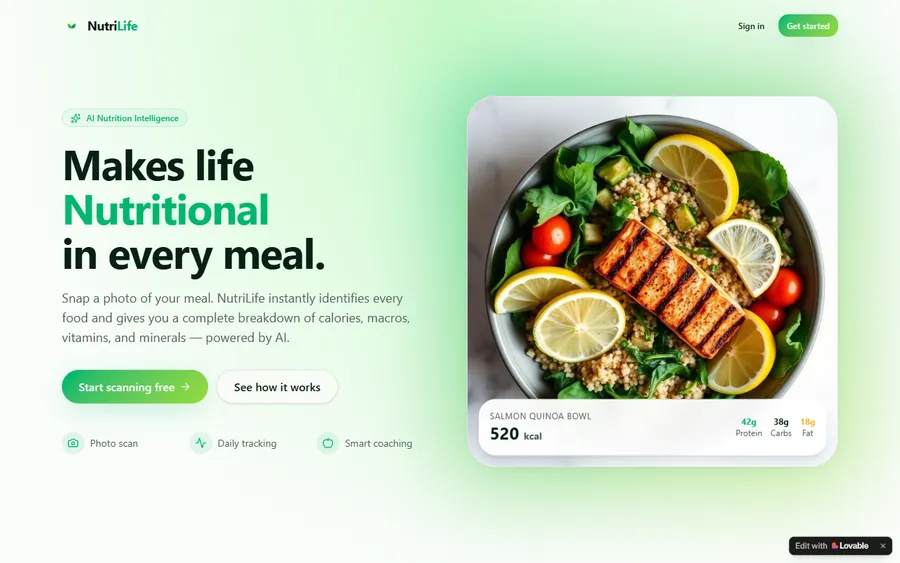
AI and ML
An AI nutrition coach that reads what you eat and works you toward a target.
AI and ML
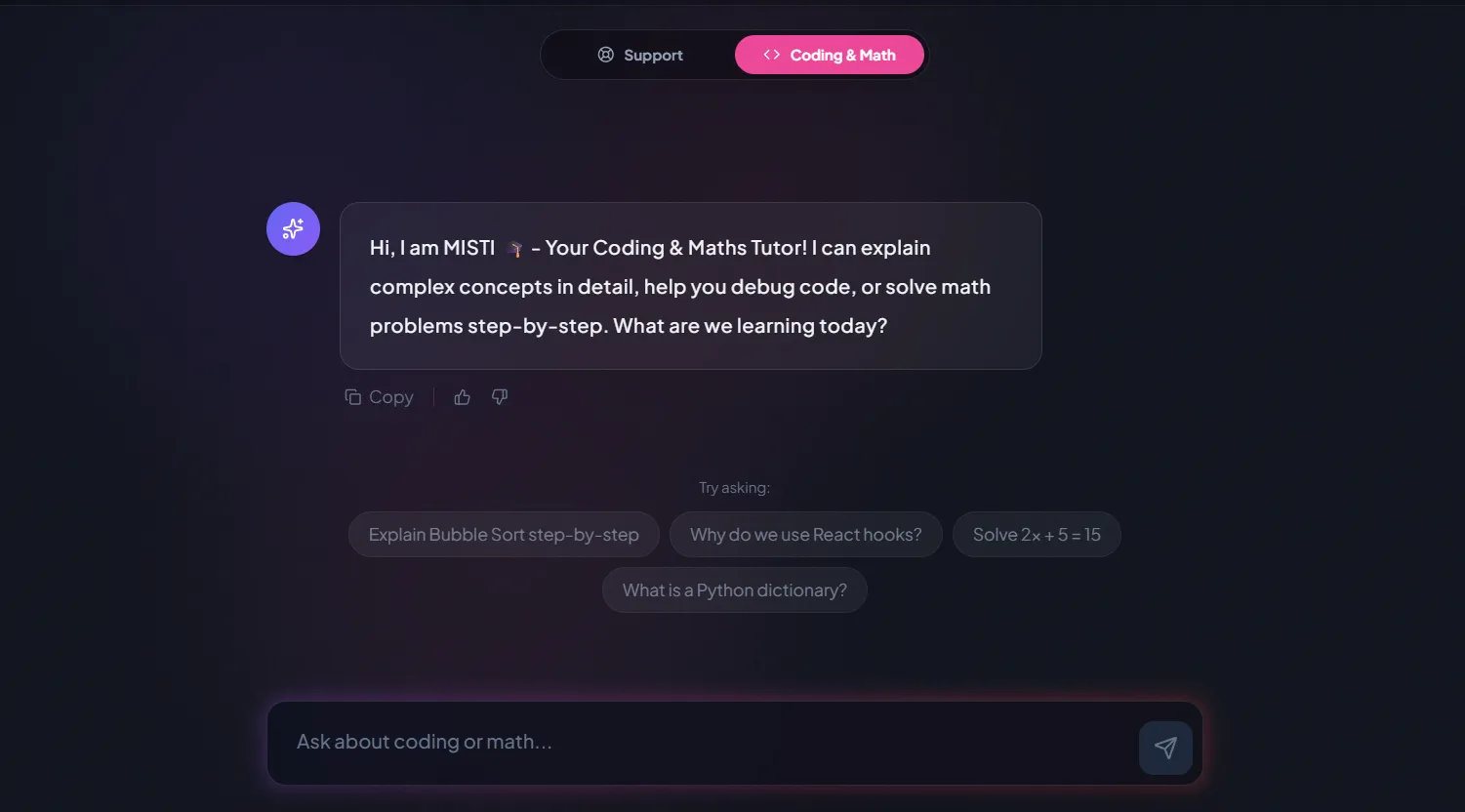
A chatbot that answers mathematics and programming questions, built and deployed by a student.

AI and ML
An assistant that helps a young person recognise unsafe situations online.
Web app
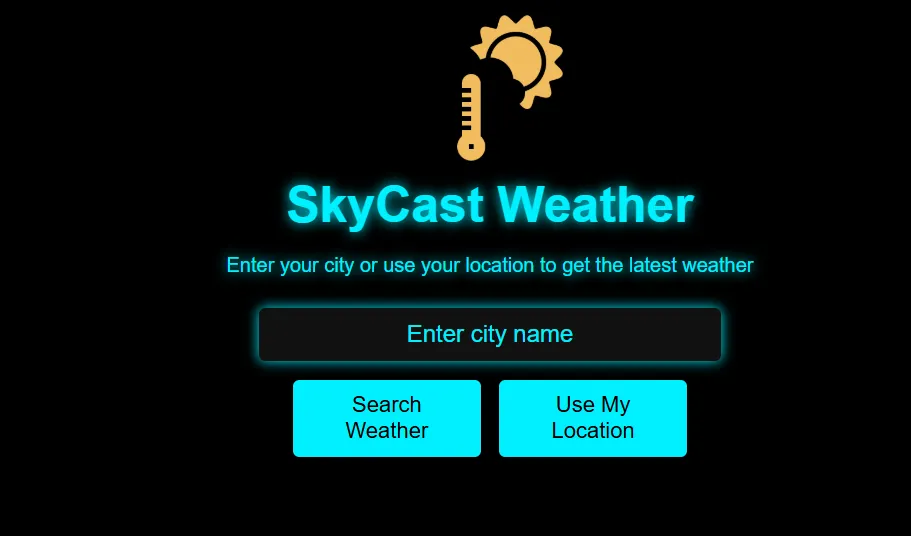
A weather forecasting site with live conditions for any location.
Fees
Charged each month in US dollars, the same for all families outside India. No enrolment fee and no fixed term.
Free first class
USD 0
no card required
Group batch
USD 100
a month, billed in US dollars
One to one
USD 150
a month, billed in US dollars
What families say
Parents in their own words, from our Google reviews.
★★★★★
"The one step solution for my son. Modern Age Coders make learning coding so simple that kids love it. The teachers explain complex concepts clearly with practical exercises and interactive content."
Ria Mukherjee
Parent
★★★★★
"Modern Age Coders has been a game-changer for me. I struggled to grasp IT concepts and coding before joining, but their classes transformed everything. I can now confidently write complex programs with ease."
Samriddha Mondal
Student
★★★★★
"One of the most wonderful education centres out there. Education is not limited to school syllabus but focuses on skill development."
Vansh Agarwal
Student
★★★★★
"My child Dhairya is really enjoying the Modern Age Coders classes. This is his first online class and he eagerly looks forward to it. I can already see his improvement, and the teachers are very cooperative."
Sonam Oswal
Parent of Dhairya
★★★★★
"Modern Age Coders have wonderful teachers who teach in a clear, easy and practical way. The teacher boosts students' confidence and inspires them to learn without hesitation."
Sonu Goyal
Parent
★★★★★
"I highly recommend this computer coding class! The teachers are incredibly knowledgeable and passionate about coding."
Ritu Kedia
Parent
Latymer questions
Yes. The school says that from September 2027, for 2028 entry, its assessments will be provided by Quest Assessments and will have three sections: Mathematics, English Comprehension and English Writing.
Verbal reasoning is not among the three sections the school lists for 2028 entry. For 2027 entry it was a 30-minute booklet alongside 30 minutes of maths.
Quest describes mathematics as Paper One of two papers sat in a single session, with multiple-choice questions. It has not published the length of the paper.
The school says applicants are expected to show competence in skills appropriate to Key Stage 2 English and Mathematics. For a test early in Year 6, that is the primary curriculum up to the end of Year 5.
Quest lists registration from March to June 2027 and the test in September 2027, with results in October 2027. The school will publish exact dates.
The school's 2026 test guidance said no calculators, and that rough paper would be provided. Check the guidance for 2027, which may differ under the new provider.
No. In Enfield Council's guide it describes itself as a truly comprehensive school despite the name. Latymer is the borough's selective school.
No. We teach mathematics only, and we do not advise on registration, the Inner Area or places.
No. We write our own questions and do not reproduce any provider's or the school's material.
You pay nothing for the first lesson. Regular lessons then cost USD 100 a month in a group or USD 150 a month one to one, and you can leave whenever you like.
Related
Coding in Enfield, our national 11 plus page, and neighbouring selective areas.
Programming lessons for the borough's children.
Our approach to 11 plus maths nationally.
Three schools next door, three tests.
Two schools whose maths answers go into digit columns.
Maths challenges, dated, for keen pupils.
Every UK area we cover.
Start here
Tell us your child's year and how fractions and number work are going. The lesson is a real one, and we will tell you plainly what we saw.
Reading first? See every course and syllabus, how we teach, and the roadmap through maths and coding.
WhatsApp us · +91 91233 66161 · contact@modernagecoders.com
WhatsApp reaches us fastest. We teach from India with an Indian phone number, and have no office in the UK.