WKM / i
11 plus maths, Warwickshire
Year 5 maths, taken deeper.
Open the syllabusWarwickshire · West Midlands Grammar Schools test maths · Live online, small groups or one to one
Warwickshire County Council describes its 11 plus in a sentence worth reading slowly: "Although it closely relates to the curriculum that children are taught in schools, the level of difficulty may go beyond the levels that children are expected to be achieving by the end of Key Stage 2." Two claims sit in that sentence, and they point in the same direction. The content is familiar. The difficulty is not. So the answer is not to race ahead into secondary topics but to go deeper into primary ones, especially the kind of question that needs several steps, each easy on its own, in the right order. This page sets out what the council publishes about the test shared by Warwickshire's six grammar schools, then teaches that kind of question: multi-step problems with rates and scaling, straight from the Year 5 curriculum.
Maths only · We do not teach English, verbal or non-verbal reasoning · No link with the council or schools
In short
Warwickshire County Council says the county has six selective grammar schools, in Stratford-upon-Avon, Alcester and Rugby, all allocating places by the 11+, which is free to sit. The test is shared with the grammar schools of Birmingham, Walsall, Wolverhampton and Shropshire: two multiple-choice tests of about 60 minutes each, covering English, verbal reasoning, non-verbal reasoning and mathematics. The council says it "closely relates to the curriculum" but that its difficulty "may go beyond the levels" expected by the end of Key Stage 2. Registration opens on 7 May each year for children in Year 5 and closes on 30 June; for 2027 entry the test was on 12 and 13 September 2026, with results on the Parent Portal on 16 October. We teach the maths deeply, live online. The first lesson is free; afterwards lessons cost USD 100 a month in a small group or USD 150 a month individually.
Starting points in Warwickshire
The test is harder, not broader. Choose by how your child handles a problem with three steps.
WARKS / 1
Year 5 content taken to the difficulty the council describes, through multi-step problems.
Open the syllabus →
WARKS / 2
For confident children who need problems with no obvious first step.
Open the syllabus →
WARKS / 3
Every step goes faster when the arithmetic inside it is automatic.
Open the syllabus →The Warwickshire test
The council coordinates the 11+ for its six grammar schools and publishes the schedule, format and schools. Read on 26 September 2026.
| Date | Step | Detail |
|---|---|---|
| 7 May 2026 | Registration opens | Through the council's Parent Portal, for children in Year 5. |
| 30 June 2026 | Registration closes | Also the deadline for access arrangements and evidence. |
| Week of 10 August 2026 | Invitations | Letters to the test sent out. |
| 12 and 13 September 2026 | Tests | Early in Year 6. |
| 16 October 2026 | Results | Available on the Parent Portal. |
The council says the test "is currently operated as a shared test between the Warwickshire, Birmingham, Walsall, Wolverhampton and Shropshire Grammar Schools", with the same papers used across all of them. Results can be shared across authorities if the relevant box is ticked on time.
It describes "four sections: English, Verbal Reasoning, Non-Verbal Reasoning and Mathematics", in "multiple-choice format". "Each of the two tests will take around 60 minutes to complete (including spoken instructions at the start and explanations of the practice items)." Raw marks are standardised and weighted into a total score.
Registration follows a standing rule: it "opens on 7 May each year for those children currently in Year 5. Candidates must register by the deadline of 30 June." For today's Year 5, that points to 7 May to 30 June 2027; the council will confirm the dates.
Places depend on each school's admission arrangements and on whether a score meets the minimum standard set for that year. That is for the council and schools to explain, and we do not.
Sources: Warwickshire County Council, the 11+ test, with its pages on grammar schools in Warwickshire, registering for the test and applying; the GL familiarisation guide hosted by the council. Modern Age Coders has no connection with the council, GL Assessment or any school.
Harder, not newer
The council's sentence is easy to misread as "includes secondary maths". Read with the familiarisation guide, it says something more useful.
The council says the test "closely relates to the curriculum that children are taught in schools". The familiarisation guide it hosts says "The Mathematics section will draw upon what you have been taught in class". Neither suggests algebra, ratio or other topics that arrive later.
So a family that responds by teaching Year 7 maths to a nine-year-old is solving the wrong problem. The content is primary. What changes is how the content is asked.
The same guide adds that "there may be some questions that are more challenging than what you are used to". In practice, harder questions on familiar content usually mean more steps, less signposting and numbers that do not come out neatly.
That is exactly what the Year 5 curriculum calls "multi-step problems in contexts, deciding which operations and methods to use and why". Deciding is the hard part. Each individual calculation is ordinary.
There is a practical reason depth matters for this test in particular. With four kinds of question in each paper and a spoken timetable guiding the sections, there is little time to puzzle over what a maths question wants. A child who has met many multi-step problems recognises the shape quickly and spends the time on the steps.
The lesson
The Year 5 curriculum asks children to solve problems "including scaling by simple fractions and problems involving simple rates". Here is how a single idea becomes a harder question.
| Level | Question | Steps and answer |
|---|---|---|
| One step | A box holds 35 crayons. How many crayons are in 6 boxes? | 6 × 35 = 210 |
| Two steps | A class has 500 crayons and gives away 6 boxes of 35. How many are left? | 210 given away, then 500 - 210 = 290 |
| Three steps | A pack of 8 batteries gives 240 hours of use in total. Another brand gives 35 hours per battery. How many more hours per battery does the other brand give? | 240 ÷ 8 = 30 hours; 35 - 30 = 5 more hours per battery |
| Scaling | A recipe for 12 biscuits uses 150 g of butter. How much for 30 biscuits? | 150 ÷ 12 = 12.5 g each; × 30 = 375 g. Or 150 × 2.5 = 375 g |
| Rate | A tap fills a 24-litre tank in 8 minutes. How long for a 60-litre tank? | 3 litres a minute; 60 ÷ 3 = 20 minutes |
Every step in that table is a calculation a Year 5 child can do. The difficulty the council describes lives in the choosing: which operation first, what to do with the answer, when to stop. The battery question in the third row is the same topic as the first, made harder only by needing a per-battery figure, a comparison and a subtraction.
On a multiple-choice paper, the wrong options for a question like that are usually the answers you get by stopping one step early: 30, or 240, or 35. A child who knows what the question asks for at the end does not fall for them.
We teach one habit for multi-step problems: write down what the question wants before calculating anything. "Extra hours per battery." Then work backwards: to find a difference per battery I need two per-battery figures; I have one; the other needs a division. The plan is three short lines, and the arithmetic follows.
Scaling problems reward flexibility. The biscuit recipe can be solved per biscuit or by noticing that 30 is two and a half times 12. Children who can see both routes check one against the other, which is a quiet advantage on a harder paper.
Source: national curriculum in England, mathematics, Year 5 addition and subtraction, and multiplication and division (statutory requirements). The questions are written by Modern Age Coders.
Warwickshire's six
The council names the six grammar schools. We reproduce the list only to show which test this page covers.
| School | Town | As described |
|---|---|---|
| King Edward VI School | Stratford-upon-Avon | Boys only |
| Stratford Girls' Grammar School | Stratford-upon-Avon | Girls only |
| Alcester Grammar School | Alcester | Boys and girls |
| Lawrence Sheriff School | Rugby | Boys only |
| Rugby High School | Rugby | Girls only; not to be confused with fee-paying Rugby School |
| Ashlawn School | Rugby | A bi-lateral school with one selective class |
Lessons are live on video, in groups of five to ten matched by level, so a child in Warwick, Leamington Spa, Nuneaton or Kenilworth learns the same way as one in Stratford or Rugby.
For coding in the county, see our UK coding page, which lists every area we cover.
The council notes that the schools are free to attend and that there is no cost to sit the test.
We have no connection with the council, GL Assessment or any of these schools, and we do not advise on applications or places.
Source: Warwickshire County Council, grammar schools in Warwickshire, read 26 September 2026.
Towards September 2027
For today's Year 5, registration should open in May 2027 and the test fall early in Year 6.
| When | Stage | Signs of progress |
|---|---|---|
| Autumn, Year 5 | 1. Secure facts | Tables, money and place value handled without hesitation |
| Winter, Year 5 | 2. Two-step problems | Chooses the right two operations and checks the answer makes sense |
| Spring, Year 5 | 3. Three steps and more | Plans a solution in writing before calculating |
| Summer holiday | 4. Timed sections | Multi-step questions answered within a section's time |
Even a spring start helps if facts come first. Multi-step work collapses when the single steps are slow.
We will tell you honestly at the first lesson how far the time can go.
Multi-step reasoning is the core of secondary maths and science. Some pupils carry on with maths through coding, where every program is a multi-step problem.
Others enjoy the problem-solving challenges on our competitions calendar.
Courses
By stage, each linked to a full syllabus.
WKM / i
Year 5 maths, taken deeper.
Open the syllabusWKM / ii
Multi-step, non-routine problems.
Open the syllabusWKM / iii
Fast steps inside long problems.
Open the syllabusWKM / iv
Years 1 to 5, made secure.
Open the syllabusWKM / v
Ratio, algebra and problem solving.
Open the syllabusWKM / vi
Every board, both tiers.
Open the syllabusWKM / vii
A visual start to number.
Open the syllabusWKM / viii
Break a problem into steps a computer follows.
Open the syllabusWKM / ix
Sequencing and logic in blocks.
Open the syllabusWKM / x
The step to typed programs.
Open the syllabusWKM / xi
Speed, once understanding is firm.
Open the syllabusWKM / xii
Multi-step thinking, automated.
Open the syllabusWhen lessons run
Teaching is live from India. Primary pupils have lessons after school or on weekend mornings, set in UK time; the twice-yearly clock change is handled at our end.
After school, weekdays
Early, before tiredness.
Weekend mornings
For busy weekday diaries.
Holidays
Short extra sessions.
Continuity, so habits are noticed.
Short updates after lessons.
Grouped by level.
No GL or council material copied.
For targeted help.
No reasoning or English coaching; no admissions advice.
Student work
Four projects published by students at our school, each built step by step from primary maths. More on the student labs page.
AI and ML
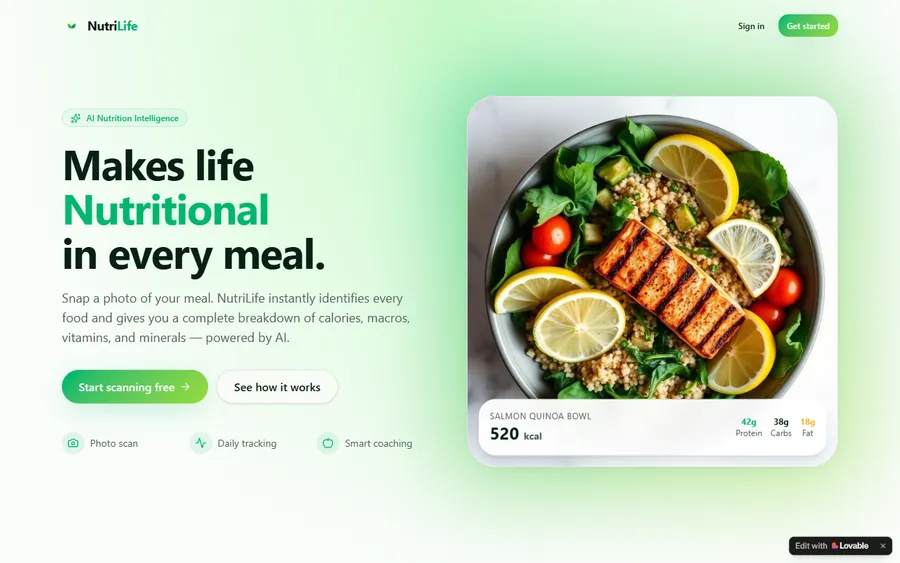
An AI nutrition coach that reads what you eat and works you toward a target.
AI and ML
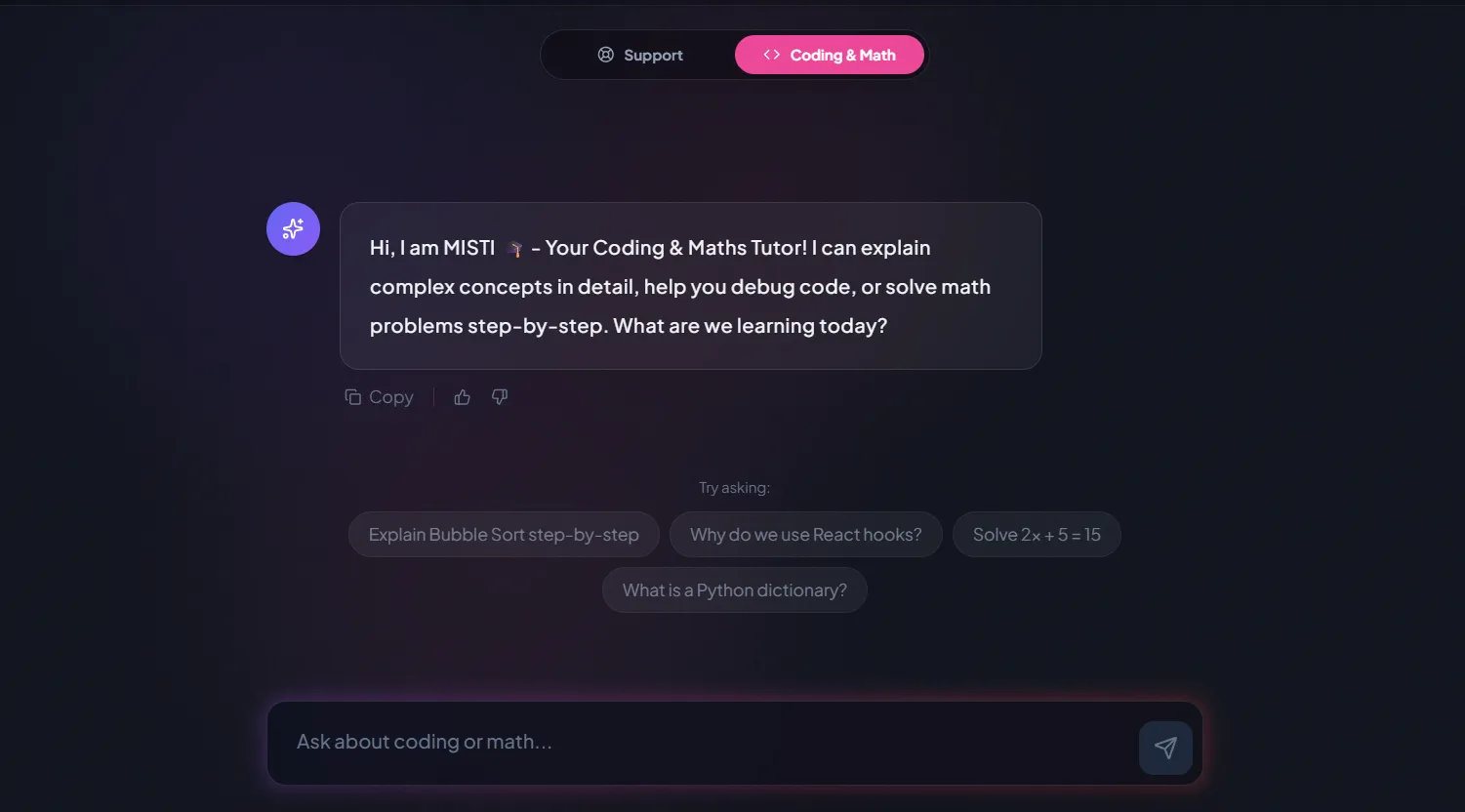
A chatbot that answers mathematics and programming questions, built and deployed by a student.

AI and ML
An assistant that helps a young person recognise unsafe situations online.
Web app
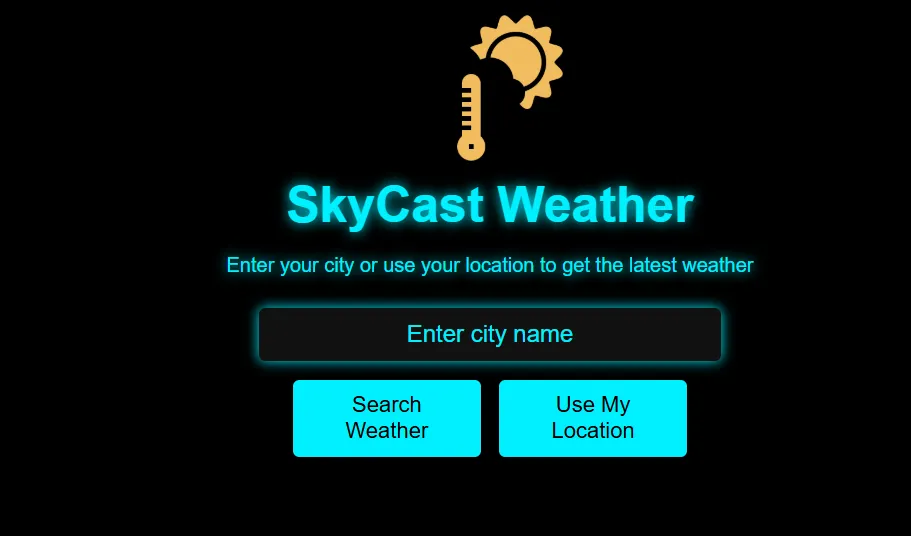
A weather forecasting site with live conditions for any location.
Fees
Monthly, in US dollars, at one rate for all families outside India. No registration fee; leave any month.
Group batch
USD 100
a month, billed in US dollars
One to one
USD 150
a month, billed in US dollars
What families say
Parents' words from Google, unchanged.
★★★★★
"The one step solution for my son. Modern Age Coders make learning coding so simple that kids love it. The teachers explain complex concepts clearly with practical exercises and interactive content."
Ria Mukherjee
Parent
★★★★★
"Modern Age Coders has been a game-changer for me. I struggled to grasp IT concepts and coding before joining, but their classes transformed everything. I can now confidently write complex programs with ease."
Samriddha Mondal
Student
★★★★★
"One of the most wonderful education centres out there. Education is not limited to school syllabus but focuses on skill development."
Vansh Agarwal
Student
★★★★★
"My child Dhairya is really enjoying the Modern Age Coders classes. This is his first online class and he eagerly looks forward to it. I can already see his improvement, and the teachers are very cooperative."
Sonam Oswal
Parent of Dhairya
★★★★★
"Modern Age Coders have wonderful teachers who teach in a clear, easy and practical way. The teacher boosts students' confidence and inspires them to learn without hesitation."
Sonu Goyal
Parent
★★★★★
"I highly recommend this computer coding class! The teachers are incredibly knowledgeable and passionate about coding."
Ritu Kedia
Parent
Warwickshire questions
The council says the West Midlands Grammar Schools tests contain four sections, English, verbal reasoning, non-verbal reasoning and mathematics, in multiple-choice format, over two tests of about 60 minutes each.
Yes. The council says it is a shared test with the Birmingham, Walsall, Wolverhampton and Shropshire grammar schools, using the same papers.
The council says the test closely relates to the curriculum, but that its level of difficulty may go beyond what children are expected to reach by the end of Key Stage 2. That means harder questions on familiar content, not new topics.
The council says registration opens on 7 May each year for children in Year 5 and closes on 30 June. For 2027 entry, the test was on 12 and 13 September 2026.
King Edward VI School and Stratford Girls' Grammar School in Stratford-upon-Avon, Alcester Grammar School, and Lawrence Sheriff School, Rugby High School and Ashlawn School in Rugby.
No. The council notes that Rugby High School is a girls' grammar school and should not be confused with Rugby School, which is fee-paying.
No. The council says there is no cost for a child to sit the 11+ test.
No. We teach mathematics only, and we do not advise on applications or places.
No. The council and the familiarisation guide both point to the curriculum children are taught; the extra difficulty is in how questions are asked. Depth in Year 5 maths is the preparation.
The first lesson costs nothing. Continuing is USD 100 a month in a group or USD 150 a month one to one.
Related
The same test seen from Birmingham, our national page, and other nearby pages.
The same test, with its equipment rules explained.
The national overview.
Programming for West Midlands children.
A neighbouring county with a new July test.
Maths challenges by date.
Every UK area.
Start here
Tell us your child's year and how they cope with longer problems. We teach a real lesson and then tell you plainly what we saw.
Want to read first? See our courses, how we teach, and the roadmap.
WhatsApp us · +91 91233 66161 · contact@modernagecoders.com
WhatsApp gets the quickest reply. We are in India, with an Indian number and no UK office.