ALG / M / 01
Maths through coding
Grade 9 algebra tested in Python.
Open the syllabusAlberta · Grade 9 · Provincial Achievement Test, mathematics
Every Grade 9 student in Alberta meets the Mathematics Provincial Achievement Test, usually in June, sometimes in January. It comes in two parts: a short, no-calculator Part A that checks number fluency, and a longer Part B of problems in real-life settings. Alberta Education says plainly that it “discourages test rehearsal and coaching”, and we agree with the spirit of that: the way to do well is to know Grade 9 math. So this page explains the test from Alberta’s own bulletin, then gives practice that builds the math itself, written by us.
Teaching live online since 2020 · 10,000+ students · Grade 9 math, taught for understanding
In short
The Alberta Grade 9 math PAT has two parts: Part A, 20 questions on mental math, estimation, square roots, exponent laws and rational numbers with no calculator (30 minutes), and Part B, 40 questions across all four strands with a calculator (80 minutes). In 2027 it runs in January and June. Modern Age Coders teaches Grade 9 math live online, one to one or in a batch, through our Algebra Foundations course.
Learn it with a teacher
The first rebuilds the algebra and number work Grade 9 rests on. The second covers the wider middle school program. The third is for students who want harder problems.
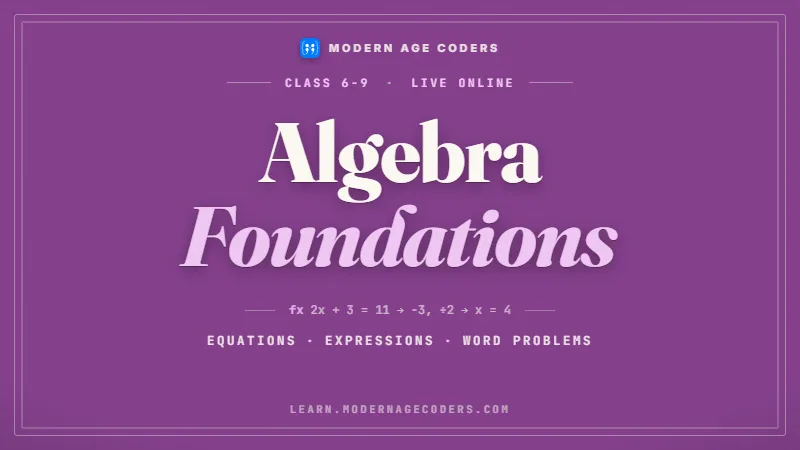
ALG / 01
Grades 7 to 9. Rational numbers, exponent laws, linear equations and polynomials, built step by step.
Open the syllabus →
ALG / 02
Number, geometry, data and probability, the full spread of the junior high strands.
Open the syllabus →
ALG / 03
Grades 7 to 12. For Grade 9 students who find school math easy and want the Pascal contest.
Open the syllabus →The test, part by part
Alberta’s subject bulletin for 2026 to 2027 describes the test in detail. The two parts are written on separate days and they are deliberately different: one checks fluency, the other checks reasoning.
| Part A | Part B | |
|---|---|---|
| Questions | 20, numerical response, one mark each | 40: 32 multiple choice and 8 numerical response |
| Share of the test | 20% | 80% |
| What it checks | “foundational skills and fluency in mental math, estimation, algebra, square roots, exponent laws, and arithmetic operations on rational numbers” | “ability to recall concepts and principles and to apply reasoning skills to solve problems” |
| Calculator | Not permitted | Permitted, but not a graphing calculator |
| Time | Designed for 30 minutes, up to 60 | Designed for 80 minutes, up to 160 |
| Number strand | 70% to 80% of questions | 25% to 35% |
| Patterns and Relations | 20% to 30% | 35% to 45% |
| Shape and Space | None | 20% to 30% |
| Statistics and Probability | None | 5% to 10% |
| Complexity | Low 80% to 90%, moderate 10% to 20% | Low 30% to 40%, moderate 45% to 55%, high 10% to 20% |
Part A is short and has no calculator, and most of its questions are low complexity: Alberta describes low-complexity items as asking students to “rely heavily on recalling and recognizing previously learned concepts and principles.” Speed and accuracy with numbers decide it.
Manipulatives such as a ruler or graph paper are allowed, and a 10 by 10 multiplication table may be used as a regular accommodation for students who use one in class, with its use recorded on the platform. It is not meant for everyone, and the bulletin says so.
Part B allows a scientific calculator, but its blueprint puts low-complexity questions at only 30% to 40%; the rest are moderate or high. The bulletin’s examples of moderate items include “Solve a word problem requiring multiple steps.”; high-complexity items may ask a student to “Solve a problem in more than one way.”
It also warns that “many of the questions on the mathematics test are placed in real-life contexts.” So reading matters as much as arithmetic: a student has to turn a paragraph into a calculation. A protractor is not permitted, and for π students may use the calculator button or 3.14.
| Acceptable standard: students are typically able to | Standard of excellence: students are typically able to |
|---|---|
| “use familiar problem-solving strategies to solve routine problems” | “use a variety of problem-solving strategies to solve novel problems” |
| “recognize and describe numerical and non-numerical patterns” | “demonstrate fluency in working with patterns represented concretely, pictorially, or symbolically” |
| “use semantic knowledge to construct correct mental representations of word problems” | “use semantic knowledge to construct and reframe correct mental representations of word problems” |
| “test generalizations from patterns to reach conclusions” | “make generalizations from patterns to reach conclusions” |
Source: Alberta Education and Childcare, 2026-2027 Mathematics 9 Subject Bulletin, read 22 October 2026. The bulletin also reminds teachers that “one test cannot measure all the components within the learning outcomes in the mathematics curriculum.” Modern Age Coders has no connection with Alberta Education and Childcare.
When, and who writes it
Alberta says PATs “are administered annually to all Alberta students in grades 6 and 9”, and that Grade 9 tests are written in January and in June. The 2026 to 2027 General Information Bulletin sets the mathematics sittings below.
| Sitting | Part A | Part B |
|---|---|---|
| January 2027 | Friday 22 January 2027, 9 AM to 9:30 AM | Monday 25 January 2027, 9 AM to 10:20 AM |
| June 2027 | Tuesday 15 June 2027, 9 AM to 9:30 AM | Thursday 17 June 2027, 9 AM to 10:20 AM |
Alberta is renewing its Grade 7 to 9 math curriculum, and schools may pilot the draft this year. The subject bulletin is direct about what that means for the PAT: “For the 2026/27 school year, classes in schools choosing to pilot the new curriculum for Mathematics 9 will not be required to write the Grade 9 Mathematics Provincial Achievement Test.”
Classes that are not piloting “will be required to write the provincial achievement test in June 2027.” So the first question for a Grade 9 family this year is a simple one for the school: is my child’s math class piloting the new curriculum?
Alberta’s diploma page records that the government “cancelled the January 2026 diploma examinations and Grade 9 Provincial Achievement Tests (PATs).” The 2026 to 2027 schedule above includes a January sitting again.
The tests are now digital. Alberta’s PAT page says students write provincial assessments “in a digital environment rather than pencil and paper”, and its practice tests, with text-to-speech and a zoom feature, sit on the same digital assessment platform.
| Step | What Alberta says |
|---|---|
| Raw scores | Teachers report Part A and Part B scores separately; they “are not to be combined into a total test score” |
| Preliminary results | Teachers are expected to report preliminary results to parents in June |
| Individual Student Profile | Released in late September 2027, through the school and on myPass |
| School comparisons | Alberta “does not support comparisons of schools or school authorities based on provincial achievement test scores” |
Sources: Alberta Education and Childcare, General Information Bulletin 2026-2027 for Provincial Achievement Testing (schedules, significant dates); 2026-2027 Mathematics 9 Subject Bulletin; 2026-2027 Grade 9 Parent Guide; Provincial Achievement Tests and Diploma exams overview pages. Read 22 October 2026.
Practice without rehearsal
The Grade 9 Parent Guide says: “Alberta Education and Childcare discourages test rehearsal and coaching. Provincial achievement tests are like any other test students would normally write.” A page offering PAT practice should take that seriously.
We do not drill secured test items, imitate released questions or teach tricks for multiple choice. None of the practice on this page is taken from an Alberta test; it is written by us to the same strands.
We also do not promise a result. The PAT gives a picture of one day’s work, and Alberta itself says PATs “don’t replace daily teacher assessments but provide insights to complement ongoing classroom observations and evaluations.”
We teach Grade 9 math: the number fluency Part A checks and the problem solving Part B rewards. A student who can multiply fractions in their head and turn a paragraph into an equation needs no rehearsal.
For familiarity with the screen, Alberta publishes its own practice tests on the digital assessment platform, and we point families to them. Ten minutes on the official format before test week is sensible; weeks of it are not.
Worked problems, ours
Both problems are our own, written for this page; they are not Alberta Education questions. The first is the kind of fluency Part A asks for, done without a calculator. The second is a multi-step problem in a real-life setting, like much of Part B.
Problem 1, no calculator. Evaluate (−3/4) + (5/6) × (−2/5).
Problem 2, calculator allowed. A candle 24 cm tall burns down 1.5 cm every hour. Write an equation for its height h after t hours, then find when it will be shorter than 9 cm.
Notice the habits in both: simplify early, check the sign, estimate, and finish with a sentence that answers the question asked. Those habits are what Alberta’s standard of excellence describes when it mentions students who “check and verify solutions to novel problems”.
Part A style practice, ours
Our own questions, not Alberta Education questions, on the skills the bulletin lists for Part A. Set a timer for 15 minutes, put the calculator away, and write each answer as a number.
Part B style practice, ours
Also ours, and not Alberta Education questions. These mix patterns and relations, polynomials, measurement and probability, the strands Part B draws on. Allow about 25 minutes.
If questions 4 to 6 felt slow, polynomials are worth a focused week. If question 7 stalled, the problem was probably the reading, not the ratio: practise drawing a quick sketch before any calculation.
Six weeks of review, ours
Our plan for the weeks before the June sitting (Part A on Tuesday 15 June 2027). It is review of Grade 9 math, not test rehearsal, and about two short sessions a week on top of school is enough.
| Week starting | Focus | A good sign |
|---|---|---|
| Monday 3 May 2027 | Rational numbers: fractions and decimals with signs, no calculator | Ten mixed operations correct in ten minutes |
| Monday 10 May 2027 | Exponent laws, square roots and estimation | Can explain why (−3)2 and −32 differ |
| Monday 17 May 2027 | Linear relations, patterns and graphs | Writes an equation from a table without guessing |
| Monday 24 May 2027 | Linear equations and inequalities, polynomials | Remembers to flip the sign when dividing by a negative |
| Monday 31 May 2027 | Measurement, similar shapes and probability in word problems | Sketches a diagram before calculating |
| Monday 7 June 2027 | Light mixed review; one look at Alberta’s practice test on the platform | Calm, rested, and nothing new learned |
Whatever the PAT shows, the number fluency in Part A is what Math 10C assumes from day one. A student who leaves Grade 9 comfortable with fractions, signs and exponent laws starts high school with a real advantage.
That is why we teach Part A skills without a calculator even in classes that are not about the PAT. The calculator is for checking, not for thinking.
If your class is piloting Alberta’s draft Grade 7 to 9 curriculum, you will not write this PAT in 2026 to 2027, and your course may include topics the current program does not, such as functions and simple quadratic equations named in Alberta’s draft snapshot for Grade 9.
The review above still helps: number fluency and linear relations sit underneath both versions. We plan from the class’s own unit list either way.
Where your child is now
Our own stages, from teaching Grade 9 students across Canada.
| Stage | Typical signs |
|---|---|
| 1. Calculator-led | Reaches for the calculator for 6 × 7 or half of a fraction |
| 2. Accurate but slow | Gets fraction and integer questions right, given time |
| 3. Fluent | Simplifies before multiplying, estimates first, and spots a sign slip |
| 4. Flexible | Solves a word problem two ways and explains which is quicker |
Ask your child to work out a fraction question aloud at the dinner table. Hesitation over signs or common denominators is the best clue to what to practise.
Keep the PAT in proportion. Alberta treats it as one picture among many, and so should a Grade 9 student.
Estimate before you calculate. If your answer is far from the estimate, one of them is wrong.
On word problems, underline what the question actually asks for before you start. Then answer that, in a sentence.
The catalogue
All live online with one regular teacher, in a group or individually.
ALG / M / 01
Grade 9 algebra tested in Python.
Open the syllabusALG / M / 02
A head start on Math 10C.
Open the syllabusALG / M / 03
For younger siblings building number sense.
Open the syllabusALG / C / 01
Contest problems a step beyond class.
Open the syllabusALG / C / 02
For students who love a hard problem.
Open the syllabusALG / C / 03
Waterloo’s programming contest.
Open the syllabusALG / K / 01
A first real programming language.
Open the syllabusALG / K / 02
Interactive pages and games.
Open the syllabusALG / K / 03
Patterns and data, put to work.
Open the syllabusHow classes run
Weekdays or weekends, flexible: choose your batch, or for a very personalised plan choose 1-on-1 at your convenience, weekend mornings or weekdays.
Weekdays
After school in Alberta, with the time set by the batch.
Weekends
Weekend mornings on Alberta time.
1-on-1
Booked around unit tests and the June sitting.
Number sense before buttons.
Taught in the class’s own order.
Read, sketch, then calculate.
Never copied from a test.
Steady weekly work, no cramming.
Fifteen to twenty, or one child.
Student work
Older students turn the same number sense into programs and data projects. More are on the student labs page.

AI and ML
An AI nutrition coach that reads what you eat and works you toward a target.

AI and ML
A chatbot that answers mathematics and programming questions, built and deployed by a student.

AI and ML
An assistant that helps a young person recognise unsafe situations online.

Web app
A weather forecasting site with live conditions for any location.
Fees
The first class is on us. After that, a monthly fee buys eight live classes, shown below in your currency, and you can end it at any month’s close without a penalty.
Free first class
Free
no card required
Group batch
$100 USD
a month, eight live classes
One to one
$150 USD
a month, eight live classes
What families say
Google reviews from parents and students, word for word.
★★★★★
"The one step solution for my son. Modern Age Coders make learning coding so simple that kids love it. The teachers explain complex concepts clearly with practical exercises and interactive content."
Ria Mukherjee
Parent
★★★★★
"Modern Age Coders has been a game-changer for me. I struggled to grasp IT concepts and coding before joining, but their classes transformed everything. I can now confidently write complex programs with ease."
Samriddha Mondal
Student
★★★★★
"One of the most wonderful education centres out there. Education is not limited to school syllabus but focuses on skill development."
Vansh Agarwal
Student
★★★★★
"My child Dhairya is really enjoying the Modern Age Coders classes. This is his first online class and he eagerly looks forward to it. I can already see his improvement, and the teachers are very cooperative."
Sonam Oswal
Parent of Dhairya
★★★★★
"Modern Age Coders have wonderful teachers who teach in a clear, easy and practical way. The teacher boosts students' confidence and inspires them to learn without hesitation."
Sonu Goyal
Parent
★★★★★
"I highly recommend this computer coding class! The teachers are incredibly knowledgeable and passionate about coding."
Ritu Kedia
Parent
Questions from Alberta parents
It is the Provincial Achievement Test in mathematics written by Alberta Grade 9 students. It has two parts: Part A, 20 questions on number fluency without a calculator, and Part B, 40 questions on problem solving with a calculator.
In January, Part A is on Friday 22 January 2027 and Part B on Monday 25 January 2027. In June, Part A is on Tuesday 15 June 2027 and Part B on Thursday 17 June 2027. Each starts at 9 AM.
Alberta says Part A assesses foundational skills and fluency in mental math, estimation, algebra, square roots, exponent laws and arithmetic operations on rational numbers, without a calculator. It has 20 numerical-response questions, designed for 30 minutes.
Not on Part A. On Part B a calculator is allowed, but not a graphing calculator, and a protractor is not permitted on the test. For pi, students may use the calculator button or 3.14.
Not quite. For 2026 to 2027, classes in schools piloting the new Grade 9 math curriculum are not required to write it. Classes not piloting will write it in June 2027. Ask the school which applies.
By learning Grade 9 math well. Alberta discourages test rehearsal and coaching and says the tests are like any other test. Steady practice with fractions, integers, exponent laws, linear relations and word problems helps far more than drilling test items.
Yes. Alberta now delivers provincial assessments on a digital platform, and its own practice tests are on the same platform.
Teachers are expected to share preliminary results with parents in June, reporting Part A and Part B raw scores separately. The Individual Student Profile follows in late September 2027.
Yes, live online for students anywhere in Alberta. Weekdays or weekends, flexible: choose your batch, or for a very personalised plan choose 1-on-1 at your convenience, weekend mornings or weekdays.
There is no charge for the first class. After it, a single monthly fee covers eight live classes and can be stopped between months. See the Fees panel on this page for the current amounts.
Elsewhere on this site
For Alberta families with a Grade 9 student.
All our Canadian pages in one place.
Coding and math for Alberta children and teens.
One-to-one help through the Grade 9 year.
Math support for every grade.
Waterloo’s contest for Grade 9 students.
Where Part A fluency begins.
Equations and polynomials, one to one.
What Alberta and the others teach.
Our approach to a live lesson.
Start here
Share the unit your child is on and one recent test. We will find the gaps in the first class and suggest a plan for the term.
Curious first? How we teach explains a lesson, and the Algebra Foundations syllabus shows the Grade 7 to 9 plan.
WhatsApp us · +91 91233 66161 · connect@modernagecoders.com
Lessons are live on video, with teachers working from India, so there is no commute for anyone. Families in Alberta usually reach us fastest on WhatsApp.
A priority demo is a full class of about 45 to 60 minutes. After the class the mentor sends a written skill report and a personal learning roadmap on WhatsApp. If you enrol, the demo fee is adjusted against your first month's fee. Share your demo Order ID with us on WhatsApp and we take it off.
Book a priority demo