KGM / 01
11 plus maths preparation
Year 5 maths for every answer format.
Open the syllabusKingston upon Thames · Tiffin entrance test maths · Live online, small groups or one to one
Kingston's two selective schools, Tiffin School for boys and The Tiffin Girls' School, each run their own two-stage entrance test, and both put a detail about maths answers into their published FAQs that changes how a child should practise. At Stage One, some maths questions are multiple choice but others ask for a number, which the child writes digit by digit into columns on an answer sheet. The Tiffin Girls' School explains that the columns "represent single digits, `tens', and `hundreds'", and that a time is given "as a digital clock". With no options to pick from, a slipped digit is simply wrong. Yet the grid carries a useful clue: the number of columns tells a child how many digits the answer should have. At Stage Two the options disappear altogether, and the girls' school says no marks are given for working. This page covers what both schools publish, and how we teach for it.
Maths only · We do not teach English for the tests · No connection with either Tiffin school
In short
Tiffin School and The Tiffin Girls' School are Kingston's selective schools, and each runs its own two-stage test. Stage One is an English paper and a maths paper, each under an hour, answered on a computer-marked OMR sheet; in maths, some questions are multiple choice and others need a numerical answer written into digit columns. Children with the highest Stage One scores are invited to Stage Two, where answers are handwritten. Both schools say the tests assume the National Curriculum up to Year 5, with some unfamiliar formats. For September 2027 entry, Stage One falls on 1 and 2 October 2026, and Stage Two on 7 November (girls) and 12 November (boys). Maths counts for half of Tiffin School's combined score and 40% at Tiffin Girls'. We teach the maths, live online, for both kinds of answer. There is a free first lesson; afterwards a group place is USD 100 a month and one to one teaching USD 150 a month.
Where to begin for Tiffin
Choose by accuracy, not speed: a column answer with one wrong digit scores nothing.
KINGSTON / A
Year 5 content practised with multiple-choice, digit-column and handwritten answers.
Open the syllabus →
KINGSTON / B
Checking an answer in the head before committing each digit to a column.
Open the syllabus →
KINGSTON / C
For children in Year 4 who still mix up tens and hundreds under pressure.
Open the syllabus →The two tests
Kingston's council admissions service returned an error to our reader, so everything here comes from the two schools' own pages and 2027 FAQs, read on 26 September 2026.
| Step | Tiffin School (boys) | The Tiffin Girls' School |
|---|---|---|
| Registration | Opened 5 June 2026, in the summer term of Year 5 | Closed 12.00 noon, Tuesday 1 September 2026 |
| Stage One | Friday 2 October 2026, morning or afternoon | Thursday 1 and Friday 2 October 2026 |
| Stage Two invitations | 16 October 2026 | On or around 14 October 2026 |
| Stage Two | 12 November 2026 | Saturday 7 November 2026 |
Tiffin School works "in partnership with Quest to set our Year 7 Entrance Tests". Stage One is English and maths, each about 40 to 60 minutes, answered on an OMR sheet "marked by a computer". For the maths paper, the FAQ says, answers "may be similar to those above (multiple choice), or they may be numerical". Stage Two papers are of similar length and "require hand written answers".
The Tiffin Girls' School describes the same pattern: Stage One is "an English paper and a maths paper", each lasting less than 60 minutes, with maths answers that are either multiple choice or "a numerical answer". Its Stage Two papers are set and marked by the school, with an answer sheet for maths.
Both schools say they do not publish past papers. Tiffin School publishes illustrative questions; Tiffin Girls' warns that its papers change each year, "often involving the number of questions, time limits, and question types". Both assume children have completed the National Curriculum for Year 5, and Tiffin Girls' adds that some questions will be "in unfamiliar formats".
We note one thing and leave it there: the published registration deadline for Tiffin School appears in more than one form across its page and FAQ, so we do not print one. Families should check the school's current key dates. Admissions, priority areas and ranking belong to the schools.
Sources: Tiffin School, Year 7 admissions and its FAQs for entry in September 2027; The Tiffin Girls' School, Year 7 admissions and its FAQs for September 2027. The council's admissions pages returned HTTP 403 and were not used. Modern Age Coders has no connection with either school, Quest or the council.
The lesson
The Tiffin Girls' School FAQ shows how numerical answers are marked: one column per digit, with examples of 7, 87 and 521, and a time written like a digital clock.
| Our question | Columns on the sheet | Answer to write |
|---|---|---|
| What is 1,000 - 637? | Three: hundreds, tens, ones | 3 6 3 |
| How many minutes are there in 3 hours 20 minutes? | Three | 2 0 0 |
| What is the largest whole number that rounds to 700 to the nearest 100? | Three | 7 4 9 |
| A film starts at 18:40 and lasts 1 hour 35 minutes. When does it end? | Four, as a digital clock | 2 0 1 5 (20:15) |
| What is the smallest prime number greater than 80? | Two | 8 3 |
The Tiffin Girls' School says that for numerical answers "the columns will represent single digits, `tens', and `hundreds'", so a one-digit answer has one column and a three-digit answer three. That turns the grid into a check. If a child's answer to a three-column question has four digits, something has gone wrong before any digit is written: a place value slip, a multiplication by ten too many, a forgotten step.
The check has limits, and we teach them honestly. It catches answers of the wrong size. It does not catch 463 written for 363. For that, a child still needs the other habits: estimate first (1,000 - 637 is a bit less than 400), then check the last digit (7 + 3 ends in 0).
Times are the second trap. The school's own example gives 5 minutes past 7 as 07:05, four columns with a leading zero. A child who writes 7:5, or 705 in three columns, has the right idea and the wrong answer. Converting between analogue and digital time, and between hours and minutes, is primary work; writing it in exactly the form asked is a separate skill we practise.
All the examples the school publishes are whole numbers or clock times. We therefore teach children to expect numerical questions whose answers are whole numbers, and to treat a decimal or a remainder in their working as a sign to reread the question.
Sources: The Tiffin Girls' School FAQs for September 2027 (the OMR column description and its examples); Tiffin School FAQs (maths answers "may be numerical"). The questions in the table are written by Modern Age Coders.
The second stage
Children with the highest Stage One scores are invited back in November. The maths changes character again.
Tiffin School says Stage Two papers are similar in length to Stage One and "require hand written answers". The Tiffin Girls' School says its Stage Two maths has an answer sheet, and states: "No marks are given for calculations or workings out."
That sentence is worth sitting with. In school, and later at GCSE, a child who sets out a method well gets credit even with a slip at the end. In this paper, as the school describes it, the final answer is all that counts. A beautiful method with a copying error scores the same as a blank.
We still teach children to write working, because working is how they get the answer right. What changes is the ending: every answer is checked against the question before it goes on the sheet. Does it answer what was asked? Is it in the right unit? Is it the right size?
We also teach children to copy carefully from working to answer box, which sounds trivial and is not. Under time pressure, 368 in the margin becomes 386 on the sheet more often than anyone expects.
| School | Share of combined score from maths | How the maths share is built |
|---|---|---|
| Tiffin School | 50% | Stage One and Stage Two maths in the ratio 2:3 |
| The Tiffin Girls' School | 40% | Stage Two and Stage One maths in the ratio 3:1 |
Both schools weight the written second stage more heavily than the first. We give those published ratios so families can see why Stage Two maths deserves as much preparation time as Stage One, not to suggest any score. Both schools also standardise raw marks for age.
Changing papers
Neither school publishes past papers, and Tiffin Girls' says its papers change in the number of questions, time limits and question types. That is a reason to prepare differently, not to worry.
Both schools assume the Year 5 National Curriculum and nothing beyond it. Whatever the format, the maths inside is known in advance.
A child who has only ever practised one layout can be thrown by a new one. We vary layouts on purpose: multiple choice one week, columns the next, written the week after.
Tiffin Girls' says some questions test "application skills and adaptability". A familiar idea in a new setting is exactly what Year 5 problem solving should look like.
Tiffin Girls' notes that other schools' past papers and online resources exist, that practising with them "can be helpful preparation", and that it does not endorse any. We agree with the caution. Papers from elsewhere are useful for stamina; they say nothing about what Tiffin will ask.
Our own questions are written for Year 5 content and for the answer formats the schools describe. We do not reproduce the illustrative questions or anything from either school's tests.
The girls' school also asks that children bring no ruler and use a standard HB pencil. We set practice the same way, so the physical side of the test is familiar long before October.
English is half or more of both combined scores, and we do not teach it for the test. Families should know that before booking with us.
Kingston and beyond
The tests are sat in person, Tiffin School's Stage One at the school itself. The preparation needs no travel at all.
Tiffin School and The Tiffin Girls' School run separate tests with separate dates, so a family applying to one is preparing for one set of papers. The maths content and answer formats are similar enough that the same teaching serves both.
For coding and computing in the borough, we have a separate Kingston coding page.
Groups are formed by level. A child preparing for Tiffin can share a lesson with children at the same stage of Year 5 maths from other parts of the UK, five to ten at a time, all on video.
We have no link with either school, with Quest or with the council, and we give no advice on registration choices, priority areas or places.
The months ahead
Kingston's Stage One falls in early October of Year 6, a little later than many areas. For a child in Year 5 now, that is roughly a year away.
| When | Stage | Ready when |
|---|---|---|
| Year 4 | 1. Place value | Reads, writes and rounds numbers confidently, and knows which digit is worth what |
| Autumn and spring, Year 5 | 2. Year 5 content | Covers the full Year 5 curriculum with accurate written methods |
| Summer, Year 5 | 3. Column answers | Writes numbers and digital times into columns, and uses the column count as a check |
| September, Year 6 | 4. No options | Answers without choices, checks against the question, copies accurately to the sheet |
Registration is in the summer of Year 5, and Stage One in October of Year 6, so a late start still leaves months. Spend them on accuracy first.
We will tell you frankly at the free lesson how much can be done in the time.
Accurate, checked answers are the habit of good secondary mathematicians. Many children carry on with maths through coding, where a program either gives the right output or it does not.
Some try the challenges on our competitions calendar.
All our courses
Organised by stage; every card opens the syllabus.
KGM / 01
Year 5 maths for every answer format.
Open the syllabusKGM / 02
Quick checks before an answer is committed.
Open the syllabusKGM / 03
Place value and number sense from the start.
Open the syllabusKGM / 04
Columns of beads before columns on a sheet.
Open the syllabusKGM / 05
Key Stage 3 number, algebra and geometry.
Open the syllabusKGM / 06
Accurate answers and clear working to GCSE.
Open the syllabusKGM / 07
Answer-only problems, the competition way.
Open the syllabusKGM / 08
Programs that are either right or wrong.
Open the syllabusKGM / 09
Exact instructions, tested straight away.
Open the syllabusKGM / 10
Typed code for children ready for more.
Open the syllabusKGM / 11
Faster methods on firm foundations.
Open the syllabusKGM / 12
Numbers in, predictions out.
Open the syllabusTimetable
Teaching comes live from India. We keep primary lessons to early evening and weekend morning slots in UK time, and our side absorbs the clock change each spring and autumn.
Weekday evenings, early
Soon after the school day ends.
Weekend mornings
When children are fresh.
Holiday weeks
Short extra sessions in the breaks.
The same person every week tracks each child's habits.
A few honest lines after lessons, including what went badly.
Same level, so every explanation is pitched right.
Nothing copied from either school's illustrative material.
For accuracy problems that need close attention.
No English coaching and no advice on admissions.
Student work
Four projects published by students at our school, built on the same careful arithmetic. See the rest on the student labs page.
AI and ML
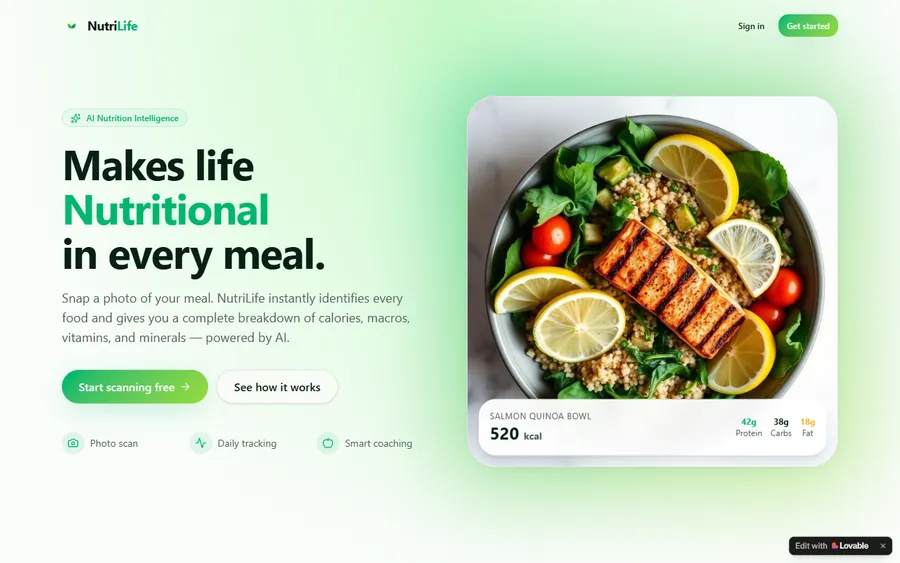
An AI nutrition coach that reads what you eat and works you toward a target.
AI and ML
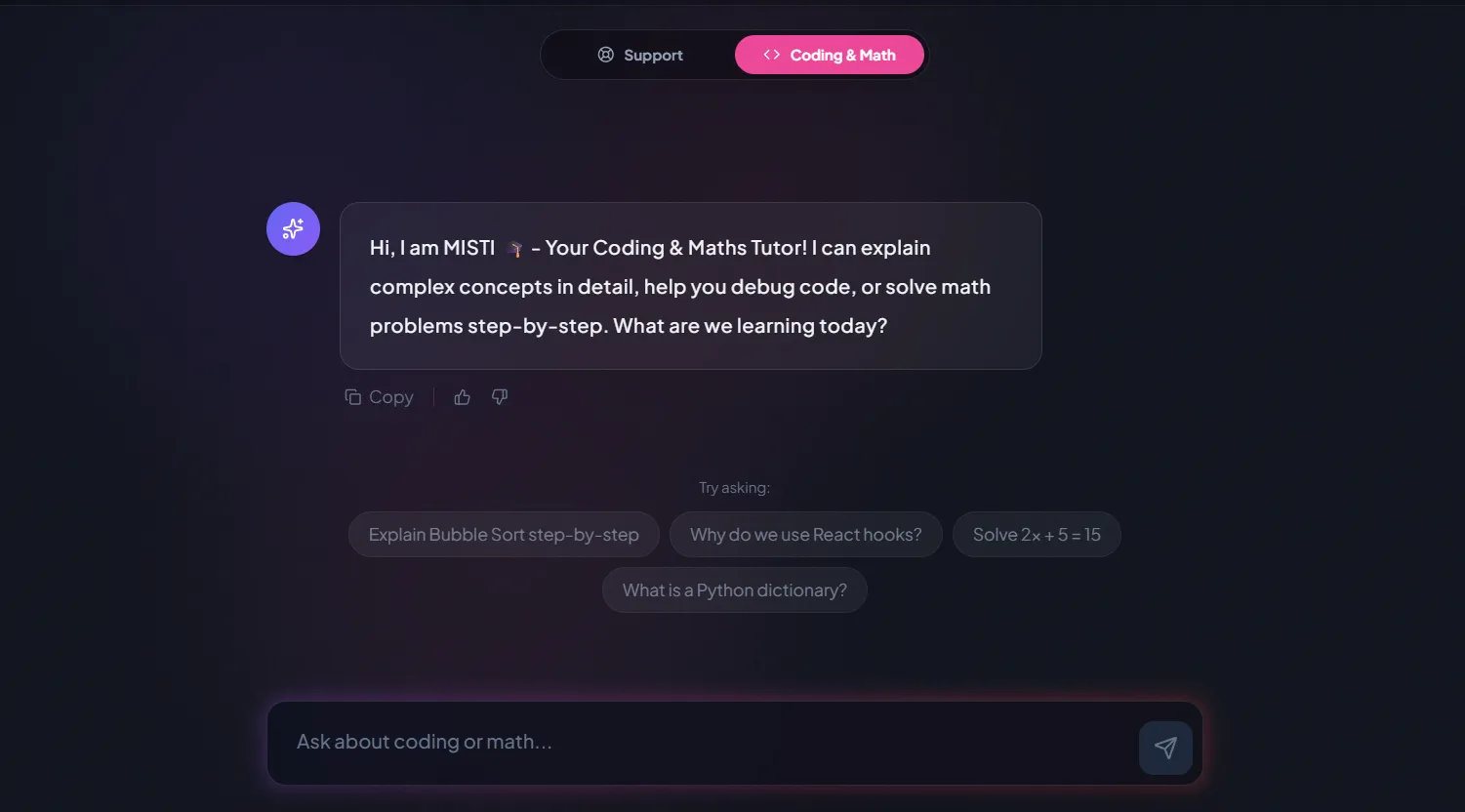
A chatbot that answers mathematics and programming questions, built and deployed by a student.

AI and ML
An assistant that helps a young person recognise unsafe situations online.
Web app
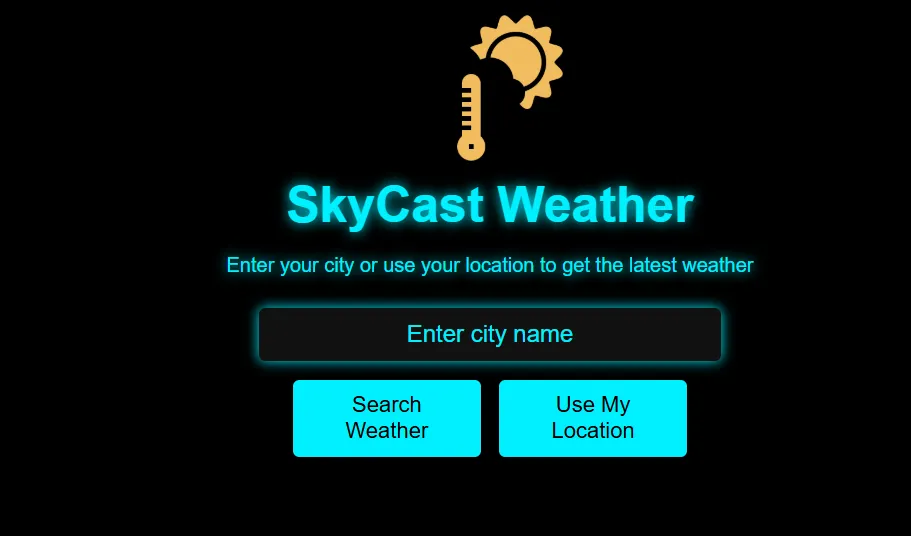
A weather forecasting site with live conditions for any location.
Fees
Monthly, in US dollars, the same for all families outside India. No sign-up fee and no fixed term.
Free first class
USD 0
no card required
Group batch
USD 100
a month, billed in US dollars
One to one
USD 150
a month, billed in US dollars
What families say
What parents have written on our Google profile, verbatim.
★★★★★
"The one step solution for my son. Modern Age Coders make learning coding so simple that kids love it. The teachers explain complex concepts clearly with practical exercises and interactive content."
Ria Mukherjee
Parent
★★★★★
"Modern Age Coders has been a game-changer for me. I struggled to grasp IT concepts and coding before joining, but their classes transformed everything. I can now confidently write complex programs with ease."
Samriddha Mondal
Student
★★★★★
"One of the most wonderful education centres out there. Education is not limited to school syllabus but focuses on skill development."
Vansh Agarwal
Student
★★★★★
"My child Dhairya is really enjoying the Modern Age Coders classes. This is his first online class and he eagerly looks forward to it. I can already see his improvement, and the teachers are very cooperative."
Sonam Oswal
Parent of Dhairya
★★★★★
"Modern Age Coders have wonderful teachers who teach in a clear, easy and practical way. The teacher boosts students' confidence and inspires them to learn without hesitation."
Sonu Goyal
Parent
★★★★★
"I highly recommend this computer coding class! The teachers are incredibly knowledgeable and passionate about coding."
Ritu Kedia
Parent
Tiffin questions
Both schools say Stage One includes a maths paper of under an hour, answered on a computer-marked OMR sheet. Some questions are multiple choice; others need a numerical answer written into columns.
The Tiffin Girls' School says the columns represent single digits, tens and hundreds, so the number of columns matches the number of digits. Times are written as on a digital clock, for example 07:05.
Children with the highest Stage One scores are invited back in November for English and maths papers with handwritten answers. Tiffin Girls' says no marks are given for calculations or workings out.
Tiffin School says its combined score is 50% English and 50% maths, with Stage One and Stage Two maths in the ratio 2:3. Tiffin Girls' says 60% English and 40% maths, with Stage Two and Stage One maths in a ratio of 3:1.
Both schools assume completion of the National Curriculum for Year 5 and do not expect topics beyond it, though some questions come in unfamiliar formats.
Not published when we checked on 26 September 2026. For 2027 entry, Stage One is on 1 and 2 October 2026 and Stage Two in November 2026. The schools publish new dates each year.
No. Both schools say they do not publish past papers; Tiffin School publishes illustrative questions. We write our own practice and do not copy either school's material.
No. We teach maths only, and we do not advise on registration, priority areas or places.
The Tiffin Girls' School asks that children do not bring a ruler, as rulers are not allowed in any of its tests.
The first lesson is free. After that it is USD 100 a month in a group or USD 150 a month one to one, with no joining fee.
Nearby pages
Coding in Kingston, the national 11 plus page, and neighbouring selective areas.
Our coding page for the borough.
Our national page on 11 plus maths.
Another two-stage process, next door.
For families across the county boundary.
Maths challenges through the year.
Every area we cover in the UK.
Start here
Tell us the school year, and whether careless slips or hard problems are the bigger worry. We teach a real lesson, then give you an honest verdict.
Would rather look around? Every course syllabus is online, how we teach explains our lessons, and the roadmap shows the route onward.
WhatsApp us · +91 91233 66161 · contact@modernagecoders.com
Message us on WhatsApp for the fastest answer. We are in India, with an Indian number and no UK office.