UK / GAM / 01
Our 11 plus maths course
For both St Olave's stages.
Open the syllabusBromley · St Olave's and Newstead Wood · Years 5 and 6
Bromley has two grammar schools, and on maths they could hardly differ more. St Olave's Grammar School tests boys in two stages, and maths is in both: a one-hour multiple-choice paper in September, then, for the 450 boys invited back, a written Mathematics Paper in November, sat with pencils, an eraser and a ruler. Newstead Wood School tests girls in verbal and non-verbal reasoning and says: "We do not test on any other subjects." Modern Age Coders teaches upper primary maths live online, to a class or to one child. This page sets out both schools' tests from their own pages and the council's booklet, and teaches the diagram that a ruler in a maths exam is for: the bar model.
From the London Borough of Bromley's 2027-2028 booklet and both schools' pages, read 31 October 2026 · Not connected with either school or the council
Is there maths in the Bromley 11 plus?
It depends on the school. The London Borough of Bromley says its two grammar schools, St Olave's Grammar School and Newstead Wood School, each admit on their own selection test, which the council does not run. St Olave's Selective Entrance Test, held on Friday 18 September 2026 for 2027 entry, "will last one hour and will comprise multiple choice questions in English, Logic (both Verbal and Non-Verbal Reasoning) and Mathematics", and the top 450 boys sat a Stage 2 English Paper and Mathematics Paper on Friday 13 November 2026. Newstead Wood's test, on 25 and 26 September 2026, is verbal and non-verbal reasoning only. Modern Age Coders teaches the maths behind the St Olave's papers live online, in a group or 1-on-1, through our 11 plus maths preparation course.
Where to start
For a boy aiming at St Olave's, the first card is the core course; the second firms up arithmetic before a timed hour; the third adds the early secondary topics a demanding written paper can reach towards.
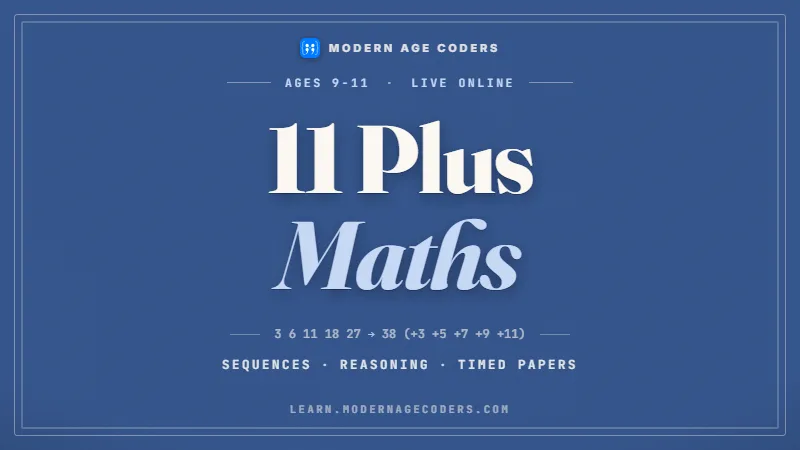
BROM / 01
Upper primary maths for a multiple-choice hour and then a written paper, with diagrams and full working.
Open the syllabus →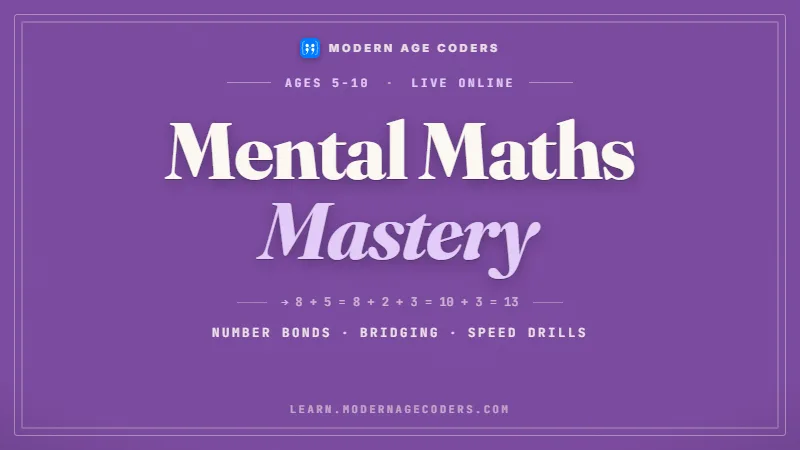
BROM / 02
Fluent facts and mental strategies, so a mixed English, logic and maths hour is not lost to slow sums.
Open the syllabus →
BROM / 03
Ratio, equations and geometry for a strong Year 6 who wants more depth.
Open the syllabus →Two schools, two answers
Two. The council's booklet names them and says both "admit children based on the outcome of their selection test", with applications "prioritised in score order from highest to lowest." Only one of the two tests maths.
| St Olave's Grammar School (boys) | Newstead Wood School (girls) | |
|---|---|---|
| Who runs the test | The school | The school |
| Maths in the test? | Yes, in Stage 1 and in Stage 2 | No: verbal and non-verbal reasoning only |
| Test dates for 2027 entry | Stage 1 Friday 18 September 2026; Stage 2 Friday 13 November 2026 | 25 and 26 September 2026 |
| How places go | Rank order from both stages, with parental preferences | Score order, within a 9-mile catchment |
| Catchment | None | 9 miles from the main entrance |
| Demand the school publishes | Around 1,600 applicants on average for 2025 and 2026; 1,595 applications for 2027 entry | 1,510 registrations for September 2025 entry |
The booklet is clear: "The London Borough of Bromley does not administer the selective/grammar testing for either of the two grammar schools in Bromley." Families register with each school, and the council handles only the common application, open from 1 September and closing on 31 October 2026.
It also warns that "being successful in a test does not guarantee admission". The grammar school still has to be named on the council form, and the council offers the highest named preference that can be met.
A family with a son and a daughter in Year 5 faces two quite different years. For St Olave's, maths is central, and written maths matters by November. For Newstead Wood, our maths lessons would be for school and Year 7, not for the test.
We say that plainly because it would be easy to sell maths tuition for a test that sets none. If your daughter is applying only to Newstead Wood, the school's own advice and its familiarisation links are the right starting point.
Sources: London Borough of Bromley, Secondary education in Bromley 2027-2028; St Olave's FAQ; Newstead Wood, About the Selection Test. Modern Age Coders works independently of both schools and of the borough council.
The boys' school
Two stages. Stage 1, the Selective Entrance Test, is one hour of multiple choice in English, logic and maths. The 450 highest scorers come back for Stage 2: an English Paper and a Mathematics Paper.
| Step | What the school publishes |
|---|---|
| Register (the SIF) | Opened Monday 8 June 2026 at 9am, closed Monday 29 June 2026 at midday; no late applications |
| Stage 1, the SET | Friday 18 September 2026: one hour, multiple choice, English, logic (verbal and non-verbal reasoning) and mathematics, HB pencil on an answer sheet |
| Stage 1 outcome | Mid-October, before half term and before the council deadline |
| Who goes through | The top 450 performing boys, all of whom have met the minimum standard |
| Stage 2 | Friday 13 November 2026: an English Paper in pen, a Mathematics Paper with pencils, an eraser and a ruler |
| Not allowed | Mobile phones, wristwatches and calculators at both stages; dictionaries at Stage 1 |
| Places | A published admission number of 124, plus up to 4 chorister places |
| Offers | Monday 1 March 2027, by the council, from the final rank order and parental preferences |
Stage 2 falls after the 31 October council deadline. The school's answer is that every boy invited to Stage 2 has already met its minimum standard, so families know before the deadline whether St Olave's is worth a preference.
The reverse is just as firm: "Any boy who does not proceed to the Stage 2 test will not be eligible for an offer." The school advises such families not to name it, since that "would be a waste of one of your school preferences."
Stage 1 asks maths inside a single hour shared with English and logic, all multiple choice. Speed and accuracy count, and an answer can be checked against the options.
Stage 2 is a Mathematics Paper of its own, and the school's kit list tells you something about it: a ruler, an eraser and pencils. A boy should be at ease drawing a neat diagram and writing his working, not only choosing a letter.
The school says it has no catchment area, no sibling policy and no feeder schools. Entry rests "solely on performance in our entrance tests".
The school publishes sample questions for both stages on its site but says it does not provide past papers. We do not reproduce its samples here.
The final rank order goes only to the council. After offer day the school can indicate how many boys remain above a child, but it does not hold the waiting list.
Sources: St Olave's, Key Dates, Entrance Test Information and FAQ, read 31 October 2026. For 2028 entry the school lists Stage 1 on Friday 17 September 2027 and Stage 2 on Friday 12 November 2027, with registration from 7 June to 28 June 2027.
The girls' school
No. Newstead Wood says its Selection Test "consists of two papers. The first will assess Verbal Reasoning and the second will assess Non-Verbal Reasoning. We do not test on any other subjects."
| Question | What the school says |
|---|---|
| What is tested? | Verbal reasoning in one paper, non-verbal reasoning in the other; no other subjects |
| When? | At the end of September, just after a girl starts Year 6 (25 and 26 September 2026 in the council's list) |
| How to register | The school's Supplementary Information Form, open in the summer term of Year 5; late registrations are not accepted |
| Results | Emailed at least one week before the council application deadline |
| Cut-off | "The cut-off score on National Offer Day 2026 was 225." |
| Demand | "We received 1510 registrations to sit the test for entry in September 2025." |
| Practice material | The school does not sell past or specimen papers; free online familiarisation for disadvantage-funded girls |
For school, for the Year 6 SATs in May, and for Year 7 wherever a girl goes. A girl who also applies to a grammar school in Kent or Bexley may meet maths in that test; the council booklet reminds families that those tests are arranged by the other area, not by Bromley.
Non-verbal reasoning is not maths, and we will not claim that maths lessons raise a reasoning score.
Newstead Wood publishes the score at which offers stopped on National Offer Day 2026. It is a standardised score from that year's cohort and catchment, not a target; a later year's line can fall elsewhere.
The council's booklet lists both schools as offering places "on Test Score" rather than distance, and records that in 2026 neither school had an appeal upheld.
Sources: Newstead Wood, Year 7 Admissions and About the Selection Test, read 31 October 2026.
Our lesson family
A bar model is a drawn rectangle split into equal parts that stands for the quantities in a word problem. With a ruler it is quick and neat, and once the picture is right the arithmetic is usually one step. These examples are ours, written for this page; they are not St Olave's questions.
Read the problem once and draw one bar for each person or quantity. Make bars that are meant to be equal the same length, using the ruler.
Split the bars into equal units wherever the problem gives a fraction or a ratio. Label the total or the difference you were told.
Most problems collapse to "so many units make this number". Divide to find one unit, then build the answer the question asks for.
| Problem (ours) | The bar picture | Working |
|---|---|---|
| Sam has three times as many cards as Ben. Together they have 84. How many has Sam? | Ben: 1 unit. Sam: 3 units. Total: 4 units = 84 | 1 unit = 21, so Sam has 3 x 21 = 63 |
| Ella has 18 more stamps than Ruby. They have 100 altogether. How many has Ruby? | Two equal bars, plus an extra 18 on Ella's | 100 minus 18 = 82; 82 divided by 2 = 41, so Ruby has 41 |
| A ribbon is cut so that 2/5 is used and 45 cm is left. How long was it? | One bar in 5 parts; 3 parts left = 45 cm | 1 part = 15 cm, so the ribbon was 5 x 15 = 75 cm |
| The ratio of red to blue beads is 3 : 5, and there are 24 more blue than red. How many beads in all? | Red: 3 units. Blue: 5 units. Difference: 2 units = 24 | 1 unit = 12; total 8 units = 96 beads |
| After spending a quarter of his money and then 6 more, Leo has half left. How much did he start with? | One bar in 4 quarters; 1 quarter spent, half left, so the 6 fills the last quarter | 1 quarter = 6, so he started with 4 x 6 = 24 |
Our practice set. Draw the bars first, every time. (1) Two numbers add to 70 and one is four times the other. Find both. (2) A jug and a cup hold 1,200 ml together; the jug holds 600 ml more than the cup. How much does the cup hold? (3) Three fifths of a class are girls and there are 8 more girls than boys. How many children? (4) Ali and Zoe share 45 sweets in the ratio 4 : 5. How many does Zoe get? (5) A book costs twice as much as a pen, and both cost 27 points in a class reward shop. What does the book cost? Answers, ours: (1) 14 and 56; (2) 300 ml; (3) 40, since 1 unit is 8 and there are 5 units; (4) 25; (5) 18 points.
Multi-step problems with fractions, comparison and ratio are where a written paper separates careful thinkers from quick guessers. A bar model shows the structure before any number is calculated, which makes the right operation obvious.
It also produces exactly the kind of working a marker can follow, and the ruler on the St Olave's kit list makes the diagram quick to draw cleanly.
Bars of unequal length for equal quantities: the picture then lies. We insist on ruled, matching units.
Answering the wrong question: finding one unit and stopping when the question asked for the total. Our children underline the final question before they write the answer.
Year by year
St Olave's registration closes at the end of June in Year 5, so the plan starts early and ends later than most areas, with a written paper in November.
| When | Maths focus (ours) | Secure when |
|---|---|---|
| Year 4, summer | Fluent tables and the four written methods | Short division and long multiplication are accurate |
| Year 5, autumn | Fractions of amounts and simple bar models | Any "fraction left over" problem is drawn before it is solved |
| Year 5, spring | Ratio and comparison problems with bars; register from 7 June 2027 | Two-person ratio problems are solved in a few lines |
| Year 5, summer to Stage 1 | Mixed multiple-choice hour, with English and logic beside it | The hour ends with every question attempted |
| Year 6, October to November | Written problems with full working, if invited to Stage 2 | Each answer has a ruled diagram and clear steps |
With some 1,600 boys applying for about 124 places, most boys who apply will not receive an offer. That is arithmetic, not a judgement of any child.
Bar models and careful working pay off in any secondary school.
Our GCSE maths page is for the exams at 16.
For maths challenges through the year, see the UK competitions calendar.
All related courses
Sorted by age group. Each card leads to a full syllabus.
UK / GAM / 01
For both St Olave's stages.
Open the syllabusUK / GAM / 02
Speed and accuracy with number.
Open the syllabusUK / GAM / 03
Arithmetic and reasoning for May of Year 6.
Open the syllabusUK / GAM / 04
For younger children starting out.
Open the syllabusUK / GAM / 05
Equations, ratio and shape beyond primary.
Open the syllabusUK / GAM / 06
For boys and girls who like hard problems.
Open the syllabusUK / GAM / 07
Ratios and fractions modelled in Python.
Open the syllabusUK / GAM / 08
Logic with drag-and-drop blocks.
Open the syllabusHow lessons run
Weekdays or weekends, flexible: choose your batch, or for a very personalised plan choose 1-on-1 at your convenience, weekend mornings or weekdays. Lessons are taught from India, which does not change its clocks; that puts India time four and a half hours ahead of UK time in summer and five and a half ahead in winter. We always book in UK time.
After school
An early-evening hour for Years 5 and 6.
Weekend morning
For families whose weeknights are full.
October to November
Written-paper practice before Stage 2.
Upper primary maths taught thoroughly, never a list of shortcuts.
One lesson for Orpington, Chislehurst or Penge alike, from home.
Learn with 15 to 20 others at the same level, or with a teacher alone.
Each problem is written for our classes, never taken from a school's samples.
Brief notes on what has improved and what to work on next.
Ranks, cut-offs and offers belong to the schools and the council.
Student work
Projects by children from our classes, plenty of them now older. More on student labs.

AI and ML
An AI nutrition coach that reads what you eat and works you toward a target.

AI and ML
A chatbot that answers mathematics and programming questions, built and deployed by a student.

AI and ML
An assistant that helps a young person recognise unsafe situations online.

Web app
A weather forecasting site with live conditions for any location.
Fees
One fee per month, in the currency UK families are billed in, paid month to month with nothing required upfront. We do not charge for the first lesson.
Free first class
USD 0
no card required
Group batch
USD 100
a month, billed in US dollars
One to one
USD 150
a month, billed in US dollars
What families say
Parents on our Google profile, unedited.
★★★★★
"The one step solution for my son. Modern Age Coders make learning coding so simple that kids love it. The teachers explain complex concepts clearly with practical exercises and interactive content."
Ria Mukherjee
Parent
★★★★★
"Modern Age Coders has been a game-changer for me. I struggled to grasp IT concepts and coding before joining, but their classes transformed everything. I can now confidently write complex programs with ease."
Samriddha Mondal
Student
★★★★★
"One of the most wonderful education centres out there. Education is not limited to school syllabus but focuses on skill development."
Vansh Agarwal
Student
★★★★★
"My child Dhairya is really enjoying the Modern Age Coders classes. This is his first online class and he eagerly looks forward to it. I can already see his improvement, and the teachers are very cooperative."
Sonam Oswal
Parent of Dhairya
★★★★★
"Modern Age Coders have wonderful teachers who teach in a clear, easy and practical way. The teacher boosts students' confidence and inspires them to learn without hesitation."
Sonu Goyal
Parent
★★★★★
"I highly recommend this computer coding class! The teachers are incredibly knowledgeable and passionate about coding."
Ritu Kedia
Parent
Bromley 11 plus questions
Yes, at both stages. Stage 1 is one hour of multiple choice in English, logic and mathematics, and Stage 2 includes a separate Mathematics Paper, sat with pencils, an eraser and a ruler.
No. The school says its two papers assess verbal reasoning and non-verbal reasoning, and that it does not test any other subjects.
Stage 1 was on Friday 18 September 2026 and Stage 2 on Friday 13 November 2026. Registration ran from Monday 8 June to midday on Monday 29 June 2026.
The school lists registration from 7 June to 28 June 2027, Stage 1 on Friday 17 September 2027 and Stage 2 on Friday 12 November 2027.
The school says the top 450 performing boys in Stage 1 are invited, and all of them have met its minimum standard. A boy not invited is not eligible for an offer.
The school reports an average of around 1,600 applicants for the 2025 and 2026 seasons and 1,595 applications for 2027 entry, for 124 places plus up to 4 chorister places.
The school says the cut-off on National Offer Day 2026 was 225. It also has a 9-mile catchment from its main entrance.
No. The London Borough of Bromley says it does not administer the testing for either grammar school. It runs the common application, which closed on 31 October 2026, and passing a test does not guarantee a place.
No. The school says mobile phones, wristwatches and calculators are not allowed at either stage.
Weekdays or weekends, flexible: choose your batch, or for a very personalised plan choose 1-on-1 at your convenience, weekend mornings or weekdays. Times are booked in UK time.
Related pages
Neighbouring tests, coding in the borough, and our UK hub.
The test next door, run by its council.
For families looking across the county line.
Python and Scratch for the borough.
Our London-wide maths page.
The national 11 plus picture.
Where every UK page starts.
Part of the guide: UK selective school maths tests: 7+, 11+, 13+ and 16+
More guides: UK maths exam boards and specification codes · UK maths year by year, Reception to Year 11 · UK university admissions: maths tests and computing applications · UK maths enrichment, competitions and able pupils
Start here
Tell us whether your child is aiming at St Olave's, Newstead Wood or both. For St Olave's we will start with written problems; for Newstead Wood we will be honest about what maths can and cannot do for the test.
Reading first? Each course page has its syllabus laid out, and how we teach describes our lessons.
WhatsApp us · +91 91233 66161 · connect@modernagecoders.com
WhatsApp is fastest, and free from any UK mobile. You will hear back from India, on a +91 number; there is no Bromley office.
A priority demo is a full class of about 45 to 60 minutes. After the class the mentor sends a written skill report and a personal learning roadmap on WhatsApp. If you enrol, the demo fee is adjusted against your first month's fee. Share your demo Order ID with us on WhatsApp and we take it off.
Book a priority demo