STM / I-a
11 plus maths preparation
Key Stage 2 maths for chosen and written answers.
Open the syllabusSutton · Selective Eligibility Test and second stage maths · Live online, small groups or one to one
Sutton's selective schools ask a child to show their maths twice. First comes the Selective Eligibility Test, a multiple-choice maths paper and a multiple-choice English paper, with no verbal or non-verbal reasoning at all. For the boys' schools and the girls' schools that hold one, a second stage follows a few weeks later: another maths paper, but this time "not multiple choice". The content is the same Key Stage 2 maths. The task is not. With five options on the page, a child can check a wrong answer against the list; with a blank line, nothing warns them. That shift, from choosing to producing an answer, is what this page is about, together with what the schools and the council publish.
Maths only · No English teaching for the test · No connection with any Sutton school
In short
Six schools share the Sutton Selective Eligibility Test: Greenshaw High School, Nonsuch High School for Girls, Sutton Grammar School, Wallington County Grammar School, Wallington High School for Girls and Wilson's School. The SET is two multiple-choice papers of 40 to 50 minutes, one maths and one English, and the schools say it includes no verbal or non-verbal reasoning. The pass is on the total of the two, with no negative marking. Children who pass then sit a written second stage for the girls' or boys' schools: again maths and English, but "not multiple choice". For September 2027 entry the SET was on Tuesday 15 September 2026, the girls' second stage on 26 September and the boys' on 3 October. The maths is broadly Key Stage 2 throughout, and we teach it for both formats, live online. There is no charge for the first lesson; regular lessons cost USD 100 a month in a group or USD 150 one to one.
First steps for Sutton
Pick by how your child copes when there are no answers to choose from.
SUTTON / 1
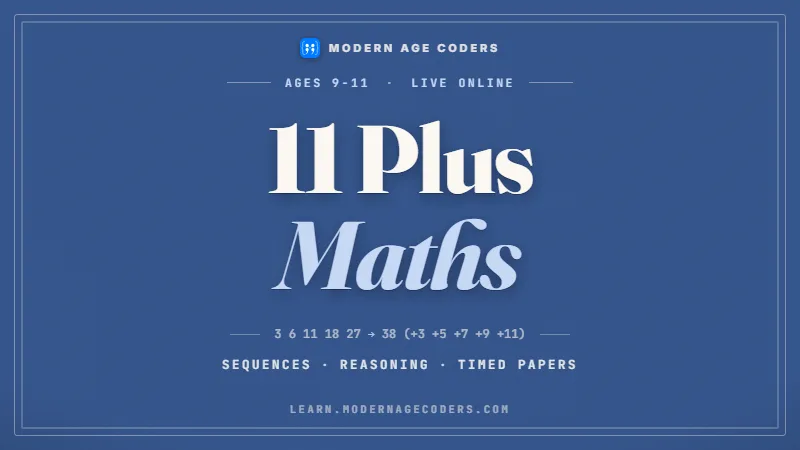
Key Stage 2 content taught for five-option questions and for written answers on a blank line.
Open the syllabus →
SUTTON / 2
No calculators at either stage; quick, reliable calculation leaves time to check.
Open the syllabus →
SUTTON / 3
For a Year 4 child who needs place value, tables and fractions secured before anything timed.
Open the syllabus →Stage one
The London Borough of Sutton lists the six schools and their deadlines; the schools publish the detail, in a shared FAQ on Sutton Grammar School's website. Read on 26 September 2026.
| Step | Date | What is published |
|---|---|---|
| Registration opens | Friday 1 May 2026 | One online form, reachable from any participating school's website. |
| Access arrangements | By Friday 12 June 2026 | Earlier deadline for requests and evidence for children with SEN. |
| Registration closes | Midnight, Friday 31 July 2026 | No late registrations accepted. |
| SET | Tuesday 15 September 2026 | Maths and English, multiple choice, for children in Year 6. |
| Girls' second stage | Saturday 26 September 2026 | Joint test for Nonsuch High School for Girls and Wallington High School for Girls. |
| Boys' second stage | Saturday 3 October 2026 | Shared test for Sutton Grammar, Wallington County Grammar and Wilson's. |
The SET is short and plain. The FAQ describes "a multiple-choice Maths paper and a multiple-choice English paper", each taking between 40 and 50 minutes, with a break between. It adds, unusually clearly: "The tests do not include verbal reasoning or non-verbal reasoning." Children shade a lozenge for A, B, C, D or E, and some questions ask for a combination of answers.
The schools say there is no negative marking, that papers are marked twice, by machine and then by hand, and that it is the total score that decides a pass, so "a very good performance in English can compensate for one that is a little weaker in Maths". A child sits the SET once only, in Year 6; it cannot be taken earlier as practice.
No rough paper is given. The FAQ says candidates may use any spare space on the question papers for working, and calculators are not permitted. The schools do not publish specimen papers, only a short set of sample questions for each subject.
Greenshaw High School uses the SET only for its ability places, and not every school holds a second stage. How each school then uses the results for places is set out by the schools, and we leave it there. This page is about the maths in the two stages.
Sources: London Borough of Sutton, secondary school tests and assessments; Sutton Grammar School, admissions FAQs, covering the SET and the shared second stage; SET Maths sample questions for 2027 entry. Modern Age Coders has no connection with any participating school or with the council.
Stage two
The second stage keeps maths and English and removes the list of answers. That is the single biggest change in Sutton's process, and the one preparation most often ignores.
For boys, Sutton Grammar School, Wallington County Grammar School and Wilson's School share one second stage: "two papers; a Maths paper and an English paper. The tests will not include verbal or non-verbal reasoning, and are not multiple choice. Each paper will be around 45 minutes to 1 hour in length." No sample tests are released; the content is broadly Key Stage 2.
For girls, Nonsuch High School for Girls and Wallington High School for Girls hold a joint second stage, with maths and English papers, and apply common criteria.
Sutton Grammar School publishes its own arithmetic. Four standardised scores, SET English, SET maths, second-stage English and second-stage maths, "will be weighted in the ratio 2:2:3:3, an age allowance will be added, and the total rounded to the nearest four marks". Wilson's and Wallington County publish their own methods.
Read as a Year 6 ratio, 2:2:3:3 has ten parts, and the two second-stage papers hold six of them. At that school the written papers count for more than the multiple-choice ones. We mention it to show why written maths deserves real time, not to predict anyone's result.
For a family, the practical point is the calendar. The SET falls in mid-September and the written papers two or three weeks later. There is no time after the SET to learn a new way of answering. Written maths has to be practised through Year 5 alongside multiple-choice work, not bolted on at the end.
The lesson
Two Year 5 curriculum statements carry most of the weight here: interpreting remainders for the context, and using rounding to check answers.
| The question | The calculation | The answer that fits |
|---|---|---|
| 215 guests sit at tables of 8. How many tables are needed? | 215 ÷ 8 = 26 remainder 7 | 27 tables: the 7 left over still need a table |
| 215 guests sit at tables of 8. How many tables are completely full? | 215 ÷ 8 = 26 remainder 7 | 26 tables |
| 215 stickers are shared among 8 children. How many does each get? | 215 ÷ 8 = 26 remainder 7 | 26 each, with 7 left over |
| 215 m of ribbon is cut into 8 equal pieces. How long is each piece? | 215 ÷ 8 = 26.875 | 26.875 m, or 26 m 87.5 cm |
The national curriculum asks Year 5 pupils to use short division and "interpret remainders appropriately for the context". The same sum has four right answers depending on what is being divided. On a multiple-choice paper, a child who writes 26 remainder 7 can often find the right option by elimination. On a written paper they must decide, alone, whether the answer is 26, 27, 26 remainder 7 or 26.875.
We teach one habit for every written answer: reread the last line of the question and say the answer out loud as a sentence. "We need 27 tables." Sentences expose nonsense that bare numbers hide.
The second habit is checking by rounding, which the curriculum also names: "use rounding to check answers to calculations and determine, in the context of a problem, levels of accuracy". 215 is close to 216, and 216 ÷ 8 = 27, so an answer near 27 is right and an answer near 270 or 2.7 is not.
The third is units. A written paper has no options to hint that the answer is in metres rather than centimetres. Children learn to write the unit before the number, so the unit is decided first.
Source: national curriculum in England, mathematics, Year 5 multiplication and division, and addition and subtraction (statutory requirements). The table is a Modern Age Coders teaching example, not a test question.
Two formats, one course
A child who can only do one format is half prepared for Sutton. We teach both side by side, from the start.
Short sets of five-option questions, marked at once, so speed and accuracy on the SET style become routine. No negative marking means every question is answered.
The same topics, with the options removed. The child writes the answer, the unit and a one-line check. We mark the check as well as the answer.
Then we give a question the child got right with options and ask it again without them. That is where hidden weaknesses show, and where the real teaching happens.
The SET gives no rough paper, so we practise with working written in the margins of the question sheet, small and in order. The second stage, being written, rewards the same tidiness: a teacher marking a script can follow neat work, and a child can find their own mistake in it.
Some SET questions ask for a combination of answers rather than one. In maths that usually means "which two of these are true?" questions, which punish half-checking. We practise them so the instruction to choose two is noticed every time.
We do not have Sutton papers and do not pretend to. The schools release sample questions only, and we never copy those. Our questions are written for Key Stage 2 content, in both formats, and changed every term so they cannot be learned by heart.
English is half of the SET total and part of the second stage, but it is not something we teach for the test. Families should know that before they book with us.
The participating schools
The council and the schools name the participants. We list them so it is clear which tests this page covers.
| School | After the SET |
|---|---|
| Greenshaw High School | SET used for its ability places; no second stage |
| Nonsuch High School for Girls | Joint girls' second stage |
| Wallington High School for Girls | Joint girls' second stage |
| Sutton Grammar School | Shared boys' second stage |
| Wallington County Grammar School | Shared boys' second stage |
| Wilson's School | Shared boys' second stage |
Registration is one form for all six schools, whichever school website a family starts from, and the SET is the same paper wherever a child lives. So is our lesson: live, on a screen at home.
For coding and computing in the borough, we have a separate Sutton coding page.
Our groups are built by level, not by postcode. A child preparing for the SET joins others at the same stage in Year 5 maths, from anywhere in the country, which is how we keep the groups between five and ten.
We have no connection with any of the six schools or with the London Borough of Sutton, and we give no advice on applications or places.
Sources: Sutton Grammar School admissions FAQs; London Borough of Sutton, secondary school tests and assessments; both read 26 September 2026.
Working back from September
For a child now in Year 5, the next SET will fall in September of Year 6, with written papers soon after. Every stage below is practised in both formats.
| When | Stage | What secure looks like |
|---|---|---|
| Year 4 | 1. Facts | Tables and number bonds instant; place value clear to a million |
| Autumn, Year 5 | 2. Written methods | Long multiplication and short division correct, with remainders read for the context |
| Spring, Year 5 | 3. The swap | Questions answered correctly with options are also answered correctly without them |
| Summer, Year 5 | 4. Two clocks | A 45-minute multiple-choice paper one week, a written paper the next, both finished and checked |
Starting in the summer of Year 5 still leaves time, if the written format is not left out. It is the part that improves slowest.
At the trial lesson we will say plainly what a few months can do.
Written maths is the maths of secondary school. Many children continue into maths through coding, where every answer has to be produced, not picked.
Keen ones try the challenges on our competitions calendar.
Our courses
Grouped by stage. Open any card for the syllabus.
STM / I-a
Key Stage 2 maths for chosen and written answers.
Open the syllabusSTM / I-b
Calculation without a calculator, at speed.
Open the syllabusSTM / I-c
Foundations for a child not yet ready for timed work.
Open the syllabusSTM / I-d
Concrete, then visual, then mental calculation.
Open the syllabusSTM / II-a
Written reasoning and algebra for Key Stage 3.
Open the syllabusSTM / II-b
Where method marks and written working count most.
Open the syllabusSTM / II-c
Problems that need a full written argument.
Open the syllabusSTM / III-a
Programs that compute and check their own answers.
Open the syllabusSTM / III-b
Precise instructions, tested at once.
Open the syllabusSTM / III-c
Typed code for confident primary pupils.
Open the syllabusSTM / IV-a
Quicker methods, once the standard ones are secure.
Open the syllabusSTM / IV-b
Maths that ends in working software.
Open the syllabusTiming
Our teachers are in India, and when Britain changes its clocks in March and October the gap changes with it. We fix primary lessons in UK time, in the early evening or at weekends, and adjust on our side.
Early evening, weekdays
A settled hour between school and supper.
Weekend mornings
Good for children who flag after a school day.
Half terms
Short intensive sessions in the break.
Continuity means patterns in a child's mistakes are spotted early.
A few plain lines to parents after lessons, good news and bad.
Children at the same level, so the pace suits everyone in the room.
All questions are ours, in both formats; no school material is reproduced.
One to one when a child needs targeted help with written answers.
We do not teach the English papers and do not advise on admissions.
Student work
Four projects built by students at our school, every one of whom started with arithmetic like this. See more on the student labs page.
AI and ML
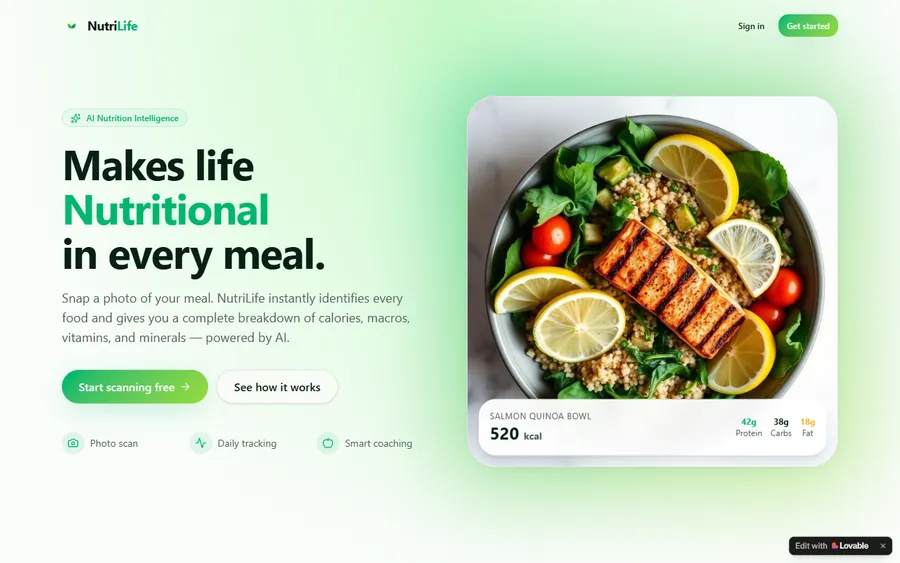
An AI nutrition coach that reads what you eat and works you toward a target.
AI and ML
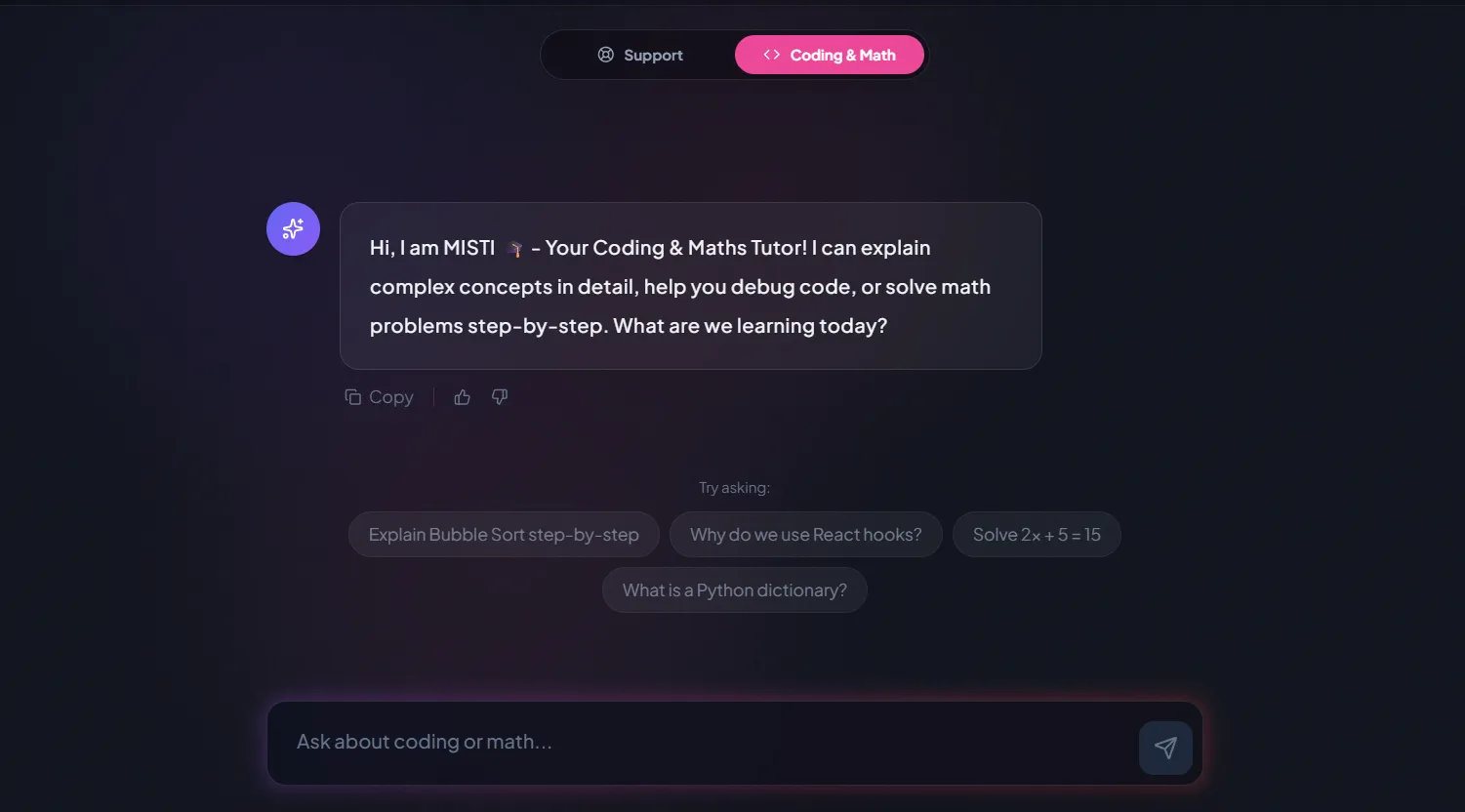
A chatbot that answers mathematics and programming questions, built and deployed by a student.

AI and ML
An assistant that helps a young person recognise unsafe situations online.
Web app
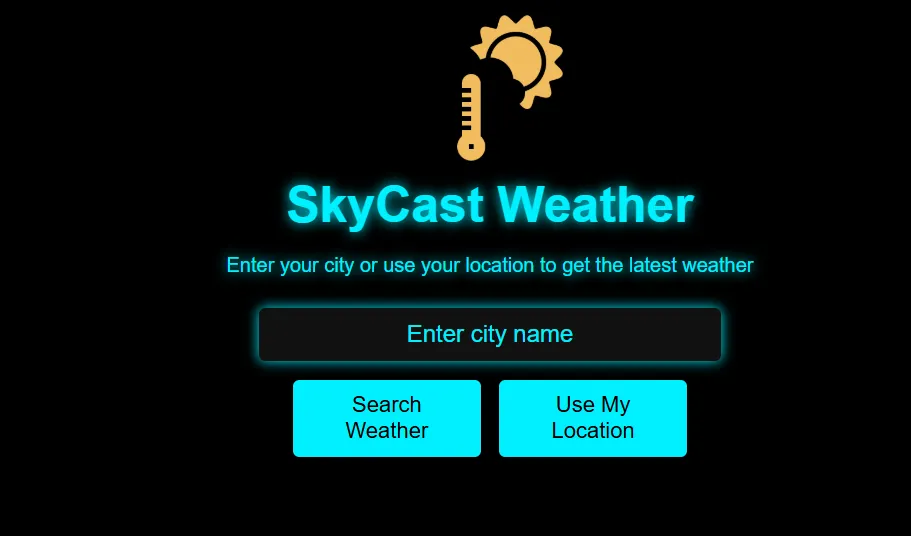
A weather forecasting site with live conditions for any location.
Fees
A flat monthly fee in US dollars, as for all families outside India. No deposit and no minimum term.
Free first class
USD 0
no card required
Group batch
USD 100
a month, billed in US dollars
One to one
USD 150
a month, billed in US dollars
What families say
Reviews by parents on our Google profile, reproduced exactly.
★★★★★
"The one step solution for my son. Modern Age Coders make learning coding so simple that kids love it. The teachers explain complex concepts clearly with practical exercises and interactive content."
Ria Mukherjee
Parent
★★★★★
"Modern Age Coders has been a game-changer for me. I struggled to grasp IT concepts and coding before joining, but their classes transformed everything. I can now confidently write complex programs with ease."
Samriddha Mondal
Student
★★★★★
"One of the most wonderful education centres out there. Education is not limited to school syllabus but focuses on skill development."
Vansh Agarwal
Student
★★★★★
"My child Dhairya is really enjoying the Modern Age Coders classes. This is his first online class and he eagerly looks forward to it. I can already see his improvement, and the teachers are very cooperative."
Sonam Oswal
Parent of Dhairya
★★★★★
"Modern Age Coders have wonderful teachers who teach in a clear, easy and practical way. The teacher boosts students' confidence and inspires them to learn without hesitation."
Sonu Goyal
Parent
★★★★★
"I highly recommend this computer coding class! The teachers are incredibly knowledgeable and passionate about coding."
Ritu Kedia
Parent
Sutton questions
Two multiple-choice papers, maths and English, each between 40 and 50 minutes, according to the participating schools. There are no verbal or non-verbal reasoning papers. Answers are shaded as lozenges A to E.
No. The schools say there is no negative marking in the SET papers, so a child should answer every question.
The schools say it is the total score that determines a pass, so a strong performance in one paper can make up for a slightly weaker one in the other.
For boys, a shared second stage for Sutton Grammar, Wallington County Grammar and Wilson's: a maths paper and an English paper that are not multiple choice, each around 45 minutes to an hour. For girls, a joint second stage for Nonsuch and Wallington High School for Girls.
The schools say the content is broadly based on the Key Stage 2 curriculum. For a September test in Year 6, that means the primary curriculum up to the end of Year 5, answered without a calculator.
They had not been published when we checked on 26 September 2026. For 2027 entry, registration ran from 1 May to midnight on 31 July 2026 and the SET was on Tuesday 15 September 2026.
No. The schools publish sample questions only, and no samples for the second stage. We write our own practice in both formats and do not copy school material.
No. We teach maths only, and we do not give advice on applications or places.
No. The schools say the SET is for children in Year 6 and can be taken only once.
The first lesson is free. After that, a group place is USD 100 a month and one to one is USD 150 a month, with no deposit and no minimum term.
Nearby
Coding in Sutton, the national 11 plus page, and other selective areas nearby.
Our page on coding for the borough.
The national 11 plus maths page.
A county test sat in the first week of Year 6.
A consortium that names four maths areas.
For families over the county line.
Every UK area we cover.
Start here
Let us know the school year and whether written answers or multiple choice feels harder. We teach a real lesson and then give you a straight account of it.
Reading first? The course syllabuses are all online, how we teach sets out our method, and the roadmap shows what follows what.
WhatsApp us · +91 91233 66161 · contact@modernagecoders.com
WhatsApp gets the quickest answer. Our phone number is Indian and we have no office in Britain.