UK / ICP / 01
11 plus maths preparation
Year 5 strands taught for problems that mix topics.
Open the syllabusIndependent senior schools · ISEB Pre-Tests · Years 5 and 6
The ISEB Common Pre-Tests are four online, adaptive, multiple-choice entrance tests set by the Independent Schools Examinations Board and used by many independent senior schools, usually in Year 6, for Year 7 entry or deferred Year 9 entry. Mathematics is one of the four. Modern Age Coders teaches that maths live online, in a group or one to one, through our 11 plus maths preparation course. The single fact that changes preparation most is in ISEB's own words: the system "does not allow them to go back and change previous answers". A child has to check before moving on, because there is no later.
Built from ISEB's pages and 2026-27 framework, read 31 October 2026 · Not connected with ISEB or any school
What is the ISEB Common Pre-Test?
The ISEB Common Pre-Tests are a set of four online tests in English, mathematics, verbal reasoning and non-verbal reasoning, used by many independent senior schools as one part of admissions. ISEB says they are multiple choice and adaptive, take 2 hours 15 minutes in total, and can be sat in one day or across several. A child sits them once in an academic year, usually at their own school, and the results are shared with every senior school the family gives the Applicant ID to. The maths test covers the national curriculum up to the end of Year 5: number, calculation, fractions, decimals and percentages, measurement, geometry and statistics. No calculator is allowed; pen and paper are. For the 2026-27 session ISEB opened registration on 9 June 2026 and live testing from 1 September 2026. Modern Age Coders teaches the maths and the one-way technique live online, with practice we write ourselves.
Where to begin
Choose by how quick and accurate the Year 5 arithmetic is. Each card opens a syllabus.
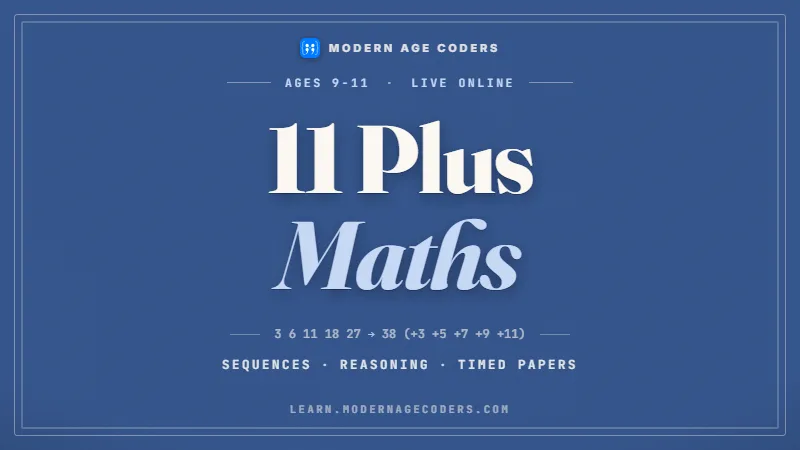
ICP / 01
Covers the Year 5 topics the ISEB framework lists, with multi-step problems that join two of them.
Open the syllabus →
ICP / 02
With no going back, the checking has to be fast; secure number facts make it possible.
Open the syllabus →
ICP / 03
For a strong Year 6 child who will meet the hardest adaptive questions and then Year 7 maths.
Open the syllabus →The test
Four short online tests, sat once, shared with many schools. ISEB describes them in its 2026-27 pages and its test framework.
| Feature | What ISEB says |
|---|---|
| Tests | English (reading comprehension and grammar), mathematics, verbal reasoning, non-verbal reasoning |
| Format | Online, adaptive and multiple choice |
| Length | All four together "will take 2 hours 15 minutes to complete" |
| When in school life | Often Year 6 for Year 7 entry; some senior schools use them before Year 9 entry |
| Where | Usually the pupil's current school, or a senior school or approved centre, in the UK or overseas |
| Registration | By a parent or guardian through the Guardian Portal; ISEB says registration is free for families |
| Window | Registration opened Tuesday 9 June 2026; live testing from Tuesday 1 September 2026 to late May 2027 |
| Sittings | "Pupils can only sit the ISEB Pre-Tests once in any academic year" |
| Results | A Standardised Age Score where "the average is 100", with stanine, percentile rank and group rank |
The "common" in the name means one sitting serves many schools. Parents create an Applicant Profile and an Applicant ID, then give that ID to each senior school applied to. ISEB says this means pupils do not miss lessons for several separate tests.
Fees, ISEB says, are paid by the senior school, per result accessed. Individual schools set their own deadlines inside the session, so the date that matters is the earliest one among the schools on your list.
ISEB's web pages give the 2026-27 testing window as 1 September 2026 to late May 2027. Its 2026-27 framework PDF says tests "can be taken between the beginning of October and the end of June". We print both because both are ISEB's; ask your child's school and the senior schools which applies.
If a child were somehow tested twice in a year, the framework says "the first set of results will stand." There is no practice run that counts.
Sources: ISEB Common Pre-Tests, information for families, information for schools, and the ISEB Common Pre-Tests Framework 2026-27, read 31 October 2026. Modern Age Coders is not connected with ISEB or with any senior school.
Adaptive and one-way
Each answer helps choose the next question, the number of questions varies, and there is no going back. Those three facts change preparation more than any topic list.
ISEB explains it directly: "The test system will assess the pupil's ability after each response and select the next question to have the most appropriate level of difficulty." It adds that "pupils may be presented with differing numbers of questions, and the system does not allow them to go back and change previous answers". It also says "it is highly unlikely that two pupils will see the same series of questions." So two children leaving the same room may have answered different questions, a different number of them, at different levels, and both had a fair test.
On a paper 11 plus, leaving a hard question and returning is good technique. Here there is nothing to return to. A child needs to decide, with a sensible estimate behind the choice, and move on.
In an adaptive test, a run of harder questions usually follows correct answers. Children who expect every question to feel easy can panic at exactly the moment they are doing well. We tell them so in advance.
Because a click is final, the check must happen before it: does the answer fit the estimate, the units, the question actually asked? Practising that two-second habit is the core of our Pre-Test lessons.
| Habit from paper tests | Does it work in the Pre-Test? | What to do instead |
|---|---|---|
| Skip and come back later | No: earlier answers cannot be revisited | Estimate, eliminate, commit |
| Count questions left to pace yourself | Not reliably: question numbers vary by pupil | Pace by the visible timer, which can be hidden if it worries the child |
| Change an answer on a final check | No | Do the check before selecting |
| Work in the margin of the question | No margin on screen | Use the pen and paper provided; that working is not marked |
| Use the easy questions to build confidence | Difficulty adjusts to the pupil | Expect hard questions and treat them as a sign of progress |
A simplified illustration of our own, not ISEB's algorithm: picture a ladder of question difficulty. A correct answer usually moves a child up a rung, a wrong one down, and the test stops when it is confident where the child stands. That is why ISEB can say the test "can be shorter while still giving an accurate score", and why a careless slip on an easy rung costs more time than it would on paper: the test has to climb back.
Source: ISEB Pre-Tests information for schools, How do the ISEB Pre-Tests work, and the 2026-27 framework. The ladder picture and the habits table are our own explanation.
The maths
The national curriculum for England up to the end of Year 5, in six strands. ISEB describes some questions as plain arithmetic and others as problems that join more than one topic.
| Strand (ISEB framework) | Year 5 examples (ours, from the national curriculum) |
|---|---|
| Number and place value | Numbers to a million, negative numbers in context, Roman numerals to M, rounding |
| Calculations | Written addition and subtraction, short multiplication and division, multiples, factors and primes to 100 |
| Fractions, decimals and percentages | Equivalent fractions, mixed numbers, thousandths, simple percentages of amounts |
| Measurement | Converting metric units, perimeter and area, estimating volume, time problems |
| Geometry | Angles in degrees, angles on a line and around a point, 3D shapes from 2D drawings, reflection and translation |
| Statistics | Line graphs and tables, including timetables |
ISEB's preparation leaflet says "The ISEB Maths test is based on the National Curriculum Programme of Study, up to the end of Year 5", and that children will be "allowed a pen and paper during the test to jot down any calculations or notes that they want to make. This working paper is not marked."
It names two common errors: pupils who "haven't read the question properly or have used the wrong operation". It recommends times tables as a route to confidence.
ISEB separates the four tests into two kinds. English and mathematics measure attainment, "in line with topics and knowledge that pupils will be taught in class". Verbal and non-verbal reasoning are meant to show potential through unfamiliar question types.
That distinction is useful. Maths is the test where ordinary, steady teaching shows up most directly, because it measures what has been learned.
Worked examples, written by us
Three original questions in a one-at-a-time, choose-one style, at Year 5 level. None is an ISEB question; ISEB's own Test Walkthrough shows the real look of the platform.
An adult ticket costs three times a child ticket. Two adults and three children cost 27 tokens. What does an adult ticket cost? Draw a bar for one child ticket. An adult is three bars, so two adults are six bars, plus three child bars: nine bars make 27, so one bar is 3 and an adult ticket is 9. Check before choosing: 2 times 9 plus 3 times 3 is 27. No algebra, one picture.
What is five sixths of 48 minus three eighths of 48? One sixth of 48 is 8, so five sixths is 40. One eighth is 6, so three eighths is 18. The answer is 22. The trap is subtracting the fractions first without a common denominator; working each part on paper takes twenty seconds and cannot go wrong that way.
Three angles sit on a straight line. One is 47 degrees and the other two are equal. What is each of the equal angles? Angles on a line make 180 degrees, so the two equal angles make 133, which is odd, so each is 66.5 degrees. An estimate catches errors: each should be a little under 70. If the options include 66.5, choose it; if a child got 133, they forgot the halving.
| Question (ours) | Answer | Check before you click |
|---|---|---|
| 2,345 plus 1,878 | 4,223 | Estimate 2,300 plus 1,900 is 4,200; the answer should be just above. |
| 1.2 kg take away 450 g | 750 g | Convert first: 1,200 g minus 450 g. Answers in kilograms and grams mixed are the usual slip. |
| Write 1994 in Roman numerals | MCMXCIV | M for 1000, CM for 900, XC for 90, IV for 4. Read it back as a check. |
| Which of 21, 23, 25 and 27 is prime? | 23 | 21 is 3 times 7, 25 is 5 times 5, 27 is 3 times 9. |
| What is 15 per cent of 60? | 9 | Ten per cent is 6 and five per cent is 3. Add, then confirm it is less than a fifth of 60. |
| A film starts at 18:40 and lasts 1 hour 55 minutes. When does it end? | 20:35 | Add 2 hours to get 20:40, then take off 5 minutes. |
Every row has a check that takes a few seconds and happens before the answer is chosen. That is the whole Pre-Test technique in miniature: on paper, a child can tidy up at the end; here, the end is each click.
Preparing well
Less than many families fear, by ISEB's own account. A sensible plan secures Year 5 maths, practises the one-way format briefly, and protects the child's calm.
From ISEB's preparation leaflet: "Additional test practice is not a requirement of the ISEB Pre-Tests; however, some parents, guardians and families may benefit from preparation work to reduce test anxiety."
ISEB endorses one commercial practice platform and warns that it "cannot guarantee the accuracy of third-party Common Pre-Tests practice resources that are not endorsed by ISEB". Our questions are third-party too, which is why we label them as ours and teach maths rather than imitate the test.
Where a senior school agrees, ISEB says applicants with special educational needs can have extra time of 25 per cent on each test, requested by the parent at registration with evidence such as an educational psychologist's report.
The visible timer can be hidden if a countdown makes a child anxious. There is no extra time for English as an additional language, though a bilingual paper dictionary may be allowed.
Families aiming at 13 plus entry may meet Common Entrance after the Pre-Test; our Common Entrance maths page covers that stage. For grammar school tests, which work quite differently, see GL Assessment 11 plus maths and the national 11 plus maths page.
Timeline
Registration for 2026-27 opened in June 2026 and sittings run through the school year, so many children sit in the autumn or spring of Year 6.
| When | Stage | Secure when |
|---|---|---|
| Early Year 5 | 1. Number facts | Tables, place value and fraction equivalents recalled, not worked out |
| Through Year 5 | 2. The six strands | Each of ISEB's strands answered correctly at Year 5 level, with mixed-topic problems |
| Summer before Year 6 | 3. One-way habit | Estimate, check, commit, on screen, without wanting to go back |
| Weeks before the sitting | 4. Calm rehearsal | The Walkthrough tried, a timed mixed set done, and nothing new attempted |
If the sitting is weeks away, we work on the commonest slips and the one-way habit, not on new topics.
We will say honestly what that time can and cannot change.
ISEB describes the Pre-Tests as one part of a school's admissions process; each senior school sets the rest.
Children who enjoy the problem solving often move on to competition maths.
All related courses
By stage, from Year 5 arithmetic to the maths that follows entry.
UK / ICP / 01
Year 5 strands taught for problems that mix topics.
Open the syllabusUK / ICP / 02
Fast recall so checks fit inside the time.
Open the syllabusUK / ICP / 03
For gaps that sit underneath Year 5 work.
Open the syllabusUK / ICP / 04
Pre-algebra and geometry for the first senior years.
Open the syllabusUK / ICP / 05
Harder, slower problems for keen mathematicians.
Open the syllabusUK / ICP / 06
Data reading and chance, taken further.
Open the syllabusUK / ICP / 07
Patterns and number explored in Python.
Open the syllabusUK / ICP / 08
Calculation methods for number lovers.
Open the syllabusHow lessons run
Weekdays or weekends, flexible: choose your batch, or for a very personalised plan choose 1-on-1 at your convenience, weekend mornings or weekdays. Teachers are based in India; India time is four and a half hours ahead of UK time in summer and five and a half in winter, and we fix every lesson in UK time.
After school
The usual slot for Years 5 and 6.
Weekend morning
Room for a longer mixed set.
Holidays
Short, frequent lessons before a sitting.
Questions shown singly, answers locked, as in the real test.
Rough working on paper beside the screen, as ISEB allows.
Progress noted strand by strand from ISEB's framework.
Written by us at Year 5 level, never presented as ISEB items.
A batch of 15 to 20 at one level, or a teacher for one child.
Hard questions framed as progress, so they do not frighten.
Student work
Projects students made in our classes in the years after entrance tests. More on student labs.

AI and ML
An AI nutrition coach that reads what you eat and works you toward a target.

AI and ML
A chatbot that answers mathematics and programming questions, built and deployed by a student.

AI and ML
An assistant that helps a young person recognise unsafe situations online.

Web app
A weather forecasting site with live conditions for any location.
Fees
A monthly fee in the currency we use for UK families, the same for every month you choose to continue. The first lesson is free.
Free first class
USD 0
no card required
Group batch
USD 100
a month, billed in US dollars
One to one
USD 150
a month, billed in US dollars
What families say
Parents' words from our Google profile, as written.
★★★★★
"The one step solution for my son. Modern Age Coders make learning coding so simple that kids love it. The teachers explain complex concepts clearly with practical exercises and interactive content."
Ria Mukherjee
Parent
★★★★★
"Modern Age Coders has been a game-changer for me. I struggled to grasp IT concepts and coding before joining, but their classes transformed everything. I can now confidently write complex programs with ease."
Samriddha Mondal
Student
★★★★★
"One of the most wonderful education centres out there. Education is not limited to school syllabus but focuses on skill development."
Vansh Agarwal
Student
★★★★★
"My child Dhairya is really enjoying the Modern Age Coders classes. This is his first online class and he eagerly looks forward to it. I can already see his improvement, and the teachers are very cooperative."
Sonam Oswal
Parent of Dhairya
★★★★★
"Modern Age Coders have wonderful teachers who teach in a clear, easy and practical way. The teacher boosts students' confidence and inspires them to learn without hesitation."
Sonu Goyal
Parent
★★★★★
"I highly recommend this computer coding class! The teachers are incredibly knowledgeable and passionate about coding."
Ritu Kedia
Parent
ISEB Pre-Test questions
Mathematics from the national curriculum for England up to the end of Year 5. ISEB's framework lists number and place value, calculations, fractions, decimals and percentages, measurement, geometry and statistics, with some arithmetic questions and some problems that mix topics.
ISEB says the four tests together take 2 hours 15 minutes. They can be sat on one day or split across several days, as the invigilation centre arranges.
No. ISEB says the adaptive system does not allow pupils to go back and change previous answers. That is why we teach children to estimate and check before they choose.
No. ISEB says calculators must not be accessible. Pupils do have pen and paper for rough work, and ISEB says that working paper is not marked.
Because the test is adaptive. ISEB says each answer helps choose the next question and that it is highly unlikely two pupils will see the same series of questions, or even the same number.
Once in an academic year. ISEB's framework adds that if a child were tested more than once in the same year, the first set of results would stand.
ISEB's web pages give live testing from 1 September 2026 to late May 2027, after registration opened on 9 June 2026. Its framework PDF gives a window from the beginning of October to the end of June, so confirm the date with your child's school and each senior school.
As a Standardised Age Score, adjusted for age and compared with a sample of pupils applying to independent schools, where the average is 100. Schools also see stanine and percentile rank.
ISEB says additional practice is not a requirement, though some families find preparation reduces anxiety. We teach Year 5 maths and the one-way habit; we do not claim to know the live questions.
Weekdays or weekends, flexible: choose your batch, or for a very personalised plan choose 1-on-1 at your convenience, weekend mornings or weekdays. Every lesson is set in UK time.
Related pages
Other entrance tests, and what comes after.
The written exams some schools set at 11 and 13.
Grammar school tests written to each area's order.
The subject itself, without a test provider in mind.
The national tests at the end of Year 6.
For children who want harder problems.
Our hub for every UK page.
Part of the guide: UK selective school maths tests: 7+, 11+, 13+ and 16+
More guides: UK maths exam boards and specification codes · UK maths year by year, Reception to Year 11 · UK university admissions: maths tests and computing applications · UK maths enrichment, competitions and able pupils
Start here
Tell us your child's year and roughly when they will sit. We teach a real lesson, one question at a time, and then tell you what we saw.
Want to read first? The course page lists every topic, and how we teach explains our approach.
WhatsApp us · +91 91233 66161 · connect@modernagecoders.com
WhatsApp is the fastest way to reach us and is free from a UK mobile. Replies come from our team in India, on a +91 number.
A priority demo is a full class of about 45 to 60 minutes. After the class the mentor sends a written skill report and a personal learning roadmap on WhatsApp. If you enrol, the demo fee is adjusted against your first month's fee. Share your demo Order ID with us on WhatsApp and we take it off.
Book a priority demo