UK / TT1 / 01
Primary maths
The whole primary maths curriculum, placed by year.
Open the syllabusNorthern Ireland · P7 · Ages 10 and 11
Northern Ireland's transfer test is now a single assessment. The Schools' Entrance Assessment Group, SEAG, sets two identical-format papers on consecutive Saturdays each November, written and marked by GL Assessment, and all 63 schools that use academic selection accept the outcome. Each paper has a short untimed practice section, then a main test of 28 English and 28 maths questions with one shared allowance of 60 minutes. SEAG's own format guide adds a detail that shapes everything: "Pupils may begin their Main Test by starting with English (or Gaeilge) questions or by starting with Maths questions." So a ten-year-old has to decide, under pressure, how to split one hour between two subjects. The Maths score is half the result. This page sets out the format, the maths content, the timing decision, and how outcomes are calculated, from SEAG's published documents.
Live teaching since 2020 · 10,000+ students · From SEAG's specification, format guide and parent guidance
In short
The SEAG Entrance Assessment is the single transfer test used by all 63 post-primary schools in Northern Ireland that select academically. Children in P7 sit two papers of identical format, in 2026 on Saturday 14 and Saturday 21 November. Each paper begins with an untimed practice section of five English and five maths questions, then a main test of 28 English and 28 maths questions in 60 minutes, which pupils may start with either subject. In the maths section, questions 29 to 50 are multiple choice with five options and questions 51 to 56 are free response; every question is worth one mark. Outcomes are standardised for age: an English score and a Maths score, each averaging 100, are added to give a total, and pupils are placed in six bands, Band 1 being the top 40 per cent. The content is based entirely on the Northern Ireland Key Stage 2 curriculum. Modern Age Coders teaches that maths content live and practises the format and timing with SEAG's free practice papers. The first lesson is free, then USD 100 a month in a group or USD 150 one to one.
Start here
Primary maths, quick number skills, and exam-style practice. SEAG's test is based on the Northern Ireland Key Stage 2 curriculum, and we teach from SEAG's own content list.
TT / 01
Number, fractions, measurement, shape, data and money across the primary years.
Open the syllabus →
TT / 02
Quick, reliable calculation, which matters when 56 questions share one hour.
Open the syllabus →
TT / 03
Written for England's 11+, but much of the problem solving carries across; SEAG content is taught from SEAG's own list.
Open the syllabus →The format
From SEAG's 2026 Entrance Assessment Format (at a glance) and Assessment Guide.
| Section | What it contains | Counts? |
|---|---|---|
| 1. Practice test | 5 English and 5 maths questions, not timed, to settle pupils and practise the answer sheet | No |
| 2. English main test | 28 questions: punctuation, grammar and spelling exercises, then a comprehension passage | Yes |
| 3. Maths main test | 28 questions: numbers 29 to 50 multiple choice, 51 to 56 free response | Yes |
| Time for sections 2 and 3 | 60 minutes in total for all 56 main-test questions | Not applicable |
SEAG says "Both Papers have an identical format and are set at the same level of difficulty", and a child must sit both: a pupil who sits only one receives estimated outcomes marked with an e. Every question is worth one mark, and each multiple-choice question has five possible answers. Answers go on a separate answer sheet, where a multiple-choice answer can be marked with a horizontal line or by shading the box.
| Date | What happens |
|---|---|
| 21 to 24 September 2026 | Late registration window, the final opportunity to register |
| Friday 9 October 2026 | Pupil cards available to download |
| Saturday 14 November 2026 | Paper 1 |
| Saturday 21 November 2026 | Paper 2 |
| Saturday 23 January 2027 | Outcomes released online |
| 25 January to 3 February 2027 | Window for re-mark requests |
Source: SEAG Assessment Guide, the 2026 Format (at a glance), the 2026 Specification, SEAG's key dates and FAQs, and its 2026 guidance notes for parents. Dates are SEAG's as displayed on 21 September 2026; check SEAG's site for any change.
The shared hour
The feature of the SEAG test that most changes how a child should practise.
The 60 minutes are not divided by SEAG. The format guide says pupils may start with either subject, and the parents' guidance notes that invigilators announce when there are "about 30 minutes left" and "about 10 minutes left". Nothing else tells a child how long to spend on the maths. A pupil who lingers over a comprehension passage can reach question 51 with too little time for the six free-response maths questions, and one who rushes the maths can leave English marks behind.
Some children do better starting with the subject they find harder, while fresh; others settle with the easier one first. Either works if it is decided before the day and practised every time.
The invigilator's warning at about 30 minutes is a natural checkpoint: roughly one subject should be done. Practising with that checkpoint builds a sense of pace.
Every question is worth one mark. A child running out of time should at least mark an answer for each remaining multiple-choice question rather than leave it empty.
The last point needs care. SEAG's documents say each question is worth one mark and do not describe any penalty for wrong answers; we therefore teach children to answer every multiple-choice question, and to make a considered choice where they can. We do not claim more about the marking than SEAG publishes.
Maths content
From SEAG's 2026 Specification, which bases the test entirely on the Northern Ireland Key Stage 2 curriculum.
| Area | Includes |
|---|---|
| Number | Place value, decimals to two places, multiplying and dividing by 10, 100 and 1000, estimation, mental calculation, fractions, decimals and percentages and their equivalence |
| Patterns and algebra | Sequences, doubling and halving, prime, square, cube and triangular numbers, simple indices, function machines, a letter standing for an unknown |
| Operations | Problem solving with the four operations, estimation and approximation, interpreting a calculator display |
| Money | Calculations with money, including working out change |
| Measurement, shape and space | Units and measures, properties of shapes, position, movement and direction |
| Probability | The language of chance, ordering events by likelihood, fifty-fifty, and probability with a dice |
| Data | Recording, representing and interpreting data in graphs, tables and diagrams |
The specification says pupils will be expected to recognise patterns and relationships and make predictions, "responding to open-ended or multiple choice questions". The multiple-choice questions reward accuracy and elimination: with five options, ruling out two or three wrong ones is often faster than working the answer out in full. The six free-response questions at the end reward clear working and a precise final answer, with no options to check against.
Fractions, decimals and percentages as one idea, converting between them quickly.
Multi-step money and measurement problems, where the arithmetic is easy but the order of steps is not.
Transferring answers accurately to a separate answer sheet, which the practice test exists to rehearse.
Keeping pace across 28 maths questions while also managing the English half.
Outcomes
SEAG's outcomes are standardised, and maths is exactly half of the total.
| Outcome | What it means |
|---|---|
| Maths SAS | A standardised age score for the maths section, on a scale that runs from 69 to 141 with an average of 100 |
| English SAS | The same for the English (or Gaeilge) section |
| TSAS | The two scores added together, averaging 200 |
| Cohort percentile | How a pupil compares with everyone who sat the assessment |
| Band | Six bands; Band 1 is a cohort percentile of 60 or higher, the top 40 per cent |
The scores are standardised, SEAG explains, to take account of the pupil's age when they sat the test, the number of correct answers and the difficulty of the assessment. A child born in June is compared fairly with one born the previous July. Because the total is simply the English score plus the Maths score, a gain in maths counts exactly as much as the same gain in English. The percentile needed for each band stays the same each year, while the score needed may vary slightly.
Teach the Key Stage 2 maths on SEAG's list, with extra time on the areas a child finds slow, and practise five-option multiple choice and free-response questions separately.
Rehearse the full format with SEAG's free practice papers and answer sheets, including the shared 60 minutes and the half-time checkpoint.
A band or a score. The outcome depends on the whole cohort, and schools set their own admissions criteria.
Anything about marking beyond what SEAG publishes, and any shortcut past the content itself.
For later years, the CCEA GCSE Maths page explains the GCSE pathways, and the Northern Ireland page sets out the wider system. For England's tests, see 11+ maths in Kent.
Progression
Placement follows what a child can do accurately and at pace, not only what they have covered.
| Rung | When | What should be true |
|---|---|---|
| 1. Secure number | P6 | Place value, the four operations, fractions, decimals and percentages, done accurately |
| 2. The full list | P6 into P7 | Every area on SEAG's specification covered, including probability, data and function machines |
| 3. The format | Early P7 | Five-option multiple choice, free response, and a separate answer sheet handled confidently |
| 4. The shared hour | Autumn of P7 | Both subjects completed in 60 minutes, with a chosen order and a half-time check |
Children often meet one or two areas late, such as function machines or probability. SEAG's list is the checklist.
Children who enjoy puzzles may also like the Primary Maths Challenge.
Pace comes from timed papers with both subjects together, not from maths alone.
Lessons wind down after the November papers.
The catalogue
Grouped by purpose. The free lesson settles where a child starts.
UK / TT1 / 01
The whole primary maths curriculum, placed by year.
Open the syllabusUK / TT1 / 02
Speed and accuracy without pen and paper.
Open the syllabusUK / TT1 / 03
Problem solving for selective tests, adapted to SEAG content.
Open the syllabusUK / TT2 / 01
A visual way into number.
Open the syllabusUK / TT2 / 02
Calculation shortcuts for children who like patterns.
Open the syllabusUK / TT2 / 03
For siblings aged four to seven.
Open the syllabusUK / TT3 / 01
Block coding, a relaxing change from test practice.
Open the syllabusUK / TT3 / 02
Puzzles and logic for curious children.
Open the syllabusUK / TT3 / 03
After November, a project to look forward to.
Open the syllabusHow lessons work
Our teachers are in India, which keeps the same clock all year, so Northern Ireland is four and a half hours behind in summer and five and a half in winter. Lessons are set in UK time.
After school
Short sessions suit P6 and P7 children.
Early evening
Before homework and tea.
Saturday morning
The same time of day as the real papers.
Every area in the specification covered, checked off as it becomes secure.
Multiple choice with elimination, so options become a tool rather than a trap.
The last six maths questions practised with clear working and exact answers.
Transferring answers to a separate sheet, as in the real test.
Full timed papers with both subjects, a chosen order and a half-time check.
Five to ten P7 children, with a calm, encouraging pace.
Student work
Small projects from everyday lessons, not practice tests. Plenty more are in student labs.
AI and ML
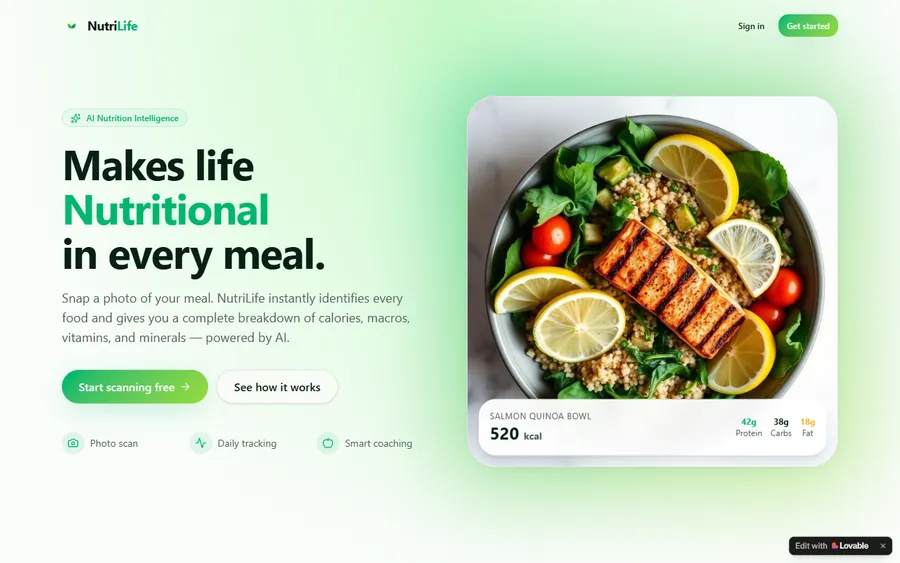
An AI nutrition coach that reads what you eat and works you toward a target.
AI and ML
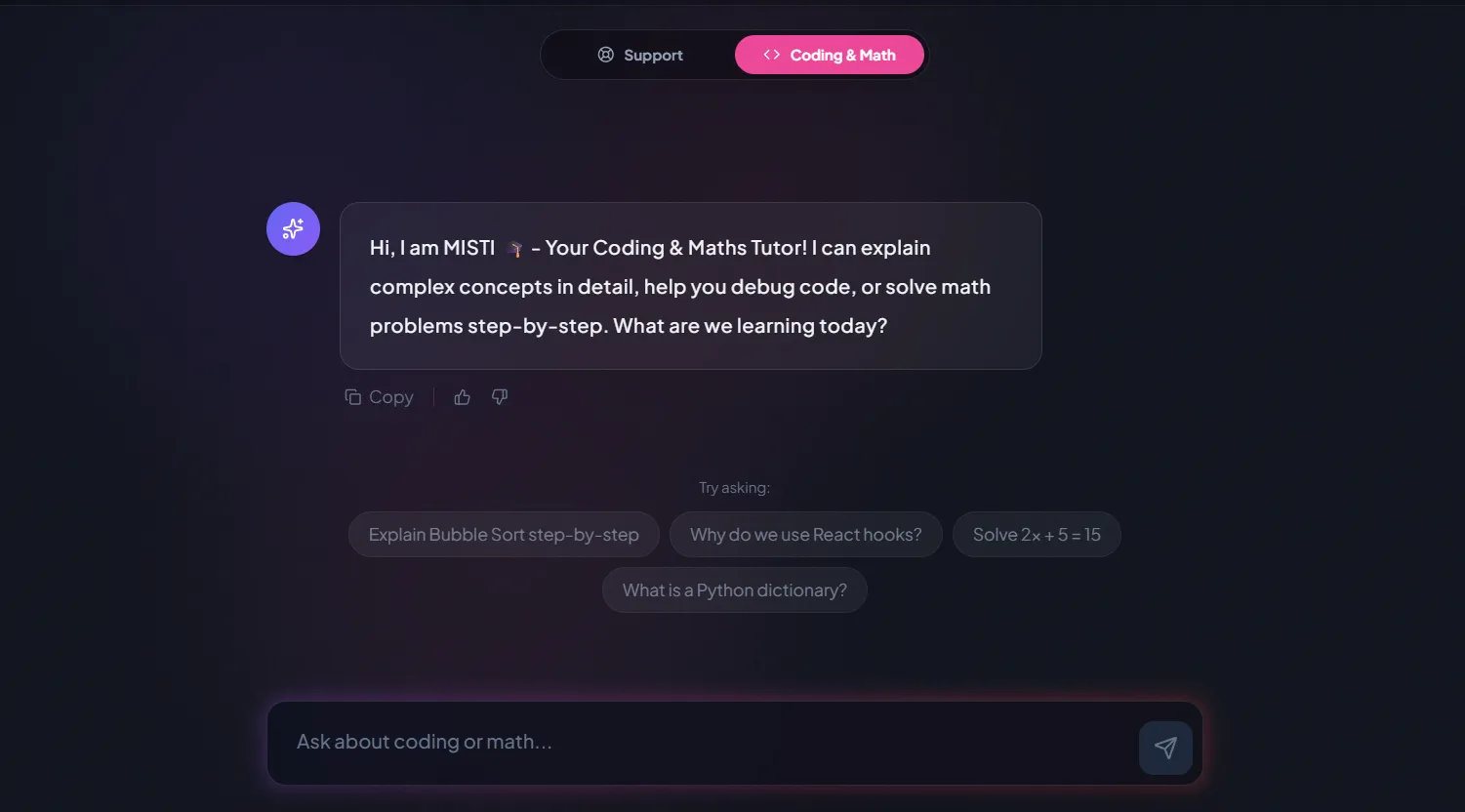
A chatbot that answers mathematics and programming questions, built and deployed by a student.

AI and ML
An assistant that helps a young person recognise unsafe situations online.
Web app
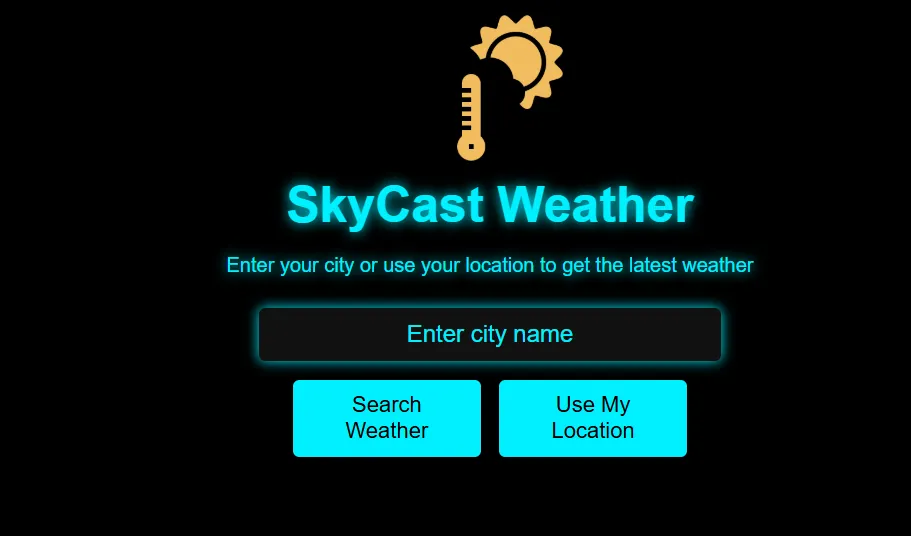
A weather forecasting site with live conditions for any location.
Fees
Fees are monthly and in US dollars, at one rate for families anywhere outside India. There is no charge for the first lesson, and we send no bill until a course and a weekly slot are agreed.
Free first class
USD 0
no card required
Group batch
USD 100
a month, billed in US dollars
One to one
USD 150
a month, billed in US dollars
What families say
What parents have written on Google, unedited.
★★★★★
"The one step solution for my son. Modern Age Coders make learning coding so simple that kids love it. The teachers explain complex concepts clearly with practical exercises and interactive content."
Ria Mukherjee
Parent
★★★★★
"Modern Age Coders has been a game-changer for me. I struggled to grasp IT concepts and coding before joining, but their classes transformed everything. I can now confidently write complex programs with ease."
Samriddha Mondal
Student
★★★★★
"One of the most wonderful education centres out there. Education is not limited to school syllabus but focuses on skill development."
Vansh Agarwal
Student
★★★★★
"My child Dhairya is really enjoying the Modern Age Coders classes. This is his first online class and he eagerly looks forward to it. I can already see his improvement, and the teachers are very cooperative."
Sonam Oswal
Parent of Dhairya
★★★★★
"Modern Age Coders have wonderful teachers who teach in a clear, easy and practical way. The teacher boosts students' confidence and inspires them to learn without hesitation."
Sonu Goyal
Parent
★★★★★
"I highly recommend this computer coding class! The teachers are incredibly knowledgeable and passionate about coding."
Ritu Kedia
Parent
Questions about the transfer test
The single transfer test used by all 63 post-primary schools in Northern Ireland that use academic selection. It is set and marked by GL Assessment for SEAG, and around 13,000 pupils sit it each year.
Paper 1 is on Saturday 14 November 2026 and Paper 2 on Saturday 21 November 2026. Outcomes are released on Saturday 23 January 2027.
An untimed practice section of five English and five maths questions, then a main test of 28 English and 28 maths questions in 60 minutes, which pupils may start with either subject.
Questions 29 to 50 are multiple choice with five possible answers, and questions 51 to 56 are free response. Each question is worth one mark.
Key Stage 2 content from the Northern Ireland curriculum: number, fractions, decimals and percentages, patterns, simple algebra, measurement, shape and space, money, probability and data.
An English score and a Maths score, each standardised for age with an average of 100, are added to give a total. Pupils are then placed in six bands; Band 1 is the top 40 per cent of those who sat.
Yes. A pupil who sits only one paper receives estimated outcomes marked with an e, and schools decide how to treat those under their own admissions criteria.
Yes. SEAG provides Gaeilge versions of the assessment, invigilated in Irish at centres that offer it. Our lessons, though, are in English only.
SEAG set a final late registration window from 21 to 24 September 2026. After that, no child can be registered for the 2026 assessment.
Our first lesson is free. After that, lessons are one monthly fee in US dollars, lower for a group place than one to one, as shown in the fees section, with nothing charged in advance.
Elsewhere on this site
The GCSE years ahead, the wider system, and puzzles for keen children.
The GCSE pathways that come later.
Primary school to A level.
A UK-wide puzzle competition for primary children.
Gentle contests in maths and coding.
How England's selective tests differ.
Every UK page, in one place.
Start here
Leave a number and we will call at a UK time that suits your family. The first lesson is gentle, uses SEAG-style maths, and ends with a plan up to November.
Rather look around first? The course list gives each syllabus in full, our teaching page describes how we work with ten-year-olds, and student labs collects children's projects.
WhatsApp us · +91 91233 66161 · contact@modernagecoders.com
The fastest reply comes on WhatsApp, which is free from a UK phone. Our office is in India, so the number you will see starts +91.