Table of Contents
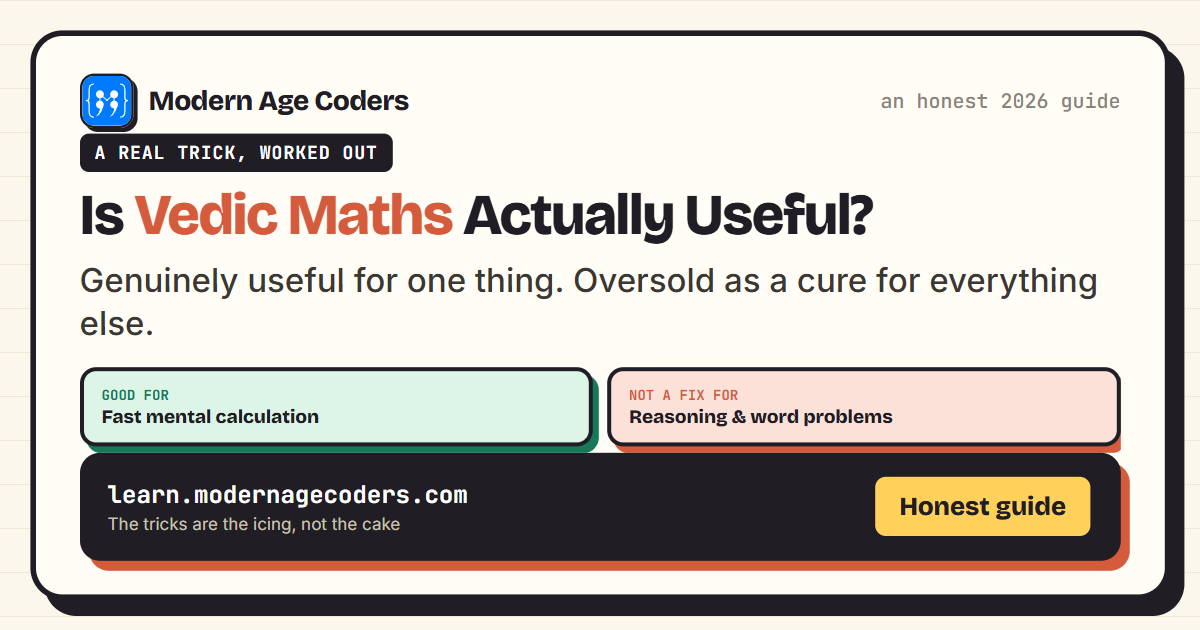
Vedic maths is sold with impressive promises: multiply large numbers in seconds, turn your child into a human calculator. Some of that is real, and some of it is marketing. The honest answer is that Vedic maths is useful for a specific thing and oversold as a cure-all. Here is where it genuinely helps, where it does not, and one trick worked out so you can judge for yourself.
The short answer
Yes, Vedic maths is useful, for fast mental calculation. It is a collection of shortcuts for arithmetic like multiplication and squaring that let a child calculate quickly and with confidence, which many children find genuinely fun and motivating. What it does not do is teach the reasoning, word problems and concepts that school maths is mostly about. Use it as a speed booster on top of real understanding, not instead of it.
One mental shortcut worth knowing whatever method you use: x% of y is always equal to y% of x, so 8% of 50 is simply 50% of 8. Our guide to calculating percentages explains why it works and builds every other percentage from 10% and 1%.
A child who can multiply fast with Vedic tricks but cannot reason through a word problem has learned a skill, not maths. The tricks are the icing. Understanding is the cake.
One trick, worked out honestly
It is easier to judge Vedic maths by seeing an actual trick than by taking the marketing on faith. Here is a real one for squaring any two-digit number that ends in 5.
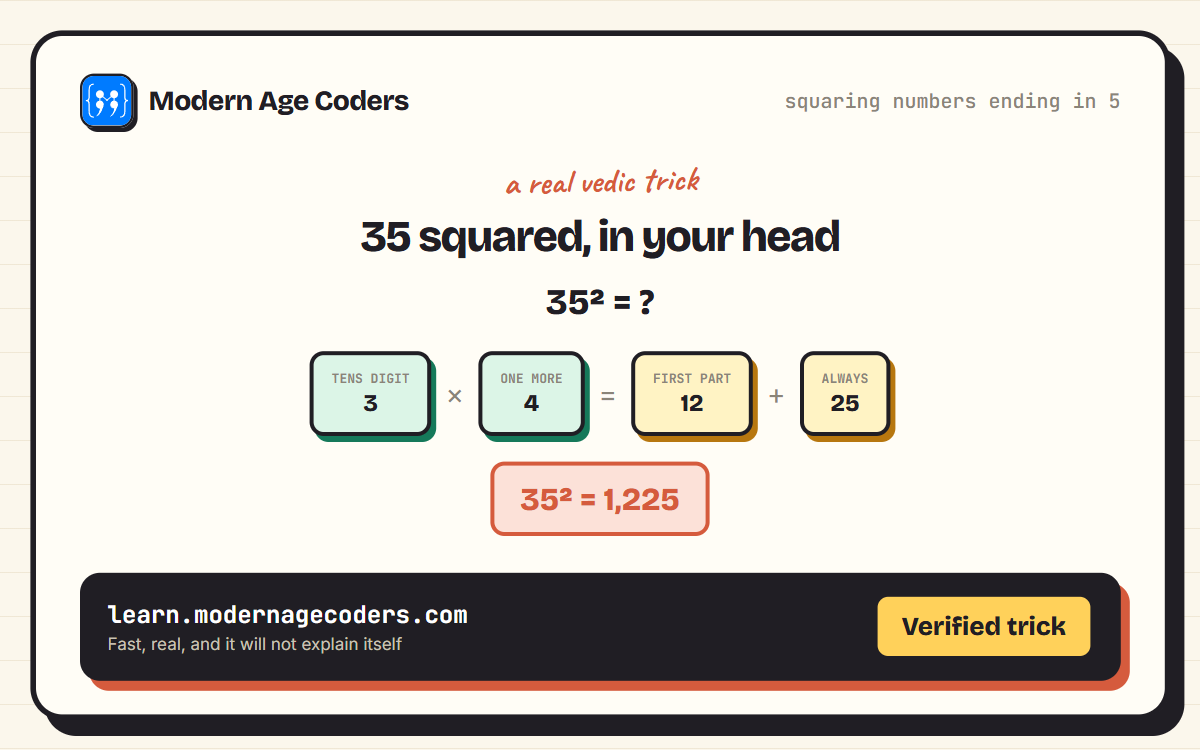
For 35 squared: the tens digit is 3, one more than 3 is 4, and 3 times 4 is 12. Write 25 after that, and you get 1,225, which is exactly 35 squared. The same pattern works for any number ending in 5: 45 squared is 4 times 5, giving 20, then 25 after it, which is 2,025. It genuinely is that fast once it is memorised, and it genuinely does not explain why it works unless someone shows you the algebra behind it separately.
The trick is algebra in disguise: (10a + 5) squared expands to 100a(a + 1) + 25, which is exactly the two parts of the answer. Expanding and factorising brackets like this is also the key to quadratic equations, covered step by step in our guide to solving quadratic equations.
What Vedic maths is genuinely good at
- Fast mental arithmetic. Its shortcuts really do speed up multiplication, squaring and similar calculations.
- Confidence. Calculating quickly in your head feels good, and that confidence can spill over into liking maths more.
- Engagement. The tricks are fun, which helps a reluctant child warm to numbers.
- A useful edge in timed tests where quick arithmetic saves seconds, once the child already understands the questions.
What it does not teach
This is the part the brochures skip. School and exams are mostly not about calculating fast. They are about understanding concepts, reading and solving word problems, reasoning through multi-step questions, and explaining why an answer is right. Vedic maths shortcuts do none of that. They also do not usually explain why the trick works, so a child can apply a method without understanding it, which is the opposite of what deep maths needs. A fast calculator who cannot reason is still stuck on the questions that matter most.
What age is it for?
Vedic maths suits children who already calculate comfortably and want to go faster, usually from around age nine or ten upwards, and it is popular for competitive exam speed. For younger children still building basic number sense, a physical tool like an abacus or plenty of hands-on practice is usually a better first step. And at every age, the deeper work of understanding matters more than the shortcuts.
So should your child learn it?
If your child already understands maths and would enjoy calculating faster, Vedic maths is a fun and useful add-on. If your child is struggling with school maths, do not reach for Vedic maths first, it will not fix a missing foundation or trouble with word problems. Fix the understanding first, then add speed if they want it. The right order is understanding, then fluency, then tricks, never the other way round.
Children do not need another app that teaches them to copy code. They need a mentor who teaches them to think.
, Shivam Khemka, Founder of Modern Age Coders
The bottom line
Vedic maths is genuinely useful for fast mental calculation and can make maths more fun, but it is not a substitute for understanding concepts, problem solving and reasoning, which is what school and exams reward. Use it as a booster on top of real teaching. Modern Age Coders teaches maths for genuine understanding, live and in small batches for ages 6 to 67, and is rated 4.9 across 547 Google reviews. There is a free demo class before you pay.
Frequently Asked Questions
Yes, for fast mental calculation. Its shortcuts genuinely speed up arithmetic like multiplication and squaring, and calculating quickly builds confidence and makes maths more fun. What it does not teach is the reasoning, word problems and concepts that school and exams mostly test, so treat it as a helpful add-on, not a substitute for understanding.
It helps a little, by making arithmetic faster, which can save time in timed tests once a child already understands the questions. But school and exams are mostly about concepts, word problems and reasoning, which Vedic shortcuts do not teach. A fast calculator who cannot reason is still stuck on the questions that carry the most marks.
Vedic maths suits children who already calculate comfortably and want more speed, usually from around age nine or ten. Younger children building basic number sense are often better served by an abacus or hands-on practice first. At every age, understanding matters more than the shortcuts.
They are not competing. Vedic maths is a set of calculation shortcuts; normal school maths is about understanding concepts and solving problems. Vedic maths can make calculation faster and more fun, but it does not replace the reasoning and problem solving that real maths, and every exam, is built on.
Not first. If your child is struggling, the problem is usually a missing foundation or trouble with word problems, and Vedic shortcuts fix neither. Build understanding first with proper teaching, then add speed tricks later if your child enjoys them. Understanding before fluency, fluency before tricks.
Squaring a number ending in 5 is a good example: take the tens digit, multiply it by one more than itself, then write 25 after the result. For 35 squared, 3 times 4 is 12, so the answer is 1,225. It is genuinely fast, but it will not explain why it works unless someone walks through the algebra separately.
No. Each trick is built for a specific pattern, like numbers near a round base or numbers ending in 5, and does not generalise to arithmetic outside that pattern. That is different from understanding place value or the standard method, which works for every number. Vedic maths is a set of special cases, not a general replacement for arithmetic fluency.