Table of Contents
Good mental maths is not about memorising a bag of magic tricks. The best tricks are really just ways of understanding how numbers work, so a child can rearrange them into something easy to calculate in their head. Here are ten that build genuine number sense, not just speed, each with a worked example you can try right now.
The short answer
The mental maths tricks worth teaching build number sense: breaking numbers apart, rounding and adjusting, using doubles, and spotting patterns in tens and nines. Practise them little and often through games and everyday life, five minutes at a time. The point is not to turn your child into a calculator, it is to help them truly understand how numbers behave, which makes all of maths easier, from times tables to algebra years later.
10 tricks that build number sense, with worked examples
| Trick | Worked Example | Why It Works |
|---|---|---|
| Break numbers apart | 47 + 38: split into 40+30=70 and 7+8=15, then 70+15=85 | Splitting by place value turns one hard sum into two easy ones |
| Round and adjust | 101 - 98: subtract 100 to get 1, then add back 2 to get 3 | Rounding to a friendly number removes the awkward subtraction |
| Use doubles | 7 + 6: 6+6=12, one more is 13 | A known double gives a free stepping stone to its neighbours |
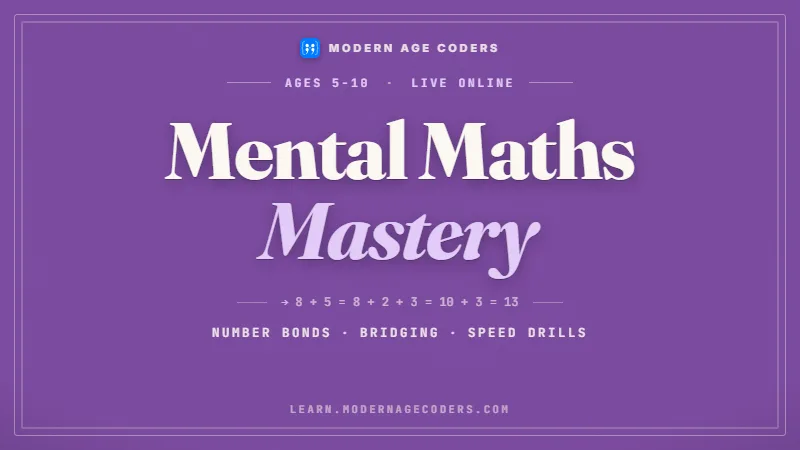
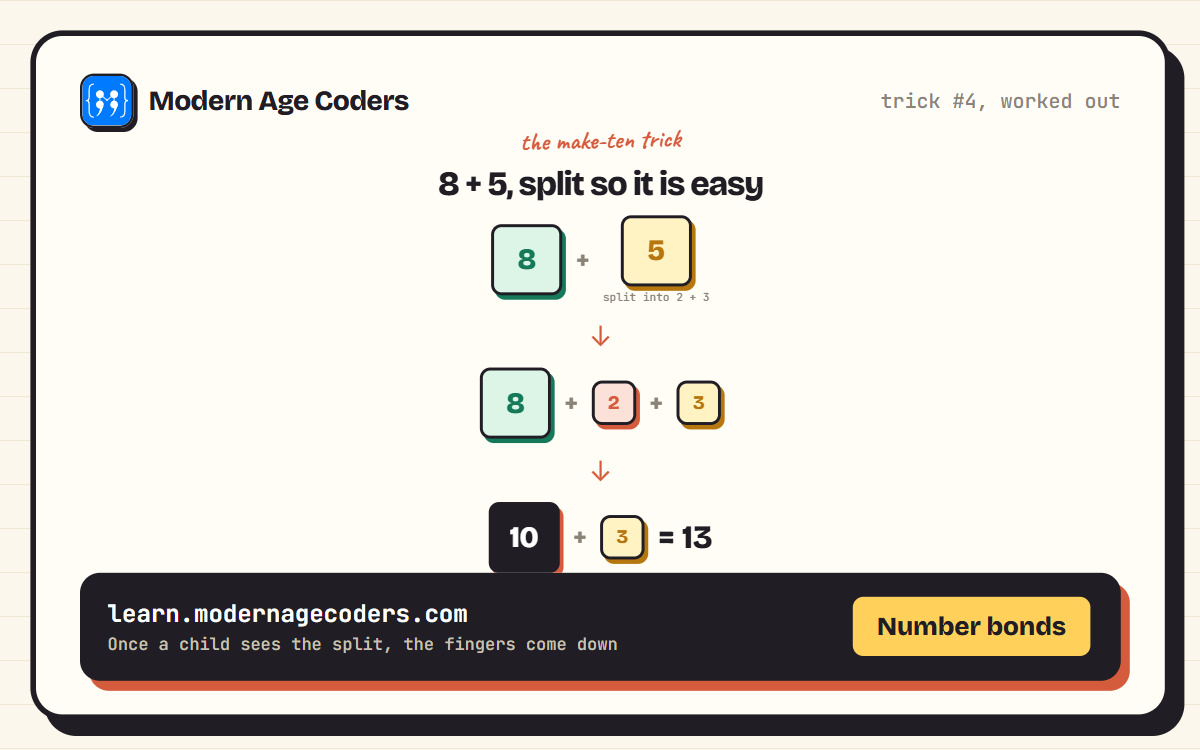
| Make ten first | 8 + 5: move 2 from the 5 onto the 8 to make 10, then add the remaining 3 to get 13 | Ten is the easiest number to build onto in a base-10 system |
| Shift for 10, 100, 1000 | 34 x 100 = 3,400 | Understanding place value turns multiplication into moving digits, not a memorised rule |
| The nine times trick | 9 x 8: 8x10=80, subtract 8 to get 72 | Nine is one less than ten, so subtract the number instead of multiplying by 9 directly |
| Halve and double | 5 x 16: double the 5 to 10, halve the 16 to 8, then 10x8=80 | Doubling one factor and halving the other keeps the product the same but easier to hold in your head |
| Add from the left | 342 + 156: 300+100=400, 40+50=90, 2+6=8, total 498 | Mental maths naturally starts with the biggest place value, unlike written column addition |
| Use money and time | Quarter past three plus 20 minutes is twenty-five to four | Clocks and coins are a built-in physical model for fractions and multiples |
| Estimate first | 297 x 4: round to 300x4=1,200, so an actual answer of 1,188 looks right | A rough check catches a slipped digit before it becomes a wrong answer written down |
A short daily practice plan by age
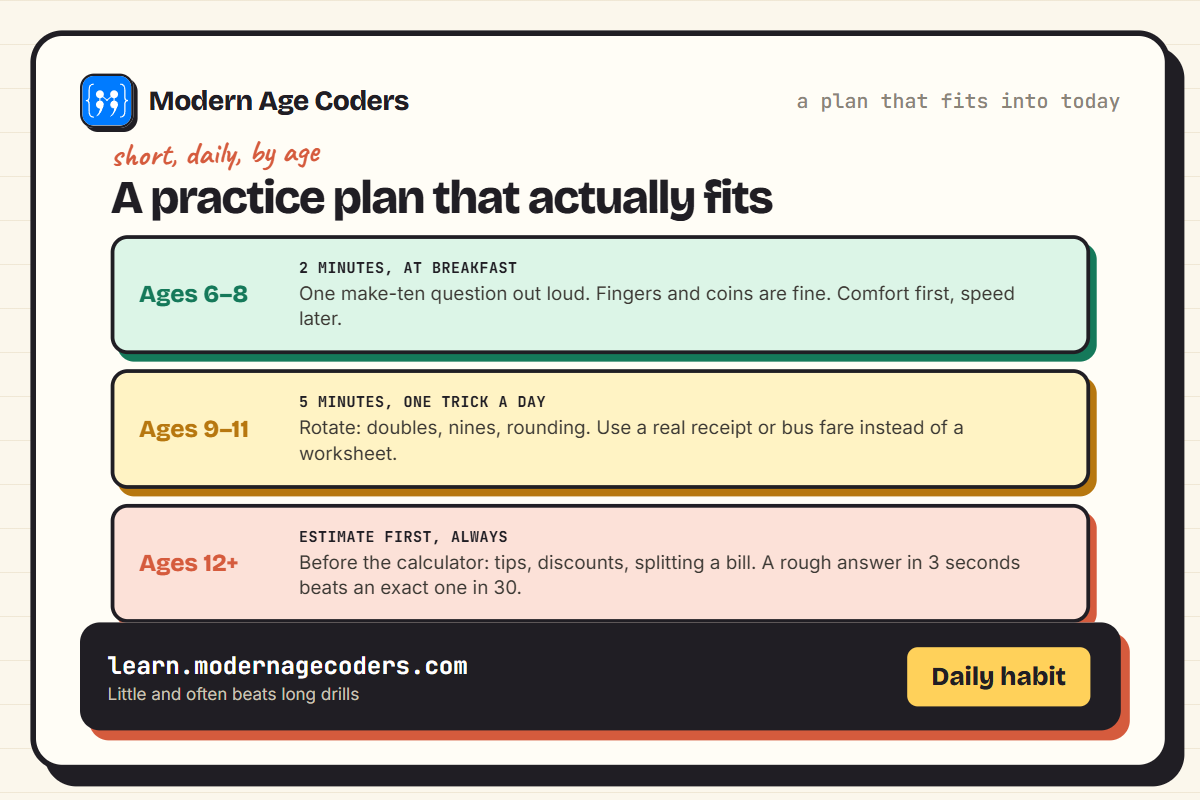
- Ages 6 to 8: Two minutes at breakfast. Ask one make-ten question out loud, and let them use fingers or coins on the table. The goal at this age is comfort with the idea, not speed.
- Ages 9 to 11: Five minutes, one trick a day, in rotation. Monday is doubles, Tuesday is the nine times trick, Wednesday is rounding. Use a real receipt or a bus fare as the practice sum instead of a worksheet when you can.
- Ages 12 and up: Before reaching for a calculator, ask for an estimate first, then let them check the exact answer against it. Mental maths at this age is most useful for tips, discounts, and splitting a bill, real situations where a rough number in three seconds beats an exact number in thirty.
How to practise them
Little and often beats long drills. Play quick number games in the car, add up the shopping together, or ask a fun mental sum at breakfast. Keep it playful and pressure-free, and never put a child on the spot in front of others. The goal is for these ways of thinking to become second nature, which happens through relaxed, repeated use, not timed tests.
Times tables deserve their own plan. Our guide to how to learn times tables fast shows why only 21 of the 144 facts need real memory work, the order to learn the tables in, and a five-minute daily card method.
Common mistakes that undo mental maths practice
- Turning it into a timed test: a stopwatch teaches anxiety, not number sense. Speed should be a side effect of understanding, never the goal of a session.
- Teaching the trick without the why: a trick taught as a blind rule is just one more thing to memorise and forget. Always show the reasoning underneath it, even if it takes longer the first few times.
- Comparing siblings or classmates on speed: number sense grows at different paces for different children, and comparison usually just teaches a child to dread the subject.
- Skipping written maths entirely: mental tricks support paper methods for long or multi-step problems, they do not replace them. A child still needs to know how to work through a problem on paper.
- Practising in only one context: a worksheet is fine sometimes, but real-life use, shopping, cooking, scorekeeping in a game, is what makes a trick actually stick.
Why understanding still comes first
Notice that every trick above is really a way of understanding numbers, not a shortcut to memorise blindly. That is the difference between mental maths that helps and mental maths that becomes another thing to forget. A child who understands why the trick works can adapt it to any problem. A child who just memorised steps is stuck the moment the numbers change. Speed is a lovely side effect. Understanding is the real goal.
The same is true of division. Children who understand it as sharing and grouping, and can see it in an array, find the mental shortcuts natural. Our guide to explaining division to a child starts there.
Children do not need another app that teaches them to copy code. They need a mentor who teaches them to think.
, Shivam Khemka, Founder of Modern Age Coders
The bottom line
The best mental maths tricks for kids build number sense: break numbers apart, round and adjust, use doubles, and spot patterns, each backed by a worked example a child can actually picture. Practise them playfully, little and often, and keep understanding at the centre. Modern Age Coders teaches maths for real understanding, live and in small batches for ages 6 to 67, and is rated 4.9 across 547 Google reviews. There is a free demo class before you pay.
Frequently Asked Questions
The best ones build number sense: breaking numbers apart, rounding and adjusting, using doubles and near-doubles, making ten first, and spotting patterns in tens and nines. Each is really a way of understanding how numbers work, so a child can rearrange them into something easy to calculate in their head.
Practise little and often through games and everyday moments rather than long timed drills. Play quick number games, add up the shopping together, and estimate before calculating. Speed grows naturally when the underlying number sense is strong, so focus on understanding the tricks, not just memorising them.
The good ones are not. Each is a way of understanding how numbers behave, which lets a child adapt it to any problem. A child who only memorises steps gets stuck when the numbers change, while one who understands the trick can use it flexibly. That is why understanding always comes before speed.
Simple mental maths starts young, as soon as a child is comfortable with basic numbers, and it grows with them. Keep early practice playful and hands-on, using money, games and everyday sums. There is no rush; the aim is a relaxed, growing feel for numbers, not pressure to perform.
Yes, when they are built on understanding. Strong number sense makes school maths easier and faster, and estimating helps a child spot unreasonable answers. But mental tricks support school maths rather than replace the reasoning and problem solving that exams mostly test, so understanding remains the priority.
No. Mental tricks are for numbers a child can hold in their head, usually two or three digits. Written methods and calculators are still the right tool for long, multi-step problems. Mental maths sits alongside them, not instead of them, and strong number sense actually makes written maths faster and more accurate too.
Vedic maths and the abacus are structured systems with their own formal techniques, usually taught as a dedicated course. The tricks here are lighter, meant to build number sense in five minutes a day rather than a full curriculum. Read our comparison of abacus, Vedic maths, and mental maths if you are deciding between the three.