Coding and maths reinforce each other: maths builds the logic and problem solving that coding puts into action, and coding makes abstract maths concrete by turning it into things that run. You do not have to choose between them. Modern Age Coders teaches coding and maths together for ages 6 to 67, in small live batches.
“Children do not need another app that teaches them to copy code. They need a mentor who teaches them to think.”
Coding, maths, or the course that refuses to choose.
 The fusion
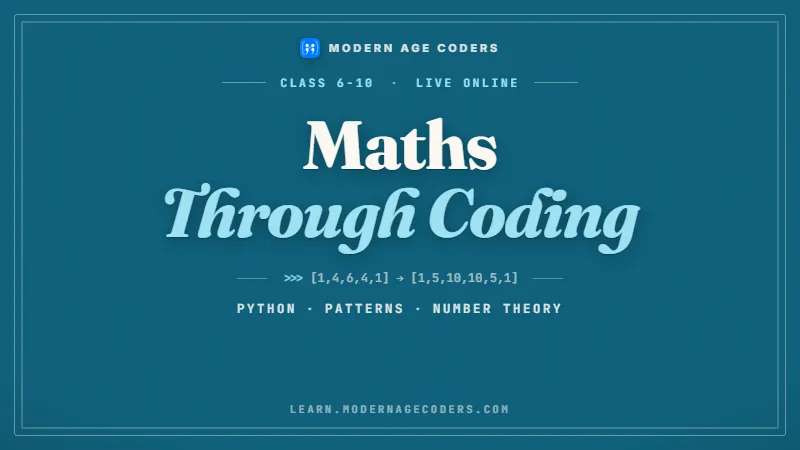
Maths Through Coding
The thesis as a course: learn maths by building it in Python, fraction machines, turtle geometry, probability sims.
$100/mo group · $150/mo 1-on-1
View course & enroll
Python & AI for Kids
The coding-first door: real text code taught gently, with the maths smuggled in through projects.
$100/mo group · $150/mo 1-on-1
View course & enroll
Middle School Mathematics Mastery
The maths-first door: the make-or-break school years taught for ownership, coding connections included.
$100/mo group · $150/mo 1-on-1
View course & enrollNeither "wins": coding and maths train the same underlying muscle, structured, logical, creative problem-solving, from two directions. Coding makes ideas touchable and motivating; maths makes them rigorous and general. Which first? Follow the current need: school maths hurting means maths first (confidence there lifts everything); curiosity burning means coding first (the motivation engine is free). Best of all worlds: both, or our fusion course where children learn maths by programming it.
The rivalry is a scheduling problem wearing a philosophy costume.
The question is really "we have budget and evenings for one activity, which?", and it deserves a straight answer, which we give below. But first the false premise needs naming: the subjects are not rivals, and treating them as rivals is how children end up half-equipped.
A programmer without number sense writes code that runs and lies, wrong formulas, unchecked edge cases, probability misread. A maths student without computation lives in a world where their knowledge cannot touch anything. Every field your child might love, AI, games, engineering, finance, science, sits exactly on the overlap.
We built the school on this overlap: every mentor here teaches both subjects. It is why our maths classes can turn probability into a dice simulator your child programs, and our coding classes quietly rebuild fraction sense inside a scoring system. One teacher, one method, two subjects that keep shaking hands.
So the honest version of "coding vs maths" is not a versus at all. It is a sequencing question, which door to open first, and that depends on your child's current state, mapped honestly below.
What each one actually trains.
| Dimension | Coding trains… | Maths trains… |
|---|---|---|
| Thinking style | Decomposition: breaking big problems into steps a machine can follow | Abstraction: seeing the general pattern inside specific cases |
| Feedback loop | Instant and honest: code runs or it does not, and the computer never flatters | Slower and deeper: proofs and multi-step problems build patience for delayed payoff |
| Creativity | Expressive: games, apps and art that exist because your child imagined them | Structural: elegance, the "aha" of a beautiful argument, the pleasure of certainty |
| Resilience | Debugging: error messages as clues, failure as information | Being stuck productively: sitting with a hard problem without panic |
| School payoff | Indirect but real: logic, precision and confidence that leak into every subject | Direct: the grades gatekeeping every next academic door run through maths |
| Motivation source | Built-in for most kids: they already love the artifacts (games, apps) | Must usually be built, which is exactly what understanding-first teaching does |
Read the table twice and the secret shows: the columns are complementary halves of one education. Decomposition plus abstraction, instant feedback plus patience, expression plus rigor, that pairing is the whole game.
Which first: the decision table we use on real calls.
| Your child right now | Start with | Why |
|---|---|---|
| Struggling or anxious at school maths | Maths first | School maths pain compounds monthly and gates future doors; fixing it lifts confidence everywhere, including future coding |
| School maths fine, curiosity burning for games and screens | Coding first | The motivation engine is already running; point it at building, and the logical habits feed back into maths quietly |
| Ages 10-15, bored by worksheets, loves building | The fusion: Maths Through Coding | Maths arrives wearing a project the child wants to build; the computer rejects vague understanding, so depth is forced honestly |
| Strong at both, hungry for more | Both, one slot each | Two hours a week, two subjects, one mentor style; this is our most common two-slot pattern |
| Exam year approaching (SAT, GCSE, boards) | Maths first, coding after the exam | Sequencing honesty: the exam calendar wins, and coding makes a great post-exam reward that keeps momentum |
Unsure which row is yours? That is what a Priority Demo reads: one hour with a mentor who teaches both, ending in a straight recommendation.
One small project, both subjects, no seam.
results = [0] * 13
for roll in range(10000):
dice = random.randint(1,6) + random.randint(1,6)
results[dice] = results[dice] + 1
for total in range(2, 13):
print(total, ":", "#" * (results[total] // 100))
The setup: two siblings argue whether rolling a 7 or a 12 is likelier. The mentor suggests settling it with ten thousand rolls, which the child then programs.
What just happened, in both columns: the coding column got loops, lists, indexing and a text-graph; the maths column got sample spaces, frequency versus probability, and the discovery that 7 has six ways and 12 has one, read directly off their own histogram. Neither subject was the garnish. That is the fusion working.
Scale this pattern across a year, coordinates through game maps, fractions through scoring systems, algebra through function machines that literally ARE functions, and you get a child for whom the two subjects were never separate. Which was, historically speaking, always the truth: the first programmers were mathematicians who wanted their ideas to run.
Everything parents ask about coding versus maths.
Which is more important for my child's future: coding or maths?
Maths gates the academic doors (every selective program checks it); coding compounds into the building skills modern careers run on. The honest answer is that the future your child probably wants, AI, engineering, science, games, finance, sits on the overlap, which is why we teach them as one muscle rather than rivals.
Does coding actually improve maths performance?
In our classrooms, visibly, when taught deliberately: coordinates become geometry, scoring becomes arithmetic and fractions, simulations become probability, and the computer's refusal to accept vague understanding forces the depth school worksheets cannot. One of our most-quoted parent reviews says exactly this about her son. What does not work is assuming any coding class does this automatically, the maths connection has to be taught, which is why our mentors teach both subjects.
My child loves coding but hates maths. Force the maths?
Do not force, smuggle. This exact child is who our fusion approach exists for: the maths arrives inside projects they already want to build, and hatred usually turns out to be a reaction to worksheets, not to mathematics. Within months the child is doing coordinate geometry voluntarily, because their game needed it.
My child is great at maths but shows no interest in coding. Is that fine?
Completely, and also worth one experiment: mathematically strong children often light up when they discover code is the best maths toy ever built, proofs they can run, patterns they can generate. One Priority Demo settles whether the spark exists; if not, deeper maths (competition tracks, advanced courses) is a wonderful road on its own.
Is coding just maths in disguise? My child is young and weak at maths.
Starting coding does not require strong maths, Scratch at age 6-9 needs no more than counting and comparing. The relationship flows the other way: the sequencing, logic and precision built in coding become soil that later maths grows in more easily. Weak maths is a reason to start coding gently, not to wait.
What do the two tracks cost, and why the difference?
The fees for private 1-on-1 and small-group classes are shown in your own currency in the pricing section. Billing is monthly, there is no contract and you can cancel any time.
Can one child do both without overload?
Comfortably: it is two hours of live class a week plus light quests, and the subjects reinforce rather than compete, the same mentor style, often the same mentor. It is our most common two-slot pattern, and children experience it as one education, not two activities.
Who teaches, that they can handle both subjects?
Mentors hired and trained for exactly this dual fluency, it is the school's founding requirement, not a lucky accident. Meet them on the team page, and watch them teach both subjects in the recorded classes on How We Teach.
Both roads, and the bridge between them.
One hour with a mentor who teaches both. Then you will know.
Book a Priority Demo. The mentor reads your child across both subjects and recommends a door plainly, coding first, maths first, or the fusion. No pressure, and the honest answer either way.
Real student projects
What our students actually build
Every one is a real, live project shipped by a Modern Age Coders student. Explore more in Student Labs.
 ToolImage Slider WebsiteA visually appealing site with a smooth image carousel, auto or manual navigation, responsive layout and beautiful transition effects.by SomrajOpen the live project ↗
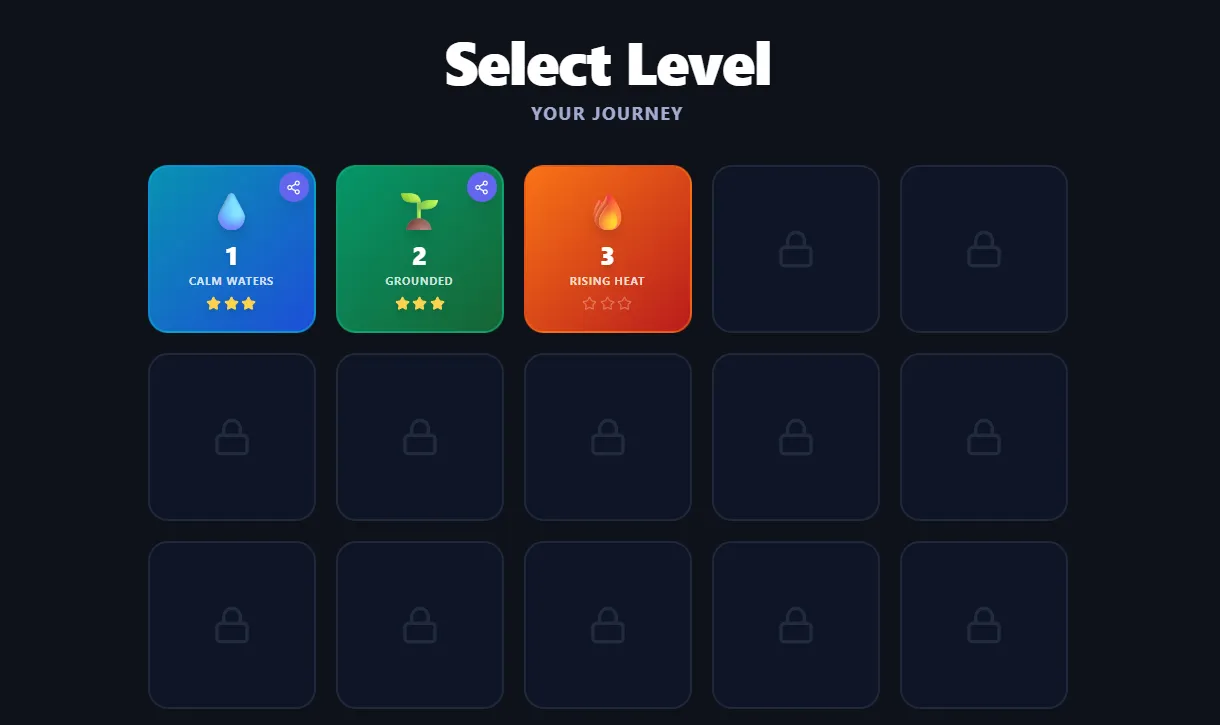 GameThe Beautiful MindA scientifically designed focus and brain-strength game with 15 progressive levels, testing attention, control and mental endurance with real-time progress tracking and leaderboards.by Modern Age CodersOpen the live project ↗
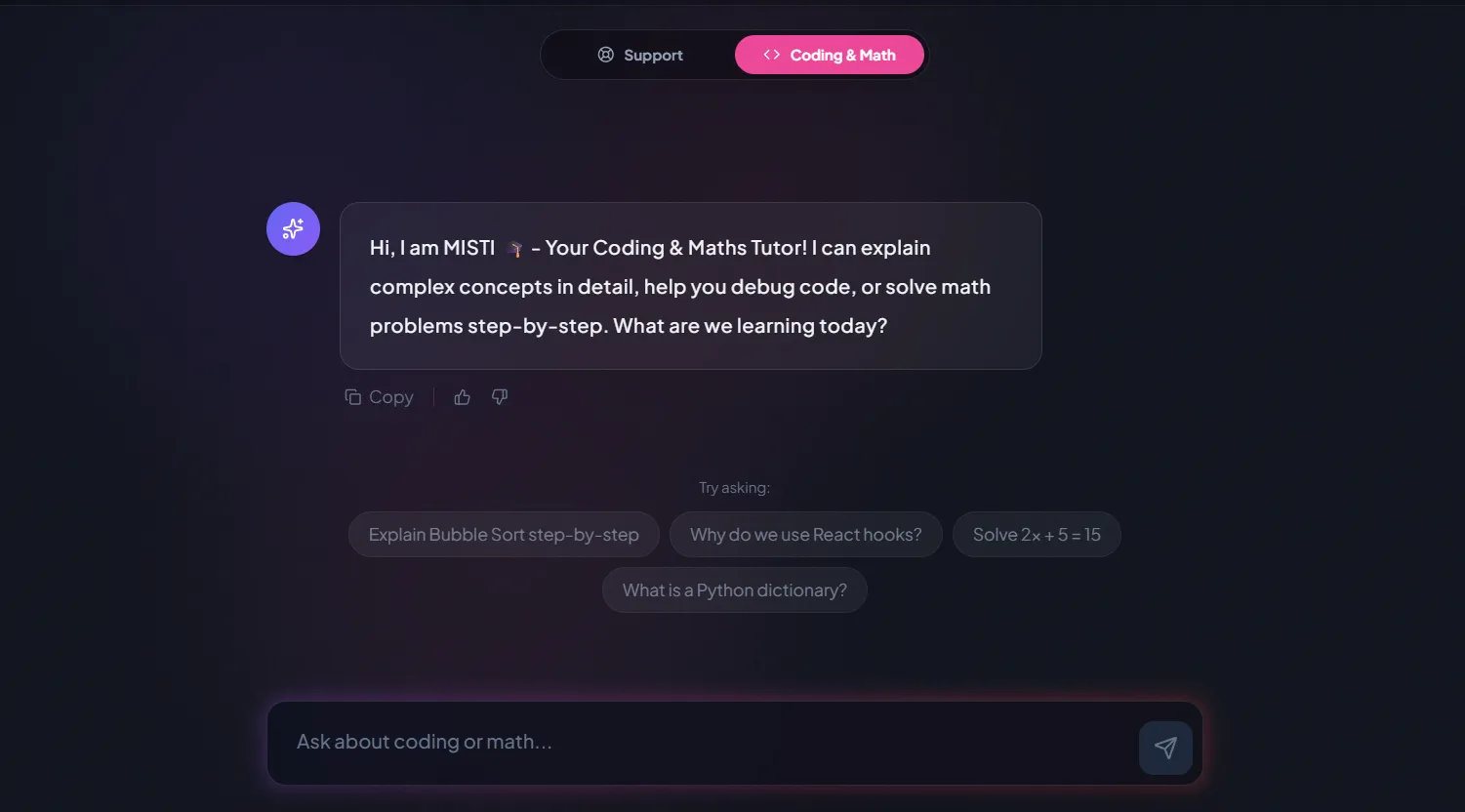 AI & MLMisti: AI Chatbot for Maths & CodingAn intelligent AI-powered chatbot that helps students solve maths and coding questions with deep, step-by-step explanations using advanced Python AI frameworks and LLM APIs.by HarshitOpen the live project ↗
Parent & student voices
What our families say
Real, verified reviews from Modern Age Coders families. Read hundreds more on our Wall of Love.
“I absolutely love it here! I made new friends and learned important valuable coding skills while having the fun of my life. It's not just coding here, it's outings, bonding and most importantly preparing you for your future. Definitely five stars.”
Student
“I am really glad to be a part of Modern Age Coders as it helped me a lot to know what coding means and helped me find myself. I thank Shreya Ma'am, Mihir Sir and Shivam Sir for always being there for me and for showing me the real path for success.”
Student
“Very good classes. Makes learning very easy and interactive.”
Parent
More comparisons
See how Modern Age Coders compares with other programmes, and how coding and maths learning paths differ.
- Coding vs Programming
- Modern Age Coders vs Codingal
- Modern Age Coders vs Cuemath
- Modern Age Coders vs Juni Learning
- Modern Age Coders vs Kumon
- Modern Age Coders vs Mathnasium
- Modern Age Coders vs Outschool
- Modern Age Coders vs Tynker
- Modern Age Coders vs WhiteHat Jr, Cuemath & Codingal
- Private Tutor vs Online Tutoring