KS2 SATs Maths: Arithmetic, Reasoning and Times Tables
Instant times tables, a calm arithmetic paper and reasoning answers that show their thinking, built up over eight months rather than crammed in April.
Syllabus updated October 2026
Questions? WhatsApp +91 91233 66161 or email connect@modernagecoders.com
Recordings are free with a Google sign-in. These recordings show how we teach, not the exact syllabus of this course.
Our promise
The world's best learning experience, open to everyone.
- World-class instructorsEvery class is taught by an instructor who specialises in that exact field.
- No compromise on qualityEvery lesson, project and piece of feedback is held to the highest standard.
- Education for everyoneLearners aged 6 to 67, from first-time beginners to working professionals, in 25+ countries.
If you want the highest quality, Modern Age Coders is the right choice.
Book a Priority DemoHow long this course takes
This course runs 8 months (32 weeks), timed to finish before the May tests at 2 live classes/week + 20 minutes of practice on most days. The range allows for background and pace: a complete beginner uses the full span, and a student with prior knowledge finishes sooner. The syllabus below is planned to the shorter end, with margin kept for revision.
For personalised duration planning, call +91 91233 66161 and we'll map a schedule to your goals.
At a glance
- Who it is for
- Children in Years 4, 5 and 6 at primary schools in England, ages 8 to 11.
- Prerequisites
- Working on Year 4, 5 or 6 maths at school. The first week's diagnostic shows where each child is, and the plan starts from there
- Format
- Live, interactive classes with a real teacher, never pre-recorded videos. Live classes run about one hour.
- Language
- English or Hindi, depending on the batch.
- Duration
- 8 months (32 weeks), timed to finish before the May tests
- Weekly commitment
- 2 live classes/week + 20 minutes of practice on most days
- Class size
- Group batches of 15 to 20 students, mini batches of up to 6, or 1-on-1.
- Certificate
- Course-completion certificate from Modern Age Coders
- Watch first
- Free recordings of real classes for ages 6 to 12, free with a Google sign-in. These recordings show how we teach, not the exact syllabus of this course.
- Live demo
- Optional. Enrol directly on this page, or book a Priority Demo: a full live class of about 45 to 60 minutes with a mentor reserved for you.
- Questions
- WhatsApp +91 91233 66161 or email connect@modernagecoders.com.
How we teach
Deep understanding. Real projects. Expert guidance.
Learn coding, AI and maths through careful explanations, practical demonstrations, and hands-on problem-solving. Our instructors guide you from the foundations to advanced ideas, helping you understand what happens, why it happens, and how to build it yourself.
You will explore concepts step by step, write and improve code, investigate mistakes, ask questions, and apply your knowledge to meaningful projects. Lessons are designed around active participation, thoughtful feedback, and growing independence.
Expert-led live teaching, with practical participation built into every lesson.
- Students explain their thinking.
- Instructors demonstrate, then guide practice.
- Learners code, solve, or build during lessons.
- Questions and misconceptions get attention.
- Assignments receive useful feedback.
- Progress is checked before advancing.
How to join KS2 SATs Maths: Arithmetic, Reasoning and Times Tables
Four steps from this page to the first class. See a full class first with a Priority Demo, or choose a plan and enrol today.
Rated 4.9 across 547 Google reviews. Monthly billing, cancel any time.
How enrolment works
See a full class first (optional)
Book a Priority Demo: a live class of about 45 to 60 minutes with a mentor reserved for you, today or tomorrow. After the class the mentor sends a written skill report and a personal learning roadmap on WhatsApp. If you enrol, the demo fee is adjusted against your first month's fee. Share your demo Order ID with us on WhatsApp and we take it off.
Book a Priority DemoDemo fee ₹499Choose a plan
Group batch (15 to 20 students), mini batch (up to 6 students, India only) or 1-on-1 with your own mentor. Every plan is live online, and each class runs about one hour. The cards below show classes per week and the monthly fee in your currency.
Enrol and pay the first month
Press Enrol Now on your plan, fill in the student's name, email and phone, and pay through secure Razorpay checkout: UPI, cards or net banking in India, and debit or credit card from any other country.
Fix your class timings
After payment, message us on WhatsApp or call +91 91233 66161 with the student's name, the course and your preferred time slot. We confirm the batch, send the class link and schedule the first class at your chosen time.
Billing is monthly and you can cancel any time.
International Students (Outside India)
Billed monthly in US dollars, the same price in every country. Contact us with any questions.
Questions before you enrol? Talk to our team.
Ask about class timings, the right level for your child, what they need to know already, or payment. Parents and adult learners can reach us on WhatsApp, by email or by phone.
Program Overview
The key stage 2 maths test is three papers. The test framework sets them out plainly: Paper 1 is arithmetic, 40 marks in 30 minutes, and Papers 2 and 3 are mathematical reasoning, 35 marks and 40 minutes each, so 110 marks across 110 minutes in total. In 2027 the maths papers are timetabled for Wednesday 12 May (Papers 1 and 2) and Thursday 13 May (Paper 3). Results come back as a scaled score between 80 and 120, and a score of at least 100 meets the expected standard.
Underneath all of it sit the times tables. The national curriculum expects children to have memorised the tables up to 12 by the end of Year 4, and the multiplication tables check tests exactly that: 25 questions, six seconds each, taken in June of Year 4. A child who still counts up in fives to find 7 times 5 loses time on every paper, so this course starts there.
The course runs in four phases: times tables to instant recall, the arithmetic paper method by method, the reasoning papers question type by question type, and finally full papers under real timing. Classes are live and small, so the teacher sees each child's working, not just the answer, and parents get a short written note every month on what has moved and what is next.
What Makes This Program Different
- Built from the government's own key stage 2 mathematics test framework: the three papers, their marks and timings, and the resource list children actually use
- Times tables first, because the multiplication tables check and every SATs paper lean on instant recall
- The arithmetic paper taught as a set of written methods, each practised until it is automatic and checked
- Reasoning taught by question type: multi-step word problems, explain-your-answer questions, measures, geometry and statistics
- Full papers under real timing in the last two months, marked against the published mark schemes
- Calm by design: short daily practice and clear progress notes for parents, not late-night cramming
Your Learning Journey
Career Progression
Detailed Course Curriculum
Explore the complete week-by-week breakdown of what you'll learn in this comprehensive program.
Topics Covered
- A short diagnostic: which facts are instant, which are counted, which are guessed
- The 2, 5 and 10 tables and the patterns that make them quick
- Doubling to reach the 4 and 8 tables
- Commutativity: why learning 3 times 7 also gives 7 times 3
- The 11 table and its pattern up to 11 times 9
- A personal fact chart: green for instant, amber for slow, red for unknown
Projects You Build
- Fact chart started: every fact up to 12 by 12 coloured by speed after the diagnostic
Practice & Assignments
Ten minutes of mixed facts on most days, focusing on amber facts
Topics Covered
- The 3, 6 and 9 tables and how they connect
- The 7 table, the one most children find hardest, with memory hooks
- The 12 table built from the 10 and 2 tables
- Square numbers up to 12 by 12
- Spotting which facts are still slow and why
- Using known facts to work out unknown ones
Projects You Build
- Fact chart updated: amber and red facts listed with a hook for each
Practice & Assignments
Daily mixed practice weighted towards the 6, 7, 8 and 12 tables
Assessment
Month 1 check: 25 mixed facts, untimed, then the same 25 timed
Topics Covered
- Division facts from each table, read the other way
- Missing number questions such as 6 times something equals 42
- Fact families: four facts from three numbers
- Multiplying by 10 and 100 using place value
- Scaling a known fact: from 3 times 4 to 30 times 4
- Recognising factors and multiples
Projects You Build
- Fact family cards made for the ten facts the child finds slowest
Practice & Assignments
Mixed multiplication and division facts with a short timer
Topics Covered
- Practice in the multiplication check format: 25 questions, six seconds each
- Typing answers quickly and accurately on a keyboard or tablet
- Staying calm when one fact is missed and moving to the next
- Re-testing every fact that was amber in month 1
- Using tables inside short calculations
- Keeping recall instant with five minutes a day
Projects You Build
- Fact chart completed: the aim is every fact green
Practice & Assignments
Three short timed checks a week in the check format
Assessment
Month 2 check: a full 25-question timed check, scored out of 25
Topics Covered
- Place value to ten million and reading large numbers
- Column addition with several carries
- Column subtraction with exchanging across zeros
- Adding and subtracting decimals by lining up the point
- Estimating before calculating to catch slips
- Inverse operations as a check
Projects You Build
- Method book started: one worked example per method, written by the child
Practice & Assignments
20 column calculations a week, each checked by estimation
Topics Covered
- Short multiplication by a one-digit number
- Long multiplication by a two-digit number
- Short division, including remainders
- Long division by a two-digit number
- Order of operations with brackets
- Choosing a mental method when the numbers allow it
Projects You Build
- Method book entry: long multiplication and long division set out step by step
Practice & Assignments
15 multiplication and division calculations a week
Assessment
Month 3 test: a half-length arithmetic paper, 20 marks in 15 minutes
Topics Covered
- Equivalent fractions and simplifying
- Adding and subtracting fractions with different denominators
- Mixed numbers and improper fractions
- Multiplying fractions, including by a whole number
- Dividing a fraction by a whole number
- Fractions of amounts
Projects You Build
- Method book entry: every fraction method with a worked example
Practice & Assignments
20 fraction calculations a week, answers simplified
Topics Covered
- Multiplying and dividing decimals by 10, 100 and 1000
- Multiplying a decimal by a whole number
- Percentages of amounts
- Squares, cubes and simple powers
- Working through a full arithmetic paper in 30 minutes
- Checking strategy for the last five minutes
Projects You Build
- Arithmetic tracker: score and time recorded for every practice paper
Practice & Assignments
One full arithmetic paper a week under timing
Assessment
Month 4 test: a full arithmetic paper, 40 marks in 30 minutes, marked and reviewed
Topics Covered
- Reading a word problem twice and finding the question
- Bar models for comparison and part-whole problems
- Multi-step problems that combine two or three operations
- Ratio and scaling problems
- Simple algebra: missing numbers and formulae in words
- Showing working so method marks are possible
Projects You Build
- Problem journal started: one solved problem per question type with a bar model
Practice & Assignments
10 word problems a week, each with a written plan before the calculation
Topics Covered
- Converting units of length, mass and capacity
- Money problems with change and value-for-money comparisons
- Reading and calculating with time, including timetables
- Perimeter and area of rectangles and compound shapes
- Area of triangles and parallelograms
- Volume of cuboids
Projects You Build
- Problem journal entry: a measures question for each unit type
Practice & Assignments
12 measures questions a week in reasoning-paper style
Assessment
Month 5 test: a 20-minute reasoning section, marked against a published scheme
Topics Covered
- Angles on a line, around a point and in triangles and quadrilaterals
- Measuring and drawing angles with a protractor
- Properties of 2-D and 3-D shapes, including circles
- Coordinates in four quadrants, translations and reflections
- Reading line graphs, tables and pie charts
- Calculating and interpreting the mean
Projects You Build
- Problem journal entry: geometry and statistics questions with labelled diagrams
Practice & Assignments
12 geometry and statistics questions a week
Topics Covered
- Explain-your-answer questions and what a full answer includes
- Always, sometimes or never true statements
- Spotting and correcting a mistake in someone else's working
- Checking that an answer is sensible in context
- Mixed reasoning sets that do not announce their topic
- Pacing a 40-minute paper
Projects You Build
- Explanation bank: model answers to ten explain questions, written in the child's own words
Practice & Assignments
One full reasoning paper a week under timing
Assessment
Month 6 test: a full reasoning paper, 35 marks in 40 minutes, marked and reviewed
Topics Covered
- A full set: arithmetic paper, then both reasoning papers on separate days
- Marking against the published mark scheme
- Sorting lost marks: recall, method, reading or carelessness
- Re-teaching the two weakest areas
- Times tables kept instant with short warm-ups
- Using the resource list: ruler, protractor and mirror
Projects You Build
- Paper tracker: scores for each paper on one chart
Practice & Assignments
One full set of three papers each fortnight
Topics Covered
- Short lessons on each child's own weak spots, taken from the tracker
- Arithmetic speed drills on the slowest methods
- Reasoning questions of the types most often dropped
- Reading questions aloud in the head before answering
- Leaving and returning to a hard question
- Checking answers in the final minutes
Projects You Build
- Repair list: each weak area with the date it was fixed
Practice & Assignments
Focused sets on two weak areas a week
Assessment
Month 7 checkpoint: a second full set of three papers, marked
Topics Covered
- A final full set under real timing
- Review of every lost mark
- Mixed practice from the repair list
- Arithmetic in under 30 minutes with checking time left
- Reasoning pacing: 40 minutes per paper
- Confidence from seeing the tracker rise
Projects You Build
- Paper tracker completed
Practice & Assignments
Short daily mixed practice, no all-day sessions
Topics Covered
- Light revision of methods from the method book
- Times tables warm-ups
- What to expect on each day of test week
- Sleep, breakfast and a normal routine
- A short talk with parents about keeping test week low-pressure
- Planning maths for the summer and Year 7
Projects You Build
- Finished method book, problem journal and explanation bank, kept for Year 7
Practice & Assignments
Ten minutes a day of light, familiar practice
Assessment
Final review with the teacher and a written note for parents
Projects You'll Build
Build a professional portfolio with A complete SATs maths kit: fact chart, method book, problem journal, explanation bank and paper trackers real-world projects.
Weekly Learning Structure
Certification & Recognition
Technologies & Skills You'll Master
Comprehensive coverage of the entire modern web development stack.
Support & Resources
Career Outcomes & Opportunities
Transform your career with industry-ready skills and job placement support.
Prerequisites
Who Is This Course For?
Career Paths After Completion
Course Guarantees
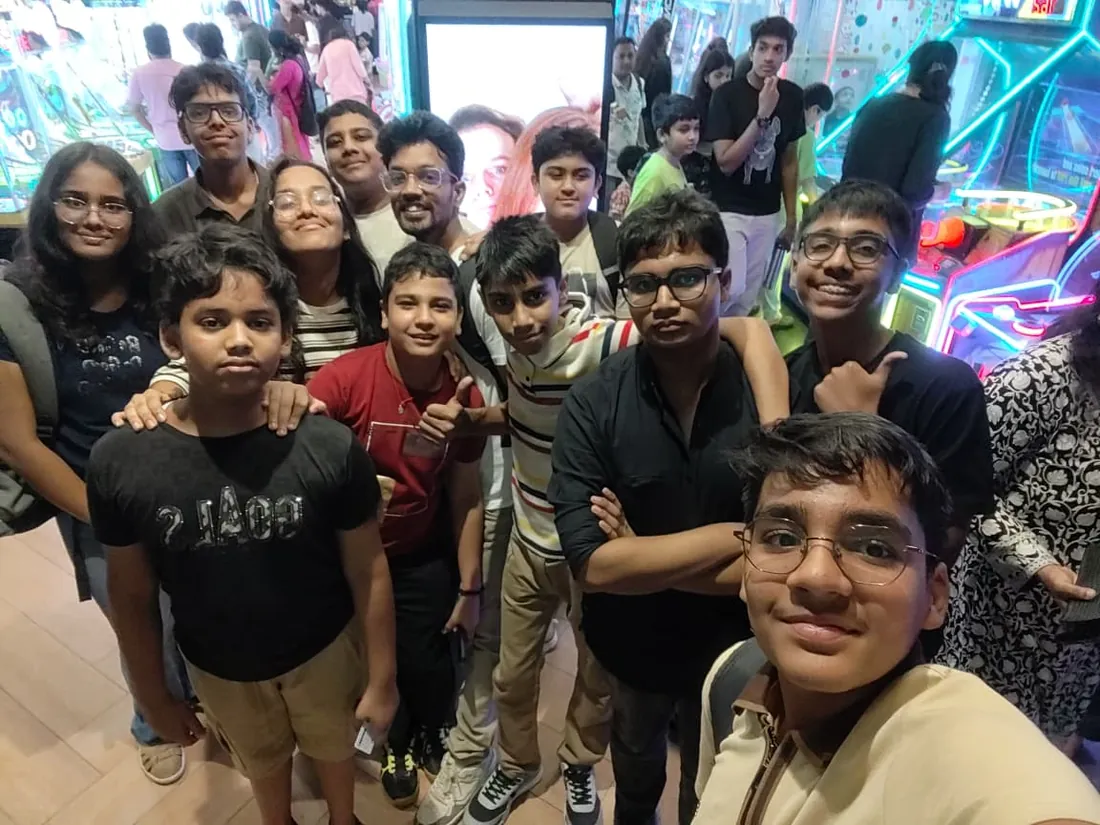
Real students. Real moments. Real joy.
These are our actual student meetups. No stock photos, no filters. Swipe through and meet the community you'll be joining.






































What families say
Straight from the parents and students who learn with us. Rated 4.9 across 547 Google reviews.
“Mivaan enjoys the class. He understands the concepts and completes his tasks with excitement. He started taking interest in coding… truly amazing class.”
“I absolutely love it here! I made new friends and learned important valuable coding skills while having the fun of my life. It's not just coding here, it's outings, bonding and most importantly preparing you for your future. Definitely five stars.”
“What stands out most is how excited my son is before every class. He looks forward to learning, problem-solving, and sharing what he's built. I've noticed a big boost in his confidence!”
“Modern Age Coders has been a game-changer for me! I struggled to grasp IT concepts and coding before joining, but their classes transformed everything. I'm now the topper in my class and can confidently write complex programs with ease.”
“Modern Age Coder have wonderful teachers who teach in a clear, easy and practical way. The teacher boosts students' confidence, keeps them updated with technology, and inspires them to learn without hesitation.”
“The one step solution for my son. Modern Age Coders make learning coding so simple that kids love it.”
“Coding classes here make learning very interesting and conceptual. The teachers teach us in a very easy-to-understand and efficient manner.”
“One of the most wonderful education centres out there. Education is not limited to school syllabus but focuses on skill development. Learning here has been a wonderful journey and still continuing.”
“I highly recommend this computer coding class! The teachers are incredibly knowledgeable and passionate about coding. They make every session engaging and insightful.”
“My child Dhairya is really enjoying the Modern Age Coder IT classes. This is his first online class, and he eagerly looks forward to it.”
“Very good classes. Don't worry about coding. They teach the best, especially Shivam sir.”
“Very good classes. Makes learning very easy and interactive.”
Hear it from our students
Real parents and students in their own words, on our public YouTube channel.
Straight answers about KS2 SATs Maths: Arithmetic, Reasoning and Times Tables
- Who should take this course?
- Children in Years 4, 5 and 6 at primary schools in England, ages 8 to 11. It suits year 6 children preparing for the may tests who want steady, structured practice; year 4 children getting ready for the multiplication tables check; year 5 children who want arithmetic and times tables secure a year early.
- What will they learn and build?
- The key stage 2 maths test is three papers. The test framework sets them out plainly: Paper 1 is arithmetic, 40 marks in 30 minutes, and Papers 2 and 3 are mathematical reasoning, 35 marks and 40 minutes each, so 110 marks across 110 minutes in total. In 2027 the maths papers are timetabled for Wednesday 12 May (Papers 1 and 2) and Thursday 13 May (Paper 3).
- How deeply are topics covered?
- The course runs 8 months (32 weeks), timed to finish before the May tests at 2 live classes/week + 20 minutes of practice on most days, across 4 phases listed week by week in the syllabus below. A structured plan built from the government's test framework, taught step by step.
- Who teaches it?
- Modern Age Coders mentors, who teach the live classes themselves. You can watch them at work in the free class recordings before you decide.
- How do practice, feedback and assessment work?
- Monthly checks, full arithmetic and reasoning papers, and full timed sets marked against published schemes. Doubt support for parents between classes over WhatsApp. A course-completion certificate and a finished SATs maths kit the child keeps.
- What does it cost?
- Three monthly plans: a group batch, a mini batch and 1-on-1. Prices are shown in your currency in the plans section. Monthly billing, cancel any time.
- When can classes take place?
- Live classes are scheduled around your week. Group batches meet at a fixed weekly slot; 1-on-1 students choose their own. International students are scheduled in their own timezone. Ask on WhatsApp for the current slots.
- Can I watch the teaching before deciding?
- Yes. Full recordings of real 6 to 12 classes are free to watch, free with a Google sign-in. These recordings show how we teach, not the exact syllabus of this course. Some classes are in English and some in Hindi; everyone follows at their own pace. Watch a class end to end, like you are in it. Sessions are interactive and each moment builds on the last.
- Can I enroll without a live demo?
- Yes. Choose a plan on this page and enrol directly; a demo is not required. If you would like to see a full class with a mentor first, book a Priority Demo.
- How do I reach you with a question?
- WhatsApp +91 91233 66161, email connect@modernagecoders.com, or call +91 91233 66161. Tell us the student's age and what they have learned so far, and we will point you to the right plan and batch.
Common Questions About KS2 SATs Maths: Arithmetic, Reasoning and Times Tables
Get answers to the most common questions about this comprehensive program
Still have questions? We're here to help!
Contact UsRelated Courses You May Like
Continue your learning journey with these recommended programs
 Advanced Placement Mathematics
AP Statistics: Exam Prep with the Investigative Task
Live online AP Statistics exam prep: all nine AP units, the Investigative Task, free-response rubric...
Explore Course Digital Skills for Kids
Microsoft Office for Kids: Word, PowerPoint and Excel
Microsoft Office course for kids aged 7-12: live online classes for Word, PowerPoint, Excel, OneNote...
Explore CourseRelated Articles & Guides
Deepen your knowledge with these hand-picked articles
 Mathematics
13 min read
Mathematics
13 min read
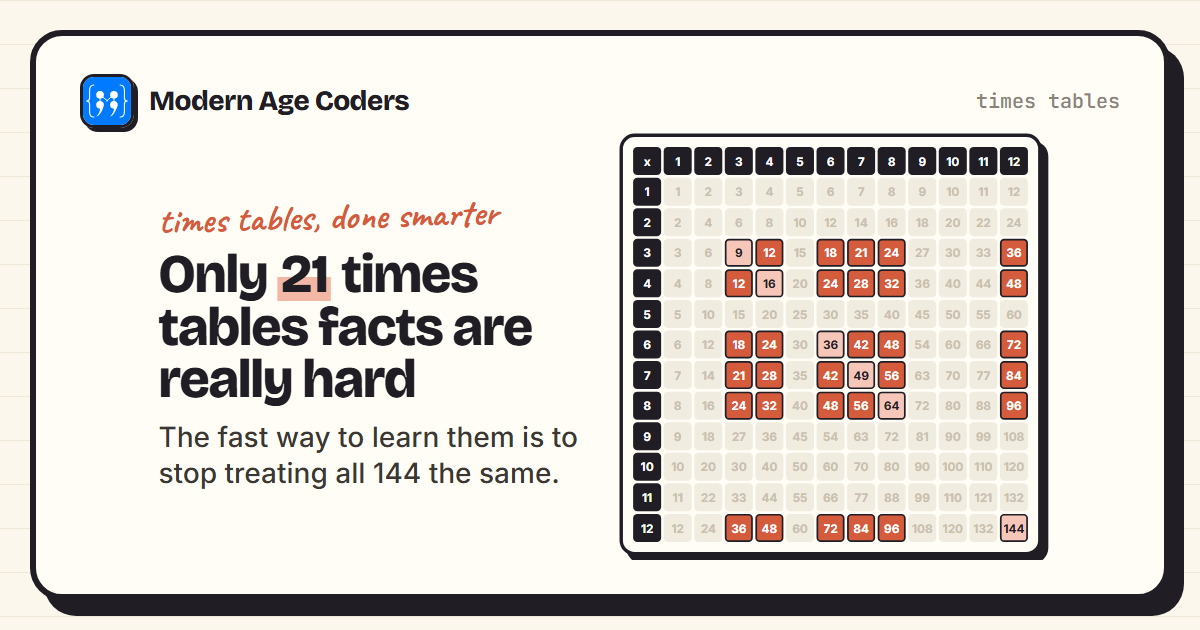
How to Learn Times Tables Fast: The 21-Fact Method
How to learn times tables fast: why only 21 facts are really hard, the best order to learn them, str...
Read Article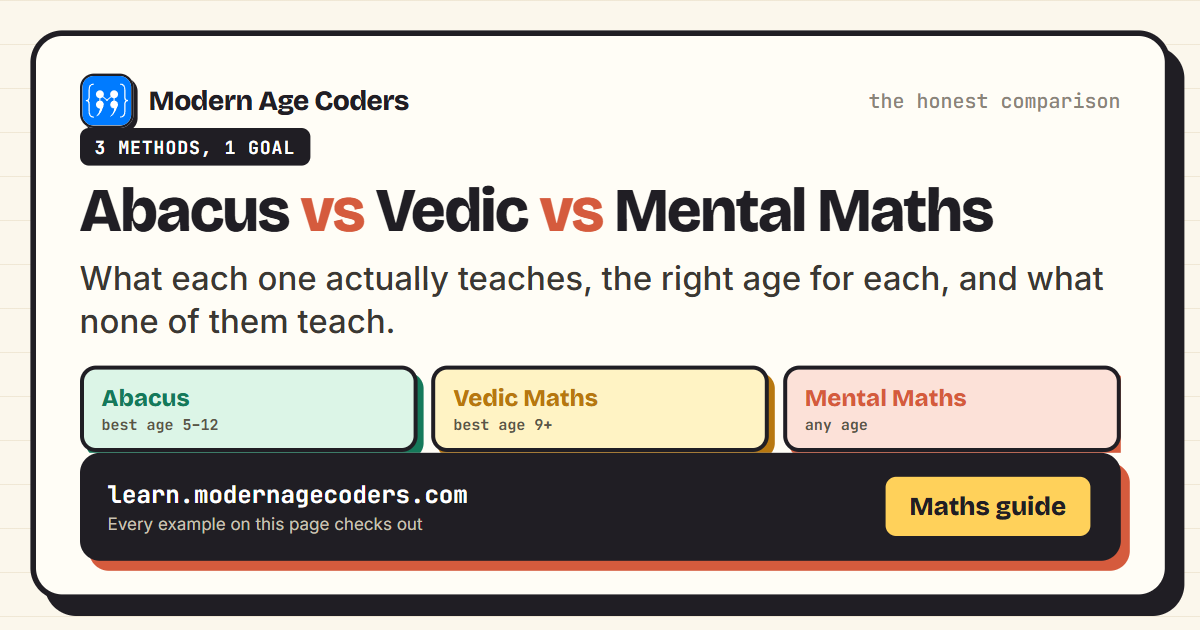 Mathematics
8 min read
Mathematics
8 min read
Abacus vs Vedic vs Mental Maths: A Clear Comparison
Abacus, Vedic maths, and mental maths compared: what each teaches, the right age, real worked exampl...
Read ArticleReady to start KS2 SATs Maths: Arithmetic, Reasoning and Times Tables?
Book a Priority Demo to see a full live class with a mentor reserved for you, today or tomorrow. Or choose a plan and enrol now.
Questions? WhatsApp +91 91233 66161 or email connect@modernagecoders.com