
Table of Contents
Watching your child struggle with maths is stressful, and it is easy to conclude they are simply not good at it. Almost always, that is the wrong conclusion. Maths struggles have specific, fixable causes, and naming the real one is most of the solution. Here are the reasons children actually struggle, how to tell them apart, and what to do about each.
The short answer
Most maths struggle comes down to one of four things: a missing earlier foundation, being pushed too fast, anxiety, or memorising steps without understanding. None of them means your child cannot do maths. Find the specific cause, address it directly, and the struggle usually eases far quicker than you would expect.
Division is a common example. Many children learn it only as times tables backwards and never meet its two meanings, sharing and grouping, so word problems stop them cold. How to explain division to a child shows how to rebuild it with objects and arrays.
Five causes, how to spot each, and the actual fix
| Cause | How to spot it | What actually fixes it |
|---|---|---|
| Missing foundation | Struggle appears on topics that build on an earlier idea, not randomly across everything | Find and fill the specific missing topic, not drill the current one |
| Taught too fast | Confusion starts right at the point the class moved to a new topic | Extra time on the missed topic at their own pace, ideally one-to-one or small group |
| Maths anxiety | Physical stress signs, blanking on material they knew yesterday, avoidance | Remove timers and pressure, praise effort, rebuild confidence with small wins |
| Memorising, not understanding | Fine with familiar question types, collapses the moment a question looks different | Rebuild understanding of why a method works, not just the steps to follow |
| Boredom or no relevance | Capable but disengaged, careless mistakes despite clearly understanding the idea | Make it concrete through games, money or code, and raise the challenge instead of repeating easy work |
Gap or anxiety? How to tell them apart
These two causes get confused constantly because they can look identical from the outside: a child stuck, upset, and refusing to continue. The distinguishing detail is what happens when the pressure is removed.
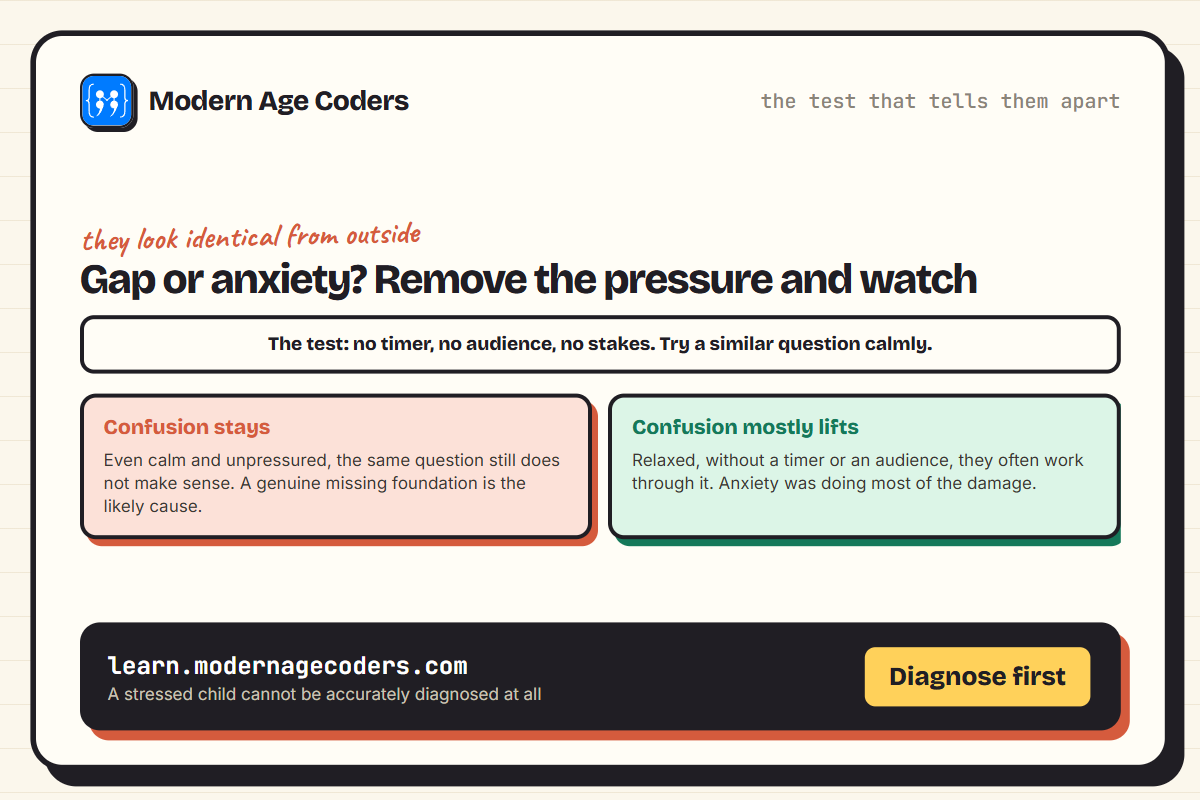
If a child relaxes and can often work through the same type of question calmly once the timer and the audience are gone, anxiety was doing most of the damage. If the same confusion persists even in a calm, unpressured moment, a genuine missing foundation is more likely the real cause, and anxiety, if present, is a symptom of that gap rather than the root of it. Either way, the fix starts with removing pressure first, since a stressed child cannot be accurately diagnosed at all.
How to find the real gap
The hardest part is spotting the specific missing foundation, because it usually sits a topic or two below where the struggle shows up. A patient teacher can find it quickly by working backwards from the point of confusion until the child is on solid ground again, then building up from there. That diagnosis, more than extra worksheets, is what turns things around.
Fractions are the most common place for this kind of hidden gap. Our guide on how to help a child understand fractions lists the four beliefs behind most fraction mistakes and the order the topic should be learned in, so you can see which stage was skipped.
Children do not need another app that teaches them to copy code. They need a mentor who teaches them to think.
, Shivam Khemka, Founder of Modern Age Coders
The bottom line
Your child is almost certainly not bad at maths. They are missing a foundation, moving at the wrong pace, anxious, or memorising instead of understanding, and every one of those is fixable. Modern Age Coders teaches maths, and coding and maths together, live and in small batches for ages 6 to 67, with mentors who find the gap and rebuild confidence patiently. We are rated 4.9 across 547 Google reviews, and there is a free demo class before you pay.
Frequently Asked Questions
Usually because of one of a few fixable reasons: a missing earlier foundation, being taught too fast, maths anxiety, or memorising steps without understanding. It is almost never a lack of ability. Finding the specific cause and addressing it directly, especially filling a missing foundation, usually turns things around quickly.
Almost certainly not. Children who look bad at maths are usually missing one earlier idea that makes everything above it feel impossible, or they are anxious rather than unable. Remove the fear and fill the gap, and most children turn out to be far more capable than they, or their parents, believed.
The gap usually sits a topic or two below where the struggle shows up. A patient teacher finds it by working backwards from the point of confusion until the child is on solid ground, then building up. That diagnosis matters more than piling on extra worksheets at the level where the child is already stuck.
Yes. Anxiety triggers a fear response that shuts down the part of the brain that does maths, so an anxious child underperforms regardless of ability, which then deepens the fear. Lowering pressure, removing timers, praising effort, and rebuilding confidence with small wins usually breaks the cycle.
A patient one-to-one or small-group teacher helps most when the struggle is persistent, because they can find the missing foundation and rebuild confidence in a way a large class cannot. Look for a mentor who diagnoses the gap and teaches for understanding, rather than one who simply assigns more of the same practice.
Remove the pressure for a day, no timer, no audience, no stakes, and see what happens on similar questions. If the confusion mostly disappears, anxiety was doing most of the damage. If it persists even when calm, a genuine missing foundation is the more likely cause, and any anxiety present is probably a symptom of that gap rather than a separate problem.
Yes, and it is often missed. A capable but unchallenged child can disengage, make careless mistakes, and look like they are struggling when they actually understand the material and simply are not being stretched. The fix here is the opposite of remediation: more interesting, harder problems, not more repetition of easy ones.