The lecture moves at the speed of the syllabus, not the speed of your understanding.
College math is fast. A professor states a definition, proves a theorem, and is three results further on before you've absorbed the first. Office hours are crowded, and the textbook explains everything except the one step you're stuck on. So students do the natural thing: they memorize worked examples and pattern-match on the exam.
It works until the exam question is phrased differently, and college exams are designed to be phrased differently. That's when a B student who "studied hard" walks out stunned.
The fix isn't more solved examples. It's understanding the idea well enough to rebuild the method on a problem you've never met.
That's what one-to-one time is for. We find the precise concept that's shaky, rebuild it properly, and teach you to reason forward from definitions, the skill that separates a passing grade from a confident one.
Understand the definition, and the problems solve themselves.
Every session works from your actual course, in the direction of the exam you'll actually sit.
Pin down the exact concept
We find the definition or theorem you're applying without really understanding. That's almost always the source of the lost points.
Build it from first principles
We derive the result so you see why it's true and where it can and can't be used, instead of treating it as a black box.
Apply it to unseen problems
We work problems you haven't seen, including ones phrased the way your professor likes, so exam day isn't the first time.
Sharpen exam reasoning
Before midterms and finals we focus on the high-value topics, common traps and how to set out work that earns full method credit.
What a derivative actually is: before any rules.
What gets memorized: "the derivative of xⁿ is n·xⁿ⁻¹." Students apply the rule fluently and still can't say what a derivative is, so related rates, optimization and any unfamiliar setup feel like guesswork.
How we do it. A derivative is one idea: the slope of a curve at a single point, found by zooming in until the curve looks straight. We make that precise with the limit of a secant line:
let the gap h shrink to zero:
f′(x) = lim (h→0) ( f(x+h) − f(x) ) / h
for f(x) = x²:
( (x+h)² − x² ) / h = ( 2xh + h² ) / h = 2x + h → 2x
The power rule isn't a law handed down. It's what this limit always produces. Once a student sees the derivative as "instantaneous rate of change," related rates, optimization and linear approximation stop being separate tricks and become the same idea wearing different clothes. That's the difference between scraping a C and owning the course.
Proof and program are the same discipline of careful reasoning.
Precise definitions
A proof lives or dies on the exact meaning of each term, exactly like a function signature in code. Sloppy definitions break both.
Logical structure
"If this, then that" chains a proof together the same way control flow chains a program. We teach you to build and check that chain.
Counterexamples & tests
Finding the case that breaks a claim is the mathematician's version of a failing test. It's how you learn what's actually true.
We're Modern Age Coders. The reasoning we teach for computer science is the same reasoning that makes college math click, which is why our students in engineering, CS and economics tend to find the rest of their quantitative courses easier too.
The college sequence, taught to your course.
From the required calculus that gates a major to the proof-based courses that decide it.
Calculus I–III
Limits, derivatives and integrals; sequences and series; multivariable calculus, partial derivatives, gradients and multiple integrals.
Linear algebra
Vectors and matrices, systems, span and independence, eigenvalues and eigenvectors, with the geometric meaning, not just the row-reduction.
Probability & statistics
Distributions, expectation, the central limit theorem, hypothesis testing and regression, what the formulas mean and when they apply.
Discrete math & differential equations
Logic, sets, combinatorics, graphs and recurrences; first- and second-order ODEs and the methods that solve them.
Proof-based courses
Intro to proofs, real analysis and abstract algebra, reading definitions precisely and writing arguments that actually hold.
College algebra & pre-calc
If you're starting from the prerequisites, we rebuild them solidly so the calculus that follows isn't built on sand.
The right fit: and an honest word on what to expect.
This fits the STEM major fighting a weed-out calculus course, the economics or pre-med student who just needs to clear a required class, the student facing their first proof-based course, and the adult returning to study after years away. We teach all of them.
What's realistic. Most students feel the difference within a couple of weeks, problem sets stop feeling impossible. A grade turnaround tracks the term and your own effort between sessions. We won't claim we can rescue a final you're sitting in three days with no foundation; we'll be straight with you about what's achievable.
What we won't do
- Complete graded assignments or take-home exams for you.
- Teach pattern-matching with no concept beneath it.
- Pretend a single cram session replaces a semester.
- Promise a grade we can't honestly support.
Built around lectures, labs and exam season.
1:1, live
One student, one mentor, real-time video and a shared whiteboard for working problems together.
8 sessions a month
Two each week, around an hour, worked from your syllabus, textbook and problem sets.
Your time zone
All six US zones, with evening and weekend slots that fit around classes.
Exam-season focus
We ramp into targeted review before midterms and finals when it counts most.
One simple price. No contract.
1:1 Private Mentorship
$150 / month
- 8 live one-to-one sessions a month (2 per week, 1 hour each)
- 4 live one-to-one sessions a month (1 per week, 1 hour each)
- The same dedicated mentor through the term
- Taught to your course, textbook & problem sets
- Exam-season review · cancel any time
Small-Group Cohort
$100 / month
- 8 live small-group sessions a month (2 per week, 1 hour each)
- A few students in the same course or topic
- Same teaching approach, lower price
- Good for shared classes · cancel any time
Want the complete topic map and project work? Explore the College Mathematics Masterclass →
Mentors who've sat where you're sitting.
Our college-level mentors have strong quantitative backgrounds and, just as importantly, remember what it felt like to be lost in a fast lecture. They can read your professor's notation, follow your textbook's conventions, and explain the idea the way that finally lands for you.
You keep the same mentor through the term, so there's no re-explaining your course every week. They learn how you think and aim their explanations there.
"My son struggled with math for years. Integrating it into coding projects has transformed his understanding and confidence. Highly recommended!"
Shewta Singh, mother of Ishan · verified Google review
How we differ from the alternatives.
| What matters | Modern Age Coders | Solution websites | Campus tutoring center |
|---|---|---|---|
| Teaches transferable understanding | Always | No, final answers | Varies by tutor |
| Works from your syllabus | Yes | No | Sometimes |
| Same mentor all term | Yes | N/A | Rarely, drop-in |
| Handles proof-based courses | Yes | Poorly | Sometimes |
| Monthly price | $150 (1:1) / $100 (group) | $15–30 | Free–$ varies |
Campus centers are a great free resource when you can get consistent help. We add a dedicated mentor who knows your course and your gaps from week to week.
Everything you might be wondering.
Which college math courses do you cover?
Single and multivariable calculus, linear algebra, differential equations, discrete math, probability, statistics, and proof-based courses (intro to proofs, real analysis, abstract algebra). We also cover college algebra and pre-calculus for students starting there.
Can you work from my specific course and textbook?
Yes. Your professor's syllabus, your textbook, your problem sets and your course's notation, so tutoring lines up with what you're graded on.
I'm not a STEM major but my course requires math. Can you help?
Yes. Many of our college students are in economics, psychology, business or pre-med, clearing a required calculus or statistics course. We teach to the depth your course needs.
Can you help before an exam or with problem sets?
Yes. We teach the method on problem sets rather than handing over solutions, and run focused review before midterms and finals. We don't complete graded work for you.
How much does it cost?
The fees for private 1-on-1 and small-group classes are shown in your own currency in the pricing section of this page. Billing is monthly, there is no contract and you can cancel any time.
Can we try a class before enrolling?
Yes. Book a Priority Demo: a full live class of about 45 to 60 minutes, today or tomorrow, with a mentor reserved for your child. After the class the mentor sends a written skill report and a personal learning roadmap on WhatsApp. If you enrol, the demo fee is adjusted against your first month's fee.
Do I get the same tutor each time?
Yes, one mentor through the term who knows your course, your gaps and how you think.
What times are available?
All six US time zones, with evening and weekend slots around lectures and labs. You choose two weekly slots.
Are sessions live?
Yes, live, one-to-one, with a shared whiteboard where we work problems in real time.
Can you help with proof-based courses?
Yes, and it's where students most need us: reading definitions precisely, structuring an argument, and writing a proof that holds.
I'm an adult returning to study. Is that fine?
More than fine. We rebuild whatever's rusty without judgment, then move at a pace that respects your time. See also our adult math classes.
Can we start mid-semester?
Yes. Most college students reach out mid-semester when a topic or exam becomes urgent. We start exactly where you are.
Book a Priority Demo.
Bring your syllabus and the topic that's giving you trouble. We'll show you how we'd teach it, and you decide from there. No card needed.
More math tutoring from Modern Age Coders.
Real student projects
What our students actually build
Every one is a real, live project shipped by a Modern Age Coders student. Explore more in Student Labs.
 Web AppLumenFX: AR/VR Photo Effects StudioUpload a photo and transform it with cinematic filters, AR face effects and the wildest trending edits, the same looks blowing up on TikTok, Reels and Snap, with 240+ one-tap presets. Raayan vibe-coded the whole studio from an idea: prompted the concept, then built the effects engine and gallery UI by hand.by RaayanOpen the live project ↗
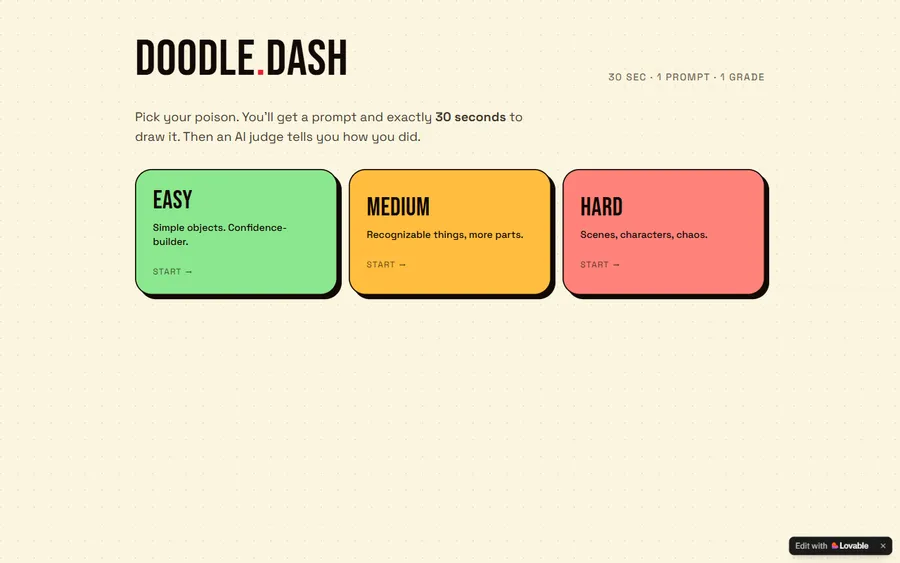 GameDoodle Dash: 30-Second Drawing ChallengePick a difficulty, get a prompt, and you have exactly 30 seconds to draw it, then an AI judge scores how close you got. Three modes from easy objects to chaotic scenes. Shubh vibe-coded it idea-first, wiring real AI image grading into a fast, addictive drawing game.by ShubhOpen the live project ↗
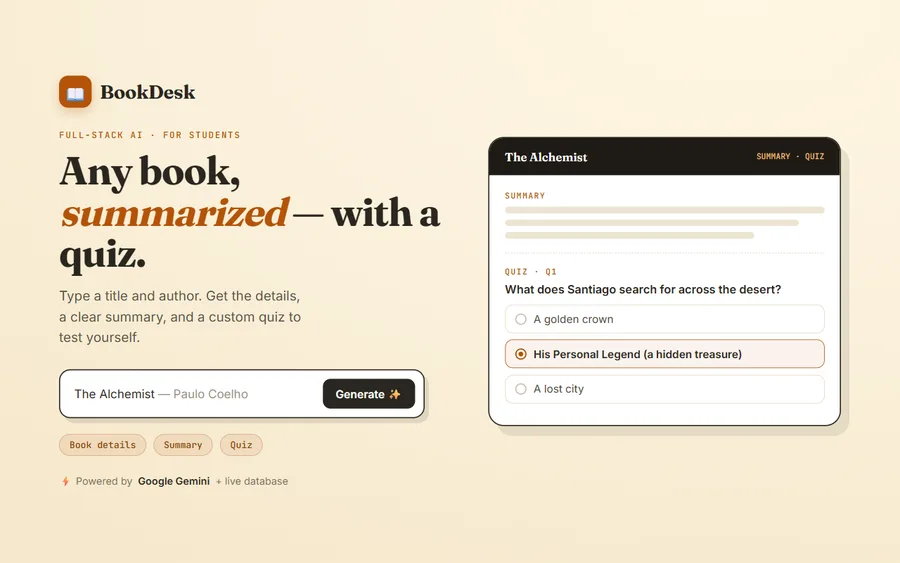 AI & MLBookDesk: AI Book Summaries & QuizzesType in any book name and author, and BookDesk pulls together the book's details, a clear summary and a custom quiz to test what you've learned, a genuinely useful study companion. Anika built it as a full-stack AI application, powered by Google Gemini with a live database behind it.by AnikaOpen the live project ↗