MOT / A / 01
Primary maths, Years 1 to 5
The number work everything above stands on.
Open the syllabusUnited Kingdom · Year 7 to Year 13 · Every round, one table
Parents meet the olympiad ladder in the wrong order: a letter comes home saying a child has qualified for something, and nobody explains what it is or what comes next. This page is the map. Every UK olympiad round with its date, its year groups, how many questions it asks and how long it gives, from a two-hour paper for twelve-year-olds to the three and a half hours that choose the national team. And one observation that reassures almost every pupil who reads it: as the papers get harder, they give you more time per question, not less.
Every figure quoted from UKMT or BMOS with the date · Our own arithmetic, labelled · No promise about any result
In short
The UK olympiad ladder runs from the Junior Mathematical Olympiad, "a 2 hour Challenge consisting of 6 Olympiad style questions" on 15 June 2027 for Year 8 and below, through the Cayley, Hamilton and Maclaurin papers, "six Olympiad style problems" in two hours on 18 March 2027 split by school year, to the British Mathematical Olympiad: BMO1, a "3 1/2-hour paper" of "6 problems" on 18 November 2026, and BMO2, the same length with "4 problems", on 20 January 2027. Alongside them the Mathematical Olympiad for Girls runs "2.5 hours" of "five challenging problems" on 22 September 2026, two answer-only and three written. Around 1,200 pupils qualify for the junior olympiad each year and around 1,800 for the intermediate ones. Everything above the first challenge is marked by hand on the reasoning. We teach the mathematics and the writing: the first class is free, a group place is USD 100 a month and one-to-one teaching USD 150.
Where to start
The limit at every rung is technique and written argument, not syllabus.
MOT / 01
The core course at every level: unfamiliar problems, and solutions written so that a marker is convinced.
Open the syllabus →
MOT / 02
For Years 7 to 9, where the algebra and geometry the junior papers lean on are still being built.
Open the syllabus →
MOT / 03
For sixth formers, so that technique never becomes the thing slowing an olympiad answer down.
Open the syllabus →The ladder
Each row was read at UKMT or the British Mathematical Olympiad on 20 September 2026, and each links to the page behind it.
| Round | Who sits it | Date | Paper |
|---|---|---|---|
| Mathematical Olympiad for Girls | Year 11 and above, S4 and above, Year 12 and above in Northern Ireland | 22 September 2026 | Five problems in two and a half hours |
| British Mathematical Olympiad 1 | Open entry, full-time secondary education | 18 November 2026 | Six problems in three and a half hours |
| British Mathematical Olympiad 2 | Those above the threshold | 20 January 2027 | Four problems in three and a half hours |
| Cayley | Year 9 and below, S2 or below, Year 10 or below in Northern Ireland | 18 March 2027 | Six problems in two hours |
| Hamilton | Year 10, S3, Year 11 in Northern Ireland | 18 March 2027 | Six problems in two hours |
| Maclaurin | Year 11, S4, Year 12 in Northern Ireland | 18 March 2027 | Six problems in two hours |
| Junior Mathematical Olympiad | Year 8 and below, S2 or below, Year 9 or below in Northern Ireland | 15 June 2027 | Six questions in two hours |
| Challenge | Date | Leads to |
|---|---|---|
| Senior Mathematical Challenge | 7 October 2026 | The Senior Kangaroo and the British Mathematical Olympiad |
| Intermediate Mathematical Challenge | 27 January 2027 | Cayley, Hamilton, Maclaurin and the Grey and Pink Kangaroos |
| Junior Mathematical Challenge | 5 May 2027 | The Junior Kangaroo and the Junior Mathematical Olympiad |
Two numbers give the shape of the thing. UKMT says around 1,200 pupils qualify for the Junior Mathematical Olympiad from the Junior Challenge each year, and around 1,800 for the three intermediate olympiads. These are small rooms: a pupil who sits one is already among a few hundred per year group nationally.
Everything in the first table is written out in full and marked by a person. Everything in the second is multiple choice and marked by a machine. That is the only real dividing line in the ladder, and it falls between the Challenge in the spring and the olympiad six weeks later.
Scotland runs its own ladder alongside this one. The Scottish Mathematical Challenge has been going since 1976, spreads three rounds across the year, and has always marked "explanations of answers rather than ... simply getting the correct answer". A Scottish pupil can sit both.
Nothing here is entered by a family. Schools enter pupils for the challenges and UKMT invites the qualifiers, and no tutor, service or payment shortens that route.
Sources: the UKMT competitions calendar, its round pages and the British Mathematical Olympiad, all read 20 September 2026. We have no connection with UKMT or the BMO Subtrust.
The observation
This is arithmetic on the published formats, and it is the most reassuring thing on the page.
Every exam a pupil has ever sat works one way: as the content gets harder, the questions get shorter and the clock gets meaner. The olympiad ladder does the opposite, and once you see the numbers you cannot unsee them.
| Round | Questions | Minutes | Minutes per question |
|---|---|---|---|
| Junior Mathematical Olympiad | 6 | 120 | 20.0 |
| Cayley, Hamilton and Maclaurin | 6 | 120 | 20.0 |
| Mathematical Olympiad for Girls | 5 | 150 | 30.0 |
| British Mathematical Olympiad 1 | 6 | 210 | 35.0 |
| British Mathematical Olympiad 2 | 4 | 210 | 52.5 |
Nobody expects an answer in three minutes. Nearly an hour a question at the top of the ladder is permission to sit and think, which is exactly what these papers are testing.
Speed drills are the wrong preparation. They help in the multiple-choice challenges and do almost nothing for an olympiad paper.
If a pupil is finishing early, they are not writing enough. A complete argument takes far longer than finding the answer did.
The reason for the pattern is simple once stated. At the bottom of the ladder a question can be seen through: find the trick, write it down, move on. At the top it cannot, and the time is there for the part that is genuinely hard, which is being sure and then being convincing.
It also explains why finishing is not the goal. Two complete solutions on a BMO1 paper is a real result, and three well-written answers on a two-hour olympiad beats six hurried ones every time.
The marking backs it up. UKMT tells candidates that "just stating an answer, even a correct one, will earn you very few marks", and the British Mathematical Olympiad has around sixty people gather in December to read every BMO1 script by hand over three days.
A pupil who understands that the clock is generous and the marking is human prepares completely differently, and usually enjoys it far more.
The minutes-per-question figures are ours, computed on 20 September 2026 from the question counts and durations each organiser publishes.
How to train
Olympiad training looks slower than exam revision because it is. It is also the only thing that works.
| Worth the hours | Why | Not worth it |
|---|---|---|
| Writing up problems already solved | The writing is the half being marked and the half nobody practises | Solving more and writing none |
| Sitting with one problem for an hour | These questions are built to resist a first reading | Twenty quick questions to feel productive |
| Reading the organiser's own solutions | They show the standard of explanation expected | Checking only whether the final answer matched |
| Building a repertoire | Invariants, extremal cases, pigeonhole, bounding, colouring | Hoping for a flash of insight on the day |
| Stamina, before the senior rounds | Three and a half hours of concentration is a physical skill | Any drilling in the last fortnight |
The commonest mistake families make is buying harder material. The mathematics in a junior or intermediate olympiad question is rarely beyond a good pupil in that year group; what is unfamiliar is the packaging and the demand for proof. More topics do not help. More writing does.
The second commonest is treating a qualification as a verdict. Nothing depends on these papers, no school place turns on them, and a pupil who enjoys one will come back next year a rung higher against the same people.
What a teacher adds is reading. A pupil can tell whether their answer is right; they almost never can tell whether their explanation convinces a stranger, and that is the thing worth an hour a week of somebody else's attention.
The individual pages for each round set out the technique that round rewards, from writing a first proof at the junior olympiad to invariants at the British Mathematical Olympiad.
The route
A pupil usually spends two years on each rung, and the habit carried up matters more than the score at any of them.
| Years | Rung | The paper that tests it |
|---|---|---|
| 7 to 8 | 1. Fast, accurate, unfamiliar | The Junior Mathematical Challenge and Kangaroo |
| 8 to 9 | 2. A first written solution | The Junior Mathematical Olympiad |
| 9 to 11 | 3. Complete arguments | Cayley, Hamilton and Maclaurin |
| 11 to 13 | 4. Proof and stamina | The Mathematical Olympiad for Girls and the British Mathematical Olympiad |
Write up three problems already solved, properly, and have someone read them as a stranger would. It is the highest-return evening available at any rung.
Do not add topics. Every one of these papers is built from mathematics the pupil has already met.
The top BMO2 scorers are invited to a training camp at Trinity College, Cambridge, from which an IMO squad and then a team of six is chosen.
Pupils who like proving things often take to informatics olympiads as well, where the marker is a compiler.
The full list
Grouped by the stage a pupil is at, with each syllabus a click away.
MOT / A / 01
The number work everything above stands on.
Open the syllabusMOT / A / 02
Calculation that stops costing thinking time.
Open the syllabusMOT / A / 03
Test a claim on a thousand cases, then prove it.
Open the syllabusMOT / B / 01
Unfamiliar problems, finished in writing.
Open the syllabusMOT / B / 02
Algebra and geometry, argued not drilled.
Open the syllabusMOT / B / 03
The school course, taught to the board in use.
Open the syllabusMOT / C / 01
Technique that should never be the obstacle.
Open the syllabusMOT / C / 02
Pure, mechanics and statistics, taught to the exam.
Open the syllabusMOT / C / 03
Counting arguments made rigorous.
Open the syllabusMOT / D / 01
Where proof meets running time.
Open the syllabusMOT / D / 02
The informatics version of the same patience.
Open the syllabusMOT / D / 03
Enough code to explore a conjecture.
Open the syllabusHow lessons run
Teaching is live on video from India, five and a half hours ahead of the UK in winter and four and a half in summer, at a time agreed and kept in UK time.
Weekday evening
The usual slot from Year 7 upwards.
Weekend morning
Long enough to take one problem to a finished proof.
Holiday intensives
For stamina before the senior rounds.
Someone who has not seen the problem reads the solution and says where they stopped following it.
Each technique is taught with a name so a pupil can reach for it deliberately rather than hope.
Big enough that somebody solves it differently, small enough that nobody goes unheard.
Twenty minutes without progress is normal here and we say so, because pupils assume it is failure.
Ours, in the same idiom. The organisers give their past papers away and that is where the real ones belong.
Qualification is not ours to give and we do not pretend otherwise.
Student work
Four published projects by students at our school, none of them competition work. The student labs page collects them.

AI and ML
An AI nutrition coach that reads what you eat and works you toward a target.
AI and ML
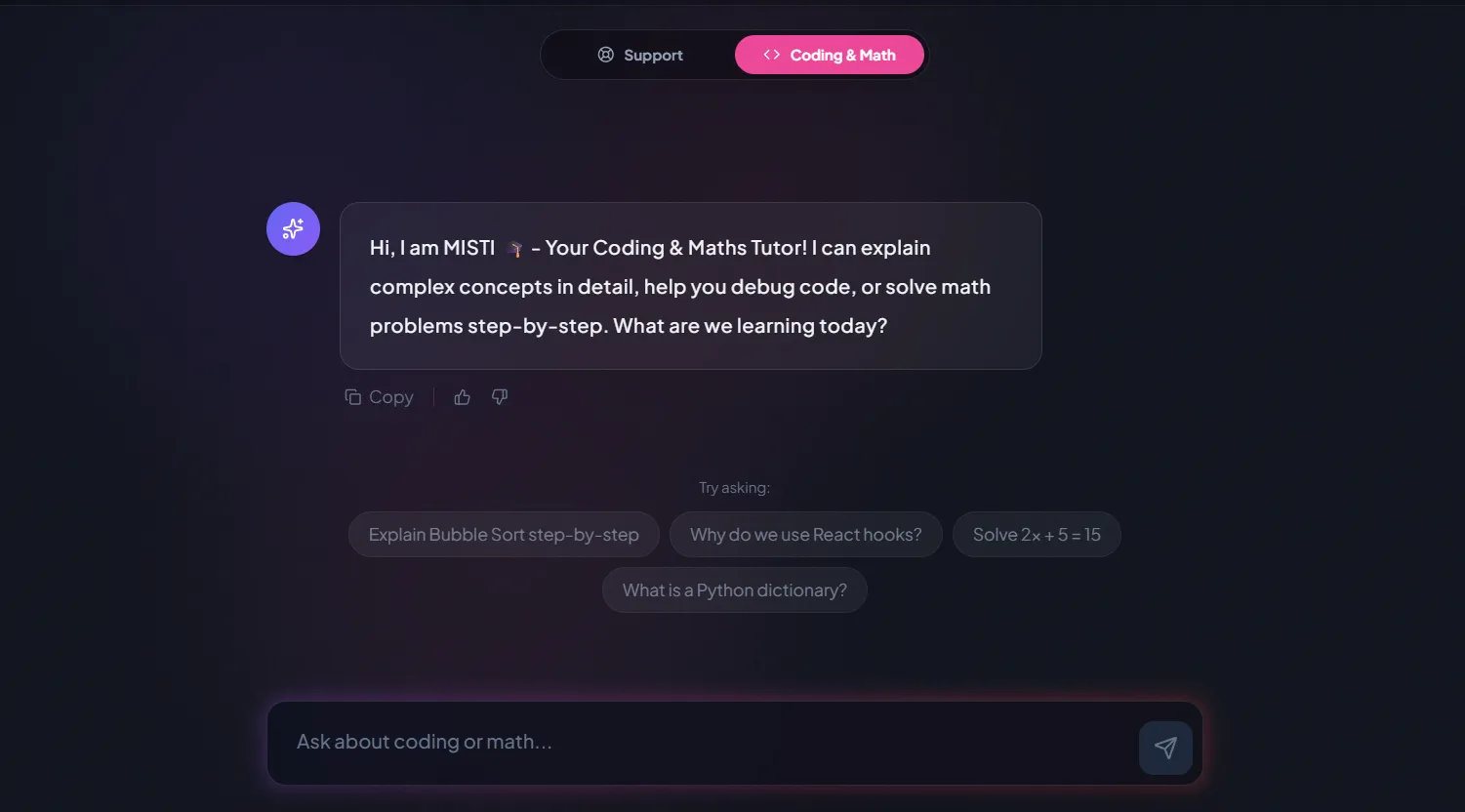
A chatbot that answers mathematics and programming questions, built and deployed by a student.

AI and ML
An assistant that helps a young person recognise unsafe situations online.

Web app
A weather forecasting site with live conditions for any location.
Fees
The same price each month in US dollars outside India, nothing charged to start, and no commitment past the month you are in.
Free first class
USD 0
no card required
Group batch
USD 100
a month, billed in US dollars
One to one
USD 150
a month, billed in US dollars
What families say
Google reviews left by families here, printed as written.
★★★★★
"The one step solution for my son. Modern Age Coders make learning coding so simple that kids love it. The teachers explain complex concepts clearly with practical exercises and interactive content."
Ria Mukherjee
Parent
★★★★★
"Modern Age Coders has been a game-changer for me. I struggled to grasp IT concepts and coding before joining, but their classes transformed everything. I can now confidently write complex programs with ease."
Samriddha Mondal
Student
★★★★★
"One of the most wonderful education centres out there. Education is not limited to school syllabus but focuses on skill development."
Vansh Agarwal
Student
★★★★★
"My child Dhairya is really enjoying the Modern Age Coders classes. This is his first online class and he eagerly looks forward to it. I can already see his improvement, and the teachers are very cooperative."
Sonam Oswal
Parent of Dhairya
★★★★★
"Modern Age Coders have wonderful teachers who teach in a clear, easy and practical way. The teacher boosts students' confidence and inspires them to learn without hesitation."
Sonu Goyal
Parent
★★★★★
"I highly recommend this computer coding class! The teachers are incredibly knowledgeable and passionate about coding."
Ritu Kedia
Parent
Olympiad ladder questions
A ladder of written papers run by the UK Mathematics Trust and the British Mathematical Olympiad: the Junior Mathematical Olympiad, the Cayley, Hamilton and Maclaurin papers, the Mathematical Olympiad for Girls and the two British Mathematical Olympiad rounds.
Through a multiple-choice Mathematical Challenge sat at school, after which UKMT invites those above a qualifying score, with discretionary entries also possible. Around 1,200 pupils qualify for the junior olympiad each year and around 1,800 for the intermediate ones.
The Mathematical Olympiad for Girls on 22 September 2026, British Mathematical Olympiad 1 on 18 November 2026, BMO2 on 20 January 2027, Cayley, Hamilton and Maclaurin on 18 March 2027 and the Junior Mathematical Olympiad on 15 June 2027.
Two hours for the junior and intermediate olympiads, two and a half for the girls olympiad, and three and a half hours for both British Mathematical Olympiad rounds.
No, and this surprises everyone. Per question it is 20 minutes at the junior and intermediate olympiads, 30 at the girls olympiad, 35 at BMO1 and 52.5 at BMO2. The ladder gives more time as it gets harder.
Because finishing is not the goal. Three complete, well-written solutions on a two-hour olympiad beats six hurried ones, and two on a BMO1 paper is a real result for a first attempt.
By hand, on the reasoning. UKMT tells candidates that just stating an answer, even a correct one, will earn very few marks, and around sixty markers gather in December to read every BMO1 script over three days.
Writing up problems the pupil has already solved, spending an hour on single problems, reading the organiser's own published solutions for the standard, and building a repertoire of techniques. Not speed drills and not new topics.
Yes. The Scottish Mathematical Challenge has run since 1976, spreads three rounds across the year and marks explanations rather than answers. A Scottish pupil can sit it alongside the UKMT ladder.
The top British Mathematical Olympiad round 2 scorers are invited to a training camp at Trinity College, Cambridge, from which an IMO squad and then a team of six plus reserves is chosen.
The pages behind this one
Every rung has its own page, with the organiser's words and the technique that rung rewards.
Why forty examples are not a proof.
Why a complete answer means all of them.
Finding the thing that cannot change.
Two questions want a number, three want the reason.
The multiple-choice follow-ons, and what the wrong options are for.
Where it all starts, at ages 9 to 11.
Start here
Tell us the year group and which round is next. The free lesson takes one problem from first reading to a written argument.
Rather read first? Every syllabus is on its course page, the method on how we teach, and the order of topics on the roadmap.
WhatsApp us · +91 91233 66161 · contact@modernagecoders.com
The quickest reply usually comes on WhatsApp, which is free from a UK mobile. The number is registered in India, as we say everywhere, and no British office sits behind it.